A startup pitch is often the first opportunity founders have to convince investors that their business deserves serious attention. In a short conversation, founders must explain what their company does, which customers it serves, why the problem matters, and what evidence suggests the business has potential. When that explanation is unclear, investors may struggle to recognize the opportunity, even if the underlying product is promising.
Delivering an effective startup pitch is not simply a matter of speaking confidently or presenting impressive financial projections. It requires choosing the right information, explaining unfamiliar concepts in accessible language, and connecting the company's achievements to a credible business opportunity. The founder must communicate enough substance to establish interest without turning the conversation into an extended product demonstration or a detailed business plan.
A strong Fundraising Strategy defines the company's financing objectives and what additional capital should accomplish. The startup pitch communicates the business case behind those objectives. Its purpose is to help investors understand the opportunity, evaluate the founders' thinking, and decide whether a more detailed discussion is worthwhile.
This guide explains how to structure a startup pitch, communicate a compelling investment case, adapt the presentation to different audiences, and respond effectively to investor questions. It also includes practical examples and common mistakes founders should avoid.
What Is a Startup Pitch?
A startup pitch is a concise spoken presentation that introduces a business opportunity to a particular audience. Founders commonly deliver pitches during investor meetings, networking events, accelerator programs, startup competitions, and introductory conversations with potential business partners.
The content depends on the situation, but most investor pitches address a familiar set of questions. What does the company do? Who needs its product? Why is the existing approach inadequate? How does the company intend to make money? What progress has it demonstrated, and why is the founding team capable of executing its plans?
A startup pitch differs from an investor pitch deck. The pitch is the founder's spoken explanation of the business, while a pitch deck is the visual material that may support that explanation. Slides can help communicate product workflows, financial information, and market assumptions, but they should not become a substitute for clear verbal communication.
The immediate objective is also important. A short pitch rarely provides enough information for an investor to complete an investment decision. Instead, it should establish enough clarity and credibility to encourage further evaluation. A successful introductory conversation may lead to a longer meeting, a request for supporting information, or an introduction to another decision maker.
What Makes a Startup Pitch Effective?
The most effective startup pitches combine clarity, relevance, evidence, and a logical business argument. Investors should be able to understand the company without first learning specialized industry terminology. That means founders must explain the product in straightforward language and identify the customers who would benefit from it.
Relevance comes from describing a meaningful problem. A technically impressive product does not automatically represent a valuable commercial opportunity. Investors need to understand why customers might adopt the solution, what alternatives already exist, and whether the startup has identified a realistic way to reach those customers.
Evidence provides the foundation for credibility. Depending on the company's development stage, this may involve customer research, product testing, paying customers, revenue, retention, or verified technical milestones. Founders should present the strongest relevant information available rather than selecting figures solely because they sound impressive.
A coherent pitch also connects its individual claims. The product should address the customer problem, the business model should reflect how those customers purchase products, and the company's growth expectations should be consistent with the available evidence. When these elements reinforce one another, investors can evaluate the opportunity more easily.
How to Structure a Startup Pitch
A strong startup pitch follows a clear progression rather than presenting unrelated facts about the company. The founder begins by explaining what the business does, introduces the customer problem, describes the solution, and then establishes why the opportunity may be commercially attractive.
The next part of the pitch should address execution. Founders can discuss the evidence supporting customer demand, explain the revenue model, and identify the experience or capabilities that make the team suitable for the opportunity. During a fundraising conversation, the presentation should also communicate the financing objective and the progress that investment could support.
The appropriate level of detail depends on the available time. A brief introduction may only communicate the business, customer, problem, and primary benefit. A longer investor meeting provides more room to explain financial assumptions, traction, competitive positioning, and business risks.
Startup Pitch Formats and Recommended Content
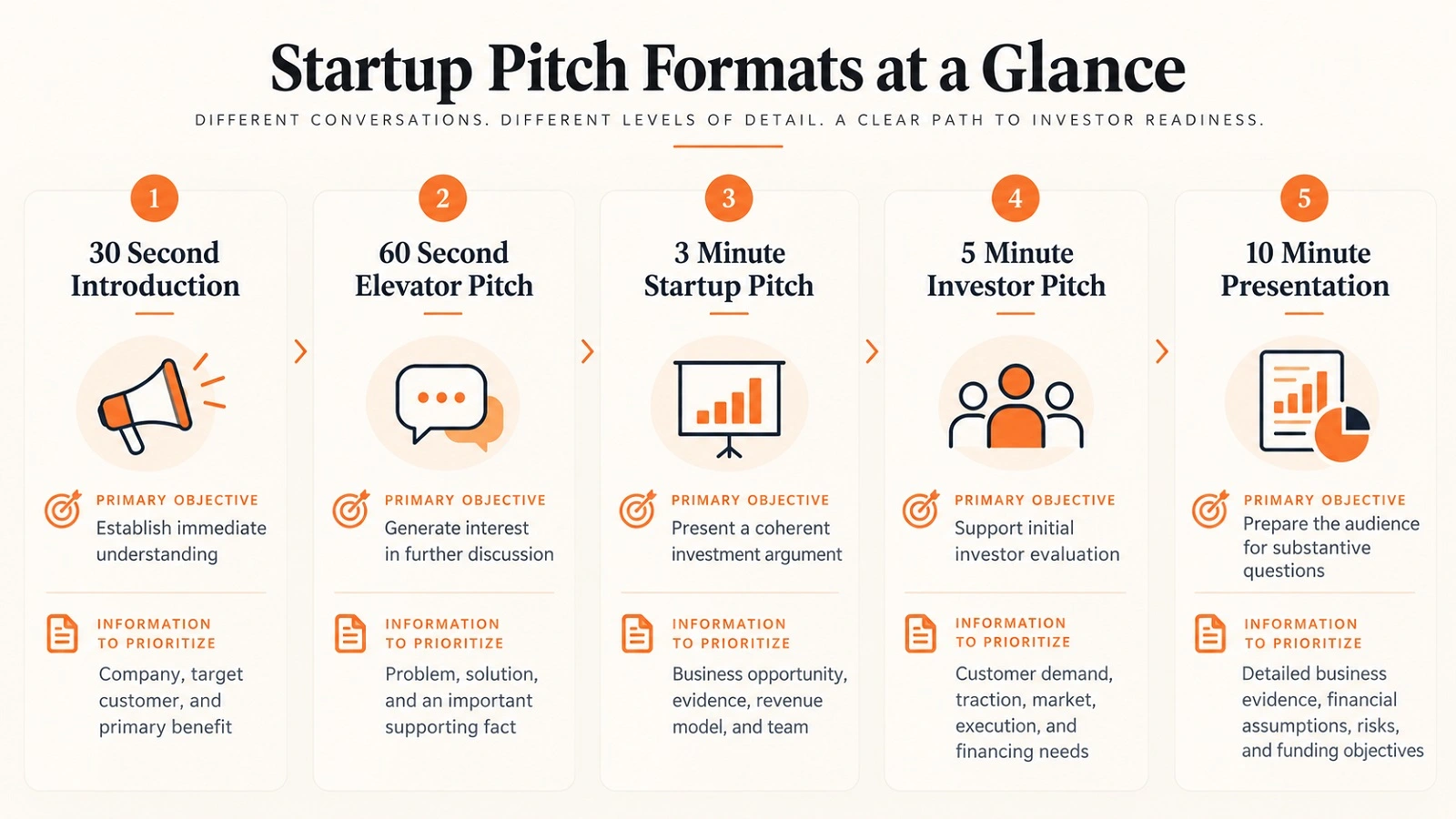
These timeframes are examples rather than fixed rules. Investors and event organizers may impose different limits, and some introductory meetings develop into open discussions rather than formal presentations.
Founders should adjust the amount of information instead of simply increasing their speaking speed. The strongest short pitch makes a few important points memorable, while a longer presentation provides enough evidence to support meaningful investor questions.
Begin With a Clear Explanation of the Business
The opening is one of the most important parts of a startup pitch because it establishes how the audience interprets everything that follows. Investors should understand what the company does before hearing detailed explanations of technology, market projections, or long term ambitions.
Consider a hypothetical startup called RoutePilot, which develops delivery planning software for regional distributors. A vague introduction might describe RoutePilot as an intelligent platform transforming the future of logistics. Although the description sounds ambitious, it reveals little about the company's actual product or customers.
A clearer introduction would explain that RoutePilot helps regional distribution businesses organize delivery routes, coordinate drivers, and manage schedule changes through one software system. This immediately establishes the product category, target customer, and intended benefit.
Founders can then introduce the customer problem. Regional distributors may rely on spreadsheets, phone calls, and separate communication tools to coordinate deliveries. As operations become more complicated, these workflows can become difficult to manage. By explaining the business first, the founder gives investors the context they need to understand why the product may be useful.
An effective opening does not need a dramatic story or an exaggerated claim. It needs to establish the business clearly enough for the audience to follow the remaining argument.
Explain the Customer Problem and Why It Matters
After introducing the company, founders should describe the customer difficulty that creates demand for the product. This explanation should identify who experiences the problem, how it affects their activities, and why existing alternatives may be inadequate.
For RoutePilot, the problem might involve managers spending considerable time coordinating delivery schedules across disconnected systems. Changes to routes or customer orders may require repeated communication between drivers and warehouse staff. The company would need to investigate whether these difficulties are sufficiently important for customers to consider purchasing new software.
A convincing problem statement should reflect customer evidence wherever possible. Interviews, observations, pilot programs, and relevant industry research can help founders understand whether the problem exists beyond their own assumptions. These sources may also reveal that different customer groups experience the problem in different ways.
Founders should avoid converting unverified frustrations into precise financial claims. If a pitch suggests that customers lose a particular amount of revenue because of the problem, the underlying calculation should be defensible. When financial consequences have not been measured, it is more credible to explain what customers have actually reported.
The purpose is to establish a commercially meaningful problem, not simply demonstrate that the founders have identified an inconvenience.
Show How the Product Solves the Problem
Once investors understand the customer problem, the solution should follow naturally. Founders should concentrate on the product capabilities that address the specific difficulty rather than describing every feature available.
RoutePilot might demonstrate how distribution managers create delivery schedules, assign drivers, and communicate changes through a single interface. A short explanation of the workflow would help investors understand how the product differs from the existing process.
Technical details are valuable when they explain an important advantage. If the company uses specialized optimization technology, founders can describe what that technology enables without devoting the opening presentation to its underlying algorithms. Investors who require deeper technical information can request it during subsequent evaluation.
The distinction between product capabilities and expected benefits also matters. A startup may demonstrate that its software allows managers to adjust schedules within one application, but it should not claim a verified reduction in operating costs unless appropriate evidence supports that result.
Founders should also distinguish working functionality from planned improvements. A prototype, pilot product, and commercially available system represent different stages of development, and the pitch should accurately communicate which one applies.
A useful solution explanation leaves investors understanding what the product does today and why the company believes customers will benefit from it.
Demonstrate Traction and Business Potential
Investors need evidence that the startup can translate its idea into meaningful progress. For an early business, this might involve customer discovery, technical validation, pilot participation, or initial product usage. A company with commercial activity may instead emphasize paying customers, revenue, retention, or repeat purchases.
The evidence should match the company's business model. RoutePilot might discuss the number of distributors testing its software, how many have become paying customers, or what the company has learned about purchasing decisions. Each measure communicates something different and should be presented accurately.
A pilot participant is not necessarily a paying customer, just as a conversation with a prospective partner does not represent an executed agreement. Combining these categories can create a misleading impression of the company's development.
Founders should also explain the significance of their results rather than merely listing numbers. If the company has gained paying customers, investors may want to know how those customers were acquired and whether they continue using the product. If early testing has revealed product limitations, management should understand how those findings affect its development priorities.
For businesses without revenue, a lack of commercial metrics does not automatically make the pitch ineffective. The founder should instead present appropriate evidence of progress and explain which assumptions remain untested.
Credibility comes from demonstrating what the startup has learned and achieved, not from presenting every early signal as proof that the business will succeed.
Explain the Business Model and Market Opportunity
A startup pitch should help investors understand how the company intends to earn revenue and whether the customer opportunity is large enough to support its ambitions.
The business model explanation should identify who pays, what they purchase, and how pricing works. RoutePilot, for example, might propose a subscription model in which distributors pay according to the number of vehicles or operating locations using the software. If that pricing has not been validated through actual customer purchases, the founder should describe it as an assumption requiring further testing.
The market opportunity should focus on customers the startup can realistically serve. A company offering software for regional distributors should not automatically treat the entire global logistics industry as its accessible market. Instead, it can identify businesses that match its customer profile, operate in markets it can reach, and have a plausible reason to adopt its solution.
Founders should distinguish estimated demand from demonstrated demand. A calculation based on potential customer numbers and proposed subscription prices may illustrate commercial opportunity, but it does not prove that those customers will purchase the product.
A clear pitch connects the revenue model to the go to market approach. Investors should understand how the startup intends to reach customers, who makes purchasing decisions, and which commercial assumptions remain uncertain. This explanation is particularly important when the sales process requires demonstrations, integration work, or approval from several people within a customer organization.
The objective is to show that the founders understand both the potential opportunity and the practical requirements of building revenue.
Explain Why the Team Can Execute
Investors evaluate founders partly because early startup outcomes depend heavily on the team's ability to make decisions under uncertainty. A compelling pitch should therefore establish why the people building the company have relevant knowledge and capabilities.
Founders can highlight industry experience, technical expertise, product development skills, commercial experience, or direct familiarity with the customer problem. The most persuasive qualifications are those connected to the business being presented.
For RoutePilot, experience with distribution operations, software engineering, or selling technology to logistics businesses could strengthen the investment case. These capabilities may help the company understand customer workflows and respond to implementation challenges.
A brief pitch does not require a complete professional biography. Founders should explain the most relevant experience and how responsibilities are divided within the team. If important capabilities are missing, they may describe how the company intends to address those needs through recruitment or specialist support.
The goal is not to portray the founders as experts in every business function. It is to demonstrate that the team understands what execution requires and has a credible basis for pursuing the opportunity.
Startup Pitch Examples for Different Situations
A useful pitch example should demonstrate how the same business can be introduced at different levels of detail. The following versions use RoutePilot, a fictional startup created solely to illustrate the communication structure. No commercial achievements or investment commitments are being attributed to a real company.
A 60 Second Startup Pitch Example
"RoutePilot builds delivery planning software for regional distributors. Many smaller distribution companies coordinate deliveries using spreadsheets, calls, and separate messaging tools, which can make schedule changes difficult to manage.
Our software brings route planning, driver assignments, and delivery updates into one system. We are testing the product with distribution teams to understand how it fits their workflows and whether they would adopt it as a paid service.
Our goal is to turn those early findings into a product that distributors can use consistently as their operations grow."
This version introduces the business, customer problem, solution, development status, and commercial objective. It does not attempt to present a complete financial model or make unsupported claims about market leadership.
A Longer Investor Pitch Example
"RoutePilot develops delivery planning software for regional distribution businesses. These companies often manage scheduling, driver communication, and route changes through several disconnected tools. As their daily operations become more complex, maintaining accurate delivery plans can require substantial coordination.
We are developing one system that allows managers to organize routes, assign drivers, and communicate changes from a central interface. Our initial focus is on smaller distribution operations that need more structured planning but may not require the complexity of larger enterprise systems.
We are testing the product with potential customers to understand the most valuable capabilities, implementation requirements, and willingness to pay. Our proposed business model is a software subscription, although pricing and customer acquisition assumptions still require validation.
The next stage is to complete product testing, establish stronger evidence of customer demand, and determine whether we can build a repeatable commercial process. We are preparing to discuss financing that would support those development and validation milestones."
The longer version provides more information about customer selection, commercial assumptions, and development priorities. Importantly, it does not pretend that the hypothetical company already has paying customers or proven economics.
A real founder should replace the illustrative statements with verified customer results, relevant market evidence, actual team qualifications, and the specific financing objective. The strongest example is not the one with the most dramatic claims, but the one that communicates the company's real position clearly.
Deliver the Pitch With Confidence and Clarity
Presentation delivery matters because investors must be able to understand and retain the information being communicated. A founder who explains the business calmly and logically can make a complex opportunity more accessible without relying on theatrical speaking techniques.
Confidence should come from understanding the company rather than memorizing a promotional script. Founders should know the evidence supporting their claims, the assumptions behind their forecasts, and the important uncertainties affecting the business. This preparation allows them to communicate naturally and respond when the discussion moves away from the planned sequence.
Pacing is equally important. Speaking too quickly can make unfamiliar concepts difficult to follow, especially when several financial or technical facts are introduced close together. Founders should allow enough time for the audience to absorb important information and avoid treating every pause as a problem.
Delivery should also reflect the setting. A formal accelerator presentation may require greater attention to timing because interruptions are unlikely. An investor meeting may be more conversational, with questions arising throughout the explanation. In the second setting, founders should be prepared to respond directly rather than insist on finishing every planned point before engaging with the audience.
When using slides or demonstrations, the founder should remain the primary source of explanation. Visuals can reinforce the argument, but reading sentences directly from a presentation rarely communicates expertise as effectively as a clear discussion of the business.
Prepare for Investor Questions and Objections
Questions are an important part of startup pitching because they reveal what investors want to understand before continuing their evaluation. Investors may challenge assumptions about customer demand, ask about competition, examine financial forecasts, or question whether the founding team has the necessary capabilities.
Founders should treat relevant questions as opportunities to clarify their reasoning. A question about competition, for example, does not necessarily mean the investor considers the company unattractive. It may simply indicate that existing customer alternatives are an important part of the evaluation.
Responses should be direct and supported by available information. When a question requires data the company does not yet have, it is better to acknowledge the limitation than to invent a number or imply that an assumption has already been validated.
Common Investor Questions and Effective Responses
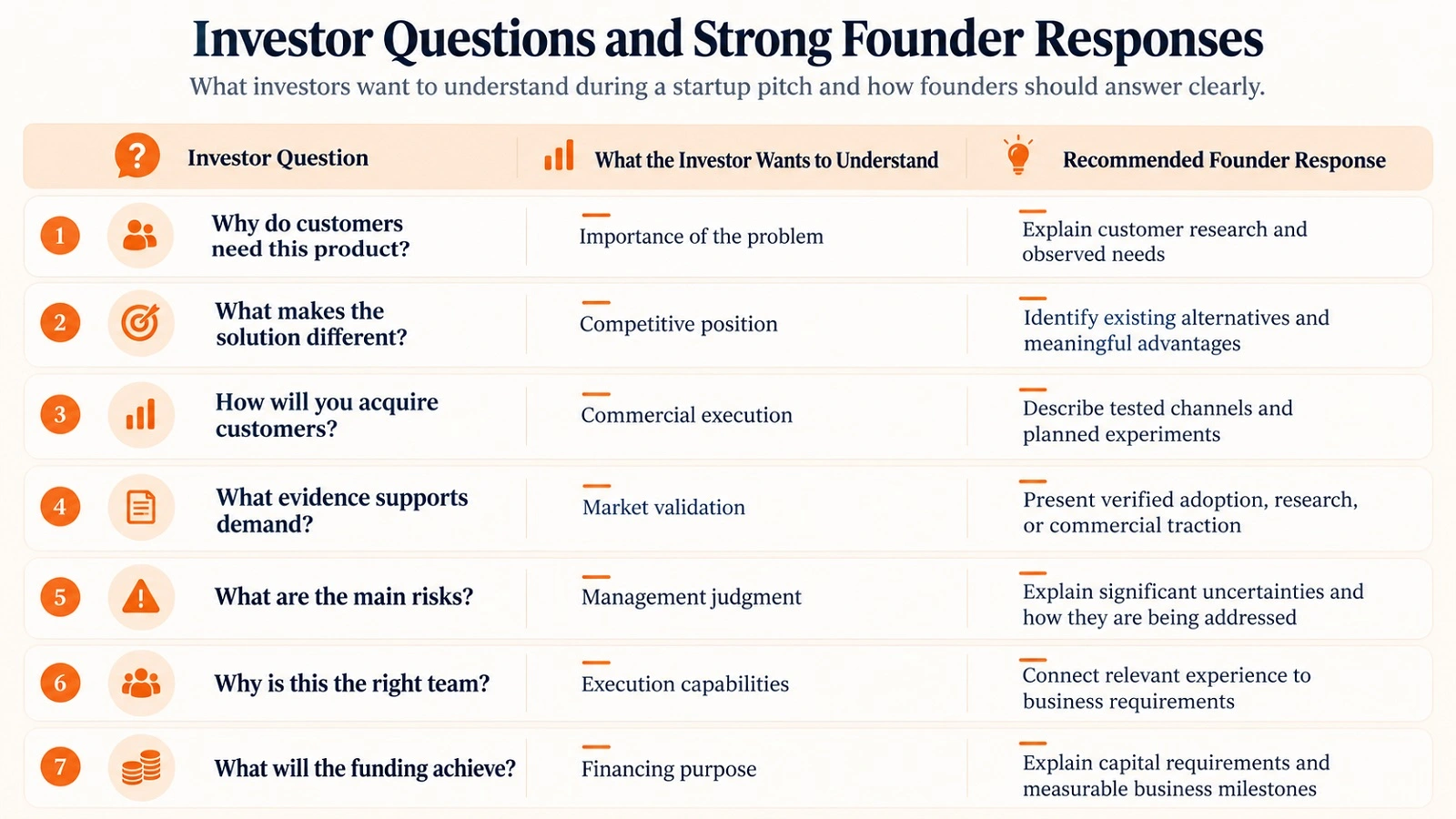
Effective responses do not need to eliminate every concern. Early startups frequently face unresolved questions about customer behavior, pricing, technology, or market development. What matters is whether founders understand those uncertainties and have a sensible approach to investigating them.
Investors may also ask questions that require a more detailed conversation than the initial pitch allows. Founders can offer supporting information or propose a separate discussion when appropriate, particularly for technical subjects or complex financial assumptions.
The ability to engage with difficult questions thoughtfully often communicates more about a founding team's judgment than a perfectly rehearsed presentation.
Practice the Startup Pitch Without Memorizing Every Word
Rehearsal helps founders identify explanations that are too complicated, arguments that lack supporting evidence, and sections that consume more time than their importance justifies. It should improve the founder's understanding of the message rather than turn the presentation into a rigid script.
A useful starting point is the company's opening explanation. Founders can test it with someone unfamiliar with the product and ask that person to describe the business in their own words. If the listener cannot identify the customer, product, and intended benefit, the introduction needs refinement.
The complete pitch should then be practiced within the expected time limit. Recording a rehearsal can reveal rushed explanations, unnecessary technical language, and transitions that make the presentation difficult to follow. It can also show whether the founder spends too much time on company history while neglecting traction, customer demand, or the financing objective.
Practice should include questions and interruptions because real investor conversations rarely follow a perfectly predictable sequence. Founders need enough familiarity with the business to explain its main assumptions without returning constantly to a prepared script.
When multiple founders attend a meeting, responsibilities should be agreed in advance. Different team members can contribute expertise, but explanations of revenue, customer progress, product status, and financing requirements should remain consistent.
Adapt the Pitch to the Investor and Funding Stage
An effective startup pitch should reflect the company's maturity. Founders with an early idea may concentrate on the customer problem, founder insight, technical feasibility, and evidence from initial research. A business with a working product can discuss usage, pilot outcomes, and customer feedback, while a company generating revenue may place greater emphasis on retention, commercial growth, and the repeatability of its sales process.
The investor's background also affects which information deserves attention. An investor familiar with the company's industry may want to discuss customer behavior or technical differentiation in greater depth. An investor evaluating broader commercial opportunities may focus on market size, business economics, and the potential for expansion.
However, adapting the explanation should not mean changing the underlying facts. Verified revenue, customer counts, product capabilities, and financing requirements must remain consistent regardless of the audience. What can change is the order of information and the amount of explanation given to specific business considerations.
Founders should also distinguish investor pitches from product sales pitches. A prospective customer primarily wants to understand how a product will solve a particular problem. An investor needs to evaluate whether the company can build a meaningful business by solving that problem for an attractive customer market. The two conversations may use some of the same evidence, but their objectives are different.
Common Startup Pitch Mistakes to Avoid
One frequent mistake is beginning with ambitious statements about transforming an industry before explaining what the business does. Investors need a clear understanding of the product and customer before they can evaluate the larger vision. Vague language can make founders appear less familiar with their commercial opportunity rather than more ambitious.
Another problem is including too much detail in a short presentation. Founders may explain every product feature, introduce several unrelated customer segments, or spend excessive time describing the history of the company. These details can distract from the strongest evidence and make the central message difficult to remember.
Unsupported claims are particularly damaging. Exaggerated market estimates, unverified customer demand, and financial forecasts presented as guaranteed outcomes can weaken credibility. Investors should be able to distinguish measured progress from management expectations, and founders should not conceal important limitations.
Some pitches also focus exclusively on the product while neglecting how the startup intends to generate revenue. Others explain the commercial opportunity but fail to establish why the founding team is capable of executing the plan. Both weaknesses leave investors with an incomplete picture of the business.
Finally, founders sometimes finish without explaining why they initiated the conversation. An investor should understand whether the startup is seeking an introductory relationship, feedback on a specific issue, or consideration for a financing round. A clear objective makes it easier to establish a productive next step.
How to Close a Startup Pitch Effectively
The final part of a pitch should summarize the investment opportunity and connect it to an appropriate next action. Founders do not need to repeat every earlier point. Instead, they should reinforce what the business does, which evidence matters most, and why the company is seeking further discussion.
In a short networking conversation, the next action may simply be arranging a meeting or offering a concise overview of the business. During a formal investor discussion, the founder may explain the amount of financing being sought and the operational milestones it is intended to support.
The closing should remain consistent with the company's actual readiness. A startup conducting early customer validation should not imply that its business model is already proven. A founder discussing possible investment should also avoid treating general investor interest as a financial commitment.
An effective close leaves room for questions and makes the next step easy to understand. Rather than pressing investors for an immediate decision, founders can clarify what additional information would be useful and whether the opportunity aligns with the investor's interests.
The objective is to move from initial understanding toward a more substantive conversation.
A Strong Startup Pitch Creates a Reason to Continue
A successful startup pitch communicates a business opportunity through clear reasoning, relevant evidence, and a realistic understanding of what remains uncertain. It connects the customer problem to the product, explains the commercial opportunity, and demonstrates why the founding team may be capable of executing its plans.
Founders should adjust the level of detail to the audience and available time while preserving the same central message. A short introduction can establish relevance, while a longer meeting creates opportunities to discuss financial assumptions, customer traction, competitive positioning, and business risks.
Strong delivery supports the message, but it cannot replace the underlying substance. Investors need to understand what the company has demonstrated, which assumptions still require validation, and how management intends to make progress.
Ultimately, the purpose of a startup pitch is not to secure investment through a single speech. It is to communicate the opportunity credibly enough that the right investors want to continue the discussion.
FAQ
What is a startup pitch?
A startup pitch is a concise spoken presentation that introduces a company's product, customers, business opportunity, and relevant evidence of progress. Founders use pitches during investor meetings, networking events, accelerator presentations, and other situations where they need to communicate their business and encourage further engagement.
How long should a startup pitch be?
The appropriate length depends on the situation. A networking introduction may take approximately thirty to sixty seconds, while a formal investor presentation may last several minutes or longer. Founders should follow the available time limit and select the information most relevant to the audience rather than attempting to include every business detail.
What should a startup pitch include?
A startup pitch should explain what the company does, which customer problem it addresses, how the product solves that problem, and why the opportunity matters. Depending on the audience and presentation length, founders should also discuss evidence of progress, the revenue model, team capabilities, market potential, and the purpose of the proposed financing.
What is the difference between a startup pitch and an investor pitch deck?
A startup pitch is the founder's spoken explanation of the business opportunity. An investor pitch deck is the visual presentation that may support that explanation. A strong pitch should remain understandable without slides, although charts, product demonstrations, and other visuals can help investors evaluate specific information.
How can founders improve their startup pitch?
Founders can improve their pitch by simplifying the company introduction, explaining a meaningful customer problem, supporting claims with verified evidence, and practicing within realistic time limits. They should also prepare for investor questions, identify important business uncertainties, and seek feedback from people who are unfamiliar with the startup.

Mobina Khanki
Venture & Funding Writer at PinerookMobina Khanki covers venture capital, startup funding, fundraising, and startup finance for Pinerook, focusing on founders and investors.
 Seen first.