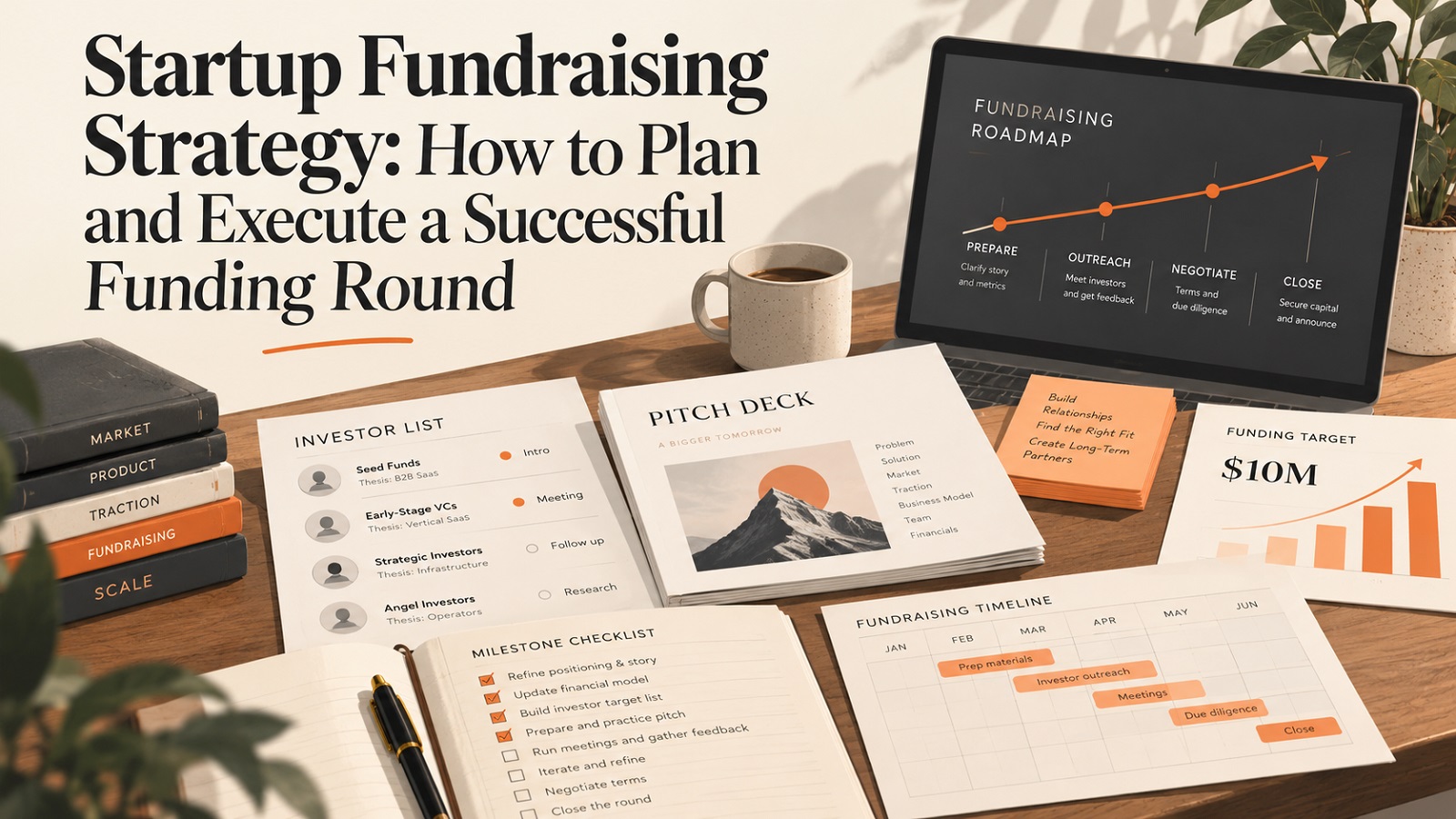
Raising investment is one of the most important financial decisions a startup founder can make. The capital secured during a funding round can support product development, customer acquisition, hiring, and expansion. However, the outcome depends on more than convincing investors that a business has potential. Founders also need to determine when funding is necessary, how much capital to request, which investors to approach, and how the financing will support the company's next stage of development.
A startup fundraising strategy provides a structured approach to these decisions. Rather than approaching investors without a clear plan, founders define their financial requirements, identify measurable business objectives, prepare supporting evidence, and organize the process of securing investment.
For startups seeking external investment, an effective Fundraising Strategy begins well before the first investor meeting. A well designed approach helps founders define financing goals, identify suitable investors, and connect each funding round to measurable business milestones.
What Is a Startup Fundraising Strategy?
A startup fundraising strategy is a plan that connects a company's financing requirements with its business objectives. It explains why additional capital is needed, what the company intends to accomplish with that capital, and how founders will identify and engage potential investors.
The strategy should reflect the startup's current development stage, financial position, growth opportunities, and ownership structure. A company preparing to launch its first product has different priorities from a business with established revenue seeking capital for international expansion.
For example, a software startup may need investment to complete product development, validate customer demand, and establish an initial sales process. A manufacturing startup may require financing to develop production capabilities, test equipment, and secure its first commercial agreements. Although both businesses are raising capital, the investment requirements and milestones differ considerably.
An effective fundraising strategy therefore begins with understanding the company's needs rather than determining how much money might be available from investors. Its purpose is to secure the appropriate resources to achieve meaningful business progress without creating unnecessary financial or ownership complications.
When Should a Startup Start Fundraising?
Fundraising timing has a direct influence on the company's negotiating position and financial flexibility. Starting too early may result in investor conversations before the business has demonstrated enough progress. Waiting too long can force founders to accept unfavorable conditions because the company urgently needs money to continue operating.
Founders should consider both financial runway and investment readiness. Runway describes how long the company's available cash may support operations at its expected rate of spending. Investment readiness concerns whether the business has sufficient evidence to attract investors at its intended financing stage.
A startup with limited runway may find it difficult to manage extended due diligence or negotiate effectively. Fundraising can involve multiple meetings, document reviews, investment approvals, legal negotiations, and closing procedures. Because these activities can take several months, preparation should normally begin well before the company reaches a critical cash position.
However, available cash is not the only consideration. Founders should also examine whether an upcoming business milestone could significantly strengthen the investment opportunity. Completing a product launch, securing an important customer contract, or demonstrating improved retention may provide stronger evidence of the company's potential.
The challenge is balancing the benefit of additional progress against the financial risks of waiting. A startup should not delay fundraising to pursue an uncertain milestone if doing so could leave insufficient time to complete financing.
The strongest timing decision considers available runway, investor expectations, realistic fundraising duration, and the milestones the company can achieve before approaching the market.
How Much Capital Should a Startup Raise?
Determining the appropriate fundraising amount requires a realistic understanding of the company's operating expenses and future development plans. The objective is not to raise the largest possible sum but to secure sufficient resources to reach meaningful business milestones.
Founders can begin by estimating expected cash inflows and outflows over the period they intend to finance. The forecast should account for employee compensation, product development, infrastructure, marketing, professional services, and other necessary expenditures.
Consider a startup expecting average monthly net cash consumption of $75,000 over the next 18 months. Under a simplified assumption that spending remains constant, the company would consume approximately $1.35 million during that period. Its actual funding requirement would depend on existing cash, planned investments, changes in customer payments, and any allowance for unexpected costs.
A complete financial plan should account for uncertainty. Revenue may arrive later than expected, recruitment may cost more than anticipated, or product development may require additional time. Founders should test how these changes affect available runway rather than relying exclusively on an optimistic forecast.
Raising too little capital can force the company to return to fundraising before achieving its objectives. Raising substantially more than necessary may increase dilution or encourage spending that the business is not prepared to manage effectively.
The appropriate funding amount should provide enough flexibility to execute the operating plan while remaining consistent with the company's stage, valuation, and long term ownership considerations.
Connect the Funding Round to Clear Business Milestones
Investors need to understand what the company expects to achieve with the capital it raises. A funding request becomes more convincing when financial requirements are connected to specific outcomes rather than broad ambitions.
For an early software startup, those outcomes may involve launching a commercially usable product, acquiring paying customers, and demonstrating that users continue receiving value from the service. A more established business may focus on improving sales efficiency, expanding into additional markets, or developing the infrastructure required for greater operating scale.
Each milestone should address an important source of uncertainty. If customer demand remains unproven, funding should help the company validate that demand. If the product already has paying customers but struggles with retention, management may need to prioritize product improvements before expanding marketing expenditure.
Founders should also establish how progress will be measured. A target such as improving customer acquisition becomes more useful when supported by defined operating indicators, realistic assumptions, and a clear evaluation period.
Milestones should not be selected simply because they appear impressive in a presentation. They should represent progress that strengthens the company and increases its ability to attract customers, generate revenue, or secure future financing.
Connecting capital to measurable progress also helps founders evaluate whether the funding round has achieved its intended purpose.
Identify Investors Who Match the Startup's Needs
Investor targeting is one of the most important parts of an effective fundraising strategy. Approaching investors whose priorities do not match the business can consume significant time without producing meaningful opportunities.
Founders should begin by examining investment stage, industry focus, geographic preferences, and typical investment amount. An investor specializing in established enterprise companies may have little interest in financing an unvalidated consumer application. Similarly, a fund focused on biotechnology may not be appropriate for a conventional retail startup.
The investor's preferred role in a financing round also matters. Some firms typically lead investments and negotiate the principal terms, while others prefer to participate alongside another lead investor. Understanding these preferences can help founders construct a realistic funding round.
Industry experience is another consideration. An investor familiar with the startup's market may better understand customer behavior, technical challenges, and the commercial opportunities associated with its product.
Startup Fundraising Strategy: Investor Selection Framework
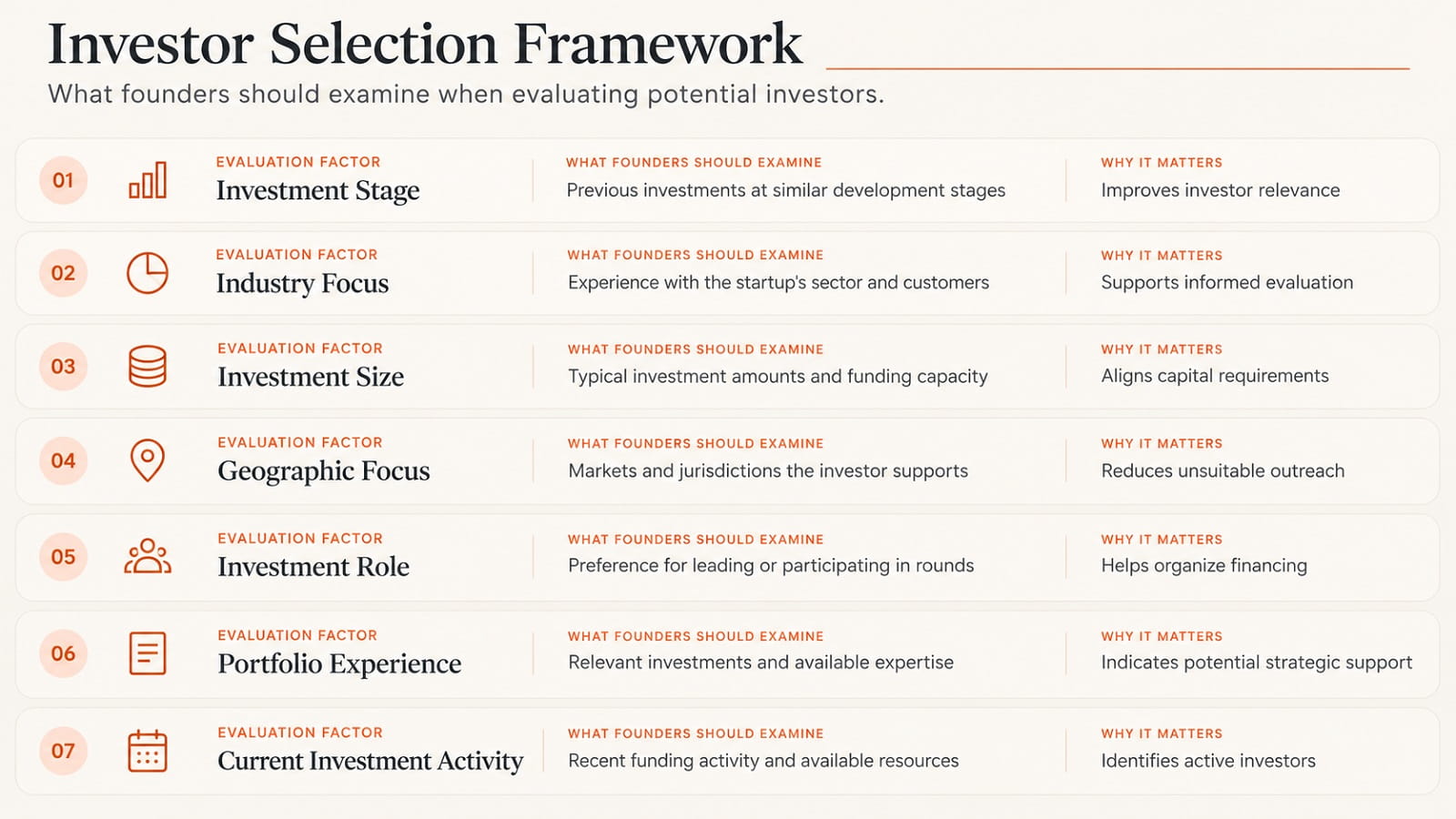
This framework allows founders to prioritize investors with a credible reason to consider the opportunity. The resulting target list should be manageable enough to support meaningful research and personalized communication.
A focused approach does not guarantee investment, but it improves the likelihood that fundraising conversations will involve investors who understand the company's market and financial requirements.
Develop a Strong Investment Narrative
An investment narrative explains why the startup represents an attractive opportunity and how additional capital could create meaningful business value. It should connect the customer problem, the proposed solution, market demand, competitive positioning, business progress, and future objectives.
The narrative begins with a clear explanation of the problem. Investors need to understand who experiences it, why existing solutions are inadequate, and whether addressing the problem creates a significant commercial opportunity.
Founders should then demonstrate why their company is positioned to offer an effective solution. This may involve specialized expertise, technology, customer relationships, distribution capabilities, or operating advantages that competitors cannot easily reproduce.
Evidence of progress strengthens the narrative. Relevant indicators may include revenue, customer engagement, signed agreements, product usage, technical development, or successful market testing. The evidence should match the company's development stage and business model.
Financial projections should connect with the company's operating assumptions. If a startup expects significant revenue growth, founders should explain which customer acquisition activities, pricing decisions, or market developments are expected to produce that result.
A convincing investment narrative does not depend on exaggerated claims. It helps investors understand what has already been demonstrated, what remains uncertain, and how the proposed financing could strengthen the business.
Prepare the Fundraising Materials Before Investor Outreach
Effective fundraising requires reliable information that supports the company's investment narrative. Founders should prepare materials before entering serious discussions so they can respond to investor questions accurately and consistently.
The pitch deck provides an overview of the business. It generally explains the problem, solution, market opportunity, competitive environment, team, business model, operating progress, and funding requirements. The presentation should be clear enough to establish the investment case without overwhelming investors with unnecessary details.
Financial projections provide more detailed information about expected revenue, expenses, hiring, cash requirements, and business assumptions. Founders should understand the calculations behind these projections and be prepared to explain how alternative outcomes could affect the company's position.
An accurate capitalization table is also important because it shows the existing ownership structure and helps investors assess the potential effects of new financing.
Other documents may include corporate records, important customer agreements, intellectual property information, and evidence supporting the company's reported operating performance.
The objective is not to prepare an excessive collection of documents. It is to ensure that information is accurate, organized, and consistent across the materials investors are likely to review.
Organize Investor Outreach as a Coordinated Campaign
Fundraising outreach should operate as a structured campaign rather than a sequence of unrelated meetings. Founders benefit from tracking potential investors, managing conversations, and understanding where each opportunity stands.
Initial outreach should be concise and relevant. A useful introduction explains what the startup does, why the opportunity matters, and which developments demonstrate progress. It should also make clear why the company may fit the investor's interests.
Personal introductions can be valuable when they come from individuals who understand both the startup and the prospective investor. However, a carefully researched direct introduction can also lead to productive conversations.
Founders should maintain a record of outreach dates, investor responses, meetings, requested information, and expected next steps. This makes it easier to follow up appropriately and avoid losing track of promising discussions.
Investor conversations also provide feedback about how the market perceives the company. Repeated questions about customer retention may indicate that the investment narrative needs stronger evidence in that area. Frequent concerns about market size may suggest that the commercial opportunity requires clearer explanation.
However, feedback should be interpreted carefully. A rejection may reflect an investor's portfolio strategy or available capital rather than a fundamental weakness in the startup.
Manage the Fundraising Process From Preparation to Closing
A funding round involves several connected activities, and founders should understand how each contributes to securing an investment.
The process typically begins with preparation and investor research, followed by outreach and introductory meetings. Investors who remain interested may conduct more detailed evaluations, review company documents, and discuss potential financing terms.
The timeline depends on the business, investor, and investment structure. Some financing rounds progress quickly, while others involve extended internal reviews or negotiations.
Startup Fundraising Process and Founder Priorities
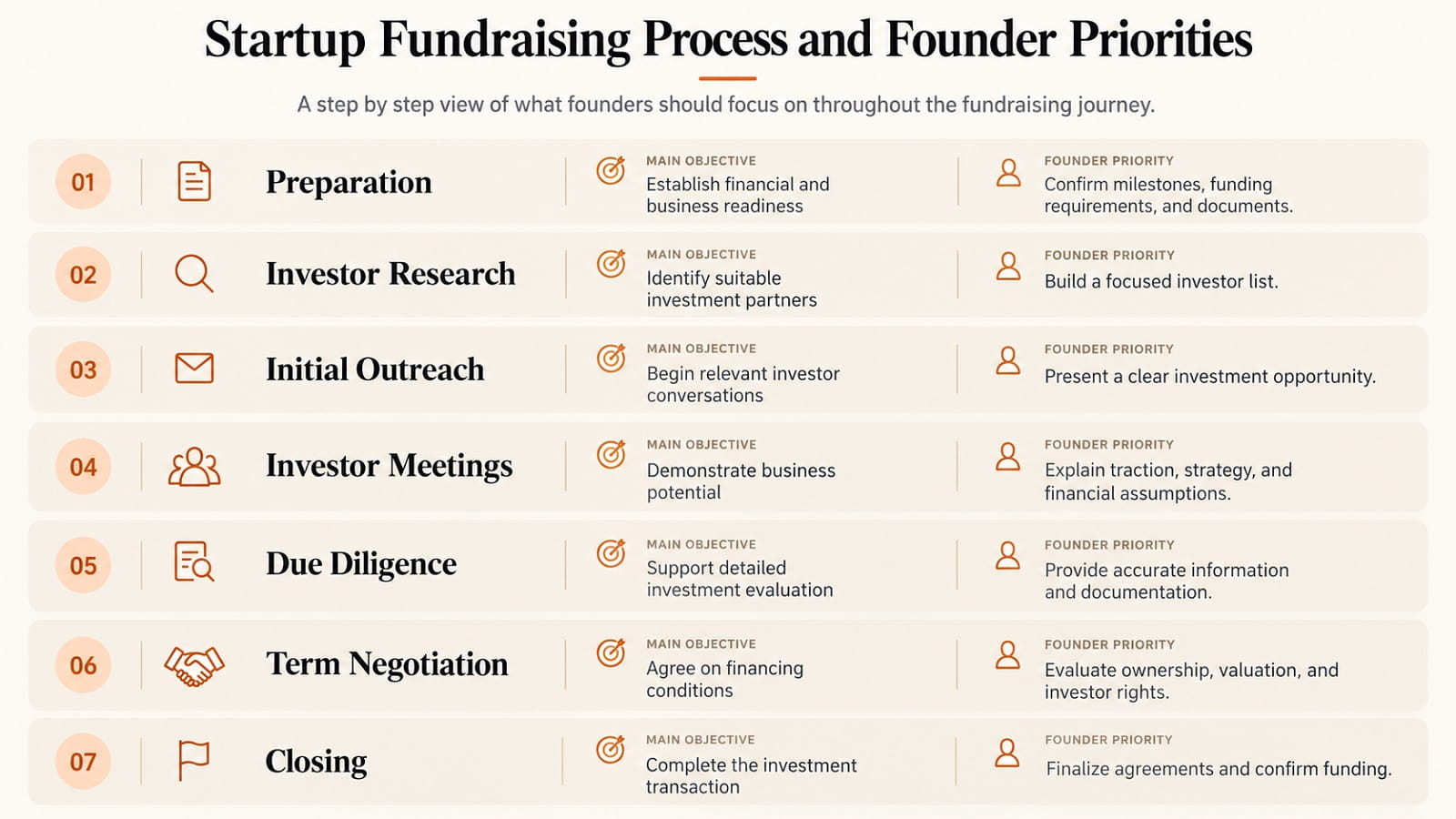
Monitoring progress across these stages helps founders determine whether the campaign is moving toward a successful financing.
A large number of introductory meetings does not necessarily indicate meaningful investor interest. Founders should examine whether conversations advance toward deeper evaluation, whether specific concerns are being resolved, and whether potential investors have the authority and resources to participate.
Accurate records and clear communication become increasingly important as several investors begin evaluating the company simultaneously.
Evaluate Investment Offers Beyond Valuation
A funding offer should be assessed through its complete economic and governance terms rather than valuation alone. Although a higher valuation can reduce immediate dilution, other provisions may materially influence future ownership and company decisions.
Founders should understand how the proposed investment affects their ownership percentage, the rights granted to investors, and the company's ability to raise additional capital. Provisions involving liquidation preferences, board representation, information rights, and future investment participation may require particular attention.
The strategic value of the investor should also be considered. Relevant industry experience, customer relationships, and support during future financing can be important advantages when they are realistic and compatible with the startup's plans.
However, founders should avoid accepting restrictive terms solely in exchange for promises of introductions or future support. The terms of the investment and the practical assistance offered should be evaluated separately.
Legal review is important because financing agreements can create obligations that remain relevant for years. The strongest offer is not necessarily the one with the highest stated valuation, but the one that provides appropriate capital and reasonable terms while supporting the company's long term objectives.
What to Do When Fundraising Takes Longer Than Expected
Even a carefully prepared fundraising campaign may encounter delays or insufficient investor interest. Founders should anticipate this possibility before beginning the process.
The first step is identifying where the difficulty occurs. If outreach produces very few responses, the company may need to reconsider its investor targeting or introductory message. If meetings frequently end without additional engagement, investors may have concerns about the business model, growth potential, or available evidence.
When discussions progress but fail during detailed evaluation, founders should examine whether financial information, customer metrics, or important business assumptions require improvement.
Feedback should be evaluated for recurring themes rather than allowing one investor's opinion to determine the company's entire strategy.
Financial contingency planning is equally important. Depending on the business, management may need to adjust planned hiring, postpone discretionary spending, improve customer collections, or reconsider the amount being raised.
Alternative financing approaches may also be appropriate when conventional venture investment does not match the company's current stage or business model.
A revised fundraising strategy should address the underlying challenge rather than simply repeat unsuccessful outreach. The objective is to preserve the company's ability to operate and create value while management identifies a more suitable financing approach.
Build a Strategy That Extends Beyond the Funding Round
Completing a financing round is not the final measure of fundraising success. The value of the investment depends on how effectively the company uses its new resources.
After closing, founders should connect spending decisions with the objectives presented during fundraising. Financial monitoring, operating priorities, and performance reporting help management determine whether the company is progressing as planned.
Investors should receive appropriate information about meaningful developments, challenges, and future financing requirements. Consistent communication can support productive relationships and provide a clearer foundation for future investment discussions.
Founders should also avoid assuming that additional financing will automatically become available. Future rounds depend on company performance, investor expectations, available capital, and market conditions.
A sustainable strategy therefore considers both current needs and the company's longer term financial position. The objective is to use each round to reduce important business risks, strengthen commercial performance, and create more financing options.
Building a Fundraising Strategy That Delivers Results
A successful startup fundraising strategy begins with understanding what the business needs to achieve. Financial requirements, investor selection, operating milestones, and communication materials should all support the same objectives.
Founders who approach investment with a clear plan can evaluate opportunities more effectively, manage investor discussions, and avoid pursuing financing that does not suit their company's stage or ambitions. Preparation also makes it easier to respond when investors question assumptions or request additional evidence.
Fundraising remains uncertain. Investors may decline promising opportunities, negotiations may take longer than expected, and broader market conditions can change during the process. A structured strategy does not eliminate these challenges, but it provides a stronger basis for making decisions.
The most valuable funding round is one that gives the startup sufficient resources to achieve meaningful progress while preserving the flexibility needed for future growth. Capital should support the business strategy, not become a substitute for it.
FAQ
What is a startup fundraising strategy?
A startup fundraising strategy is a structured plan for determining how much capital a business needs, when to raise it, which investors to approach, and how to manage the financing process. It connects investment decisions with business milestones and financial requirements.
When should a startup begin fundraising?
A startup should generally begin preparing before its available cash becomes critically limited. The appropriate timing depends on financial runway, business readiness, investor expectations, and the time likely required to complete financing.
How much capital should a startup raise?
The fundraising amount should reflect the capital required to achieve important business milestones, expected operating expenses, available cash, and reasonable allowances for uncertainty. Founders should also consider ownership dilution and future financing requirements.
How can founders identify suitable investors?
Founders should evaluate potential investors based on their preferred development stage, industry experience, geographic focus, investment amounts, recent activity, and portfolio strategy. Targeting investors with relevant expertise and appropriate funding capacity can make outreach more effective.
What should founders do if their fundraising strategy is not working?
Founders should examine investor feedback, identify where conversations are failing, and determine whether their targeting, investment narrative, or supporting evidence needs improvement. They should also review financial runway and consider alternative financing or operating plans when necessary.

Mobina Khanki
Venture & Funding Writer at PinerookMobina Khanki covers venture capital, startup funding, fundraising, and startup finance for Pinerook, focusing on founders and investors.
 Seen first.