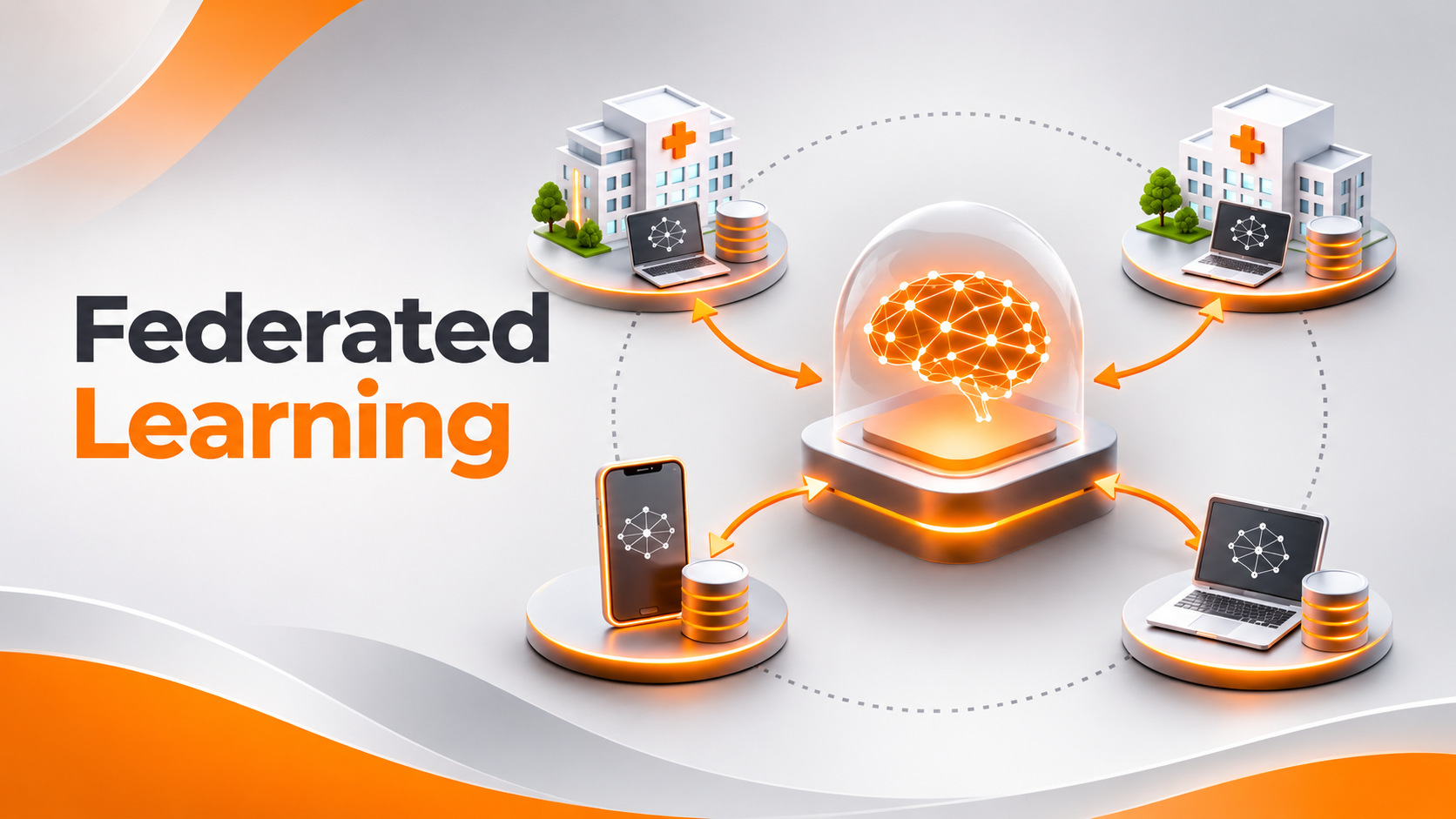
Federated Learning is a machine learning approach that allows multiple devices or organizations to train a shared AI model without combining their raw datasets in one location. Instead of transferring sensitive information to a central repository, participants contribute to model training while keeping their original data under local control.
Consider three hospitals that want to improve a medical prediction model but cannot pool patient records. Federated Learning provides a way to collaborate without transferring those records into a shared database. The important question is not just whether this protects data, but how the training process works and whether the added complexity is justified.
How Federated Learning Works
The easiest way to understand Federated Learning is to follow a single training round.
A conventional federated training system has two main components: a coordinating server and participants, also called clients. Each client holds its own dataset, while the coordinator manages the shared model.
The process follows five steps.
1. Global model initialization
The coordinator creates an initial machine learning model with a defined architecture and distributes its parameters to participating clients.
For our hospital example, each hospital receives the same starting model.
2. Local model training
Each hospital trains its copy using patient records stored within its own environment.
The training process updates the model parameters based on patterns in that hospital's dataset.
The original patient records remain at the hospital.
3. Model update transmission
After completing local training, participants send the required model updates or parameters to the coordinator.
The coordinator receives information generated through training rather than the original patient records.
4. Global model aggregation
The coordinator combines the participating updates according to the selected aggregation method.
The resulting parameters form the next version of the shared model.
5. Model redistribution and evaluation
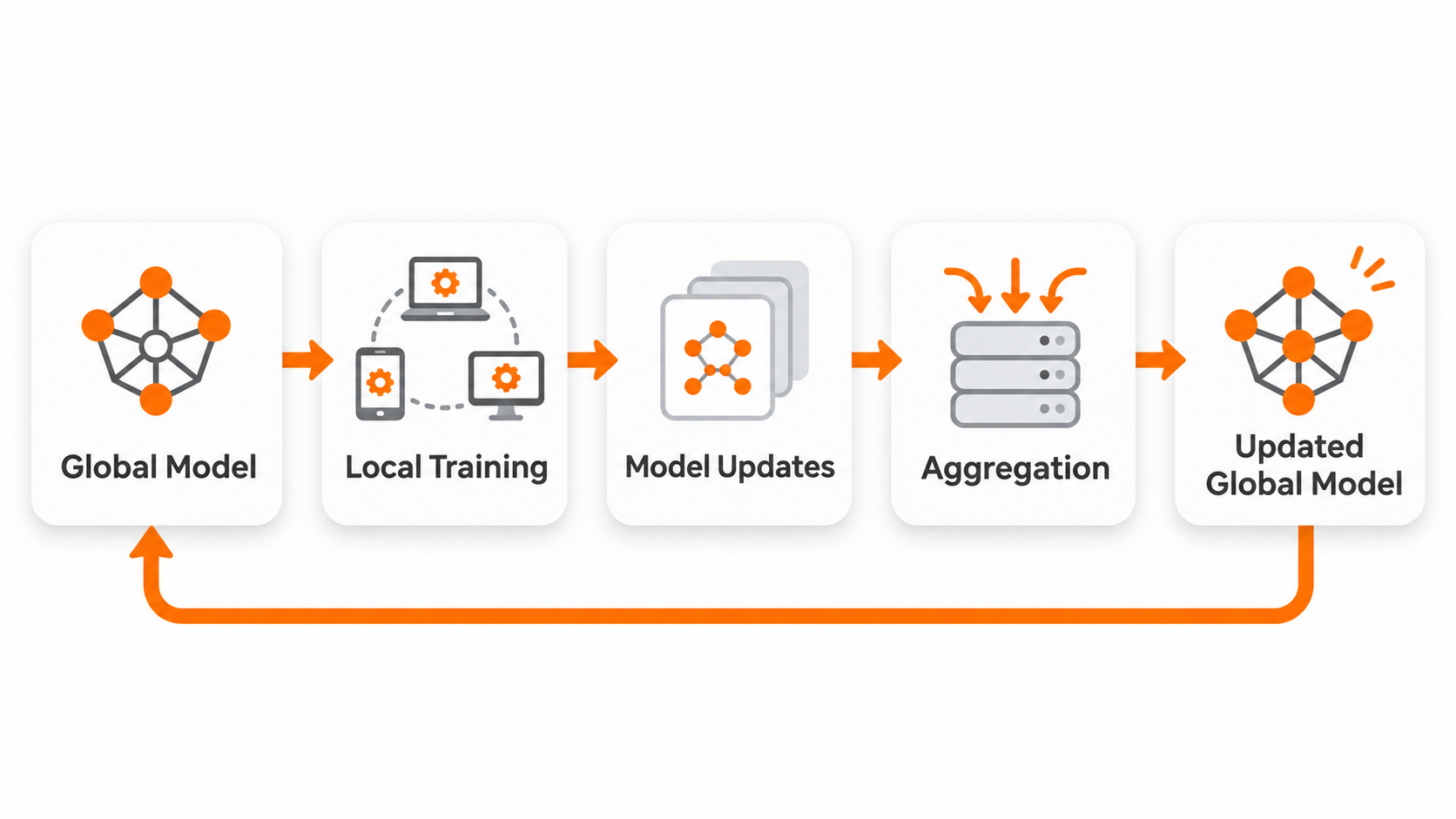
The updated model is distributed for another training round. Its performance is evaluated against defined validation criteria, and the process continues until the training objective or stopping condition is reached.
The complete cycle is:
Global Model → Local Training → Model Updates → Aggregation → Updated Global Model
This process allows institutions to contribute knowledge without combining their source datasets.
However, the coordinator still needs an appropriate communication and aggregation system. Federated Learning distributes the training workload and data ownership; it does not automatically eliminate central coordination.
Model Aggregation
The method used to combine updates affects how the shared model learns.
A widely used approach is the Federated Averaging Algorithm, also known as FedAvg.
FedAvg combines model parameters from participating clients through a weighted average. In its standard form, the weights reflect the number of training examples contributed by each participant.
Suppose three hospitals have 1,000, 2,000, and 3,000 training examples.
Under example weighted aggregation, their contributions receive weights of one sixth, one third, and one half.
This prevents a hospital with a small dataset from automatically receiving the same influence as one contributing considerably more training examples.
The averaging process combines parameter values, not patient records. It also does not guarantee that the resulting model will perform equally well at every hospital.
Federated Learning vs Traditional Machine Learning
The practical distinction in Federated Learning vs Centralized Learning is where the training data resides.
In centralized machine learning, datasets are collected into a shared training environment. This allows developers to inspect and process the complete dataset under one system.
Federated Learning changes that arrangement.
Each participant retains its dataset, performs its assigned computation, and contributes to a shared training process.
For our hospitals, the choice depends on data access.
If all three institutions are permitted to transfer their records into an approved shared environment, centralized training offers a simpler operational structure.
If those records must remain within their respective institutions, Federated Learning provides an alternative that supports collaboration.
This distinction also affects debugging.
With centralized data, engineers can directly inspect the combined training dataset. In a federated system, investigations require approved diagnostics, local validation, and information shared by participants.
Federated Learning is not a replacement for centralized training in every project. Its advantage is enabling collaborative training when bringing the underlying datasets together is undesirable or restricted.
Types of Federated Learning
Federated Learning systems are classified in two useful ways.
The first concerns how data is divided between participants. The second concerns who participates and what infrastructure they use.
These classifications describe different dimensions of the same system.
Horizontal and Vertical Federated Learning
Understanding Horizontal vs Vertical Federated Learning begins with examining the structure of the participating datasets.
Horizontal Federated Learning
Participants hold different records with the same types of features.
For example, three hospitals might collect the same clinical measurements from different patients.
Each hospital has its own patients, but the datasets share a compatible structure.
This allows each institution to train a local model using the same set of input features.
Vertical Federated Learning
Participants hold different features about overlapping records.
Consider a bank and a financial service provider that possess different information about some of the same customers.
One organization may hold transaction information, while the other holds additional financial attributes.
Their collaboration requires methods for identifying overlapping records and performing computations across separate feature sets without exposing the underlying information.
Vertical training therefore involves a different technical arrangement from training complete local models on separate groups of records.
Cross Silo and Cross Device Federated Learning
The distinction in Cross Silo vs Cross Device Federated Learning concerns the participating infrastructure.
Cross Silo Federated Learning connects a defined group of organizations or institutional systems.
Our hospital example fits this category. Each institution has its own computing environment, governance requirements, and substantial local dataset.
Cross Device Federated Learning coordinates training across large populations of devices, including smartphones and connected equipment.
These devices have different processing capabilities, network conditions, and availability.
The coordinator must account for participants that are unavailable during a particular training round.
A system can be both horizontal and cross silo, or horizontal and cross device. These are not competing labels.
Federated Learning Applications
The value of Federated Learning becomes clearer when we examine situations in which useful data is distributed across independently controlled environments.
Healthcare and Medical Research
Hospitals and research institutions hold valuable clinical datasets, but transferring patient information introduces privacy, governance, and regulatory requirements.
Federated Learning enables participating institutions to train a shared model while maintaining local control of their records.
Potential applications include medical image analysis, disease prediction, and collaborative clinical research.
For our hospital example, the shared model must be evaluated on data from each participating institution.
A model that performs well on aggregated evaluation results can still produce weaker predictions at one hospital because patient populations, equipment, or clinical practices differ.
This is why evaluation should consider individual sites rather than relying only on an overall performance score.
Mobile Devices and Predictive Text
Google has used Federated Learning to train language models for Gboard.
In this application, participating devices contribute to model improvement without sending the underlying typing examples to a central training database.
Google's published research describes deployed Gboard models trained using Federated Learning together with differential privacy.
This is a documented production application, not merely a proposed use case.
It also demonstrates the importance of handling different device capabilities and protecting information contained in model updates.
Financial Services
Financial institutions can collaborate on machine learning tasks without consolidating their complete customer or transaction datasets.
Fraud detection provides a relevant example.
Different institutions observe different transaction patterns. Combining learning from those environments can help develop a model informed by a broader range of activity.
The participating institutions still need compatible data definitions, a suitable training method, and appropriate privacy controls.
Keeping data in separate locations does not remove their legal responsibilities.
Industrial Equipment and Connected Devices
Industrial facilities generate operational data through sensors, machinery, and connected systems.
Federated Learning can support collaborative model training across facilities that retain their operational datasets locally.
Applications include equipment anomaly detection and predictive maintenance.
For example, factories operating comparable machines can contribute to a shared model without pooling their complete operating histories.
The model must still account for differences in equipment configurations, maintenance schedules, and operating conditions.
Federated Learning Benefits and Limitations
The strongest reason to adopt Federated Learning is access to useful distributed data without requiring raw data consolidation.
Other benefits depend on how the system is designed.
Local data control
Participants retain custody of their source datasets instead of copying them into a shared training repository.
Collaboration between organizations
Institutions can train a model together while maintaining separate data environments and governance responsibilities.
Access to broader training populations
A shared model can benefit from examples held by multiple participants, including populations unavailable to one institution acting alone.
Reduced movement of raw datasets
Training exchanges model information rather than complete source datasets. This reduces the need to move raw records, although repeated model communication still consumes network resources.
These benefits come with engineering requirements.
Data Heterogeneity
One of the central issues behind Non IID Data in Federated Learning is that participants do not necessarily hold data drawn from the same statistical distribution.
In the hospital example, one institution may treat older patients, another may specialize in complex conditions, and a third may use different diagnostic equipment.
Their local models therefore learn from different patterns.
This can affect convergence and cause the shared model to perform unevenly across institutions.
Evaluation must examine how the global model performs on the participating populations, not just whether training loss decreases.
Communication and Computing Costs
Every training round requires communication between the coordinator and participating clients.
Large model parameters, frequent communication rounds, and slow connections can increase the cost of training.
Different client hardware also affects participation.
A hospital with powerful computing infrastructure can complete local training under different conditions from a smartphone with limited memory and battery capacity.
The training design must reflect those constraints.
Privacy and Security
Federated Learning does not guarantee that private information is protected.
Although raw data remains local, model gradients and parameter updates can reveal information about the data used to produce them.
Research has demonstrated attacks capable of reconstructing information from individual model updates.
One technical protection is Secure Aggregation in Federated Learning, which allows a coordinator to obtain an aggregate without receiving the individual updates in readable form.
Differential privacy provides another layer of protection by limiting and obscuring the influence of individual participants.
These methods address different privacy risks and introduce their own implementation and performance tradeoffs.
A production system therefore needs a clearly defined threat model, access controls, and a privacy design appropriate to the data.
Choosing Federated Learning for an AI Project
Before selecting a framework or building a training network, we recommend evaluating whether the project genuinely needs decentralized data ownership.
The decision should begin with data access, not technology preference.
The following table provides a practical starting point.
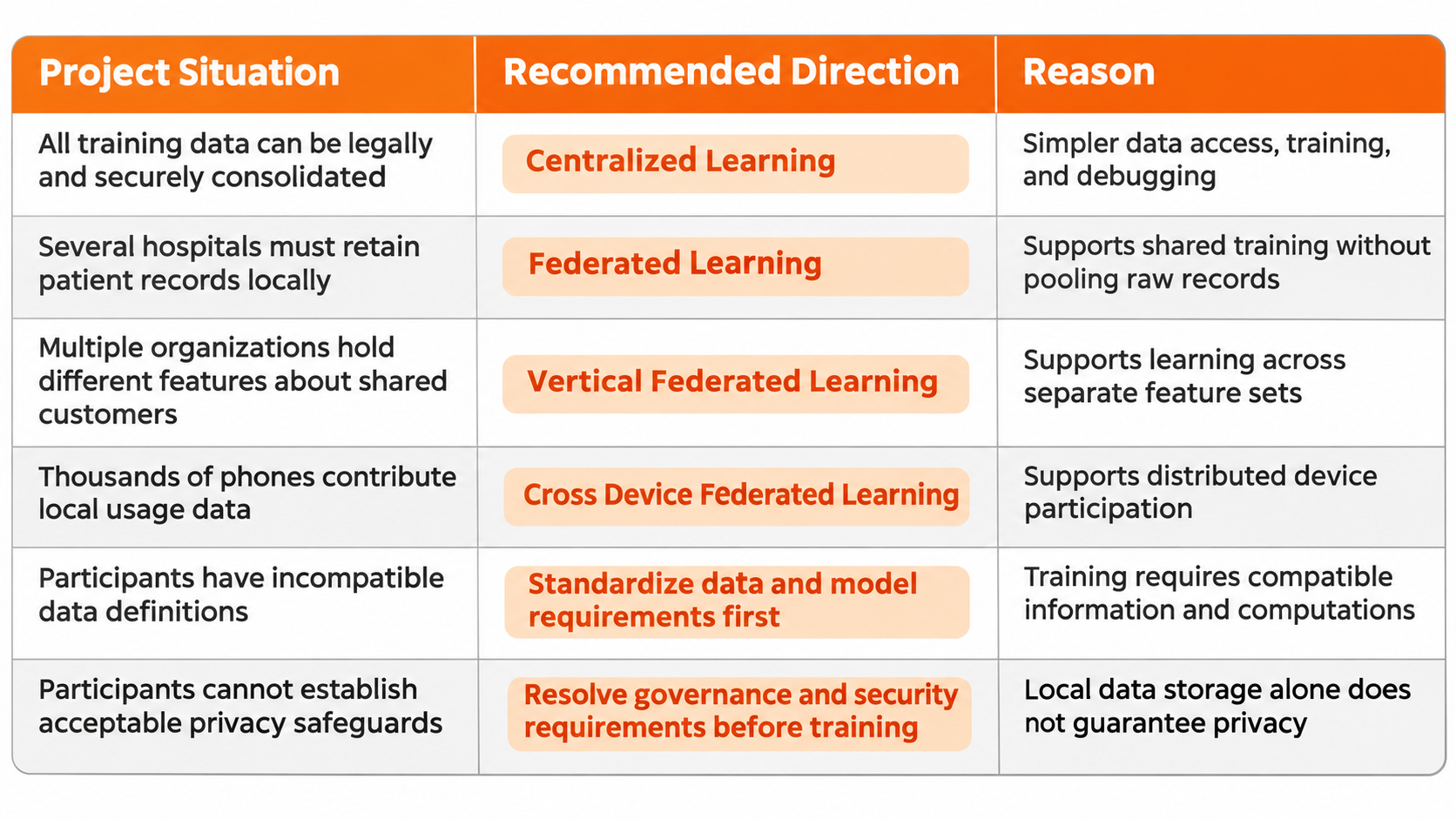
The key decision is whether the project gains access to valuable training information that cannot reasonably be centralized.
That benefit must justify the additional engineering work.
Data and Model Compatibility
Before implementation, participating organizations must agree on the learning objective and the meaning of the data used by the model.
For the hospital example, this includes consistent clinical definitions, compatible labels, and a suitable approach to handling missing information.
If one hospital defines an outcome differently from another, combining their training contributions will not automatically correct the inconsistency.
Local data quality still determines what the shared model can learn.
Model Validation
A reliable evaluation considers both overall model quality and performance across individual participants.
For a medical prediction model, appropriate validation can include sensitivity, specificity, and other metrics selected for the clinical task.
Each hospital should evaluate the model against a suitable local validation dataset.
The results help identify whether improvements at one institution come at the expense of weaker performance elsewhere.
A centralized baseline is useful when an equivalent comparison is feasible and permitted.
Without that comparison, it is difficult to determine whether the additional complexity delivers sufficient value.
Federated Learning Frameworks
Building a federated system from the beginning requires infrastructure for client coordination, model distribution, aggregation, security, and evaluation.
Several established frameworks provide these components.
Flower
Flower supports federated training with machine learning libraries including PyTorch and TensorFlow.
It provides tools for simulation and distributed execution, allowing development teams to test training behavior before connecting physical or institutional participants.
For teams with an existing Python machine learning project, Flower offers a practical starting point.
TensorFlow Federated
TensorFlow Federated is an open source framework for experimenting with machine learning and computations on decentralized data.
It provides interfaces for defining federated computations and implementing learning algorithms.
Its tutorials include model training, aggregation strategies, and differential privacy.
It is particularly useful for researchers and developers working within the TensorFlow ecosystem.
NVIDIA FLARE
NVIDIA FLARE provides infrastructure for federated AI development across distributed environments.
It supports training workflows, participant coordination, and privacy technologies.
The framework is relevant to organizations building collaborations between institutional systems, including healthcare and research environments.
Framework selection should follow the project's existing machine learning stack, security requirements, participant infrastructure, and operational needs.
The framework does not replace these decisions.
Starting a Federated Learning Project
A small simulation provides a more useful starting point than immediately connecting production datasets.
For our hospital example, we can represent three institutions as separate simulated clients.
Each client receives a partition of a permitted development dataset and trains a local copy of the same model.
The coordinator combines the updates and evaluates the shared result.
A sensible development sequence is:
Define a specific prediction task and its evaluation metrics.
Establish a centralized baseline using data approved for development.
Divide the development data into simulated client datasets.
Run federated training with an established framework.
Compare model quality across individual clients and the overall evaluation set.
Test the impact of different data distributions and communication limits.
Review privacy, security, and governance requirements before production deployment.
The simulation identifies whether the selected training design is technically workable.
It also reveals how model performance changes when clients hold unequal datasets.
Moving from simulation to production requires separate decisions about institutional permissions, infrastructure, operational responsibility, and data protection.
Federated Learning is worth adopting when its ability to learn from distributed data solves a real constraint that centralized training cannot address appropriately.
Its value comes from the collaboration it enables, not from decentralization alone.
FAQ
What happens if one hospital drops out in the middle of training?
The result depends on the aggregation protocol and the stage of the training round. A system designed to tolerate missing participants can proceed using eligible completed updates, provided its participation requirements are satisfied. Other configurations must restart or reject the affected round.
Can we add another hospital after training has already started?
Yes. A new institution can join future rounds after meeting the system's technical, governance, and access requirements. Its data and model configuration must be compatible with the agreed training process.
Do all the participants need identical hardware?
No. Participants can use different hardware when the framework and training software support their environments. Each device or institution must still provide sufficient computing resources to complete its assigned workload.
Who owns the final model when several companies train it together?
Ownership is determined by the participating organizations' agreements and applicable law. The Federated Learning architecture does not establish intellectual property rights. Model ownership, permitted uses, licensing, and withdrawal conditions should be defined before collaboration begins.
Can we remove one participant's contribution from a trained model?
Deleting the participant's original dataset or excluding it from future rounds does not automatically remove its influence from an existing model. The project requires an appropriate retraining or validated machine unlearning procedure to address that request.
Can we use Federated Learning to train large language models too?
Yes. Federated Learning supports collaborative fine tuning of large language models using distributed datasets. Techniques such as LoRA reduce the number of trainable parameters, making the process more practical. However, computing requirements, communication costs, and model compatibility must be evaluated before deployment.
Do all participants have to use the same AI model?
Not necessarily. Traditional methods such as FedAvg require compatible model architectures and parameters for aggregation. Other approaches use knowledge distillation to exchange information between different model architectures. The supported arrangement depends on the chosen training algorithm.
What if someone sends fake or malicious model updates?
Malicious participants can manipulate model updates to reduce accuracy or introduce targeted behavior. Defenses include participant authentication, update validation, robust aggregation, and controlled participation. These protections must be selected according to the system's threat model because no single technique prevents every attack.
Can Federated Learning work without a central server?
Yes. Decentralized Federated Learning allows participants to exchange and aggregate model information directly through a peer network. This removes the central aggregation server but introduces additional requirements for coordination, communication, participant trust, and fault tolerance.
How do we estimate the network costs before starting?
Estimate the size of the model information uploaded and downloaded during each training round. Multiply those amounts by the expected number of participating clients and training rounds, then account for protocol overhead, retries, and additional security traffic. A small simulation provides a practical estimate before production deployment.

Fatemeh Jahangard
Technology & AI Writer at PinerookFatemeh Jahangard covers AI, emerging technologies, and digital innovation for Pinerook, focusing on how technology shapes startups and industries.
 Seen first.