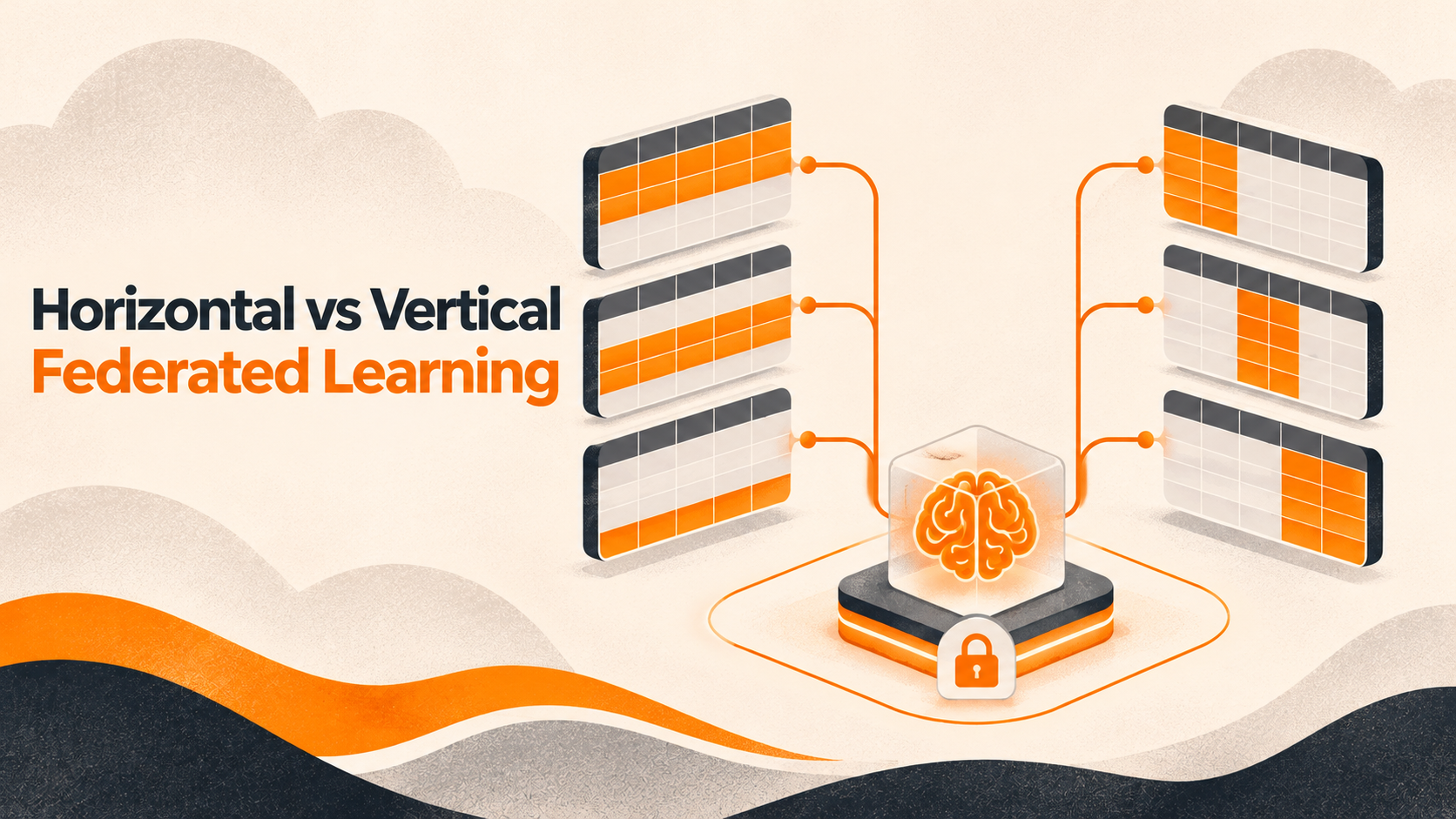
Horizontal vs Vertical Federated Learning describes two ways of training AI models across separate datasets. Horizontal Federated Learning (HFL) works with different records that share the same features. Vertical Federated Learning (VFL) combines different features belonging to the same or overlapping records.
In Federated Learning, selecting the right architecture starts with understanding how the participants' data fits together. Two hospitals collecting identical patient measurements need a different training design from a bank and an insurer holding complementary information about shared customers. That distinction determines the training process, privacy requirements, and infrastructure needed.
Choosing Between HFL and VFL
The most reliable way to select an architecture is to examine the participating datasets before choosing a training framework.
Choose Horizontal Federated Learning when organizations have compatible data columns but different records.
For example, two hospitals record age, blood pressure, glucose levels, and diagnosis for different patients.
Each hospital has the information needed to train a local model for the same prediction task. The resulting model updates can contribute to shared training.
Choose Vertical Federated Learning when organizations have different columns describing overlapping records.
For example, a bank holds transaction histories while an insurance company holds policy information about some of the same customers.
Neither organization has the complete set of features. Collaborative training must connect the corresponding records and process information from both sources.
Before selecting either architecture, we need to establish three facts: which features each participant holds, which records overlap, and where the prediction labels are available.
If the datasets have different features and almost no overlapping records, neither conventional HFL nor VFL provides a straightforward solution. The project needs a different data strategy or a learning method designed for limited overlap.
Data Partitioning and Sample Overlap
The terms horizontal and vertical refer to the way a dataset is divided.
Think of a dataset as a spreadsheet. Each row represents an individual record, and each column represents a feature.
Horizontal Data Partitioning
Horizontal Federated Learning divides the data across rows.
Suppose Hospital A holds information about 8,000 patients and Hospital B holds information about 12,000 different patients.
Both hospitals record the same clinical variables.
Their datasets have a compatible feature structure, but the patient records belong to different populations.
This arrangement supports local training because each hospital has the required input features and labels for its own records.
The hospitals must still agree on data definitions.
A blood pressure measurement expressed in one unit cannot be treated as equivalent to a differently defined measurement without appropriate standardization.
Compatible column names alone are not enough. The values and their meanings must also be consistent.
Vertical Data Partitioning
Vertical Federated Learning divides the data across columns.
Consider a bank and an insurance provider with 5,000 customers appearing in both databases.
The bank holds income and transaction information.
The insurer holds policy types, claim histories, and coverage information.
The organizations possess complementary features about those shared customers.
Combining their information for training requires a way to identify which records correspond to the same person without exposing unrelated customer data.
This is the central architectural difference: HFL combines learning from separate records, while VFL combines learning from separate features.
Model Training Architecture
The partitioning method determines what participants can calculate independently and what they need from other parties.
Horizontal Federated Learning Workflow
In HFL, participants train compatible models on their local datasets.
A coordinating system distributes a model, receives local updates, and combines those updates according to the selected training algorithm.
For instance, two hospitals can independently calculate updates using their own clinical records.
The coordinator then produces an updated shared model.
The process does not require matching patients across the two hospitals.
However, each participant must support the agreed model architecture, input representation, and prediction objective.
A participant collecting incompatible features cannot simply join the same training process without adapting its data or the learning method.
Vertical Federated Learning Workflow
VFL requires collaborative computation because each participant holds only part of the information describing a record.
Consider a model predicting whether a customer will miss a loan payment.
The bank holds financial information and the repayment outcome.
An insurance provider holds additional customer attributes but does not have the repayment labels.
A vertical training system can allow the insurance provider to process its local features while the bank contributes its own features and supervises the prediction task.
Depending on the selected protocol, participants exchange protected intermediate representations or gradients rather than sending their complete datasets.
The coordinating components combine the necessary information to calculate the training objective and update the relevant model components.
Standard model averaging is not a replacement for this coordinated computation.
Averaging independently trained models does not reconstruct the relationship between financial and insurance features belonging to the same customer.
That relationship must be represented within the vertical training design.
Entity Alignment in Vertical Federated Learning
Record matching is a critical preparation step in VFL.
A bank might identify customers using internal account numbers, while an insurer uses separate policy identifiers.
Even when both organizations hold information about the same individual, their records do not automatically match.
Entity alignment establishes correspondence between records referring to the same person, customer, or organization.
A privacy preserving method called Private Set Intersection (PSI) can help participants determine which identifiers belong to their shared population without disclosing their complete identifier lists.
However, PSI does not automatically conceal every detail about membership or eliminate all privacy risks. Its protections depend on the protocol and what each participant is permitted to learn.
Once the records are aligned, the training system must preserve that correspondence.
A feature vector belonging to Customer A must never be combined with a feature vector belonging to Customer B.
Incorrect alignment creates a data integrity problem that can damage model performance even when the underlying datasets are accurate.
Training Labels and Shared Records
In a common VFL arrangement, one organization holds the prediction labels while other participants contribute additional features.
The label owner can supervise training without receiving every raw input column.
This requires compatible training software and a protocol supporting the distributed model.
We also examine the number of successfully aligned records before proceeding.
If two organizations each have one million customers but share only a few hundred, the training population is limited to the records supported by the selected method.
A large database is not the same as a large usable vertical training dataset.
Horizontal vs Vertical Federated Learning Comparison
The following table summarizes the architectural decisions that matter most when comparing HFL and VFL.
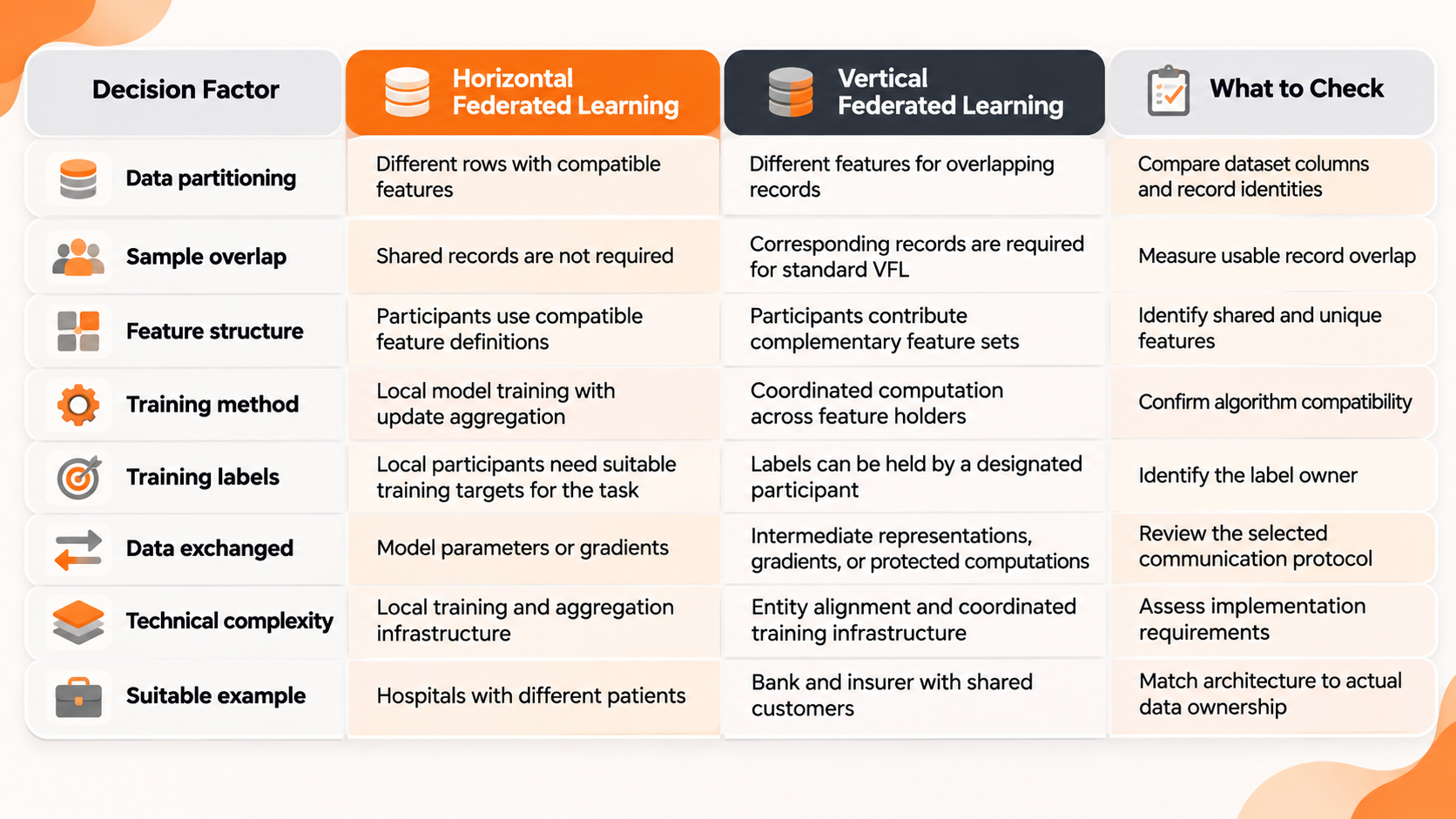
The table provides an immediate architectural decision, but it does not establish which method produces a more accurate model.
HFL and VFL solve different data partitioning problems. Comparing their accuracy without controlling the available records, features, model design, and evaluation conditions would produce a misleading conclusion.
The appropriate performance benchmark must reflect the actual project.
Privacy and Security Requirements
Both architectures allow participants to retain their raw datasets.
That reduces the need for direct data consolidation, but it does not guarantee that sensitive information remains private.
The exchanged information differs between the two approaches, which changes the security controls required.
Privacy in Horizontal Federated Learning
HFL participants exchange model information generated through local training.
Gradients and model parameters can reveal information about the underlying records.
Research has demonstrated attacks that reconstruct or infer sensitive training information from such updates.
Secure aggregation can help prevent a coordinator from inspecting individual updates while still allowing it to calculate an aggregate.
Differential privacy provides another mechanism for limiting information leakage.
The appropriate protections depend on the training protocol and threat model.
Privacy in Vertical Federated Learning
VFL introduces additional privacy concerns because participants work with different information about corresponding individuals.
The system must protect record alignment, intermediate computations, and model updates.
For example, an organization contributing customer attributes should not automatically gain access to another organization's confidential prediction labels.
Encryption, secure multiparty computation, private entity alignment, and other protective mechanisms can address specific risks.
No single mechanism guarantees complete privacy.
Before deployment, participating organizations must agree on which information each party can access, what the training process reveals, and how the system will respond to security failures.
Communication and Computing Costs
Horizontal and Vertical Federated Learning create different communication demands.
In HFL, a participant performs local training before transmitting the required model information.
The frequency and volume of these exchanges depend on the model, training algorithm, and number of rounds.
For a large model, communicating parameter updates can be expensive.
In VFL, participating organizations exchange information needed to complete coordinated computations.
A split neural network, for example, can require intermediate representations to travel between participants during training, followed by gradient information during backpropagation.
This creates a stronger dependency between the participating systems.
Network and Processing Requirements
We would not choose HFL or VFL based on an assumption that one architecture always uses less bandwidth.
The communication volume depends on the implementation.
For HFL, model size, local training steps, and update frequency are important.
For VFL, representation size, training batches, participant count, and cryptographic operations affect the workload.
Hardware requirements also differ.
HFL distributes local model training across clients.
VFL divides computation across components associated with different feature sets.
Both approaches require sufficient processing capacity for their assigned workloads.
Operational Reliability
VFL training can be interrupted when a required feature holder cannot participate in a coordinated computation.
HFL systems can be designed to complete training rounds using a selected subset of available participants.
That distinction matters when the infrastructure involves unstable connections or organizations operating under different schedules.
A project with several independent data owners needs documented participation requirements, failure handling, and monitoring before production deployment.
Model Performance and Evaluation
Choosing between HFL and VFL based on a published accuracy percentage is unreliable unless the experimental conditions match the intended project.
Horizontal learning adds access to training examples distributed across participants.
Vertical learning adds access to complementary features describing overlapping examples.
These are different sources of information.
A horizontal model can benefit from broader coverage of patient populations.
A vertical model can benefit from financial and behavioral attributes that no single organization possesses.
Neither benefit automatically translates into higher accuracy.
Evaluation Criteria
A meaningful assessment includes model performance on data that was not used for training.
For classification tasks, suitable metrics include precision, recall, and other measures selected for the prediction objective.
The evaluation should also consider the participating organizations separately.
For HFL, this helps identify performance differences between client populations.
For VFL, the evaluation should reflect the successfully aligned records and the features available under the intended deployment conditions.
If possible, compare the federated approach with an appropriate centralized or local baseline using equivalent data and evaluation criteria.
The results should establish whether the additional information obtained through collaboration improves the prediction task enough to justify the cost.
Healthcare and Finance Applications
Two practical situations show why the distinction between horizontal and vertical data cannot be ignored.
Healthcare Collaboration
Imagine three hospitals researching the same disease.
Each hospital records the same clinical measurements, but each treats different patients.
The institutions can coordinate horizontal training using compatible local datasets.
The shared model benefits from training contributions across the participating patient populations.
The main preparation work involves standardizing feature definitions, training targets, and evaluation procedures.
There is no requirement to identify matching patients across institutions.
Financial Risk Assessment
Now consider a bank and an insurance company.
The bank wants to develop a model predicting a defined financial risk.
Its records contain income, payment history, and other financial attributes.
The insurer holds additional information about customers who also use the bank.
The organizations possess complementary features about an overlapping population.
A vertical architecture enables collaborative training with those feature sets while retaining the raw records within their respective environments.
The project must establish legal permission, align records securely, identify the label owner, and implement a suitable joint training protocol.
The difference between the two scenarios is not the industry.
It is the relationship between the datasets.
Validating the Architecture Before Deployment
Before committing to a production system, we recommend testing the proposed architecture with an approved development dataset.
The test should reproduce the actual data structure rather than splitting records into convenient artificial partitions that do not reflect the project.
For HFL, the simulation should preserve meaningful differences between participant populations.
For VFL, it should use realistic feature ownership, record overlap, and label availability.
The validation plan needs to establish whether the required participants can complete training, whether the model meets its performance criteria, and whether the privacy design protects the intended information.
The final architecture decision should account for:
Dataset compatibility and record overlap
Availability and ownership of prediction labels
Model performance on appropriate validation data
Communication, infrastructure, and security costs
Operational requirements for participating organizations
Horizontal Federated Learning is the appropriate starting point for compatible features distributed across different records. Vertical Federated Learning is the appropriate starting point for complementary features belonging to overlapping records.
The correct choice follows the data structure. The decision to deploy follows technical validation.
Final Thoughts
The difference between Horizontal and Vertical Federated Learning comes down to how data is distributed across participants. HFL is designed for organizations with compatible features and different records, while VFL connects complementary features belonging to overlapping records.
The most important decision is not which approach offers more advanced technology, but which architecture matches the available data. Before implementation, teams should examine feature compatibility, record overlap, label availability, privacy requirements, and training costs.
A successful federated learning project starts with the right data architecture. Once that is established, model performance, security, and operational requirements determine whether the selected approach is ready for deployment.
FAQ
Can we combine horizontal and vertical learning in the same project?
Yes. Hybrid federated architectures support datasets partitioned across both records and features. These systems require methods for coordinating different participant groups and resolving their data relationships. The appropriate design depends on the available records and the training objective.
What if neither company has the labels we need?
Supervised training requires a defined target and suitable labeled examples. The participants must establish an approved labeling process or select a learning objective that does not depend on those labels. Vertical Federated Learning does not create missing ground truth automatically.
Do both companies need to be online whenever the model makes a prediction?
That depends on the deployment architecture. A distributed vertical model that requires features or computations from both parties needs access to those contributions during inference. An alternative serving design can change that requirement, but it must be implemented and validated separately.
Can one partner leave the training project later?
Yes, subject to the participation and governance agreements. The remaining participants must determine whether the current model can continue to be used and whether retraining is necessary. Removing a participant does not automatically erase its earlier influence from the trained model.
Can we use XGBoost instead of neural networks?
Yes. Federated methods exist for tree based models, including XGBoost, in both horizontal and vertical settings. The implementation must support the selected partitioning method and required privacy controls. Standard centralized XGBoost training cannot simply be assumed to operate across separate private datasets.

Fatemeh Jahangard
Technology & AI Writer at PinerookFatemeh Jahangard covers AI, emerging technologies, and digital innovation for Pinerook, focusing on how technology shapes startups and industries.
 Seen first.