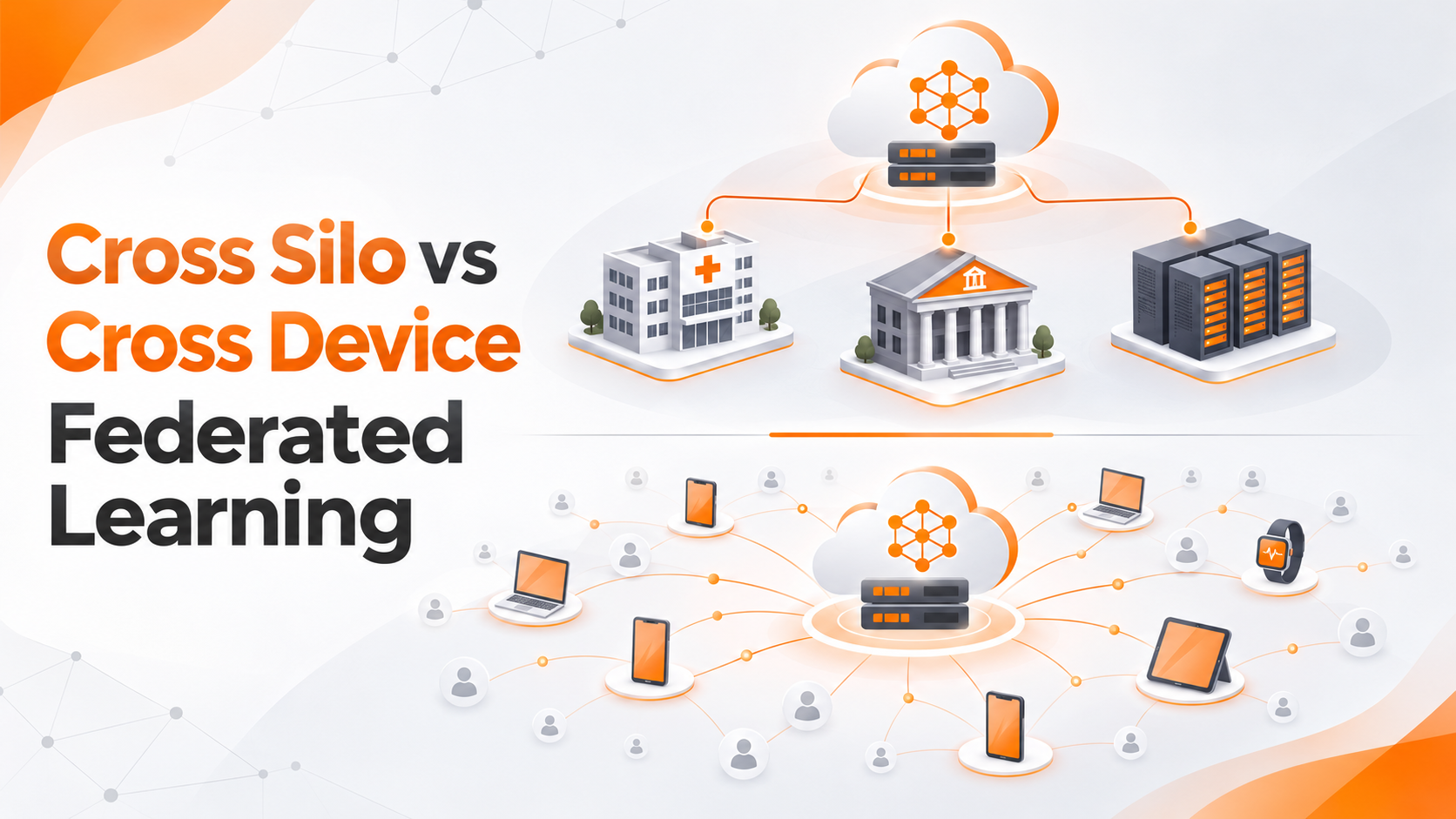
Cross silo federated learning connects a defined group of organizations that train a shared model without pooling their raw data. Cross device federated learning brings together a much larger population of individual devices, such as smartphones and wearables, with only eligible devices participating in each training round. The distinction changes how models are trained, how participants are managed, and where technical resources are needed.
In Federated Learning, understanding who controls the data is just as important as understanding the training algorithm. A hospital network and a mobile application can follow the same basic training process, yet require entirely different infrastructure to make it work.
Cross Silo vs Cross Device Federated Learning: Key Differences
The clearest way to compare these architectures is to look at their participants, data distribution, computing resources, and training requirements.
Both approaches keep raw training data with its original owner and exchange model updates during collaborative training. Their operational requirements, however, are different.
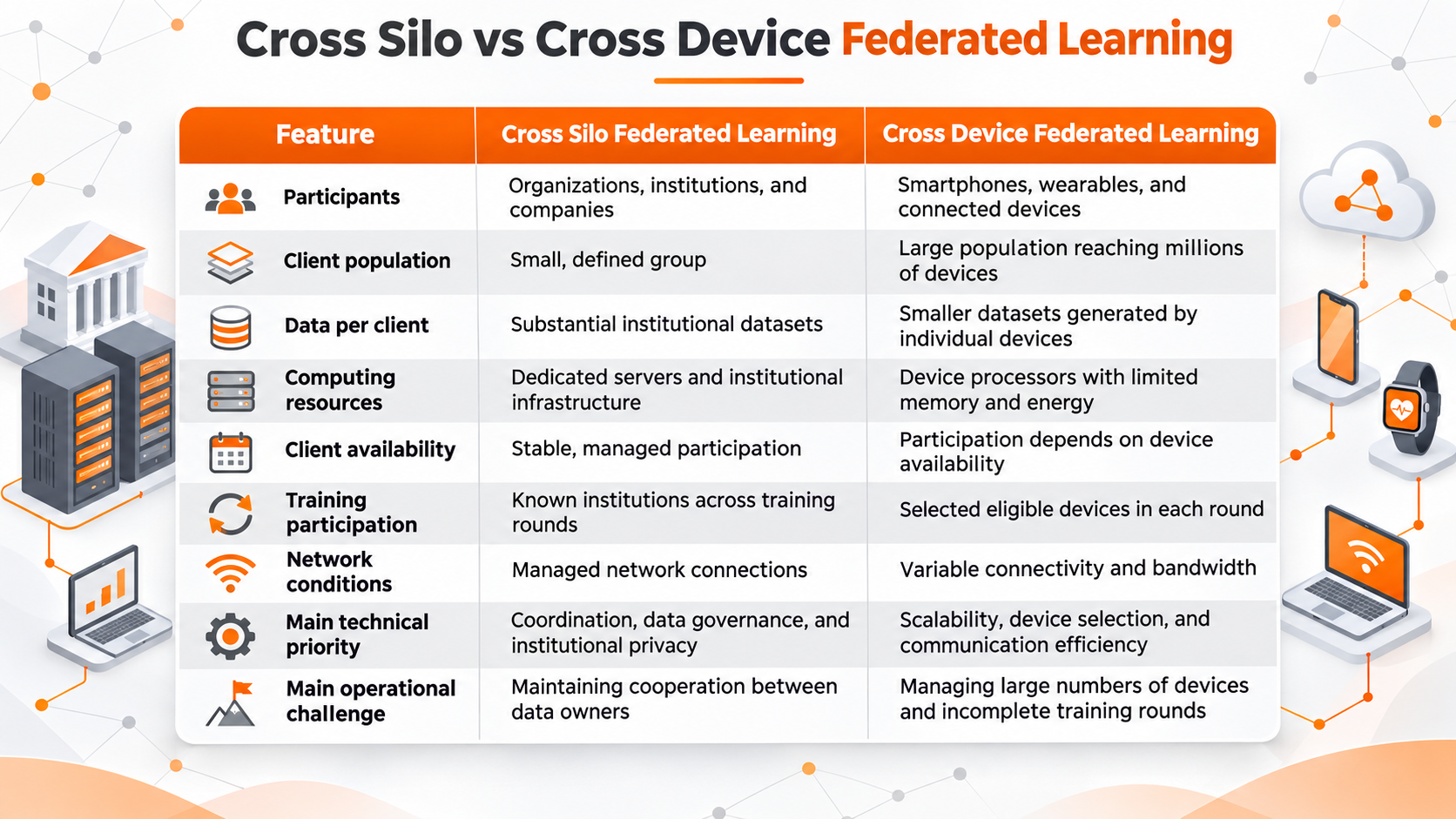
The most important distinction is the relationship between the number of participants and the amount of data each participant holds.
A small group of institutions can contribute large datasets through managed infrastructure. A device network distributes training across a much larger population, where each participant contributes a smaller local dataset.
This difference determines which training schedules, aggregation methods, and reliability measures are practical.
Cross Silo Federated Learning Architecture
Cross silo federated learning connects a defined set of data owners through a shared training process. Each organization maintains control over its own dataset and computing environment.
Consider four hospitals developing a disease prediction model. Each hospital holds patient records that cannot be transferred into a shared database.
The hospitals agree on a compatible learning task and establish a coordinated training system.
Training Process Across Organizations
In a standard coordinated architecture, the process follows five steps:
A coordinator distributes the current global model to participating hospitals.
Each hospital trains a local copy using its own patient records.
The hospitals send model updates to the coordinator.
The coordinator aggregates the updates into a revised global model.
The revised model is distributed for the next training round.
Patient records remain within each hospital's environment throughout this process.
The institutions can also evaluate the model against their own validation datasets before accepting a new global version.
Institutional Control and Coordination
The advantage of this architecture is the ability to work with known participants.
Each institution has an identifiable technical environment, designated data ownership, and an agreed role in the training process.
That structure supports access controls, participant authentication, validation procedures, and documented responsibilities.
It also creates a coordination requirement. The participating organizations need agreements covering model access, accepted updates, security requirements, and ownership of the resulting model.
Stable infrastructure does not eliminate these responsibilities. It makes them possible to manage through an established relationship between participants.
Cross Device Federated Learning Architecture
Cross device federated learning distributes model training across individual devices rather than institutional data centers.
A mobile application, for example, can improve a prediction model using information stored on users' phones without collecting the underlying training records into a central dataset.
The challenge is coordinating devices that do not share the same hardware, network conditions, or availability.
Training Process Across Devices
A cross device training round begins by identifying eligible participants from the device population.
An eligibility policy can require sufficient battery power, an acceptable network connection, and an idle device state.
The selected devices then follow this process:
Download the current global model.
Train locally using available device data.
Prepare an update based on the local training results.
Upload the update within the permitted training window.
Return control to the application while the coordinator aggregates the received updates.
The next round selects another eligible group.
Unlike a fixed institutional network, the system cannot depend on the same devices being available throughout the training process.
Device Availability and Training Reliability
A device can disconnect, lose power, or become unavailable before its update reaches the coordinator.
The training system therefore needs a policy for incomplete participation.
This includes setting a minimum number of accepted updates, defining time limits for training rounds, and rejecting updates that no longer match the current model version.
A system that waits indefinitely for every selected phone would make training dependent on devices outside the coordinator's control.
Cross device architecture addresses this by treating participant availability as part of the training design rather than an exceptional failure.
Training Performance and Model Aggregation
Both architectures can use Federated Averaging, or FedAvg, to combine locally trained model parameters into a shared model.
The algorithm does not define whether a federation is cross silo or cross device. The difference lies in how participants are selected, how much data they contribute, and how their updates are processed.
Client Selection and Communication Costs
For cross silo training, the participant group is known. The coordinator can schedule rounds with specific institutions and track their responses.
With cross device training, client selection must operate across a large, changing device population.
This creates a different communication problem.
An institutional participant can use dedicated network resources to exchange substantial model updates. A phone must operate within its available bandwidth, processing capacity, and energy limits.
Reducing update size through compression or limiting the amount of transferred model information can improve the efficiency of device training.
Data Heterogeneity and Model Quality
Data distribution affects both approaches.
Two hospitals can treat different patient populations, while two phones can reflect entirely different patterns of user behavior. This creates non IID data, where local datasets do not follow the same statistical distribution.
Combining updates does not automatically resolve that difference.
In cross silo training, an aggregate accuracy score can conceal weak performance at a particular institution.
In cross device training, an evaluation based only on successfully participating devices can fail to represent users whose devices rarely satisfy eligibility requirements.
Model evaluation must therefore examine performance across relevant data groups, not just the average result.
For institutional projects, this means validating the shared model against each participating organization's data. For device networks, it means checking whether the participating population represents the intended users.
Choosing Between Cross Silo and Cross Device Federated Learning
Architecture selection starts with the location of the training data and the operational characteristics of its owners.
The following table connects common project requirements to the architecture that directly fits them.
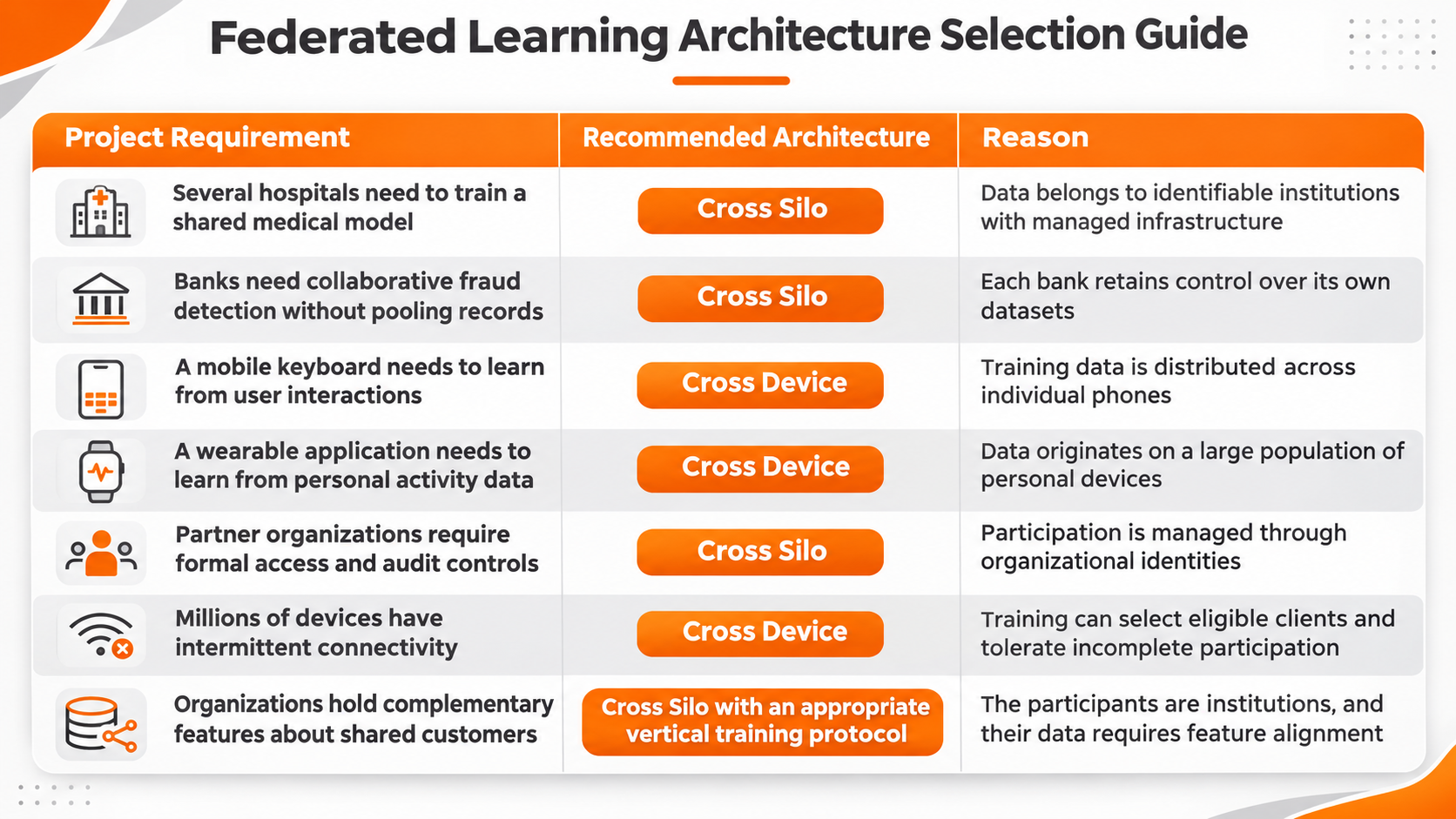
The table establishes a starting point, not a performance ranking. Neither architecture produces a more accurate model simply because of its category.
Before implementation, the architecture review should establish the expected client population, available computing resources, dataset structure, participation requirements, and privacy guarantees.
One useful test is whether the project can identify every participant and arrange reliable participation throughout training.
If the answer is yes and the data belongs to institutions, cross silo provides the relevant operating model. If training depends on a changing population of personal devices, cross device addresses that requirement.
Privacy and Security Requirements
Keeping raw data at its source reduces the need to transfer sensitive records. It does not make model training automatically private or secure.
Both architectures exchange information derived from local datasets, and that information requires protection.
Model Update Protection
Model updates can reveal information about training data through inference attacks.
Secure aggregation addresses part of this risk by allowing the coordinator to calculate an aggregate without directly inspecting individual protected updates.
Differential privacy provides an additional mechanism for limiting the influence of individual training records or participants, depending on its implementation.
These protections solve different problems and require explicit configuration.
The privacy design must specify what information is protected, from whom, and under which assumptions.
This distinction matters in small institutional federations. When only a few organizations contribute, aggregate information can remain sensitive, especially when the participant group changes between rounds.
A large device population creates a different security problem: verifying eligible clients and protecting the system against manipulated or malicious updates at scale.
Governance and Participant Accountability
For cross silo projects, security extends beyond encryption.
Organizations need agreed rules for approving participants, reviewing model versions, investigating incidents, and controlling access to training results.
Cross device projects require controls at the application and device level. Device eligibility, authentication, update validation, and privacy protections must be enforced without relying on a direct agreement with every individual device owner.
These responsibilities should be established before training begins. Adding them after deployment creates risks that model accuracy tests cannot detect.
Real World Applications
The practical value of each architecture becomes clearer when examining what a project needs from its participants.
Cross Silo in Healthcare and Finance
A healthcare consortium can train a shared diagnostic model using datasets maintained by separate hospitals.
The institutions contribute local training results while retaining responsibility for patient records.
This allows the model to learn from multiple clinical populations without establishing a central repository of their raw patient data.
Financial institutions can apply the same principle to collaborative fraud detection.
Each organization trains using its own transaction records, while the shared model benefits from patterns represented across the participating institutions.
The success of either project depends on compatible training objectives, reliable coordination, and a privacy design accepted by every participant.
Cross Device in Mobile Applications and IoT
Mobile text prediction provides a direct example of cross device learning.
A keyboard model can learn from local interaction patterns across participating phones. The system combines the accepted updates to improve the shared model while leaving the underlying user interactions on their devices.
Connected devices offer another application.
Wearables or sensor equipped devices can contribute to a shared activity recognition model without transferring their full local datasets.
The engineering priority is different from institutional collaboration. The system must operate within device resource limits and continue training despite changes in participant availability.
Cross Silo vs Cross Device and Horizontal vs Vertical Learning
Cross silo and cross device describe the participating entities and their training environment.
Horizontal and vertical federated learning describe how data is divided between participants.
These are separate architectural dimensions.
Horizontal federated learning works with datasets sharing compatible features across different records. Vertical federated learning connects complementary features associated with overlapping records.
A network of hospitals can use horizontal federated learning when each hospital records the same patient measurements for different patients.
A bank and an insurer can use vertical federated learning when they hold different information about overlapping customers and have an appropriate method for aligning those records.
Both projects fit a cross silo setting because their participants are organizations.
Cross device systems are strongly associated with horizontal data partitioning, where individual devices train on records represented by a shared feature structure.
Separating these classifications prevents the data layout from being confused with the infrastructure required to train the model.
Final Thoughts
The difference between cross silo and cross device federated learning is not the basic model training algorithm. It is the environment in which collaborative training operates.
Cross silo federated learning is designed around identifiable organizations, substantial local datasets, and coordinated participation. Cross device federated learning addresses large device populations, limited local resources, and changing client availability.
The right choice follows from the structure of the project. Identifying the data owners, training participants, infrastructure constraints, and required privacy protections provides a stronger foundation than choosing an architecture by its scale alone.
FAQ
Can we combine cross silo and cross device learning in one project?
Yes. A hierarchical federated learning architecture can combine device level training with organization level coordination. Devices contribute to an intermediate aggregator, and organizational aggregators contribute to a wider federation. The design requires privacy protection and aggregation controls at both levels.
Do we really need a central server for both approaches?
No. Federated learning can use decentralized coordination instead of a single central server. However, decentralized systems require alternative mechanisms for distributing model information, reaching agreement on updates, and maintaining consistency between participants.
What happens if an organization wants its contribution removed after training?
Stopping future participation does not remove the organization's influence from an already trained model. Removing that influence requires a verified model unlearning procedure or retraining without the relevant contribution, depending on the model and its training history.
How can we tell if a participant actually improved the model?
Contribution analysis can compare validation performance with and without selected participants, using techniques such as leave one out evaluation or approximate contribution scoring. These methods have computational and privacy costs, and their results depend on the evaluation dataset and chosen metric.
Can the same machine learning model work in both architectures?
Yes, provided the model and training implementation meet the requirements of each environment. A model that runs efficiently on institutional servers may need compression, reduced memory usage, or a different training schedule before it can operate on resource constrained devices.

Fatemeh Jahangard
Technology & AI Writer at PinerookFatemeh Jahangard covers AI, emerging technologies, and digital innovation for Pinerook, focusing on how technology shapes startups and industries.
 Seen first.