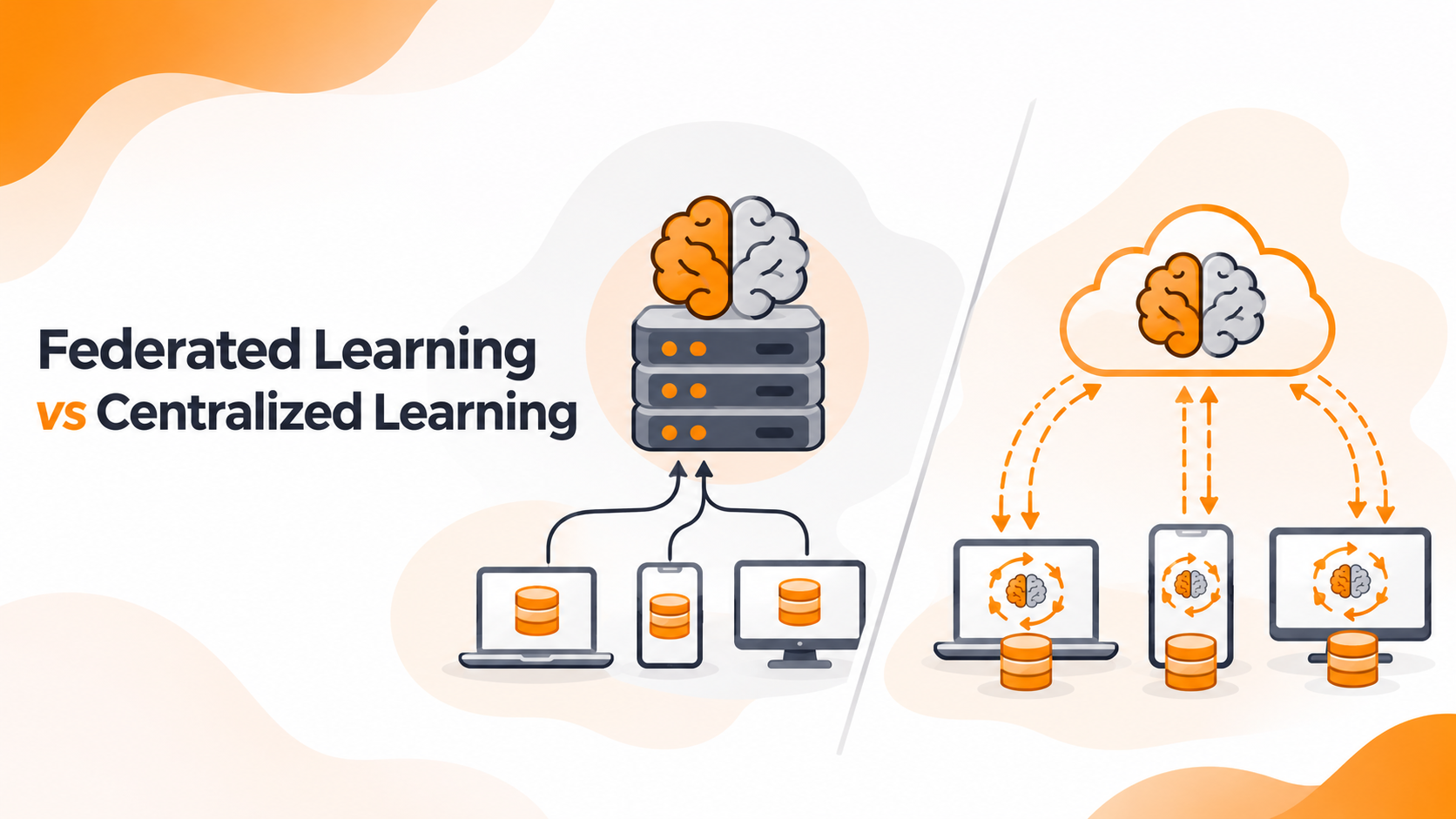
Federated Learning vs Centralized Learning comes down to where the training data stays. Centralized learning brings datasets into a shared environment to train one model. Federated learning keeps data with its owners and combines model updates instead of collecting raw records.
Choose centralized learning when data can be securely consolidated and managed in one environment. Choose federated learning when data must remain distributed and collaborative training provides a clear benefit. The decision also depends on model accuracy, privacy requirements, infrastructure costs, and operational complexity.
Federated vs Centralized Learning: The Right Choice
The first thing we examine is whether the project can legally and practically bring its training data into one environment.
If a company owns its datasets and has permission to consolidate them, centralized learning offers a simpler development process. Engineers can inspect the complete dataset, standardize the records, and train models using established infrastructure.
Federated learning becomes valuable when several participants need to contribute data without surrendering control of their original records.
Consider three hospitals developing a disease prediction model.
If patient records can be transferred into an approved shared environment, centralized training is a practical option.
If each hospital must retain its records, federated learning allows them to participate in shared training while maintaining local data custody.
The purpose of Federated Learning is not to make every training system decentralized. It is to enable learning across independently controlled datasets without requiring their consolidation.
Data ownership determines whether an architecture is feasible. Model performance and operating costs determine whether it is worth deploying.
Data Storage and Training Architecture
The two approaches can train comparable machine learning models, but the location of the training process changes how the project operates.
Centralized Model Training
Centralized learning collects approved training datasets into one environment.
Engineers can examine the available records, correct inconsistencies, create training and validation datasets, and manage the learning process from a central system.
For example, a retailer operating several stores can combine sales records in its own data platform and train a demand forecasting model.
The company controls the data pipeline and computing infrastructure.
The main dependency is that the datasets must be available for consolidation under acceptable security and governance conditions.
Federated Model Training
Federated learning distributes model training across participating clients.
A coordinating system provides the initial model. Each client trains using its local dataset and returns the required model information for aggregation.
The coordinator combines those contributions to update the shared model.
Individual participants retain their original records.
This approach introduces coordination requirements that do not exist in the same form in centralized training. Participants need compatible models, agreed training procedures, and reliable mechanisms for exchanging updates.
Federated learning can still use a central coordination server. The word federated describes how training data is distributed, not the absence of central infrastructure.
That distinction is important when evaluating architecture diagrams or infrastructure proposals.
Model Accuracy and Training Performance
Neither Federated Learning nor Centralized Learning guarantees higher accuracy.
The result depends on the training data, model architecture, optimization method, and evaluation conditions.
Centralized learning gives engineers direct access to the combined dataset. They can inspect differences between contributing sources and control how samples are selected during training.
Federated learning operates with separate datasets, which introduces additional optimization challenges.
For example, one hospital may treat older patients while another serves a younger population. A model trained locally at each institution learns from different statistical patterns.
Combining those models does not automatically remove the differences.
Evidence From Comparative Research
A 2025 study published in Database by researchers at Delft University of Technology compared federated and centralized learning across multiple datasets and classifiers.
The researchers found comparable performance under a wide range of experimental conditions.
They also identified sensitivity to batch effects when differences between datasets aligned with their source locations.
This is an important distinction.
Federated learning can achieve performance comparable to centralized learning, but comparable accuracy must be demonstrated for the specific dataset and training configuration.
A project should not assume an accuracy penalty simply because training is federated. It should not assume equivalent performance without testing either.
Evaluating Performance Across Participants
A single global accuracy score can hide weak performance at individual institutions.
In our hospital example, a model might perform well across the combined evaluation results while producing less reliable predictions at one hospital.
We therefore examine performance across participating locations using the same appropriate metrics.
For a medical classification task, those metrics can include sensitivity, specificity, and the ability to generalize to new patients.
This provides a better basis for selecting the architecture than comparing one headline accuracy number.
Federated vs Centralized Learning Comparison
The following table summarizes the factors that matter most when choosing between the two approaches.
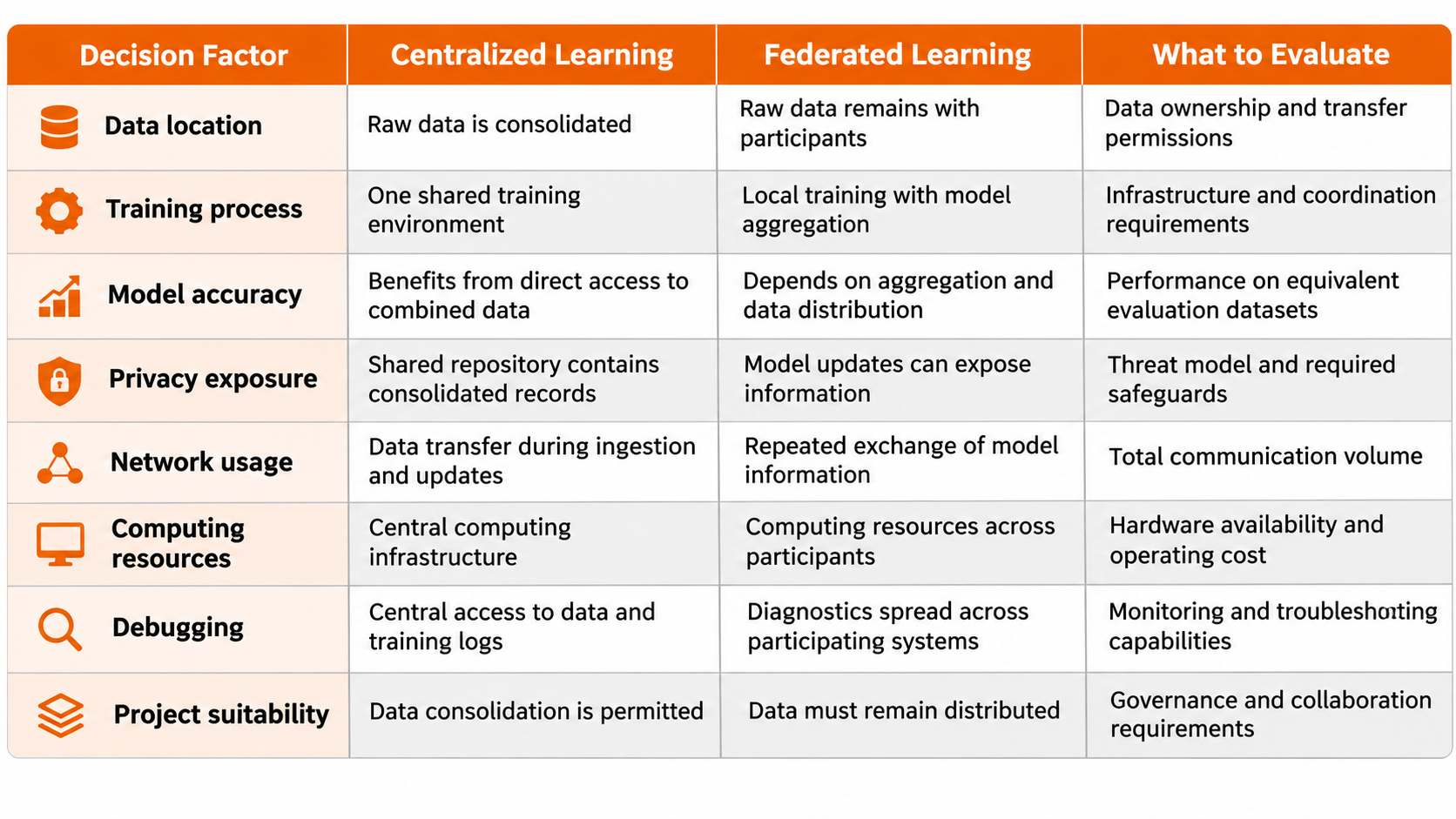
The table identifies architectural differences, not guaranteed performance outcomes.
For example, federated learning avoids transferring raw training records, but repeated model exchanges can still create substantial network traffic. Centralized learning can simplify training operations, yet its shared data environment requires appropriate security controls.
The better choice is the one that satisfies the project's constraints and performs well under measured conditions.
Privacy and Security Comparison
Federated learning reduces the need to collect sensitive raw data in one place.
That is an important advantage for organizations that must retain control of their records.
However, keeping raw data local does not guarantee privacy.
Model gradients and parameter updates can contain information about the underlying training examples.
Research has demonstrated attacks that infer properties of training data or reconstruct information from model updates.
Federated systems therefore need security measures appropriate to the information being exchanged.
Secure aggregation can protect individual client updates from direct inspection by the coordinating server. Differential privacy provides another mechanism for limiting information leakage.
These protections affect system design, computing requirements, and model performance.
Centralized learning faces a different concentration of risk.
A shared repository contains data collected from several sources, so access controls, encryption, auditing, and data retention policies are essential.
Centralization does not make a system inherently insecure. A properly governed central environment can provide strong protection.
The correct comparison is between two specified security architectures, not between an automatically private federated system and an automatically unsafe centralized system.
Data Governance Requirements
Organizations should identify which information they are permitted to collect, process, exchange, and retain.
This applies to both methods.
For centralized learning, the assessment includes transferring and storing original records.
For federated learning, it includes local processing, sharing model information, participant responsibilities, and potential information leakage.
Keeping patient records within a hospital does not automatically establish compliance with healthcare privacy laws.
The technical architecture must support the applicable legal and contractual requirements.
Training Costs and Communication Requirements
Centralized learning concentrates training resources in one environment.
The infrastructure team manages storage, computing, and training jobs through a common platform.
Federated learning distributes part of that workload across participating systems.
This changes the cost structure.
Network Communication
Centralized training requires datasets to be transferred into the approved training environment.
Once the data is available, the training process can operate within that infrastructure.
Federated learning avoids pooling raw data but requires repeated communication between clients and the coordinating system.
Consider a simplified example.
A federated project has 10 participating institutions. Each exchanges 50 MB of model information in each direction during 20 training rounds.
The approximate communication volume is:
50 MB × 2 directions × 10 clients × 20 rounds = 20,000 MB
That is approximately 20 GB of model traffic, excluding protocol overhead, retries, and additional security communication.
This is an illustrative calculation, not a benchmark.
The actual volume depends on the model size, participation rate, update strategy, and number of rounds.
The example demonstrates why avoiding raw data transfer does not automatically mean lower network costs.
Infrastructure and Maintenance
A centralized environment requires sufficient computing capacity to process its training dataset.
Federated training requires computing resources at participating locations, along with infrastructure for coordination and monitoring.
A hospital consortium may need each institution to maintain compatible software, manage access permissions, and support scheduled training rounds.
A central platform may require fewer independent operational agreements.
The relevant cost comparison is therefore not limited to server expenses.
It includes engineering effort, infrastructure maintenance, network communication, security controls, and the time required to resolve failures.
Scalability and Operational Complexity
Both architectures can support large machine learning projects, but they scale in different ways.
Centralized systems expand through additional storage, computing resources, and distributed processing within the training environment.
Federated systems can involve larger numbers of participating devices or organizations without moving their source datasets into one repository.
Increasing participation, however, introduces additional coordination.
Participant Availability
A centralized training system operates under the control of its infrastructure.
In federated learning, participating systems can have different computing capacity, network conditions, and availability.
A training round can be affected when participants become unavailable before completing their assigned work.
The coordination system needs policies for selecting clients, handling incomplete participation, and maintaining consistent training progress.
Operational Visibility
Centralized learning provides engineers with direct access to a common training environment.
Federated training requires diagnostics from separate systems, each operating under its own permissions and technical conditions.
This makes troubleshooting more demanding.
For example, if the shared model begins producing weaker predictions, the team must determine whether the cause involves local data changes, incompatible software, a participant's training process, or aggregation behavior.
The system therefore needs reliable monitoring and clear responsibility for resolving incidents.
Practical Comparison in Healthcare
Consider three hospitals developing a model to identify patients at risk of a particular condition.
Each hospital holds a separate dataset with relevant clinical information.
The project team must choose between centralized and federated training.
Centralized Approach
Under centralized learning, the hospitals transfer approved datasets to a shared environment.
The team harmonizes the data, creates a combined training dataset, and trains the model using central infrastructure.
This gives engineers direct visibility into the collected data.
They can investigate missing values, inspect differences between hospitals, and manage the entire training pipeline in one place.
This approach is appropriate if the institutions have the necessary permissions, security arrangements, and infrastructure.
Federated Approach
Under federated learning, the participating hospitals keep their patient records within their respective systems.
They agree on compatible data definitions and a common model.
Each hospital performs local training and contributes model information to the shared process.
The team evaluates the resulting model across the participating institutions.
This approach avoids consolidating the original patient records but requires additional controls for model updates, coordination, and privacy.
Comparing the Results
The project should use a consistent evaluation plan.
The following conditions matter:
Equivalent model objectives: Both systems must solve the same prediction task.
Comparable model configurations: Differences in model architecture should not distort the comparison.
Consistent validation criteria: Both approaches should use the same definitions and appropriate evaluation metrics.
Participant level results: Performance must be examined separately at each hospital.
Measured operating costs: Training time, communication volume, and infrastructure expenses must be recorded.
If a centralized experiment requires data sharing that the institutions cannot authorize, it should remain a controlled research baseline rather than an unauthorized production option.
A useful comparison does not require transferring restricted patient records merely to establish a benchmark.
The final choice should account for both technical results and the restrictions under which the system will operate.
Selecting the Training Architecture
We recommend starting with the data governance decision and then testing the technical alternatives that remain feasible.
Centralized learning is the stronger starting point when the organization can consolidate its datasets and needs a straightforward training environment.
It provides direct control over data preparation, model development, and debugging.
Federated learning is the stronger candidate when useful datasets are independently controlled and cannot be consolidated under acceptable conditions.
Its additional complexity is justified when distributed collaboration unlocks training information that would otherwise be unavailable.
Before committing to either architecture, the project team should establish a baseline, measure model quality, estimate total infrastructure costs, and review the security design.
These results are more useful than assuming that one method is faster, cheaper, more accurate, or more private in every situation.
The decision is ultimately about choosing an architecture that delivers the required model performance while respecting the project's data and operating constraints.
FAQ
Can we switch from centralized learning to federated learning later?
Yes. The project must redesign its data access, training coordination, and model aggregation processes. Existing model architectures can be reused when compatible with the selected federated training method, but the change requires new validation and infrastructure testing.
Can different companies use different AI models in the same federation?
Yes, with a method designed for heterogeneous models. Standard parameter averaging requires compatible parameter structures. Other approaches, including knowledge distillation, support collaboration between different architectures.
What happens if one company wants to leave the project?
The organization can stop participating in future training rounds according to the project's agreements. Its earlier contributions are not automatically removed from the trained model. Removing their influence requires an appropriate retraining or validated machine unlearning process.
Can a company use both training methods in one project?
Yes. A project can train a model centrally on data it is authorized to consolidate and use federated training to incorporate information held by other participants. Such a design requires compatible training methods and explicit controls over which data and updates can be shared.
Do we need a separate agreement with every organization in a federated project?
Cross organization projects need a governance framework defining participation, permitted data processing, security responsibilities, model ownership, and withdrawal conditions. The precise contractual structure depends on applicable law and the organizations involved.

Fatemeh Jahangard
Technology & AI Writer at PinerookFatemeh Jahangard covers AI, emerging technologies, and digital innovation for Pinerook, focusing on how technology shapes startups and industries.
 Seen first.