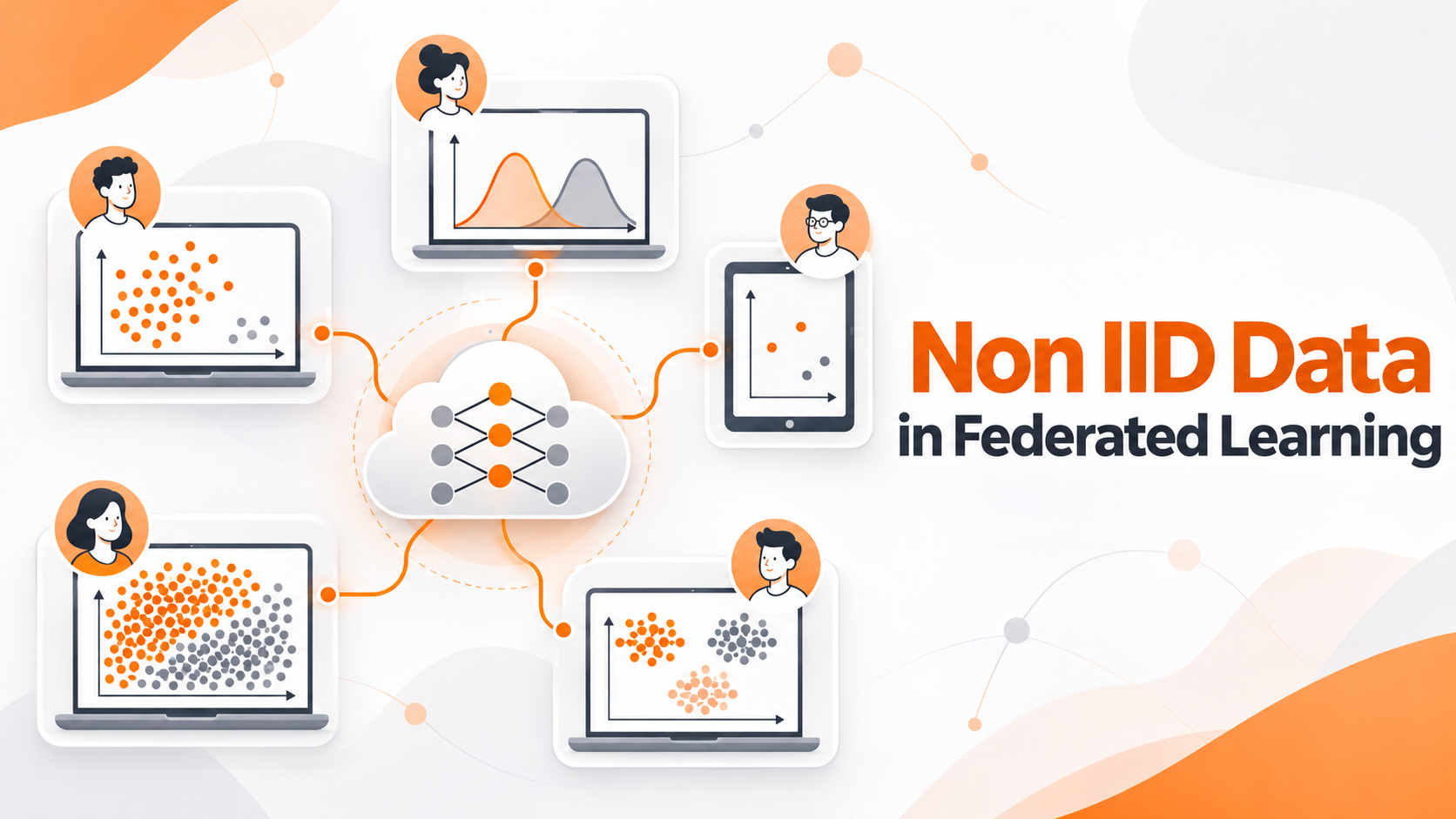
Non IID data in federated learning refers to training data that does not satisfy the same independent and identically distributed assumptions across participating clients. One hospital may treat patients with different medical conditions than another, while smartphone users generate different patterns of text and activity. These differences affect how local models learn, how updates are combined, and how reliably the global model performs.
In Federated Learning, raw data remains with individual clients instead of being collected in one location. This makes data heterogeneity a central training challenge. Before changing an algorithm, the essential step is identifying whether the problem comes from labels, features, sample counts, or changes in the relationship between inputs and predictions.
Types of Non IID Data in Federated Learning
Not all data heterogeneity has the same effect on model training. Two clients can have identical class distributions but different input characteristics. They can also use similar features while learning from different proportions of target classes.
IID data follows the assumption that observations are independent and drawn from the same probability distribution. Non IID data violates at least one of these conditions.
The distinction becomes clearer when the types of heterogeneity are examined side by side.
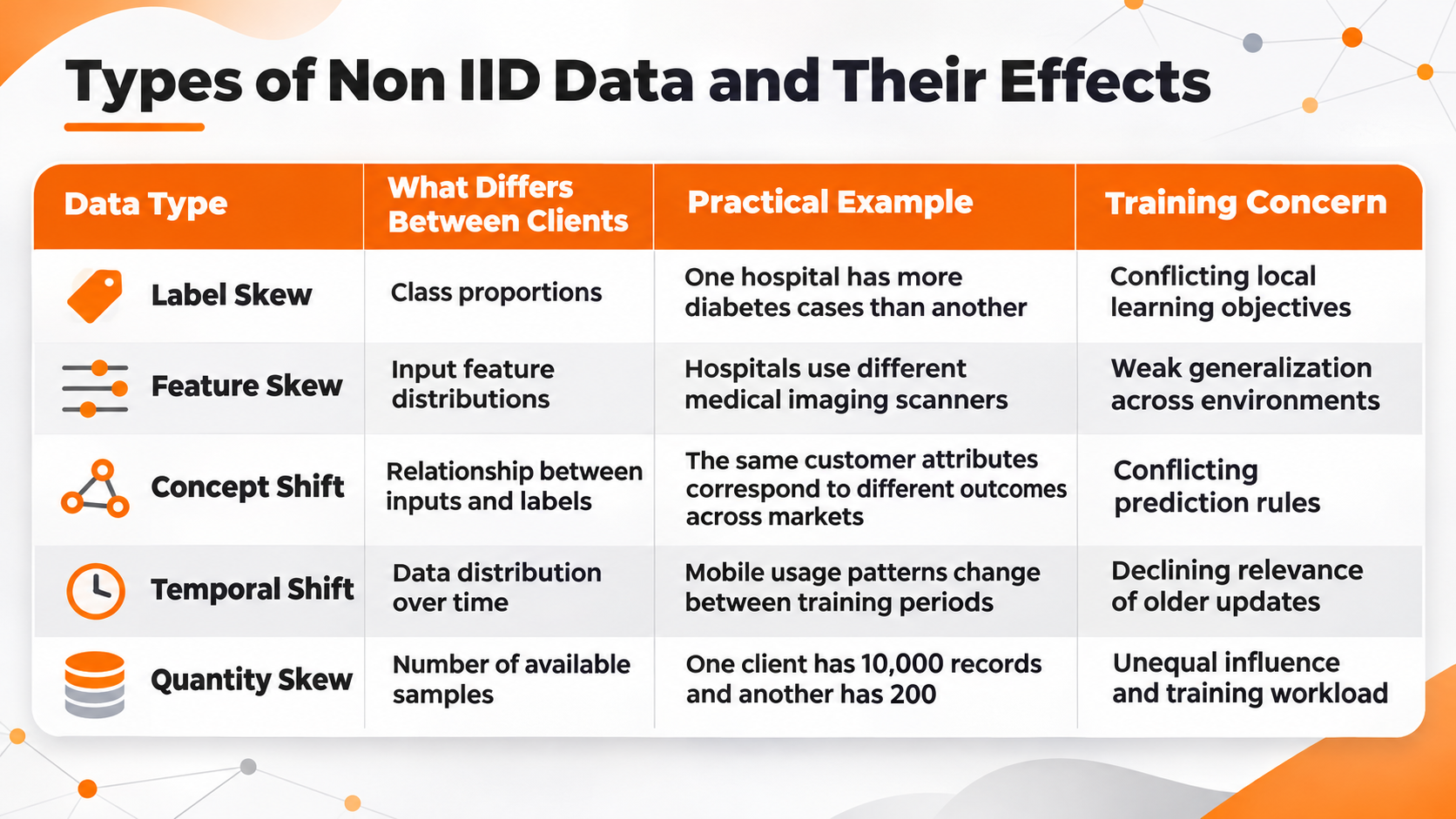
These categories explain why a single mitigation method cannot address every federated dataset.
Quantity skew also requires a distinction. Different sample counts do not, by themselves, violate the IID assumption. Two clients can receive different numbers of observations from the same distribution.
However, quantity imbalance remains operationally important because it affects aggregation weights, training workloads, and the representation of smaller clients.
Label Skew
Label skew occurs when clients hold different proportions of target classes.
Consider a medical classification model trained across three hospitals.
Hospital A has a high proportion of diabetes cases. Hospital B primarily treats cardiovascular conditions. Hospital C has a more balanced patient population.
Each hospital trains toward the same prediction task, but the relative frequency of outcomes differs across local datasets.
The problem is not the number of records. It is the difference in what those records represent.
Local optimization emphasizes the classes that dominate each institution. Aggregating these updates can produce a model that performs well on the most represented classes while underperforming on less represented ones.
Feature Skew
Feature skew describes differences in the input data collected by participating clients.
Imagine two hospitals training a model to detect the same disease from MRI images.
Both hospitals use the same diagnostic labels, but their scanners produce images with different intensity distributions, resolutions, or acquisition characteristics.
The model must learn meaningful medical patterns without becoming dependent on scanner specific features.
A label distribution comparison will not reveal this problem. The relevant differences exist in the input features rather than the class proportions.
Concept Shift
Concept shift occurs when the relationship between inputs and target labels differs across clients.
Consider a credit risk model trained across financial institutions operating in different markets.
The same customer characteristics can correspond to different repayment outcomes because lending conditions and customer behavior differ.
A global model must account for these differences instead of assuming one relationship applies equally to every institution.
This distinction matters because balancing class distributions alone does not reconcile conflicting prediction relationships.
Temporal Shift
Temporal shift introduces another dimension: the distribution changes over time.
A mobile application collecting activity data in January may observe different behavior patterns in July.
An earlier model update reflects the distribution at the time it was produced. Newer updates reflect more recent observations.
The training system must therefore evaluate whether the shared model remains representative as client data changes.
Effects of Non IID Data on Model Training
The central problem with non IID federated learning is that local optimization does not necessarily follow the same direction as optimization over the combined population.
Each client learns from the distribution it observes. When these distributions differ, the resulting updates can disagree.
Client Drift and Model Convergence
Client drift occurs when local training moves client models toward solutions favored by their individual datasets rather than the shared objective.
Consider two clients training a classification model.
The first client mainly observes Class A. The second mainly observes Class B.
After several local training steps, their models become specialized toward different class distributions.
When these updates are aggregated, the global model must reconcile competing changes.
This creates additional optimization difficulty and can increase the number of communication rounds required for convergence.
The effect depends on the degree of statistical heterogeneity, local training configuration, and aggregation algorithm.
Global Accuracy and Client Performance
A global model can achieve strong average accuracy while performing poorly for individual clients.
Consider a federation where one hospital contributes most of the training records.
A model evaluated primarily on that hospital's distribution can produce an encouraging overall score without achieving comparable results at smaller institutions.
Average accuracy does not establish that the model works equally well across participating clients.
For this reason, model evaluation needs both population level and client level results.
Aggregation and Representation
Federated Averaging, or FedAvg, combines local model updates using weights based on the number of training examples contributed by each participant.
This aligns aggregation with an objective weighted by sample counts, but it does not eliminate label skew or feature skew.
Clients with large datasets receive greater influence under this weighting scheme.
That is appropriate when the objective is performance over the combined set of individual records. It is not automatically appropriate when the project requires equal consideration for each institution or user group.
The aggregation objective must match the intended deployment objective.
Measuring Data Heterogeneity
Before selecting a solution, the data differences need to be measured.
A useful diagnostic process separates distribution differences from training instability. Weak convergence alone does not prove that non IID data is the cause.
Label Distribution Analysis
For classification tasks, compare the proportion of each label across clients.
A class distribution with substantial differences between participants provides direct evidence of label skew.
Jensen Shannon divergence can quantify differences between class probability distributions.
The metric requires comparable label definitions across clients. It also measures differences in the chosen distributions, not every aspect of statistical heterogeneity.
Feature Distribution Analysis
Feature skew requires examining input characteristics.
For medical imaging, relevant measurements include image intensity, resolution, and scanner characteristics.
For tabular datasets, compare feature ranges, categorical frequencies, and summary statistics.
These comparisons help determine whether clients observe the same prediction task under different input conditions.
Client Level Model Evaluation
Distribution measurements should be paired with model performance.
A useful evaluation records:
Global validation accuracy or task specific performance.
Performance separately for each client.
The difference between the strongest and weakest participating clients.
Training loss and validation performance across communication rounds.
Changes in these measurements as client participation varies.
Where individual client results are sensitive, reporting requires aggregation and privacy controls.
A model should not be judged solely by whether its training loss decreases. The relevant outcome is whether it performs adequately across the distributions it is intended to serve.
Methods for Handling Non IID Data
Once the dominant type of heterogeneity is identified, mitigation becomes a more focused engineering decision.
The available approaches address different parts of the problem. Some modify local optimization, others preserve client specific model components, and others change the data or participation strategy.
FedProx and Local Optimization
FedProx extends federated optimization by adding a proximal term to the local training objective.
This term penalizes movement too far from the current global model.
The approach is designed to control excessive local deviation and support optimization under statistical and system heterogeneity.
Its effectiveness depends on the proximal coefficient, model configuration, and data distribution.
SCAFFOLD and Client Drift Correction
SCAFFOLD addresses client drift through control variates.
These correction terms help local optimization account for the difference between local training directions and the broader federated objective.
The method directly targets the optimization problem caused by heterogeneous client datasets.
Its implementation requires additional control state and associated communication and storage considerations.
FedBN and Feature Distribution Shift
FedBN is designed for federated training where clients observe different feature distributions.
Instead of aggregating every batch normalization component into one shared representation, FedBN maintains local batch normalization parameters.
This allows individual clients to preserve normalization behavior suited to their own input characteristics.
The method is particularly relevant to scenarios such as medical imaging across different scanners.
It requires a model architecture with compatible batch normalization components and does not independently resolve every other type of heterogeneity.
Personalized Federated Learning
A single global model is not the only possible objective.
Personalized federated learning allows clients to retain or adapt parts of the model for their local distributions.
For example, a shared representation can support learning across multiple hospitals while client specific components adapt to differences in local patient populations.
This approach is worth evaluating when local prediction performance matters more than maintaining one identical model for every participant.
Selecting the Right Non IID Mitigation Method
The most useful comparison is not a ranking of algorithms. It is a mapping between the observed training problem and the mechanism intended to address it.
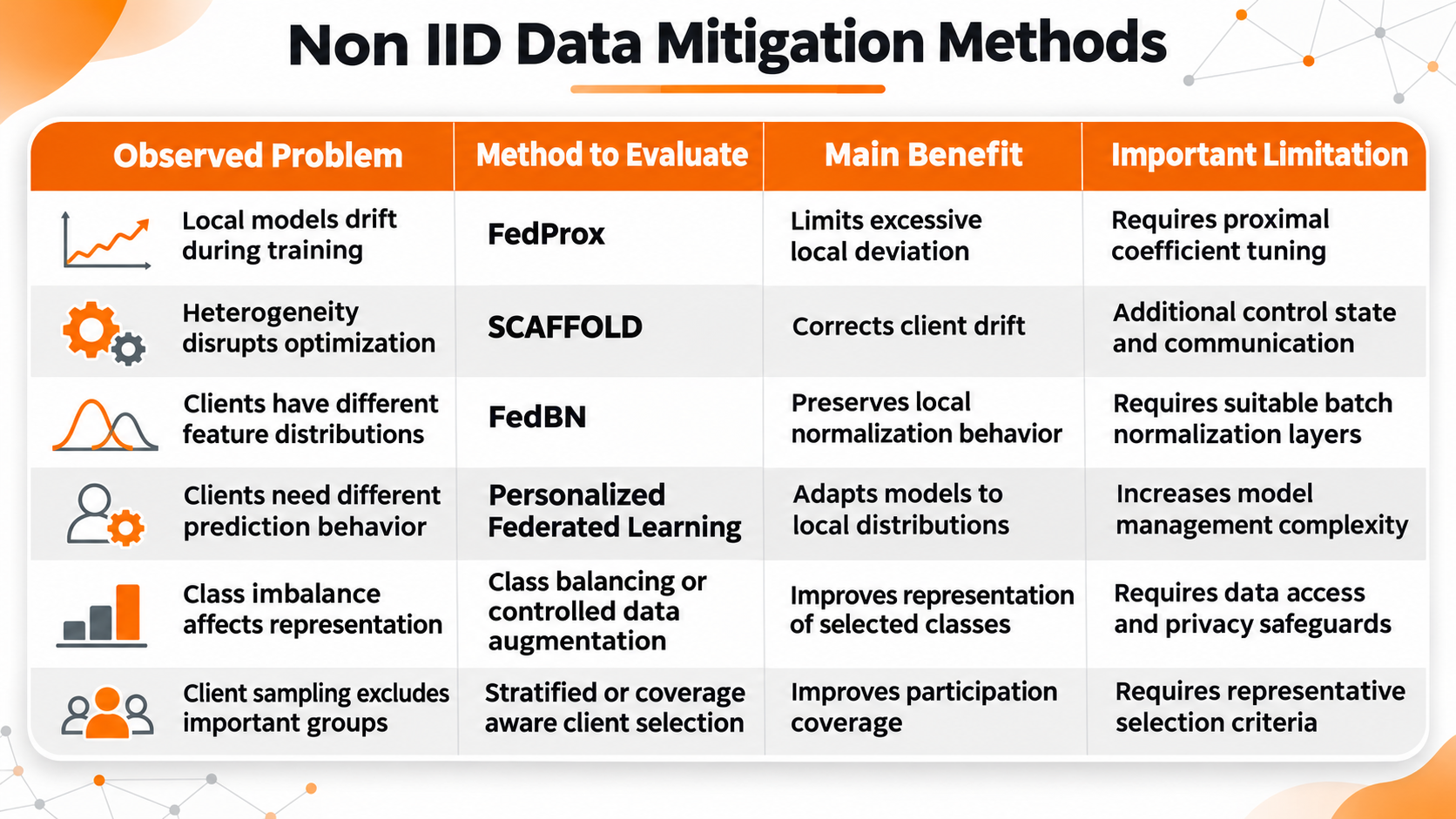
FedProx and SCAFFOLD address optimization behavior. FedBN addresses a specific form of feature distribution shift. Personalization changes the prediction objective by allowing models to adapt to individual clients.
Before replacing a training algorithm, the existing configuration should be evaluated as a baseline. Any improvement must be demonstrated on the project's actual validation distributions.
Evaluating Non IID Solutions in Practice
A reliable comparison requires testing methods under the same conditions.
Changing the training algorithm, data partition, and number of communication rounds simultaneously makes it difficult to identify the cause of a performance difference.
Controlled Data Partitioning
Research experiments create federated datasets by partitioning an existing dataset among simulated clients.
One approach uses a Dirichlet distribution to allocate class proportions.
Its concentration parameter controls the expected degree of label imbalance. Smaller concentration values produce more concentrated client class distributions in this sampling scheme.
Other experiments assign a restricted number of classes to each client or apply feature transformations to simulate different environments.
These controlled experiments are useful for comparing methods, but they do not establish performance on real institutional or device generated data.
Fair Algorithm Comparison
A meaningful evaluation keeps the following conditions consistent:
Dataset and client partitions
Model architecture and initialization
Participation policy
Local training budget
Validation protocol
Communication and computational cost measurements
Each method then receives appropriate hyperparameter tuning under the same evaluation budget.
A method that achieves higher accuracy with substantially greater communication overhead represents a different engineering tradeoff from one that improves both accuracy and efficiency.
Performance Across Clients
The final evaluation needs to reflect how the model will be used.
For a healthcare federation, report performance at each participating hospital.
For a device network, examine results across relevant device and user populations.
Include both an aggregate metric and a measure of performance variation across clients.
If the global result improves while the weakest client group deteriorates, the evaluation should make that difference visible rather than hiding it inside an average.
Non IID Data in Real Applications
Two settings illustrate why the source of heterogeneity matters more than the label attached to it.
Medical Diagnosis Across Hospitals
A hospital consortium may combine several forms of heterogeneity in one project.
Hospitals can have different disease prevalence, scanner characteristics, patient populations, and sample counts.
Treating this entire situation as label skew would leave important differences unexplained.
The appropriate evaluation separates target distribution differences from image acquisition effects and institutional performance.
Feature specific methods, optimization changes, and personalization should then be compared against the problems identified in the data.
Mobile Language Prediction
Mobile language models face different user vocabularies, interaction frequencies, writing styles, and participation patterns.
Some users contribute substantial training data, while others contribute very little.
The system must account for variation in language patterns and the fact that the participating clients in one training round do not represent every device in the population.
This makes representative evaluation essential.
An improvement measured only among frequently participating devices does not establish equivalent performance for the full user population.
Final Thoughts
Non IID data is not one training problem with one universal solution. It describes departures from shared statistical assumptions, with practical effects that depend on how client datasets differ.
Label skew, feature skew, concept shift, and temporal changes create distinct challenges. Quantity imbalance adds another consideration through unequal sample contributions and training workloads.
The strongest approach is to identify the distribution differences, measure their effects on client and global performance, and select a mitigation method that targets the observed problem.
A model that performs well across the intended client population is more meaningful than one that achieves a strong aggregate score while concealing uneven results.
FAQ
Can we check for non IID data without seeing everyone's private records?
Yes. Clients can calculate selected statistics locally and share protected summaries through an approved aggregation protocol. Techniques such as secure aggregation and differential privacy can support privacy preserving analysis. The protocol must account for the information that aggregated statistics themselves can reveal.
Does training for more local epochs make the non IID problem worse?
Increasing local epochs can increase client drift when client objectives differ. The impact depends on the optimization algorithm and training configuration. Local epoch counts should be evaluated alongside convergence, communication costs, and client level performance rather than increased without testing.
Will starting with a pretrained model fix the data differences?
No. Pretraining can provide a useful initial representation, but it does not make client distributions identical. A pretrained model still requires validation across participating clients and adaptation when its learned representation does not adequately cover their data.
Can a new client join after the global model has already been trained?
Yes. A new client can receive the existing model and participate in subsequent federated training rounds, subject to compatibility and authorization requirements. Its data distribution should be evaluated before its updates are incorporated, particularly if it represents a previously unseen population.
What if two clients use different rules for assigning labels?
Their label definitions must be reconciled before treating the data as one supervised learning task. Otherwise, identical labels may represent different outcomes, and aggregation can combine incompatible training signals. Label mapping, agreed annotation standards, or task specific modeling is required.

Fatemeh Jahangard
Technology & AI Writer at PinerookFatemeh Jahangard covers AI, emerging technologies, and digital innovation for Pinerook, focusing on how technology shapes startups and industries.
 Seen first.