A startup moat is a durable advantage that makes it harder for competitors to take customers, match economics, or replace the product. A strong moat compounds through customer usage, trusted relationships, difficult workflows, exclusive capabilities, or cost advantages. Most young companies do not have a mature moat, and that is not a failure. Their immediate task is to find a problem worth solving, then identify which part of their progress can become increasingly difficult to copy. The founder’s test is simple: what becomes more valuable, less costly, or harder to reproduce because the business served another customer?
Two startups can launch almost identical products and take very different paths. One keeps adding features and spending more to acquire each new customer. The other gradually earns a position that competitors cannot easily reproduce. It may build a trusted route to buyers, become essential to customer operations, improve from information unavailable elsewhere, or create a network that is more useful as participation increases. The feature lists may look similar, but the economics and resilience of the businesses are not.
This is the problem behind startup moats. A founder does not need a perfect legal barrier or a unique algorithm to start building one. The practical question is whether today’s product, customer, and operating decisions create an advantage that will still matter when rivals are better funded, use the same technology, and offer a cheaper alternative.
This guide explains the main forms of defensibility, the difference between traction and a true moat, how the answer changes across startup stages, and a workable way to test whether an advantage is becoming stronger rather than simply sounding impressive in a pitch deck.
What Is a Startup Moat?
A startup moat is a structural competitive advantage that protects a company’s ability to win and keep business over time. The metaphor comes from a defensive barrier around a castle. In business, the barrier is not a wall that makes competition impossible. It is a reason competing successfully becomes more difficult, slower, or more expensive for a rival than it first appears.
A moat can protect customer relationships, margins, distribution, access to scarce resources, or the value of an ecosystem. The important word is structural. A faster release cycle or a popular feature can help a startup win today, but those advantages can disappear when another team copies the feature or spends more on acquisition. Defensibility becomes credible when the business has developed a mechanism that competitors cannot quickly buy, imitate, or remove.
A useful definition for founders is this: a moat exists when the company can explain why its competitive position should become harder to attack as customers, usage, experience, or scale accumulate, and can show early evidence that this is happening.
A Moat Is Not the Same as Differentiation, Traction, or Product Quality
Differentiation answers why a buyer selects the product today. Traction shows that people are adopting or paying for it. Product quality determines whether it solves the problem reliably. All three matter, but none automatically prevents a competitor from offering a similar result. A startup with rapid revenue growth may still lose its advantage if each new customer is expensive to acquire and free to leave.
Consider a scheduling tool that wins customers because its interface is cleaner than existing options. That is meaningful differentiation. If competitors redesign their interfaces, the advantage may shrink. Now imagine the tool becomes connected to staff availability, payroll rules, client histories, compliance approvals, and recurring reports. Replacing it may require reconstructing a large part of how the organization works. That is the beginning of a more defensible position, provided customers genuinely gain value from the integration.
The distinction matters because founders can accidentally optimize for visible activity. Shipping features, expanding into new segments, and collecting more data can all increase operating complexity without making the company harder to replace.
Why Startup Moats Matter More in the AI Era
AI tools, managed infrastructure, and accessible software platforms have shortened the distance between an idea and a working product. That is good for founders because small teams can test more ideas with fewer resources. It is also a competitive pressure: the technical work that once delayed imitation may no longer protect an otherwise conventional product for very long.
An AI Startup Moat therefore cannot rest only on access to a general model, a prompt, or a feature that several teams can assemble from the same services. The stronger case comes from valuable customer context, trusted execution in an important workflow, permissioned proprietary information, specialist distribution, and systems that improve as the business operates. An AI product can be highly differentiated yet still be easy to replace. Founders need to test both questions separately.
Nor does faster product development make every industry identical. A consumer utility, a regulated workflow, a marketplace, and a scientific hardware business face different barriers. AI changes the speed of competition, but the source of defensibility must still fit the customer problem and the economics of the market.
The Main Types of Startup Moats
There is no single ranking that works for every business. An advantage that protects a marketplace may be irrelevant to a specialized enterprise product. The following comparison focuses on what causes each moat to strengthen and the evidence a founder should examine before claiming it exists.
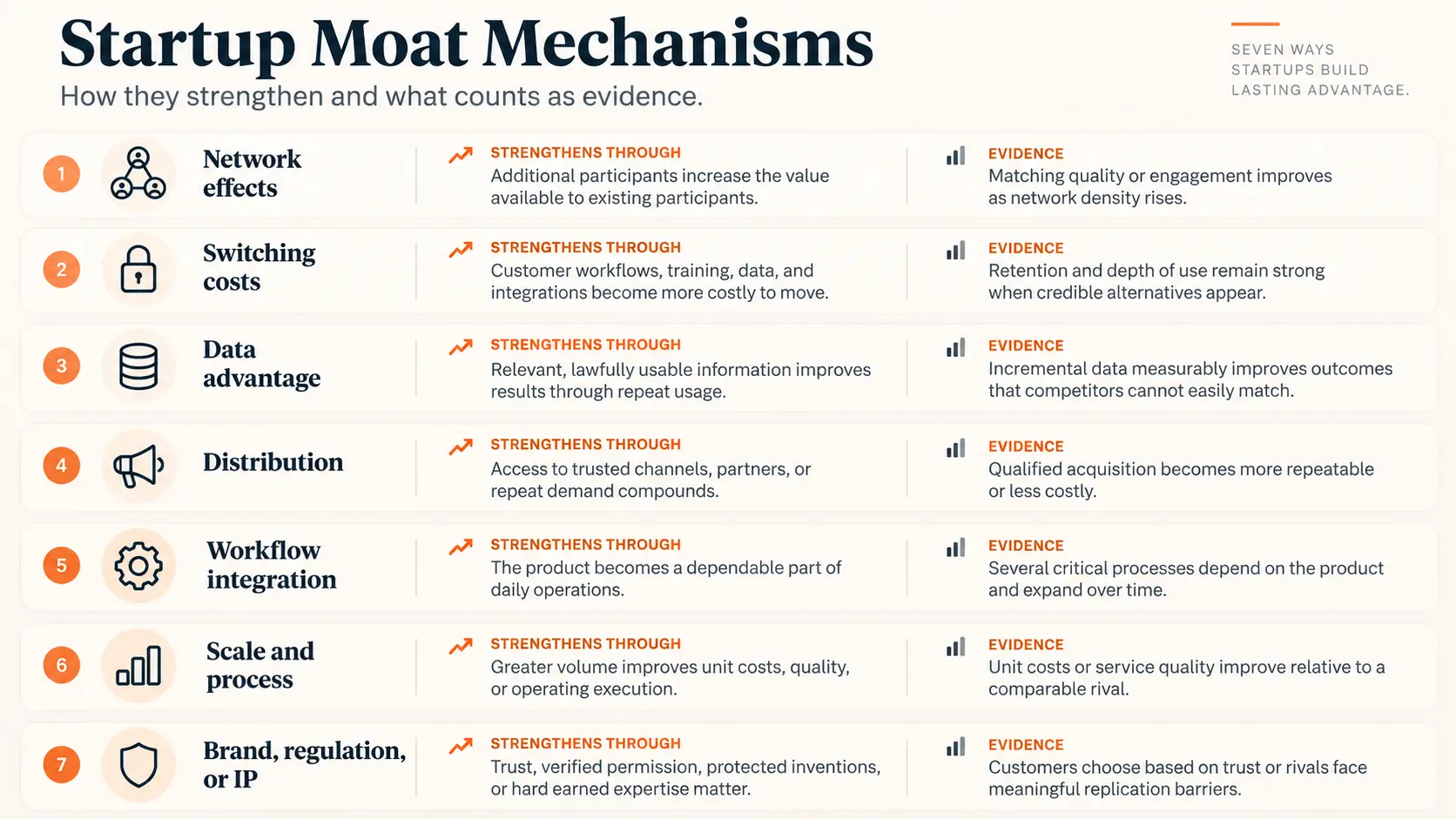
How the Different Moats Work in Practice
The value of a network
For marketplaces, communication products, and certain platforms, understanding Network Effects for Startups begins with a specific question: does each additional participant create measurable value for others? A local marketplace becomes more useful when buyers can find enough relevant suppliers and suppliers can reliably find demand. Airbnb offers a familiar illustration of the two sides of a marketplace, although value and competitive strength still depend on supply density in the destination being searched.
Growth alone is not a network effect. If a new user does not improve the experience of existing users, the startup may simply have more customers. Networks can also be local rather than global, and participants may use multiple rival services. Founders should observe matching speed, successful interactions, repeat engagement, and density in their most important segment.
The cost of leaving a trusted system
Understanding Switching Costs in SaaS requires looking at what a customer would actually have to do to move. Migration may involve data cleanup, retraining, reconfiguring permissions, replacing integrations, updating approvals, and accepting operational risk. Salesforce illustrates why software connected to important organizational processes can be more difficult to change than a simple standalone tool.
The aim is not to trap buyers with confusing contracts or poor export options. Healthy switching costs arise because the product creates genuine recurring value inside the customer’s operation. A buyer who stays only because they cannot retrieve their data may resent the supplier, avoid expansion, or seek alternatives as soon as a practical migration route appears.
When unique data creates better outcomes
A Data Moat forms when legally accessible, genuinely differentiated information improves a product in ways competitors cannot easily reproduce. For example, a fraud detection service may learn from labeled outcomes across authorized customer interactions and improve its ability to distinguish harmful activity from legitimate behavior. The defensive mechanism is the improvement in outcomes, not the quantity of stored records.
The questions are uncomfortable but necessary. Does the company have permission to use the information for this purpose? Is the data actually rare? Does adding it improve performance in a measurable way? Could a competitor buy, simulate, or collect similar information? A large warehouse of ordinary data may be an expense rather than a moat.
Owning a repeatable route to customers
A Distribution Moat develops when a company can repeatedly reach suitable buyers through relationships, trusted communities, ecosystem partners, or direct demand that competitors cannot simply purchase at the same terms. A new brand might find early customers through paid ads, but that channel alone is not protected. A reliable network of industry partners that recommends the product because customers succeed with it is much harder to recreate.
Distribution should be judged by the quality and durability of demand, not raw reach. Founders can compare qualified lead volume, conversion, retention by acquisition source, and the share of new customers arriving through repeat referrals. A distribution channel loses defensive value when its economics deteriorate or its rules are controlled by a single gatekeeper.
Becoming part of how work gets done
A Workflow Integration Moat is built when a product becomes embedded in several connected tasks that customers depend on every day. For a healthcare operations platform, that might mean coordinating staff schedules, approvals, reminders, reporting, and billing handoffs in one reliable process. Each additional integration adds value only if it solves a real problem and the customer actually uses it.
This often reinforces switching costs, but the two are not identical. Integration is the route through which the product becomes useful and operationally important. Switching cost is one consequence of removing it. Founders should not confuse a long list of available integrations with proof that a customer relies on any of them.
Improving the economics of delivery
The principle behind Economies of Scale for Startups is that producing the next unit of value can become less costly as volume increases. A company may spread fixed research, manufacturing, compliance, or infrastructure costs across more activity. In other cases, repeated delivery creates operational knowledge and fewer costly errors. Neither outcome happens automatically when revenue grows.
A startup claiming scale advantages should track unit economics in comparable customer segments, accounting for service costs and quality. If additional customers require proportionally more human work or infrastructure, scale has not yet created a cost moat. This type of advantage can also favor incumbents, so young startups should be careful not to make it their only plan.
Brand, specialized expertise, intellectual property, and regulation
Some businesses compete primarily on trust. In payments, critical infrastructure, and regulated industries, customers may value reliability, accountability, and proven experience as much as additional features. Brand can then lower perceived risk and make customer acquisition more efficient. Patents, exclusive licenses, trade secrets, and unusually difficult operations may offer additional protection when their scope and enforceability are meaningful.
Founders should resist treating an application for a patent, a compliance badge, or a recognizable logo as automatic evidence of a moat. The barrier must matter to buyers or materially limit rivals. The strongest position often combines mechanisms, such as specialized trust supporting distribution while workflow depth supports retention.
Does Being First Give a Startup a Moat?
The debate described as First Mover Advantage vs Fast Follower is often framed as a race for launch date. In practice, timing creates only an opportunity to build defensibility. The first company in a category may learn faster, secure partners, develop habits, or attract both sides of a market. A later entrant may still win by offering a better solution, reaching buyers more efficiently, or avoiding the first company’s costly assumptions.
The founder should ask what the early lead produces. If twelve months of market presence creates exclusive relationships, useful network density, or differentiated operational knowledge, time has become an asset. If it produces only a larger backlog and more brand awareness without retention, being first offers limited protection.
How to Build a Startup Moat Before You Have Scale
Founders often imagine that moat building begins after product market fit. Mature advantages do take time, but the earliest design choices determine whether growth can compound into protection. A practical process starts with a narrow problem and a clear mechanism rather than a claim that the startup will eventually have every form of moat.
Start with a repeatable customer problem
Identify a segment with a costly, recurring problem and a buying process the team can understand closely. Interview actual users, observe how work currently happens, and look for moments when an existing solution is frustrating or unreliable. Before demand is proven, customer learning is usually a more valuable priority than engineering elaborate barriers. A moat around a product nobody needs has no value.
Choose one advantage the product can accumulate
Write a single moat thesis in ordinary language: each successful customer implementation gives us a larger library of validated workflows, so the next implementation should become faster and more reliable. Another business might choose stronger network density in one city, or a distribution partnership that improves as more customers achieve a documented result. The thesis should connect customer value, accumulation, and a competitor’s difficulty catching up.
Design the feedback loop deliberately
Specify what happens after an additional customer, transaction, or successful outcome. Does onboarding get quicker? Does matching improve? Does the company gain permission to use more useful information? Do satisfied customers produce credible referrals? If there is no loop that improves something important, the proposed moat is likely just a description of normal business activity.
Invest in the mechanism without building friction for its own sake
Give the chosen advantage real product and operating support. For a specialized SaaS product, that may mean dependable integrations, workflow templates, and customer success expertise. For a marketplace, it may mean concentrating on one location until both sides experience reliable matches. For a data led service, it means lawful collection, labeling quality, performance measurement, and clear customer permissions. Make every investment justify itself through customer outcomes, not just the promise of future defensibility.
Test the advantage against a credible competitor
Imagine a well funded rival matches every visible feature and cuts its price. What would customers still value about staying? What would the rival have to recreate? How long might it take, and what assumptions support that estimate? Ask recent customers why they selected the product, ask retained customers what they would miss, and study losses to alternatives. If the only answer is that the team works harder, the moat thesis is not yet proven.
Build the Right Moat for the Stage of the Company
The sequence matters. At the idea stage, the founder’s job is to discover demand and identify a possible advantage. At early traction, the goal is repeatability within a narrow segment. Once the product is important to customers, the company can increase integration depth, strengthen distribution, or build useful network density. At scale, the priority shifts toward proving that better retention, economics, or product quality persists as competition intensifies.
This is also why it is possible to spend too early on defensibility. A complex ecosystem, an exclusive data acquisition program, or a large compliance operation can consume cash before the startup has proved that customers want the core product. The appropriate investment is the smallest one that tests the next strategic assumption.
A Worked Example: From Replaceable Tool to Defensible Business
Consider a fictional startup selling scheduling and coordination software to independent clinics. Its first version organizes appointments. The interface is good, but another company could build a similar calendar. At this stage it has differentiation, not a convincing moat.
The founder studies recurring operational problems and discovers that clinics lose time coordinating staff availability, patient reminders, and approval rules. The product expands carefully into these connected tasks. Customers begin using it across more teams, which raises the cost of replacing it because a switch would interrupt several valuable workflows. The startup measures whether this deeper usage actually improves retention rather than assuming it does.
With customer permission and proper safeguards, the team also learns which scheduling configurations reduce avoidable administrative work. It uses these insights to improve implementation templates, making the next clinic faster to onboard. A specialist software partner starts recommending the tool because implementation results are reliable. The business now has several reinforcing sources of advantage: useful workflow depth, repeatable operating knowledge, and a more credible route to buyers.
None of these defenses is guaranteed. A competing product could integrate just as deeply, new interoperability standards could lower switching costs, or a partnership could end. The advantage is credible only if customer behavior and unit economics show that the position is improving. The example illustrates a process, not a universal formula.
How to Measure Whether the Moat Is Getting Stronger
Moats need operational evidence, not a single marketing score. Select a few indicators that match the mechanism being built, compare consistent customer cohorts, and check whether the trend remains healthy when competitors increase pressure. A high retention number by itself is not enough if the contract forces customers to stay temporarily or the business must discount heavily to renew them.
Review the measures alongside the strongest competing explanation. Retention may improve because the market is growing, not because the moat is widening. Acquisition costs may fall during a seasonal spike in demand. A larger dataset may improve a metric in testing but fail to improve customer outcomes. A good moat review asks what else could explain the result and what observation would change the founder’s mind.
Common Mistakes When Founders Talk About Moats
One mistake is calling every product feature proprietary. A feature can be excellent and still be easy to imitate. Another is treating first access to a new platform as a lasting advantage. When competitors gain the same access, the startup needs another source of value. The third is assuming that accumulating data automatically produces a defensible feedback loop, even when the data is ordinary, restricted, or irrelevant to outcomes.
Founders also overestimate switching costs. A complicated cancellation flow is not equivalent to genuine customer dependence. They may mistake rapid customer acquisition for network effects, or invest heavily in a brand before the customer experience consistently earns trust. A subtler mistake is attempting to build several moats at once and funding each too thinly to become useful.
Finally, a moat can become a liability if it relies on customer frustration, unsafe data practices, or excessive dependence on a platform the startup does not control. Sustainable defensibility should grow from delivering value better, not from making customers powerless.
A Practical 90 Day Moat Review for Founders
During the first month, write a one sentence moat thesis and map the current customer journey. Interview customers who joined, customers who declined, and customers who left. Choose one behavior that would demonstrate accumulated value and record its starting point. Avoid declaring that the company has a moat at this stage.
During the second month, run one targeted experiment. A SaaS company might help a small cohort adopt a second mission critical workflow. A marketplace might focus acquisition within one dense local segment instead of spreading across many locations. An AI company might test whether consented specialist data materially improves a quality measure that matters to buyers. Keep the experiment small enough to judge without changing everything else.
During the third month, examine customer outcomes, operational cost, and the rival explanation. If the product is more deeply used but retention does not improve, the thesis may need adjustment. If acquisition costs fall only because discounts increased, the channel is not compounding. If a real gain appears, decide what capacity or process should be strengthened next. Document the result, the remaining uncertainty, and a date to review it again.
A moat is not a strategy slide completed once. It is a hypothesis about why the company should become a more difficult competitor to defeat, repeatedly tested against the market.
FAQ
Do startups need a moat before product market fit?
Not usually a mature one. Early teams need evidence of demand and a credible idea of what could compound as the company grows. Building a large defensive structure before customers value the product is often a misuse of limited capital.
What is the strongest moat for a startup?
There is no universally strongest moat. Network effects can be powerful in products where participation creates value. Switching costs and workflow depth can matter more in specialized business software. The relevant choice depends on customer behavior, market structure, and what the company can realistically build.
Can a startup have more than one moat?
Yes. Advantages can reinforce one another. A trusted distribution channel can bring in customers whose usage improves service quality, while deep integrations help retain them. A young company should usually prove one mechanism before investing broadly in several.
Is having unique technology enough to defend an AI startup?
Not by itself. The technology must remain difficult to reproduce or support an advantage that rivals cannot quickly match. For many application businesses, specialized workflows, trusted customer relationships, useful proprietary context, and distribution matter alongside the underlying model.
How can a founder tell whether a moat is real?
Name the mechanism, specify what should improve with each customer or transaction, then measure it over time. Test the result against credible alternatives such as market growth, contracts, discounts, or temporary execution speed. Evidence should be observable in behavior, outcomes, or economics.
Can a moat disappear?
Yes. New technology can reduce switching costs, interoperability can weaken lock in, channel rules can change, and a competitor can develop a better network. A moat must be maintained through continued customer value and honest reassessment.

Mohsen Avid
Founder & Editor, PinerookMohsen Avid is the founder of Pinerook, covering entrepreneurship, startup strategy, digital business, and the decisions behind building new ventures.
 Seen first.