A data moat is a competitive advantage built from information that helps a company deliver results rivals cannot easily match. Yet a startup can collect millions of records and still have no moat at all. If competitors can buy the same information, reproduce the same insights, or achieve the same customer outcome without it, the dataset is an operating resource rather than a durable barrier. For founders, the useful question is not how much data the product stores, but what unique advantage that data creates.
This distinction matters within the larger idea of Startup Moats. A defensible business becomes harder to replace as it learns from serving customers. In a data driven product, that improvement must be visible in a decision customers care about: fewer missed failures, faster approvals, better recommendations, or less manual work. The data, the right to use it, and the mechanism that turns it into an outcome all have to survive competitive scrutiny.
What Is a Data Moat?
A real data moat combines differentiated access with measurable advantage. The information is difficult for a capable competitor to reproduce, it can be used lawfully for the intended purpose, and its continued collection or refinement improves a product in ways customers notice. Some businesses have exclusive access to important records. Others produce useful information through repeated customer workflows or collect expert judgments that are expensive to label correctly. None of these sources is automatically defensible. The advantage comes from what the company can accomplish because the information exists.
Consider two companies predicting equipment downtime. Both purchase the same public specifications and sensor feeds. One also receives permitted maintenance outcomes from customer sites, including which alerts proved useful and which repairs actually prevented failures. If those labels consistently improve the accuracy of future recommendations, the second company may have an advantage. If its predictions are no better, its extra records only increase storage, security, and processing costs. That is the central test.
What Kinds of Data Can Become Defensible?
Proprietary does not have to mean secret. A startup may own its observations, have licensed access to a difficult dataset, or gain permission to learn from a workflow that others do not participate in. The best source depends on the problem. What matters is the combination of scarcity, freshness, accuracy, permissions, and usefulness. The following table helps founders separate sources worth testing from sources that merely sound impressive.
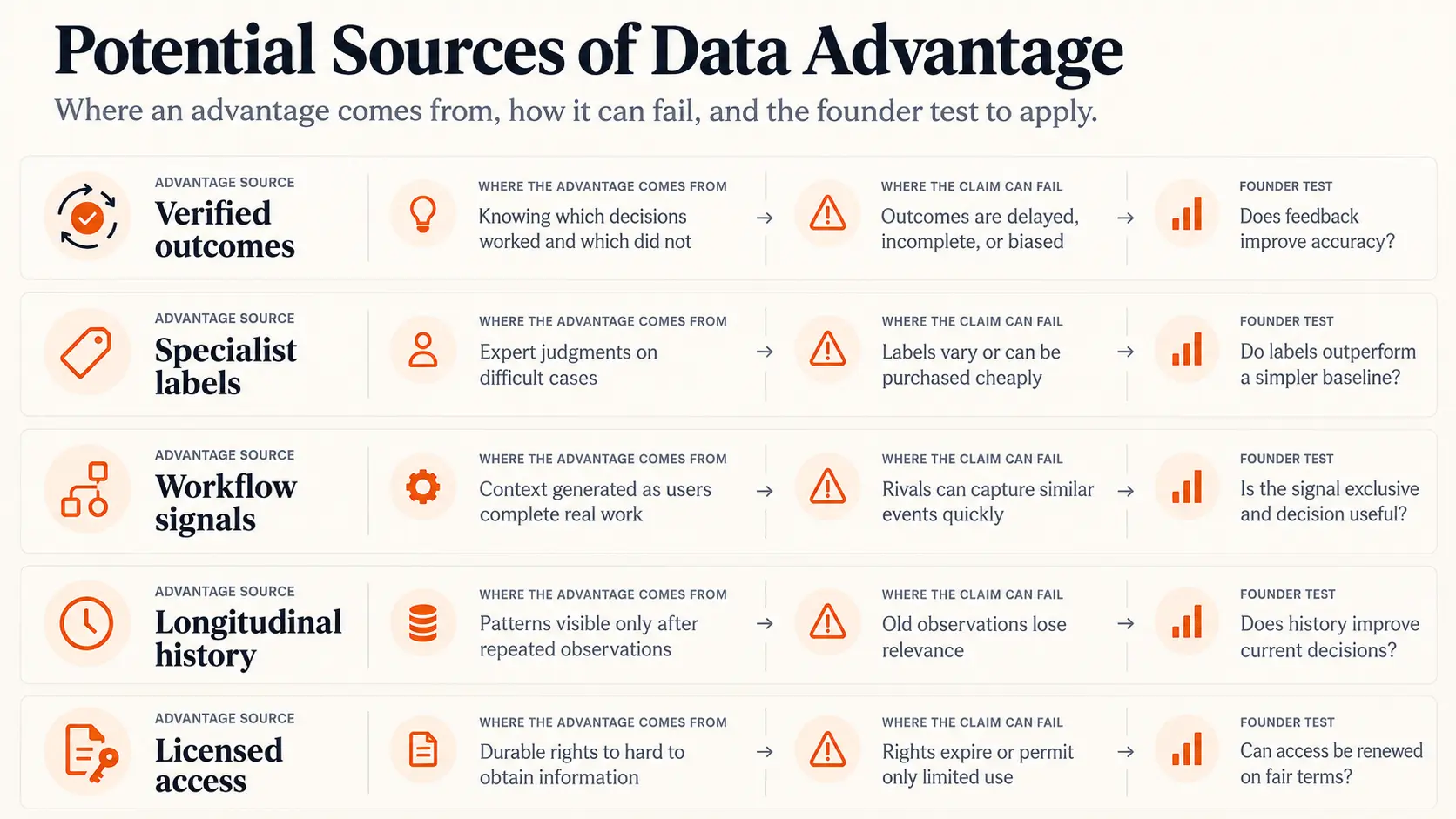
A crucial distinction is that permission to access data is not the same as permission to reuse it for every purpose. A customer may authorize a company to process records to provide a service without authorizing cross customer model training. The strength of the moat depends partly on whether the business model and its commitments allow the learning process it intends to operate.
The Data Flywheel: Where the Advantage Actually Compounds
Founders sometimes describe a simple loop: more users create more data, which makes the product better, which attracts more users. It is attractive because it sounds automatic. In practice, each connection can fail. More users may create repetitive records. More records may contain weak labels. Better model scores may not change customer behavior. And a better product may not generate any information a competitor cannot quickly collect.
A useful flywheel begins with a narrow decision and closes the loop with an observed outcome. Imagine a hypothetical software company helping a small fleet operator prioritize vehicle inspections. An inspection recommendation is useful only if the company learns which vehicles actually required repairs, how serious the issue was, and whether early action reduced disruption. Those verified outcomes can refine the next recommendation. When performance improves, operators may use the system for more inspections, generating new cases that further test the model. The company grows stronger only if the extra cases make a meaningful and repeatable difference.
This mechanism is not necessarily a network effect. Customers do not need to interact with one another for a shared learning system to improve. It may instead be a data scale advantage, and that advantage can weaken when the most common patterns have already been learned. Founders should therefore test the incremental value of fresh data rather than assuming that every added record compounds forever.
How to Build a Data Moat from an Early Stage Product
Start with one costly decision
Choose a customer decision that repeats often, matters economically, and can be evaluated after the fact. Fraud screening, inventory forecasting, maintenance triage, and matching scarce supply to demand are examples where outcomes can provide feedback. Write the hypothesis plainly: if we learn from a certain kind of verified result, we expect to reduce a specific customer cost or improve a specific decision. Without that clarity, a startup can spend months collecting events that never affect the product.
Capture the smallest useful signal
Map the information the product genuinely needs to make that decision. Some signals will already exist in the customer workflow; others require a deliberate request or integration. Define who controls the data and what permissions apply before building collection into the experience. Early teams usually gain more from a handful of consistent, high quality signals than from a large warehouse of loosely defined events. A narrowly designed dataset is easier to maintain, audit, and use.
Connect predictions to verified results
A model can sound convincing without being correct. The most valuable records often appear after the initial action, when a customer confirms what happened. Design a light feedback process that captures results rather than just clicks, generated outputs, or user acceptance. For tasks requiring human judgment, record disagreements and edge cases. Those difficult cases can reveal where a product really differs from generic software, but only if the judgments are reliable and the sample is representative.
Use the information to change a product decision
Put the new signal into a real customer workflow, not just an internal dashboard. Test whether it changes recommendations, reduces errors, improves turnaround time, or increases the share of cases handled successfully. Compare against a simpler system that uses widely available information. If the outcome is effectively the same, proprietary data has not yet proved its value. If the improvement is meaningful and repeats with new customers, the company has a stronger basis for investment.
Make the learning repeatable, not dependent on heroics
A company whose best insights live inside one employee’s memory is vulnerable. Document how feedback is collected, checked, and converted into a product improvement. Keep labels and definitions consistent across customers where agreements allow it, and record enough context to explain changes over time. This is not an argument for complex infrastructure before product market fit. It is a reason to protect the small learning process that actually drives customer value.
How to Test Whether the Moat Is Real
The strongest evidence is comparative. A founder should be able to show that legally available proprietary signals improve an outcome beyond what an informed rival could achieve with common data and competent engineering. Begin with a baseline using nonexclusive inputs. Add the differentiated information, then compare the two approaches on fresh cases not used to develop either system. A result that only looks good on historical training data is not convincing evidence of a barrier.
For example, suppose a hypothetical scheduling product correctly predicts 70 out of 100 delays using standard operating data. Adding verified local exceptions raises that result to 79 out of 100 on a comparable set of new cases. That is a useful initial sign, not proof of a permanent moat. The founder still needs to ask whether customers value the improvement, whether the advantage persists in new locations, whether the data can be collected at sustainable cost, and whether a competitor could replicate it within a reasonable period.
Review four measures together: customer outcome improvement, value from each additional useful record, durability of data access, and the estimated time or cost for a competent competitor to reproduce the result. The last measure is necessarily an estimate; test the assumptions with a competitive benchmark rather than presenting it as a scientific number. Retention or willingness to pay can strengthen the case, but neither establishes that data is the reason customers stay.
Why Data Moats Fail Even When the Dataset Is Large
One common failure is diminishing returns. Early observations reveal the frequent patterns, while later records add little information or become more expensive to label. Another is a distribution shift: behavior, regulation, equipment, or customer needs change, making last year’s records less useful. A third is weak exclusivity. If the critical information is bought from a vendor serving every competitor, a startup may have excellent analytics but not a unique barrier.
Data can also create negative defensibility when the business cannot trust or use it. Poor consent practices, vague contracts, insecure storage, and mixed customer datasets can lead to customer losses or restrictions that destroy the supposed advantage. A startup should be prepared to delete information when required, isolate customer data where promised, and explain how training or product improvement uses permitted records. Customer trust is not a bonus layered on top of a data moat; it determines whether the business can keep access to the inputs it depends on.
A Practical 60 Day Data Moat Test for Founders
In the first two weeks, choose one meaningful customer outcome and identify the information that could plausibly improve it. Record the current baseline and document where each candidate signal comes from, who controls it, and what uses are permitted. Interview users about the value of improving the decision. Do not collect data simply because it might be useful someday.
During weeks three and four, build a small process for gathering verified results and test a narrow cohort. Compare performance using common information against performance with the additional signal, keeping evaluation cases separate from development. Track quality and collection cost alongside results. If the new data does not help, revise the hypothesis before scaling collection.
During weeks five through eight, repeat the comparison on new customers or time periods, examine errors, and consider the competitor’s route to the same outcome. Can the information be licensed elsewhere? Will the signal remain available if a major partner leaves? Does the product continue to improve at an affordable cost? End the period with a decision: invest in the learning loop, redesign the experiment, or stop claiming the dataset is a moat. Each outcome gives the company more strategic clarity than a larger dashboard.
The best data moat is not the biggest dataset. It is a trusted, hard to reproduce learning advantage that improves an important customer outcome and remains valuable after the next competitor launches. Start with one decision, secure the rights to learn from real results, compare against a credible baseline, and keep measuring whether new information adds value. Until the evidence is clear, treat a data moat as a hypothesis to test rather than an asset to announce.
FAQ
What is an example of a data moat?
A specialist software company may learn from permitted, verified outcomes that are produced only when customers use its service. If this information measurably improves future decisions and competitors cannot collect comparable cases easily, it may form a data moat. The business must show the improvement, not simply claim the data is unique.
Is proprietary data always a competitive advantage?
No. Exclusive information can be stale, biased, irrelevant, or too expensive to maintain. It becomes competitively useful when the company has clear rights to use it and can demonstrate better customer outcomes than a plausible alternative relying on common data.
Do AI startups need to own their training data?
Not necessarily. An AI startup can build value with licensed data, careful evaluation, domain expertise, and customer specific workflows. Owning a dataset is neither a requirement for a good product nor sufficient proof of long term defensibility. The important questions are what the company can lawfully use and what competitors can reproduce.
How is a data moat different from a data strategy?
A data strategy describes how information is collected, governed, analyzed, and used to operate the business. A data moat is narrower: it is the hard to replicate competitive advantage created when particular information consistently helps the company deliver a better result. A startup can have a sound data strategy without having a moat.

Mohsen Avid
Founder & Editor, PinerookMohsen Avid is the founder of Pinerook, covering entrepreneurship, startup strategy, digital business, and the decisions behind building new ventures.
 Seen first.