A workflow integration moat forms when a startup’s product becomes a dependable part of how customers complete important work. It is not created by adding dozens of software connections. It emerges when teams rely on the product to move a job from the first input through approvals, decisions, and a completed outcome. Competitors may copy the interface, but replacing the product also requires customers to rebuild the way work gets done.
That makes workflow integration one potential source of Startup Moats. The distinction is important for founders: being used every day is not the same as being difficult to replace. A useful moat combines meaningful customer outcomes, dependable connections to other systems, and a position in the process that becomes more valuable as usage deepens. This guide explains what that looks like, how to build it without overengineering, and how to test whether it is real.
What Is a Workflow Integration Moat?
A workflow is a sequence of actions that produces an outcome. For a repair company, that might mean receiving a request, assigning a technician, documenting the job, sending an invoice, and collecting payment. A startup that handles only the first step can be useful. A startup that coordinates the handoffs between all five steps may become much more important to daily operations.
The moat is not the number of integrations shown on a sales page. It comes from the relationship between the product and the customer’s operating routines. When removing the product would interrupt essential coordination, force teams to reconstruct approved procedures, or reduce service quality, the software may have gained a defensible position. That position remains conditional: a simpler or more reliable alternative can still displace it.
Why Deep Integration Can Be More Defensible Than Features
Features are visible. A competitor can observe a dashboard, imitate a report, or introduce a similar AI assistant. What is harder to reproduce is the context around the feature: who is allowed to approve a request, which exceptions demand a manager’s attention, how information moves between departments, and what must happen before a task can be marked complete. This operational detail often differs from customer to customer.
Integration can also spread the product’s value across several roles. A dispatcher sees the schedule, a technician receives the assignment, a finance employee checks the invoice, and a manager reviews performance. If each role depends on consistent information from the others, the product has become more than a single person’s tool. The defense comes from coordinated value, not from making data difficult to export.
This matters in the AI era. A model can generate a draft or recommend an action, but businesses still need permissions, review steps, reliable records, and a way to handle mistakes. Founders who connect intelligence to the full process may create greater customer value than those selling an isolated output. Even then, automation only strengthens the moat when it is accurate, observable, and safe to rely on.
What Workflow Integration Looks Like in Practice
Consider a hypothetical field service startup. Its first product creates quotes. Customers like it, but they still copy the result into scheduling software and manually update their accounting records. A rival offering cheaper quotes could replace that single function with little disruption. The startup then discovers that the real customer problem is coordinating the entire job, not generating the quote.
It connects approved quotes to bookings, sends assignment information to technicians, records job completion, and transfers the final amount to invoicing. Employees no longer have to reconcile the same job across disconnected tools. The outcome is faster handoffs and fewer opportunities for missing information. The potential moat grows if the workflow is reliable, used regularly, and difficult to recreate without losing those benefits.
Real software products illustrate the operating pattern. Toast offers restaurants connected capabilities spanning point of sale, payments, ordering, and staff operations, while ServiceTitan describes a workflow connecting booking, dispatch, field work, invoices, and payments. These are examples of broad process integration, not proof that either company has a particular retention rate or an unassailable moat.
Superficial Integrations Versus Embedded Workflows
An integration can look impressive in a product demonstration and still make little difference to customer behavior. Founders should examine what changes after the connection is installed. The following comparison separates a technical connection from operational dependence.
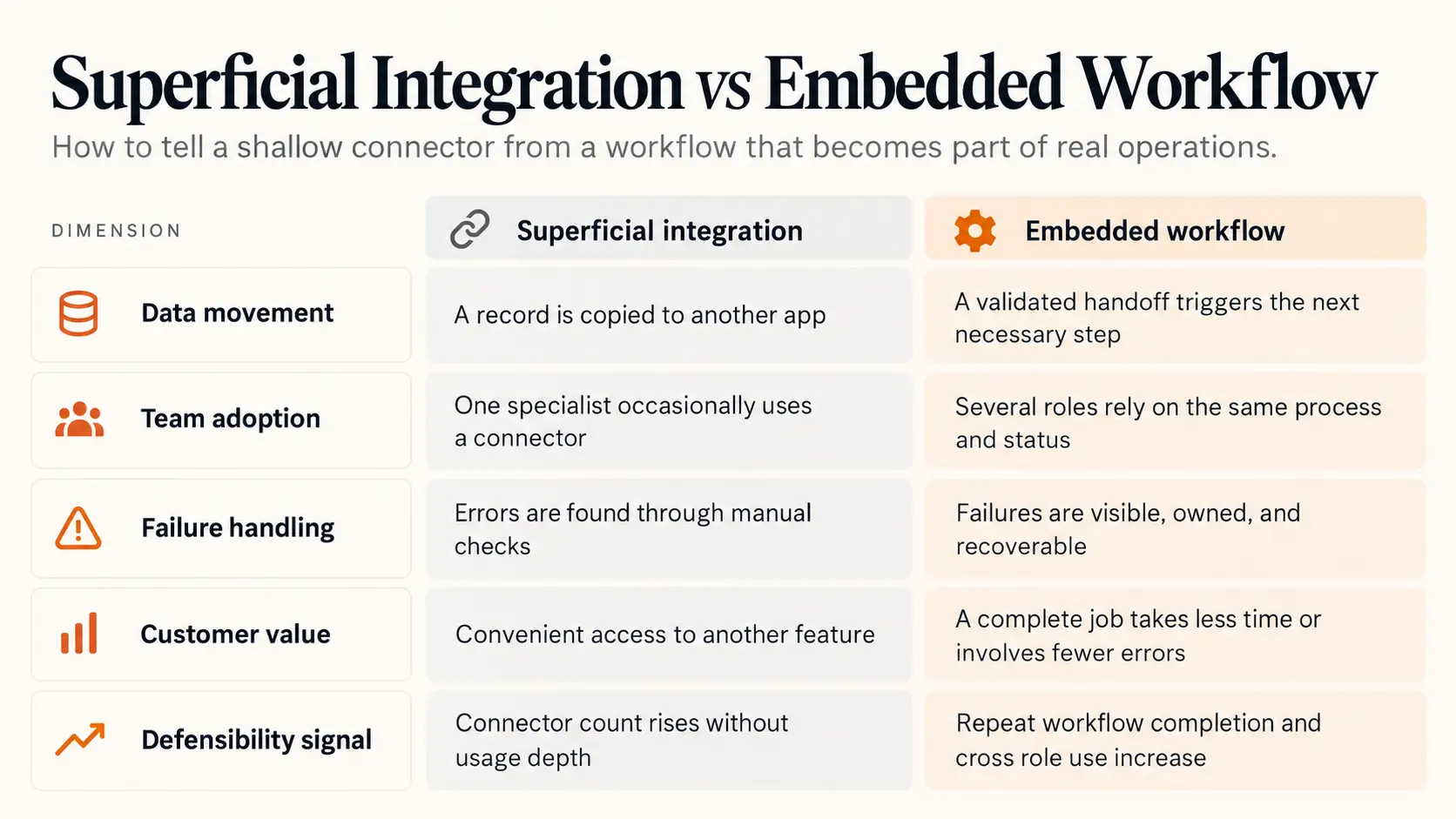
A founder should avoid treating every entry in the right column as a requirement for the first release. One critical handoff with measurable value is a stronger starting point than ten unreliable integrations. The customer’s most costly interruption, rather than the product roadmap’s longest list of features, should determine where to begin.
How Startups Build a Workflow Integration Moat
Start With One Outcome Customers Already Care About
Interview the people who complete the job, not only the executive who buys the software. Ask them to walk through a recent real case from start to finish. Identify the systems touched, manual decisions made, approval delays, and points where information is entered twice. Choose an outcome with a clear owner and measurable cost, such as the time from service request to paid invoice or from support ticket to verified resolution.
The first implementation should make that outcome consistently better. A narrowly scoped integration that eliminates a recurring operational problem can win trust faster than a broad platform that requires months of configuration. Founders can expand once they know where the actual bottlenecks are and which parts of the process customers will adopt.
Design Reliable Handoffs Before Adding More Connections
A useful workflow needs more than a connection between APIs. It needs identity checks, clear permissions, consistent data fields, retry behavior, audit history, and an understandable path when something fails. If an automation silently sends the wrong invoice or duplicates a job, the customer may stop trusting the whole process. Reliability is a product feature and a business requirement.
For that reason, founders should decide who approves consequential actions, how records are reconciled, and whether operators can correct mistakes without engineering support. Customers should also be able to export their data and understand what the system is doing. This protects trust and keeps an integration moat from turning into an abusive lock in strategy.
Expand Across Roles Only When the Core Workflow Works
Once the first process is dependable, expansion should follow the natural flow of work. A scheduling tool may add completion records before payroll integration, because the first connection closes an existing operational gap. Product teams can prioritize adjacent steps by frequency, customer pain, integration cost, and the number of employees who benefit. They should resist building a connector merely because a large prospect requests a logo for its software stack.
Expansion becomes defensible when each additional step improves the usefulness of the existing workflow. If managers, frontline staff, and finance teams share consistent records and actions, the product has a stronger place in operations. If new connectors are rarely enabled or do not change customer outcomes, they add maintenance burden without creating a meaningful moat.
How to Measure Whether the Moat Is Real
Integration depth is not adequately measured by the number of available connectors. Start with workflow completion rate, the share of jobs started in the product that reach the intended outcome without being transferred to a manual workaround. Combine it with time to outcome, measured from the first meaningful step to completion. These metrics reveal whether integration makes work more dependable and efficient.
Next, examine the percentage of active customer accounts in which multiple relevant roles complete real actions, along with the frequency of repeat workflows. Track failed handoffs, recovery time, and support tickets connected to integrations. A large account using eight integrations once a month may be less embedded than a small team completing one essential process every day.
A simple before and after exercise can help. Suppose a team previously completed 100 service jobs a month and spent an average of 30 minutes per job reconciling systems. After integrating the process, that work falls to 15 minutes. The arithmetic suggests 25 hours of monthly time saved, but a founder should confirm the difference with comparable jobs and account for setup effort, errors, and new administrative work. An illustrative calculation is not evidence of a causal improvement.
Finally, compare retention and expansion across customer cohorts with similar size, maturity, and needs. Ask customers why they stay, which workflow would break if the product disappeared, and whether a credible alternative could take its place. Higher retention among integrated accounts may be encouraging, but it is not proof of a moat by itself. Strong customers may be more likely to integrate in the first place.
What Can Weaken a Workflow Integration Moat?
The first failure mode is integration sprawl. Every connector requires maintenance as third party APIs, permissions, and customer systems change. A startup with a small engineering team can become trapped supporting brittle custom implementations. Reusable integration patterns, clear service ownership, and limits on bespoke requests are essential to keeping the business sustainable.
The second is mistaking dependence for satisfaction. If customers cannot leave because records are trapped, migration is expensive, or contracts are punitive, the product may show low churn while building resentment. That is primarily a Switching Costs in SaaS issue rather than proof of useful workflow integration. The stronger strategy is to make the product worth keeping while preserving fair access to customer data.
The third is outsourcing the most valuable part of the workflow. If a larger platform controls the customer relationship, the core approvals, and the final operating record, a startup may be only a replaceable add on. Founders should know which part of the completed job they uniquely improve and how they can preserve that value if a partner changes prices, access rules, or product priorities.
When Should a Startup Invest in Deeper Integration?
Deep integration makes sense when the target customer repeats an important process, fragmented tools cause measurable harm, and the startup has enough adoption to observe real usage. It is less attractive when the task happens rarely, customer systems vary so widely that every deployment becomes a custom project, or the team cannot support reliable integrations. An early startup should not confuse enterprise complexity with customer demand.
A practical decision is to pilot one complete workflow with a small group of customers. Establish the baseline, measure completion and failure rates, ask whether the process has become easier to run, and calculate the ongoing cost of support. Expand only if the improvement survives repeated use. A workflow integration moat is built by earning operational importance, not by announcing that the product is a platform.
FAQ
Is a workflow integration moat the same as switching costs?
No. Workflow integration describes how a product becomes part of a useful, recurring operating process. Switching costs describe the effort, risk, or expense of moving to another provider. The two can reinforce one another, but integration can create value without deliberately making customers feel trapped.
Do startups need many integrations to build this moat?
No. One reliable connection that completes a critical job can matter more than dozens of rarely used connectors. Founders should prioritize workflow outcomes and repeat usage instead of counting available integrations.
Can AI agents create a workflow integration moat?
They can contribute when they safely coordinate real tasks across systems, follow permissions and approval rules, and provide auditable results. A standalone AI feature or model connection is easier to replace than an end to end process that consistently works for the customer.
How long does a workflow integration moat take to develop?
There is no universal timeline. A startup can validate the value of a single workflow in a short pilot, but durable defensibility requires repeat usage, dependable operation, adoption across relevant roles, and evidence that alternatives struggle to match the total outcome.

Mohsen Avid
Founder & Editor, PinerookMohsen Avid is the founder of Pinerook, covering entrepreneurship, startup strategy, digital business, and the decisions behind building new ventures.
 Seen first.