An ideal customer profile (ICP) is a description of the customers most likely to get meaningful value from a product and become viable customers for the business. For a startup selling to other businesses, it usually defines a type of organization, the problem it faces, the conditions that make a purchase plausible, and the reasons an account may be a poor fit. The useful result is not a fictional portrait. It is a rule for deciding whom to approach, whom to learn from, and whom to decline.
An ICP is one input into a broader Go to Market Strategy for Startups. That strategy decides how a company enters a market, but the profile answers a narrower and more immediate question: which specific prospects deserve the team’s limited conversations and sales effort? I would rather see a founder reject ten attractive but poorly qualified leads than fill a pipeline that never produces a successful customer.
What Makes an Ideal Customer Profile Useful
The word ideal can be misleading. It suggests a dream customer with a large budget and no objections. In practice, the best fit customer is an account with a problem your product can solve, a credible reason to act, an achievable buying process, and a path to successful adoption. A large company with an impressive logo can still be a terrible early customer if deployment requires integrations your team cannot support.
I treat an ICP as a decision filter, not a marketing description. It should make it easier to choose who gets a discovery call, who enters a pilot, and who should receive a polite refusal. The earliest version will be provisional. That is acceptable as long as the startup knows which parts are observed and which are hypotheses.
ICP, Buyer Persona, and Market Segment Are Different
A market segment groups organizations or people who share broad conditions. An ICP describes the best fit customer within a commercial context. A buyer persona explains the motivations, responsibilities, and objections of a person involved in a purchase. Consider software for independent medical clinics: clinics form a possible segment; clinics with a specific compliance workflow and an available administrator may form the ICP; the practice manager and medical director have distinct buying roles.
A useful ICP does not require a detailed fictional biography. Job titles can help identify stakeholders, but age, favorite podcasts, and invented personality traits rarely tell a founder whether an account can buy and benefit from the product. For consumer startups the same decision can be framed around usage situation, urgent need, ability to access the product, and an observable behavior rather than firmographic details.
Start With Evidence You Can Actually Collect
If the startup has paying customers, begin with the accounts that have achieved the promised outcome. Review adoption, customer effort, repeat use, retention, implementation time, and the conditions under which the purchase happened. Revenue matters, but it should not be the only criterion: the largest deal may have demanded unusual customization and may not represent a repeatable customer.
If you have no customers, build a provisional profile from discovery interviews, problem observations, pilot requests, and evidence of existing spending on alternatives. Speak to people with the problem rather than contacts who merely like the idea. Ask what happened the last time the problem occurred, what they did instead, who approved the response, and what made the issue urgent. Statements of interest are weaker evidence than real actions.
The Six Fields I Would Put in a Startup ICP
Founders often collect every possible attribute because templates make them look mandatory. I prefer six fields that change qualification decisions: observable account attributes, recurring problem, buying trigger, decision ownership, capacity to adopt, and reasons to exclude. The goal is to define a recognizable situation, not a broad description of every customer who might someday benefit.
The following template can be completed before a startup has a CRM. Each field should contain a specific hypothesis, the evidence available, and a method for checking it with the next prospects.
A Practical ICP Template
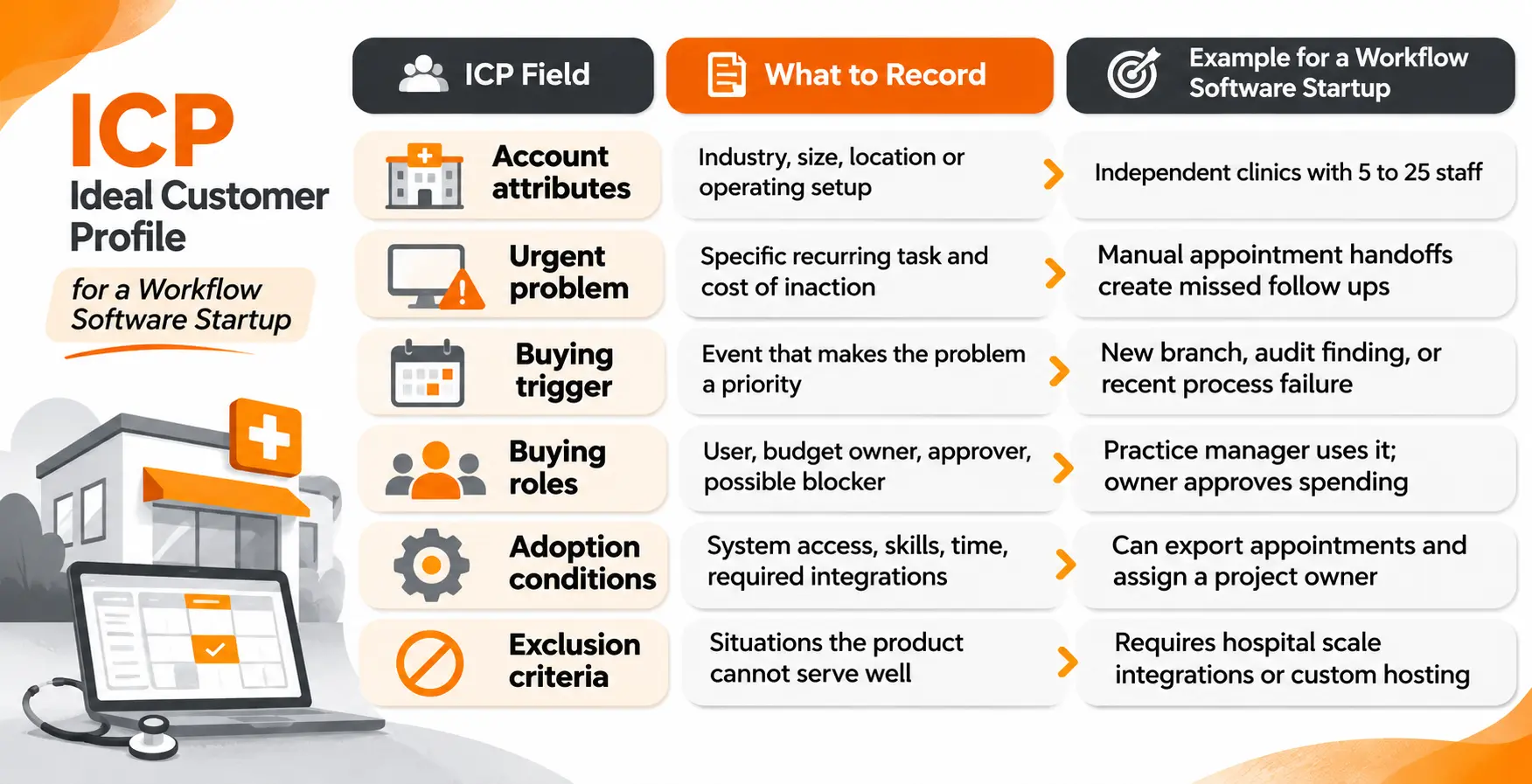
The example is illustrative, not a tested market finding. A founder should replace each assumption with customer evidence and mark unresolved fields. The most valuable line is often the exclusion criterion because it prevents enthusiastic sales conversations from consuming weeks of product and engineering work.
Find the Buying Trigger, Not Just the Industry
A startup can target the correct industry and still reach customers at the wrong moment. Two clinics may be similar in size and use the same software, yet only one is actively reorganizing operations after repeated scheduling failures. That recent event is a buying trigger. It tells the team why a prospect might act this quarter rather than someday.
Useful triggers might include a change in regulation, a new team, a contract renewal, a budget cycle, a service failure, or a capacity bottleneck. They should be checked carefully rather than inferred from vague signals. When interviewing customers, ask what changed immediately before they began looking for an alternative. A good ICP captures timing as well as fit.
Write Explicit Reasons to Say No
Early teams hesitate to exclude prospects because every meeting feels like progress. Yet some accounts lack the necessary permissions, have needs far outside the product scope, or expect service the startup cannot responsibly provide. Those accounts distort the roadmap and make conversion data hard to interpret. A precise exclusion rule protects both the business and the customer.
Exclude conditions you can recognize before a long sales process. Examples include unsupported jurisdictions, mandatory integrations not on the roadmap, a purchasing process longer than the company can sustain, or a problem that the customer does not consider important. A prospect who is not a fit today may become a fit later, but that possibility is not a reason to treat them as qualified now.
Test the Profile With Real Prospects
I would test an initial ICP with a small, deliberately chosen set of accounts that appear to match it, along with a few nearby accounts that do not. Record comparable evidence: whether the problem is active, whether the right person will engage, whether a credible next step is possible, and whether onboarding requirements fit current capabilities. Do not invent a universal conversion benchmark. The useful question is whether accounts that meet your criteria behave differently from accounts that do not.
For a working exercise, assign each criterion a simple rating of confirmed, uncertain, or not met. This prevents an arbitrary total score from hiding a fatal obstacle. An account with a large budget but a technical requirement the product cannot meet should not win merely because it earned points elsewhere.
Turn a Draft ICP Into a Learning Routine
After the first conversations, update the profile with patterns that appeared repeatedly. If prospects in the chosen industry express interest but lack purchasing authority, change the buying role definition or route to the actual decision maker. If all successful pilots share one integration or operating constraint, make that condition visible in the profile. Each revision should be tied to evidence, not to a disappointing week of sales activity.
Keep a short decision log showing what changed, why it changed, and what result would reverse the new assumption. Review the profile when the product scope changes, when a new cohort behaves differently, or when the team begins entering a different customer environment. A calendar reminder is useful, but meaningful new evidence matters more than a ritual quarterly rewrite.
Common ICP Mistakes That Waste Founder Time
The first mistake is treating every potentially interested customer as a target. The second is confusing customer size with customer fit. A third is letting one enthusiastic buyer define the whole market, particularly when that buyer needs custom development. Another frequent problem is writing an ICP with no observable trigger or clear exclusion, which makes it impossible for two team members to qualify the same prospect consistently.
The opposite error is false precision. A founder can write down an exact employee band, revenue threshold, and software stack without having evidence that any of those details predict a successful purchase. Start with the few conditions that appear causally related to the customer problem and ability to adopt. Add more detail only when it improves decisions.
A One Paragraph ICP You Can Use as a Starting Point
Our best fit initial customer is an independent clinic with a small administrative team that regularly experiences missed appointment handoffs, has recently begun a workflow improvement effort, can provide a named operational owner, and can adopt a solution using supported data exports. We do not currently target organizations that require large hospital integrations or custom infrastructure. This is a working hypothesis to validate through interviews, pilots, and observed use.
Notice that this description names the environment, problem, trigger, operational readiness, and exclusion. It does not pretend every clinic has the same budget or that every interested manager can approve a purchase. That level of restraint makes the ICP useful. The profile should help a founder spend more time with customers who can succeed and less time chasing signals that cannot become a viable relationship.
FAQ
What is an ideal customer profile for a startup?
It is a practical description of the customers most likely to gain value from the startup and become viable accounts, including their problem, buying conditions, adoption requirements, and disqualifying factors.
What is the difference between an ICP and a buyer persona?
An ICP helps decide which accounts or customer situations to target. A buyer persona explains the needs and decision roles of people within those accounts.
Can a startup create an ICP without paying customers?
Yes. Start with a provisional hypothesis informed by problem interviews, existing alternatives, and observed customer actions, then revise it after pilots or paid use.
How detailed should an early stage ICP be?
Detailed enough that two team members can independently decide whether a prospect qualifies. Unverified demographic precision is less useful than clear triggers and exclusion conditions.
Should a startup have more than one ICP?
It may eventually need several, but testing one focused initial profile often produces clearer evidence than pursuing very different customers at the same time.
When should founders change their ICP?
Revise it when repeated customer evidence shows that fit, buying triggers, or adoption constraints differ from the current assumptions, rather than changing it after one disappointing conversation.

Mohsen Avid
Founder & Editor, PinerookMohsen Avid is the founder of Pinerook, covering entrepreneurship, startup strategy, digital business, and the decisions behind building new ventures.
 Seen first.