Entering a market first can give a startup time to establish customer habits, secure valuable partners, and learn before anyone else. But it can also mean paying to educate buyers, building around unproven assumptions, and running out of cash before demand catches up. A fast follower enters after the opportunity becomes clearer, then tries to win through a sharper product, better execution, or stronger distribution. Neither route is automatically superior. The right choice depends on what early entry allows a company to accumulate and how quickly those benefits can disappear.
For founders, the larger question is whether timing can become an advantage that competitors struggle to reverse. The framework behind Startup Moats is useful here: a head start matters only when it develops into something that is valuable, difficult to replicate, and worth protecting. A launch date is a historical fact. A durable advantage must still be earned through the product, customer relationships, operations, or market structure.
What Is the Difference Between a First Mover and a Fast Follower?
A first mover is among the earliest companies to bring a particular type of offering to a defined market. It takes on the uncertainty of showing customers why the category should exist and how it should work. A fast follower enters after earlier firms have revealed some of the demand, user behavior, technical constraints, or viable business models. It is not necessarily the second company to enter, and it does not need to copy the original product.
The distinction is more useful at the level of a specific customer problem than an entire industry. A company can be a follower in online payments overall while pioneering a narrowly defined use case, geography, or customer segment. That is why founders should define the market they intend to win before claiming a first mover advantage. The relevant comparison is between solutions serving the same buyers with sufficiently similar jobs to be done.
When First Mover Advantage Is Real
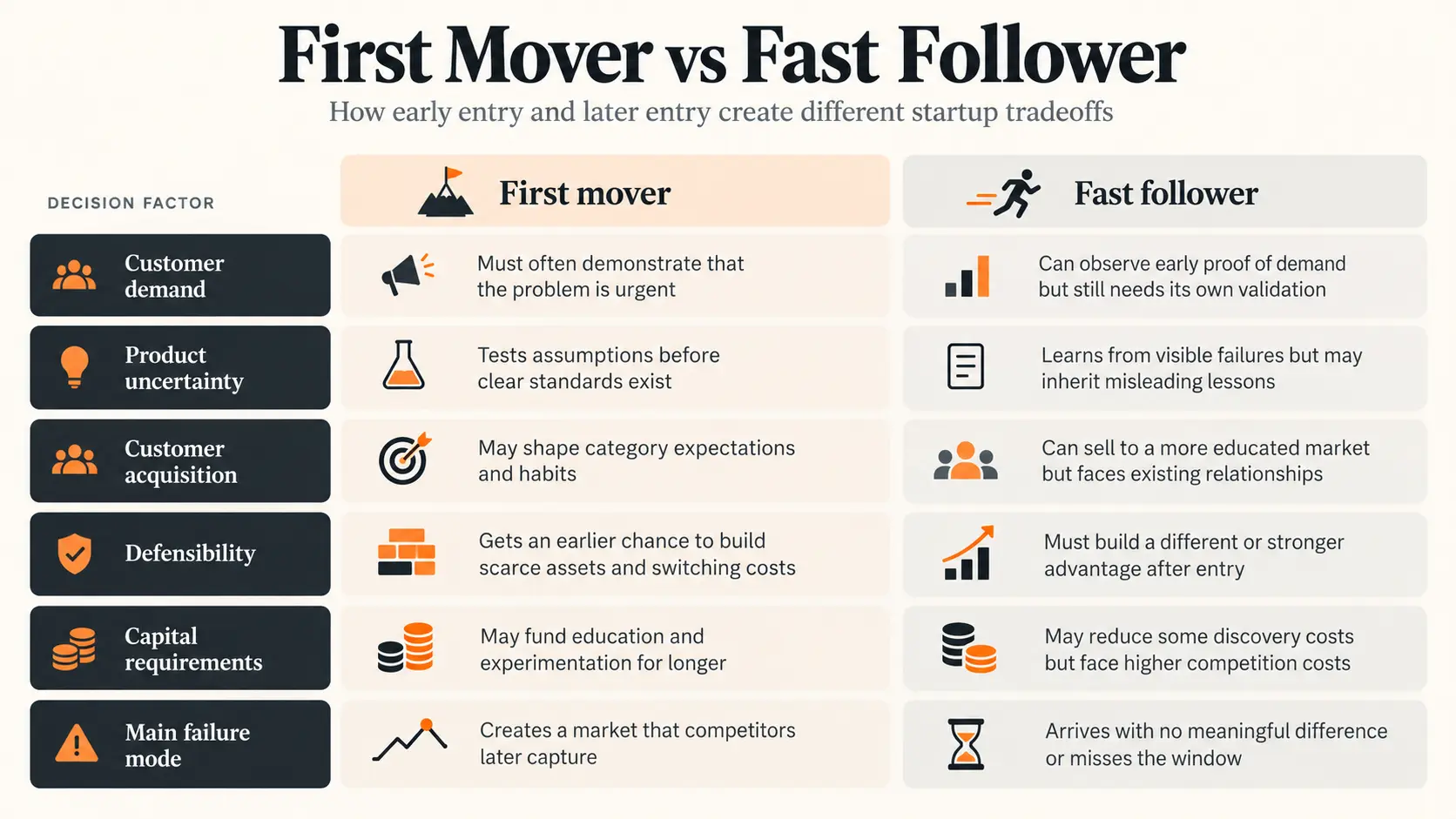
Early entry becomes valuable when the pioneer can turn time into an asset that is hard for a later entrant to purchase or reproduce. This may mean obtaining access to a scarce distribution channel, securing a limited number of strategic integrations, or learning from customer behavior in ways that steadily improve the offering. The first company to launch does not win simply because people remember its name. It wins if those early relationships or capabilities increase the cost or difficulty of competing.
Early learning creates a measurable lead
A founder might see the same software features on two websites and assume the products are interchangeable. Yet one company could have spent a year learning which errors matter most in production, how approvals actually work, and which exceptions customers will not tolerate. If that knowledge improves outcomes and is embedded in a repeatable operation, being early has created an advantage. If it remains undocumented founder intuition, the benefit is fragile and hard to scale.
Scarce resources and customer habits become difficult to dislodge
A pioneer may reserve a valuable supply relationship, establish trust in a sensitive market, or become a routine part of how customers work. Switching then requires more than installing another app. Buyers may need to retrain staff, rebuild connections, or accept operational risk. Those costs can protect early relationships. However, inconvenience alone is a poor foundation for loyalty. If customers resent the arrangement, a later entrant may eventually win them with easier migration and a better service experience.
The market is ready to reward the investment
A startup can be years ahead of widespread demand and still lose because education, infrastructure, or customer budgets are not ready. Research on market entry has long emphasized the interaction between the pace of technological change and the pace at which a market develops. A founder should therefore ask how much capital is needed to reach an actual buying cycle, not merely how exciting the category appears today.
Why Fast Followers Sometimes Have the Better Opportunity
Followers can benefit from a market that someone else helped make understandable. Early entrants expose which features buyers value, what breaks at scale, which acquisition channels work, and where pricing creates resistance. A strong follower uses this evidence to design a distinct proposition rather than repeating the pioneer's mistakes. Its advantage comes from interpretation and execution, not from the mere act of arriving later.
The challenge is speed with discipline. Waiting for perfect certainty forfeits the main benefit of following quickly. The team must have a credible way to ship, acquire customers, and improve more effectively than the pioneer. Better onboarding, a clearer target segment, more reliable operations, or an overlooked distribution partner can matter more than another incremental feature. A fast follower that has no compelling reason to be chosen is just a late entrant.
Two Real Examples Show Why Timing Is Not Destiny
Web search existed before Google became a company in 1998. Google's entry did not make the business a pioneer of web search in the broad sense. Its history is a reminder that being first to a category and building the product users eventually prefer are separate achievements. The example does not prove that waiting is always better; it shows why the category's first launch date is an inadequate explanation for long term success.
Social networking tells a similar but more complex story. Friendster launched in 2002, MySpace followed in 2003, and Facebook began as a Harvard network in 2004. Historical research describes how these services differed in audience, reliability, community design, and expansion. Facebook's later success is not evidence that followers automatically win, and Friendster's difficulties are not evidence that pioneers automatically fail. What mattered was what each company built, whom it served, and whether it could sustain adoption as the market evolved.
Five Questions That Should Determine Your Entry Strategy
1. How fast is the underlying technology changing?
If important capabilities improve every few months, an early product may need repeated rebuilding. A later entrant could start with cheaper infrastructure or more mature tools. Conversely, when technical knowledge requires a long learning cycle and accumulates through usage, entering early may be worth the cost. Founders should distinguish a transient feature advantage from learning that survives the next technology cycle.
2. How quickly will buyers become ready to pay?
Early interest is not the same as budget approval. Interview the person who would authorize spending, identify the event that triggers a purchase, and estimate the time between a successful pilot and a paid rollout. If the market will not be commercially ready before the startup needs another financing round, pioneering may become a financing problem rather than a product opportunity.
3. What can a rival not copy once it sees your product?
Ask the team to imagine a well funded competitor launching the same visible features in six months. What would the startup still possess? Answers could include permissioned customer context, a trusted relationship, distribution rights, regulatory expertise, or a significantly better operating process. If the only answer is a six month head start, early entry may be useful for growth but insufficient as a competitive defense.
4. Can the team turn feedback into improvements faster than competitors?
A first mover needs a learning system that converts early usage into better results. A fast follower needs the ability to learn from external signals without confusing another company's audience with its own. Both should measure time from observing a problem to shipping a verified improvement. An unresponsive pioneer can waste its lead; a slow follower may simply miss the opening it identified.
5. Do the unit economics survive the chosen timing?
The earliest company may shoulder the expense of educating an unfamiliar market. A follower may pay more to displace established suppliers or compete for the same advertising inventory. In either case, compare expected customer value with acquisition costs, onboarding burden, support demands, and the cash required until repeatable sales emerge. Market position is less important than whether the business can afford to hold it.
A Practical Entry Timing Test for Founders
Consider two hypothetical teams building software that helps regional clinics coordinate referrals. Team A wants to launch immediately because no specialist vendor has claimed its narrow segment. Team B plans to watch early deployments for three months, then focus on one workflow with clear administrative savings. Neither plan should be approved because of its calendar. Both need evidence of buyer urgency, access to real users, integration requirements, and a path to repeatable acquisition.
Team A should test whether early agreements produce defensible learning or simply expensive custom work. Team B should test whether waiting yields genuine insight and whether it can enter before customers become committed to the original provider. Both can run a small paid pilot, track setup time, measure an operational outcome, and ask customers what would make them choose a competing service. The pilot does not need to predict the entire market. It needs to reveal which timing risks are real.
A useful decision rule is to enter earlier when access, learning, and customer commitment compound faster than the cost of educating the market. Following becomes more attractive when the pioneer is absorbing uncertainty that the startup cannot afford, and when the team has a distinctive way to serve the validated demand. In either case, name the advantage you expect to accumulate and specify what evidence would falsify that assumption.
Mistakes That Make Either Strategy Fail
One common mistake is treating a first mover label as a fundraising narrative rather than a business hypothesis. Another is using a successful later entrant as proof that imitation works. Founders also confuse strong early signups with durable demand, ignore switching costs that protect incumbents, and assume a new technology will automatically create customer willingness to pay. These errors are not unique to pioneers or followers. They result from substituting a category story for customer evidence.
The most revealing mistake is failing to update the strategy when the market changes. A pioneer that notices competitors closing the feature gap should invest in a harder to replicate capability rather than insisting on historical priority. A follower that finds a niche with unusual customer needs may become a pioneer within that niche. Timing is a choice made under uncertainty, and a useful strategy stays responsive to what the market proves.
The Best Timing Strategy Is the One You Can Defend
The practical choice is not between heroic pioneers and clever imitators. It is between two ways of managing uncertainty. First movers must turn their head start into an accumulating advantage before competitors catch up. Fast followers must use what the market has revealed to create a sharper proposition before the opening closes. For a startup, the winning question is not who arrived first. It is what the company can keep doing better after everyone knows the opportunity exists.
FAQ
Is first mover advantage always better than being a fast follower?
No. Early entry offers more time to build relationships and capabilities, but it also exposes the startup to uncertainty and education costs. A fast follower can succeed when it uses market evidence to offer something materially better. Either strategy fails without a sustainable reason for customers to choose the business.
Does being first guarantee a startup moat?
No. A moat requires an advantage competitors find difficult to reproduce or overcome. Being first may help a team build that advantage, but the position disappears if rivals can match the experience without facing meaningful barriers.
Can a fast follower still be innovative?
Yes. A follower may create a new business model, serve customers the pioneer ignored, improve distribution, or solve operational problems the first entrant never addressed. Following a category is not the same as copying its product.
Which strategy is better for an AI startup?
It depends on how quickly models and customer expectations are changing. Early AI applications may face rapid feature commoditization, while later entrants can benefit from more capable tools. Startups in either position need durable advantages beyond access to the same foundation model.
How can founders tell whether they entered too early?
Warning signs include repeated unpaid pilots, long buyer education cycles, missing infrastructure, and customers who praise the idea but cannot approve a budget. These signals do not automatically justify abandoning the market. They show that timing and runway assumptions need to be tested again.

Mohsen Avid
Founder & Editor, PinerookMohsen Avid is the founder of Pinerook, covering entrepreneurship, startup strategy, digital business, and the decisions behind building new ventures.
 Seen first.