A SaaS customer may like a rival product and still decide not to switch. Moving historical records, rebuilding integrations, retraining staff and risking an interruption to daily work can cost more than the apparent savings. Those costs help explain why established software can remain difficult to displace, even when a newer competitor has a cleaner interface or a lower subscription price.
For a founder, the important distinction is whether those barriers exist because the product has become genuinely useful or because the vendor has made departure unnecessarily painful. In the wider picture of Startup Moats, switching costs protect an existing customer relationship, but only lasting customer value makes that protection healthy. A strong SaaS company should be difficult to replace for good reasons, not impossible to leave.
What Are Switching Costs in SaaS?
Switching costs are the time, money, effort and operational risk a customer expects to incur when replacing one software provider with another. The cost is broader than an early termination fee. A finance team changing accounting software may have to validate years of transactions, reconstruct approval permissions and test reports before the new system is safe to use. Even where the replacement license is cheaper, the transition itself can be expensive.
These costs differ from customer satisfaction. A user can be delighted by a product and still find it easy to replace. Another may actively dislike their current system but postpone migration because a failure would interrupt payroll or customer support. Both customers might renew, yet the reasons behind their retention tell very different stories about product quality and long term resilience.
Where SaaS Switching Costs Come From
Data migration and continuity
Records rarely move as neatly as a spreadsheet export suggests. Field definitions, attachments, permissions, audit histories and relationships between records can become difficult to reproduce elsewhere. In products used for regulated or business critical decisions, the buyer may need to reconcile old and new data before accepting the switch. This is a legitimate source of transition work, though proprietary data formats that serve no customer purpose can turn useful continuity into artificial dependence.
Integrations and embedded workflows
A product connected to payments, identity management, internal reporting and customer communications occupies a different position from a standalone utility. Replacing it may involve updating application interfaces, changing approval steps, reworking automated jobs and coordinating several teams. The more important question is not how many integrations exist, but how costly it would be to reproduce the business outcome those integrations support.
Training, habits and organizational change
Employees build routines around software. Managers learn where to find exceptions, support staff learn how to resolve unusual cases and administrators create rules that are not always documented. A replacement product may be technically better but still introduce temporary mistakes while people learn it. These transition costs tend to grow when a system serves multiple departments rather than one individual user.
Trust and operational risk
When software handles scheduling, financial approvals or sensitive customer operations, the customer must be confident that a new provider will work under real conditions. Evaluating security, testing business continuity and negotiating responsibilities can take longer than installation. Trust can make an incumbent harder to displace, but it must be earned through reliable service and transparent practices rather than fear of losing access.
Switching Cost Types at a Glance
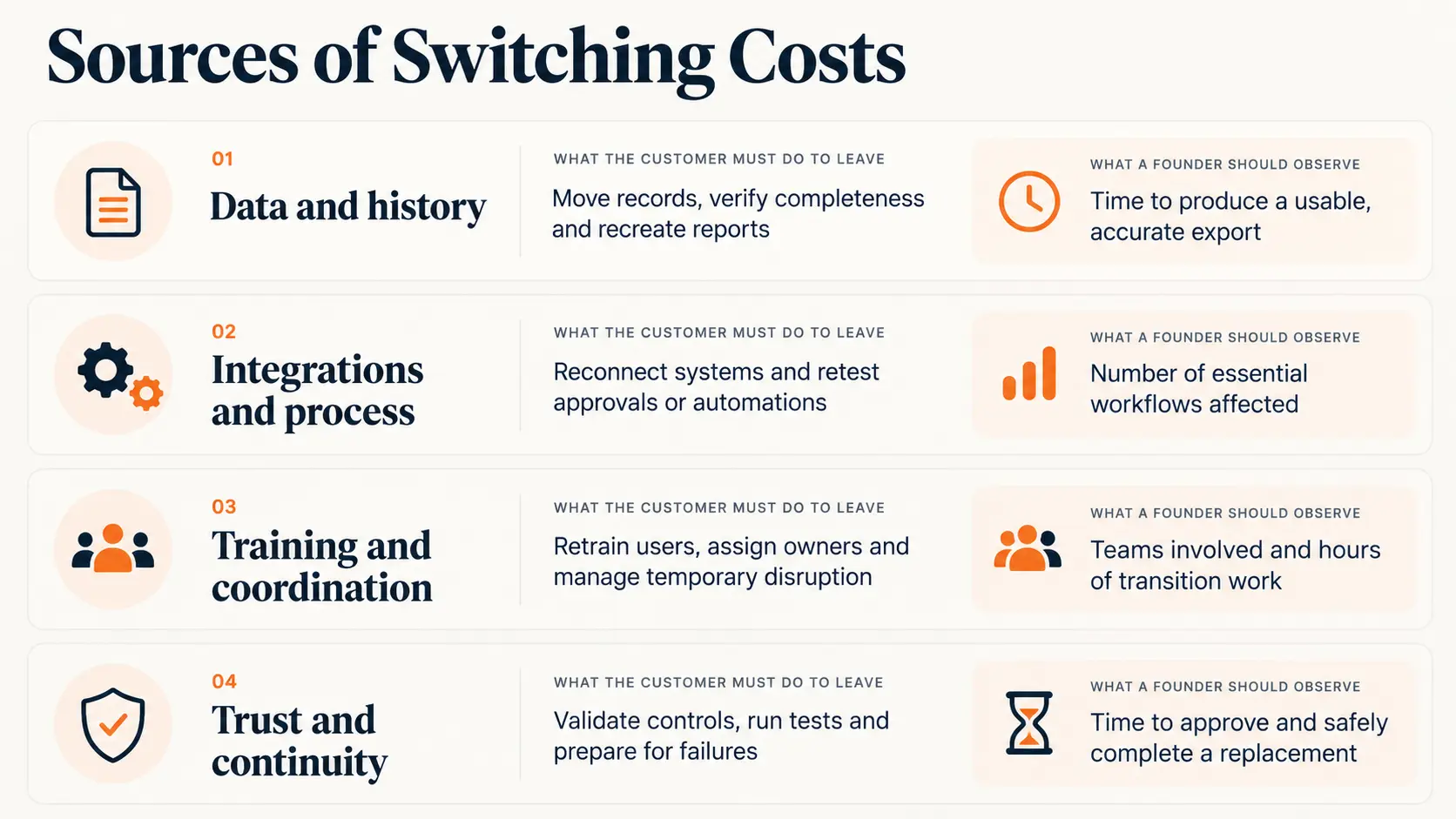
The table describes sources of cost, not a recipe for making exit deliberately complicated. A startup should understand each source because it reveals what customers rely on and what a new competitor would need to replicate. That same understanding can improve onboarding, documentation and portability.
How Switching Costs Become a Real Competitive Advantage
The strongest switching costs usually arise as a side effect of doing an important job consistently well. A small scheduling platform might initially handle bookings for one team. After it proves reliable, the customer may connect it to payroll, define shift approval rules and involve location managers. The software becomes important not because the supplier hid the export button, but because replacing the service would require rebuilding a functioning operating process.
That process can deepen over time, but additional features do not automatically create a moat. A dozen integrations that nobody uses add little protection. A single integration that prevents expensive payroll errors may matter far more. Founders should identify the work customers cannot afford to interrupt, then make that work measurably better. Continuing value gives buyers a reason to accept the cost of staying; manufactured friction merely gives them a reason to resent leaving.
Contracts can reinforce predictable relationships, especially where a supplier commits resources to an enterprise deployment. Yet long agreements should not be confused with product defensibility. A customer who renews because they face a penalty may abandon the platform as soon as the contract ends. A company that survives a straightforward comparison with alternatives has a more convincing claim to a durable position.
A Simple Example: The Economics of Replacing a SaaS Tool
Consider a hypothetical 30 person services company using a workflow platform. A competitor offers similar features for $200 less each month. On the surface, the new subscription would save $2,400 a year. The buyer estimates $1,600 to clean and validate historical records, $2,400 to rebuild three essential integrations, $1,800 for staff training and $1,000 for temporary support during the transition. The estimated one time cost of moving is $6,800.
At $200 in monthly subscription savings, the simple payback period is 34 months, before allowing for the time value of money, new risks or differences in product quality. That does not mean the existing provider has an unbreakable moat. If the rival also improves productivity enough to save another $700 per month, the combined illustrative benefit becomes $900 per month and the simple payback falls to about eight months. A meaningful improvement in customer outcomes can overcome apparently high switching costs.
These numbers are a planning example, not industry benchmarks. In a real buying decision, a founder should test estimates with customers and separate one time migration work from continuing differences in fees, productivity and risk. Switching costs matter because buyers compare the full cost of change with the expected benefit of changing, not because they calculate a universal threshold.
How to Measure Switching Costs Without Misreading Retention
Customer retention is a useful starting point, but it is not a direct measure of switching costs. A high renewal rate might reflect satisfaction, discounts, annual contracts or a shortage of alternatives. Similarly, net revenue retention can improve because several customers purchase more seats while other accounts become dissatisfied. Neither figure identifies why a buyer would struggle to leave.
A founder can build a more credible picture by combining product evidence with buyer interviews. Ask what a customer would need to replace before migrating, who would approve a change, which reports must remain consistent and how long a parallel run would take. Observe whether customers continue to use important workflows after their first contract, whether integrations support recurring tasks and whether procurement teams name migration effort as a genuine reason for renewal.
Track renewal rates by cohort alongside gross revenue retention, product adoption and customer complaints. Gross revenue retention shows how much recurring revenue from an existing group remains after downgrades and cancellations, excluding expansion. Net revenue retention also includes expansion. Both are useful financial outcomes, but strong results should be checked against the product work customers actually depend on. A growing account can conceal an unhappy department; a customer with extensive configuration can still switch quickly if a rival supplies migration tooling.
The Difference Between Switching Costs and Network Effects
These two sources of defensibility are often mentioned together, but they protect a business in different ways. Switching costs concern what an existing customer must sacrifice or rebuild to change suppliers. Network effects arise when a product becomes more useful as additional participants join. A project management system may have substantial migration effort without getting better when unrelated companies sign up. A marketplace may become more useful as buyers and sellers join even if any individual member can leave easily.
Both effects can exist in the same company. For this article, however, the practical question is narrower: what would it take to replace the product inside one customer organization, and has that difficulty emerged from value the customer genuinely wants to keep?
When Switching Costs Hurt the Business
Founders sometimes mistake deliberate lock in for a defensible business model. A vendor can restrict data exports, impose confusing cancellation steps or use proprietary formats that make migration needlessly expensive. This may delay churn in the short term, but it also creates sales objections, damages trust and gives competitors an easy way to differentiate. Enterprise buyers often assess exit provisions before signing precisely because they do not want to depend on a supplier that cannot be replaced safely.
Portability and defensibility are not opposites. A startup can provide clear exports, documented integrations and fair cancellation terms while remaining difficult to replace because its service is reliable, its workflow fits the customer and its team understands the operational problem. A product that customers choose to keep despite having a credible exit is stronger evidence of competitive advantage than a product customers cannot escape.
What Early Stage SaaS Founders Should Build First
At the beginning, a startup should concentrate on one recurring problem with a measurable consequence. A reporting tool that reduces reconciliation time each week has a clearer path to durable adoption than a broad platform promising to replace every spreadsheet. Once that value is proven, the next investment should usually be in reliable integrations, permissions and repeatable onboarding that make the product useful across the real team rather than impressive only in a demo.
As the company grows, collect specific evidence of dependency. Which tasks stop if the product is unavailable? Which approved processes would need redesign during migration? Which employees rely on it, and could the customer reconstruct the same outcome elsewhere within a week? Answers to these questions inform both roadmap choices and a realistic view of competition. If a rival can migrate a customer in an afternoon and deliver the same outcome, the product may have healthy retention but little structural protection.
The goal is not to raise the cost of leaving for its own sake. It is to increase the value customers would give up by leaving. For SaaS startups, that distinction separates a sustainable relationship from a temporary obstacle.
FAQ
Are switching costs always good for SaaS companies?
No. Costs created by reliable workflows, necessary integrations and genuine organizational adoption can support retention. Costs caused by hidden data restrictions, confusing contracts or avoidable migration obstacles may damage trust and make future sales harder.
Do switching costs matter for small SaaS startups?
Yes, but a young company should not attempt to create complexity before proving value. A small startup can begin with a recurring task customers depend on and gradually become more deeply integrated as adoption grows.
Does low churn prove that customers face high switching costs?
No. Low churn can reflect satisfaction, weak competition, contract terms or temporary customer inertia. Interviews, workflow adoption, migration estimates and renewal behavior together provide stronger evidence than a churn figure alone.
Can customers switch even when migration is expensive?
Yes. A competitor that offers sufficient savings, better performance or lower operating risk may justify the transition. Switching cost is one part of the buyer’s economic decision, not an absolute barrier.

Mohsen Avid
Founder & Editor, PinerookMohsen Avid is the founder of Pinerook, covering entrepreneurship, startup strategy, digital business, and the decisions behind building new ventures.
 Seen first.