
Prediction markets turn uncertain future events into prices that change as people trade on competing expectations. A contract asking whether a measurable event will happen might trade at 62 cents, which is commonly interpreted as roughly a 62% market implied probability. That number is useful because it updates as participants respond to news. It is not a guarantee, an official forecast, or necessarily the true probability of the event.
The industry has expanded beyond elections into economic releases, weather, entertainment, sports, and business outcomes. Its growth has made an old economic question newly relevant: can a price produced by people with money at risk reveal information that surveys and expert forecasts miss? The answer depends less on the attention surrounding a platform than on the quality of the contract, the people trading it, and the rules that determine the final result.
What a prediction market actually measures
A prediction market is a venue where participants trade contracts whose value depends on a defined future outcome. Unlike a share of stock, an event contract does not give ownership in a company or an ongoing claim on profits. Its settlement value is determined by what happens before, on, or after a stated deadline, according to the contract rules.
Most familiar examples involve two outcomes, Yes and No. Buyers who consider an outcome more likely may be willing to pay more for the relevant contract, while sellers or holders of the other side take a different view. Trading brings those views into a continuously changing price. The resulting market price summarizes what marginal participants are willing to pay at that moment, rather than a representative vote of the population.
That distinction matters for anyone using these markets to assess the economy. A prediction market is a mechanism for aggregating beliefs under financial incentives. It becomes a useful forecast only when its design and trading conditions allow those beliefs to be expressed without too much distortion.
From a clearly defined question to a final payout
1. The outcome must be measurable
A contract might ask whether an official inflation reading will exceed a specified threshold when it is first released. The wording must identify the release, date, value, and authoritative data source. “Will inflation be high?” cannot be resolved as clearly as a statement tied to a particular published figure.
This is why the fine print of event contracts deserves more attention than a simple definition of Yes and No shares: the wording, determination source, cancellation provisions, and dispute process can change the economic meaning of what people think they are buying.
2. Participants supply a price
After a contract is listed, traders submit orders based on their own estimates of the outcome. Some may use statistical models; others react to news, sector knowledge, or competing forecasts. In an order book, prices reflect bids and offers, and actual execution can differ from the last displayed trade, especially in a market with little activity.
3. News changes the collective estimate
A new economic indicator or company announcement can lead participants to revise their expectations. The price can move immediately, but the direction and scale of the move are not proof that the new consensus is correct. A small number of large orders can also produce a sharp change if the available order book is thin.
4. A documented event closes the market
After the relevant event, the venue applies its written resolution criteria. A typical binary winning contract settles at $1 and the losing side at $0, although individual market terms and fees differ. Some outcomes can be disputed when official sources are revised, different agencies publish conflicting numbers, or the question was drafted too vaguely. Sound settlement rules are therefore as important as price discovery.
Reading a market price without overstating certainty
Consider an illustrative contract on whether a specified central bank announcement will occur by a fixed date. If a Yes share is priced at $0.63, people often describe that quote as a 63% implied probability. If the qualifying outcome occurs and the contract settles at $1, the holder receives the stated settlement value. If it does not, the share is worth $0 at resolution. Fees and execution costs affect the actual economics.
The 63% interpretation is a practical convention, not a mathematical promise about reality. The quote can reflect an illiquid order book, risk preferences, transaction costs, contract ambiguity, or a trader who wants to hedge an unrelated exposure. A market can also disagree with an independent statistical model without either being obviously irrational.
For that reason, understanding prediction market odds begins with the contract definition and actual tradable prices rather than treating every number on a screen as an objective probability. When bid and ask prices are far apart, it may be more honest to describe a range of market views than to report a precise percentage.
A founder watching a policy rate market, for instance, should not rewrite the company budget simply because an implied probability moves from 55% to 65%. A stronger approach is to test the financial plan under several rate outcomes, then use market pricing as one input when deciding which scenario deserves additional attention.
The events these markets can inform
Economic event markets can express expectations about official interest rate decisions, inflation thresholds, growth indicators, and certain employment releases. Those prices may be useful to analysts assessing which policy or data outcomes are becoming more or less likely before a formal announcement.
Political and public affairs markets are widely followed because the underlying events attract information from many different observers. They can also be unusually sensitive to attention, partisan participation, legal restrictions, and the exact wording of the resolution criteria. Sports and entertainment markets attract different audiences and should not automatically be assumed to have the same informational value as economic markets.
Businesses may also define private questions about delivery deadlines, product adoption, procurement risks, or forecastable operational milestones. In every category, a strong contract asks something observable by an agreed time. A headline about a broad trend can attract interest; a measurable outcome is what makes a reliable settlement possible.
Market prices, polls, and statistical forecasts answer different questions
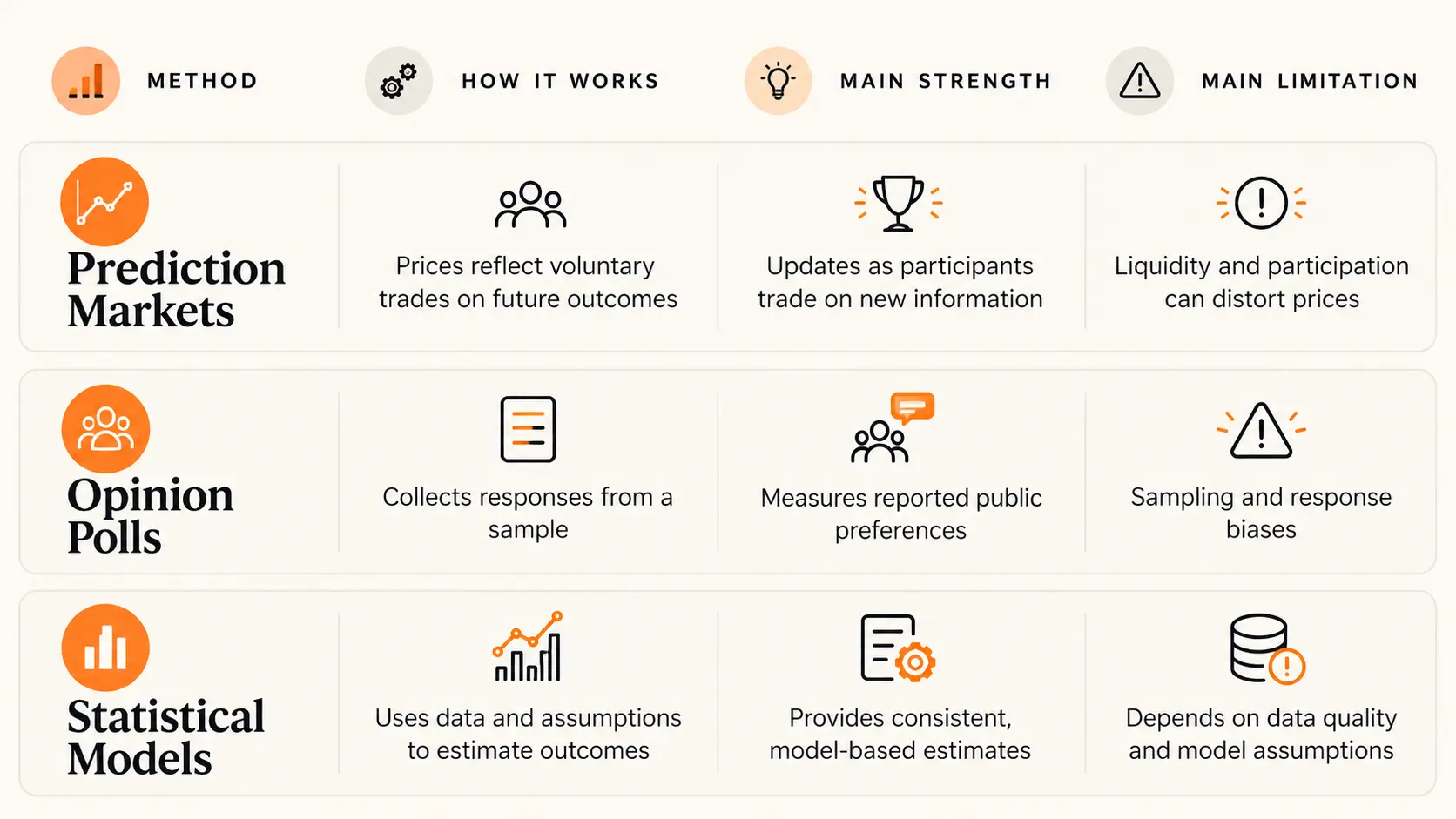
A poll estimates responses from a sampled population to specified questions. A model transforms assumptions and data into a forecast. A prediction market instead reports prices created by people choosing to trade on an outcome. These approaches may overlap, but their inputs, errors, and interpretations are different.
A useful comparison of prediction markets and polls does not ask which instrument “won” one famous election. It asks whether the survey sample is representative, whether the market attracts informed participants, whether the contract tracks the same outcome as the polling question, and how performance holds up across many resolved events.
Polling can capture current preferences without requiring respondents to predict final results. Markets can incorporate new information between polls, including anticipated turnout or a forthcoming data release, but they can also amplify concentrated narratives. A thoughtful analyst compares independent evidence rather than declaring a universal winner.
Forecast quality depends on calibration, liquidity, and participation
Calibration matters more than a single correct call
A market that assigns 70% likelihood to many comparable events is well calibrated if about 70% of those events eventually occur. A single successful prediction tells us little about calibration. Researchers therefore evaluate many resolved markets, often using scoring methods that penalize confident mistakes and reward honest probability estimates.
Recent research adds important nuance. A Kalshi research paper published in August 2026, using the exchange’s resolved market history, reported improved calibration as contracts approached resolution. Because the analysis comes from a venue studying its own markets, it is useful evidence but not a guarantee that another venue or a thin new market will perform as well. Claims about prediction market accuracy are best assessed by event category, forecast horizon, and sample selection, not by one overall accuracy percentage.
A price is less convincing when few people can trade
In practice, prediction market liquidity affects whether a displayed quote represents a competitive market or simply the last small trade. A wide bid and ask spread, shallow available orders, and limited participation can make it costly to enter or exit and easier for one participant to move the price. High reported trading volume is informative, but it does not by itself demonstrate a deep market at the current quote.
Participant diversity matters too. A market with many independent information sources can aggregate knowledge more effectively than one in which most participants copy the same commentator or model. Liquidity and genuine diversity are related, but not identical: an active market can still be dominated by one shared belief.
Platforms turn a market concept into different products
Kalshi and Polymarket have helped make outcome contracts visible to mainstream audiences, but a platform name does not define a uniform product. Rules can differ across contract types and jurisdictions, including trading access, fees, settlement sources, dispute procedures, and the underlying technology used to record or resolve outcomes.
A meaningful Kalshi vs Polymarket comparison should therefore examine the exact contract, available liquidity, resolution policy, applicable legal framework, and customer protections rather than award a winner based on branding or headline trading volumes. One market can have a stronger price signal than another even when both address the same public event.
For Pinerook readers, the broader business lesson is that an information market depends on trust in its market design. A polished interface may attract users, but sustained usefulness comes from clear rules, fair access, credible resolution, and participation that survives the news cycle.
Regulation and market integrity remain decisive in 2026
In the United States, event contracts sit within a changing legal and regulatory environment. The Commodity Futures Trading Commission oversees many federally regulated derivatives venues, while state authorities and other parties have disputed the treatment of some event contracts, especially those tied to sports. The existence of a federal registration framework does not settle every dispute over every event type.
On October 9, 2026, the CFTC announced a proposed rule intended to clarify that certain event contracts fall within the definition of a swap. On the same date, it announced an interim final rule addressing exclusions for casino style gambling products. A proposal is not a final rule, and ongoing litigation means a simple “legal everywhere” or “illegal everywhere” statement would be misleading. Coverage of prediction market regulation therefore requires regular updates and careful distinctions between proposals, effective rules, court decisions, and platform level restrictions.
Regulatory questions also concern consumer protection, market surveillance, material nonpublic information, and fair settlement. The possibility of prediction market manipulation is not limited to a dramatic false price spike: concentrated positions, misleading information, coordinated trading, or influence over the event itself can all undermine confidence. Exchanges and regulators may apply surveillance and conduct rules, but those controls do not eliminate the risk.
Traders can lose the full amount paid for a losing binary contract. Anyone using market prices as a business indicator should separate the informational usefulness of a quote from the financial and legal risks of participating in the market.
Why businesses are paying attention
Companies make forecasts constantly: when a product will launch, whether a customer segment will renew, whether a supplier will deliver on schedule, or whether a project will stay within budget. Traditional forecasts tend to flow through meetings, spreadsheets, and management chains. Prediction markets offer another way to elicit expectations from people who may hold information that formal reporting misses.
Research published in the Review of Economic Studies examined internal markets at Google, Ford, and another firm and found that, in those settings, market forecasts could improve on expert forecasts for some questions. The study also identified limitations such as thin participation and optimism bias. That evidence supports experimentation, not the idea that every company should replace planning teams with a trading system.
Well designed corporate prediction markets use clear operational questions, appropriate incentives, privacy protections, and an agreed process for acting on results. If a market assigns only a 30% chance to a product shipping on time, the useful response is to investigate what participants know and which dependencies are at risk, rather than treating the number as a verdict on the team.
The economics behind prediction market platforms
Prediction markets need participants on both sides of trades, credible mechanisms for matching and settlement, and enough economic incentive for people to contribute information. Platforms can earn revenue through trading or other transaction fees, and some may pursue data, infrastructure, or enterprise services. Exact pricing models vary by venue and product.
The economics are not captured by trading volume alone. A platform can report substantial notional activity while earning only a fraction of that amount in fees. Market making incentives, compliance, payment processing, customer support, dispute resolution, and user acquisition can all affect profitability. That distinction matters when evaluating prediction market business models, where revenue quality and cost structure are more informative than attention alone.
There is also a tension between entertainment driven growth and forecasting value. Popular markets can generate engagement, but a durable information business needs trustworthy outcomes, meaningful liquidity in economically relevant questions, and an audience that returns because the probabilities help them make decisions.
A practical framework for evaluating a market signal
Before relying on a probability in a board presentation, economic memo, or startup forecast, assess the contract itself. The following checks separate a useful market estimate from an attractive but fragile number.
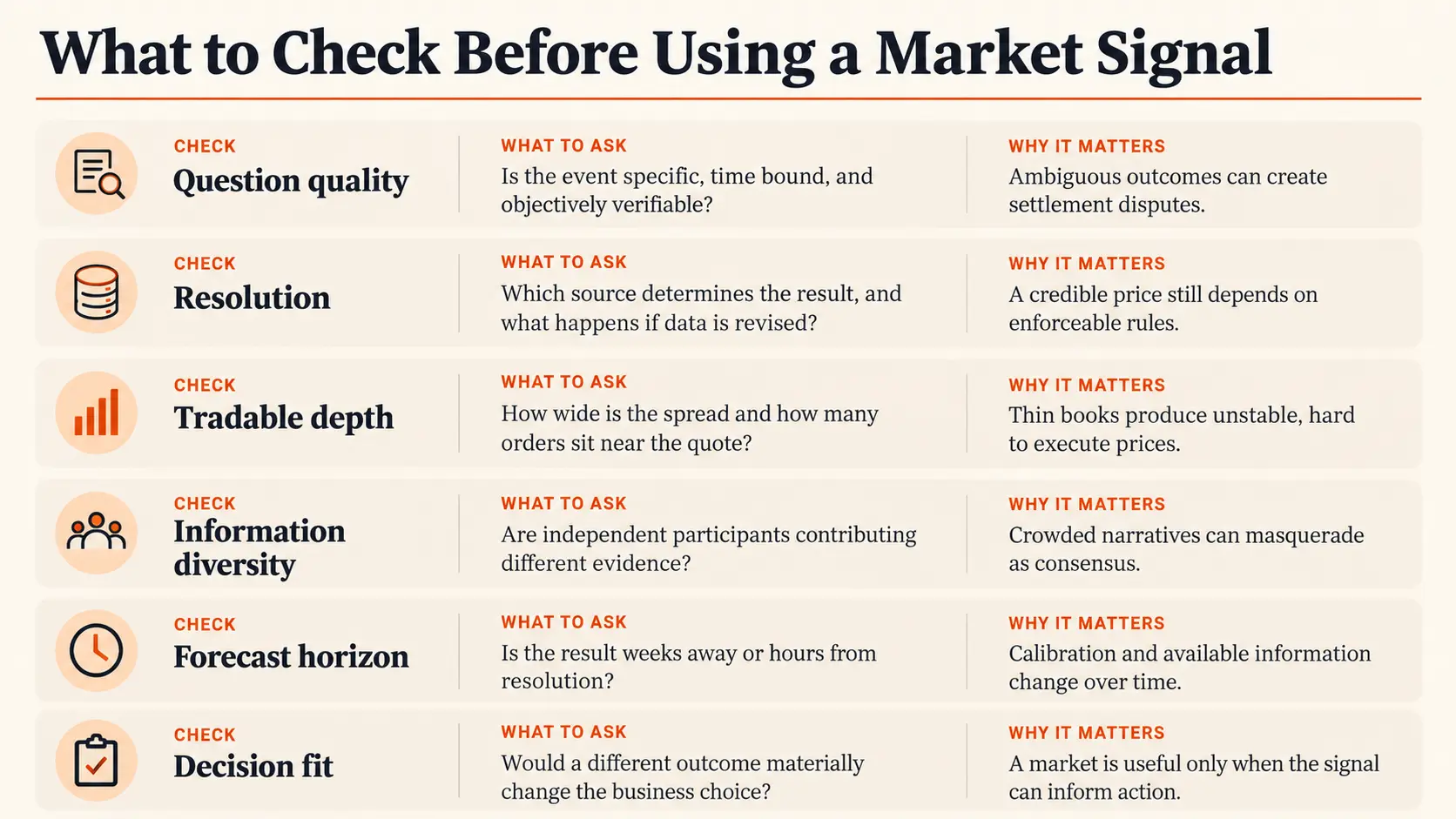
For example, suppose a company is exposed to higher financing costs if a central bank keeps policy rates unchanged. A market price can help the finance team decide which scenario to examine, but the operating plan should still include cash runway under both rate outcomes. A market can inform the weight assigned to a scenario; it should not substitute for the scenario analysis itself.
FAQ
Are prediction markets the same as gambling?
Both involve uncertainty and the possibility of financial loss, but their product design and legal treatment may differ. Some event contracts trade as regulated derivatives, while the status of particular events and platforms can be contested. The correct characterization depends on the product, jurisdiction, and current rules.
Does a 70% prediction market price mean an event will happen?
No. It is a market implied estimate at a particular moment. In a properly calibrated set of similar forecasts, events assigned around 70% should happen roughly seven times out of ten, not every time. Fees, liquidity, and contract design can also affect the price.
How are contracts settled when the outcome is unclear?
Settlement follows the contract’s prepublished rules and specified evidence sources. Some platforms provide procedures for challenges or disputes. When a question is vague or data is revised, resolution can become more complex than the simple Yes or No display suggests.
Are prediction markets more accurate than polls?
Not consistently across every event. Polls measure sampled opinion, while markets price expectations among people who choose to trade. Relative performance depends on the question, forecasting horizon, sample or participant quality, and the record of resolved forecasts.
Can startups use prediction markets without trading publicly?
Yes. Internal forecasting mechanisms can be structured around delivery dates, launches, operational milestones, or demand estimates. They still require clear rules, suitable incentives, safeguards for sensitive information, and a way to use the results constructively.
What makes one prediction market more trustworthy than another?
Clear event terms, objective resolution sources, meaningful trading depth, diverse informed participation, transparent fees, and credible market oversight all strengthen the signal. A popular market or a sharply moving price is not automatically reliable.
Why are prediction markets receiving regulatory attention in 2026?
Their reach has expanded across event categories that raise different questions about derivatives oversight, gambling law, consumer protection, and market integrity. U.S. regulators and courts are still addressing parts of that boundary, so rules and access can change.

Masoumeh Jahangard
Markets & Economy Writer at PinerookMasoumeh Jahangard covers markets, economic trends, and business conditions for Pinerook, focusing on how they affect startups and growing companies.
 Seen first.