A prediction market price can look precise even when the market behind it is fragile. A contract quoting a 70% chance of an event may reflect many independent judgments, or it may reflect a handful of trades in a market with little depth. Prediction market manipulation is the deliberate attempt to mislead participants about market activity, prices, or the underlying event. The practical challenge is separating intentional abuse from ordinary volatility, news, and genuine disagreement.
For readers using Prediction Markets as a source of information, that distinction matters more than any single price movement. Market odds can help businesses interpret uncertainty, but only when the trading process and the event rules are credible. A suspicious chart does not establish misconduct on its own; a sound assessment asks what changed, who could have influenced it, and what independent evidence supports the market's new price.
What prediction market manipulation means
Manipulation is not simply buying a large position or being right before other traders. It involves conduct intended to create a false or misleading impression, interfere with fair trading, or affect the event or data used for settlement. Some misconduct targets the visible market: reported volume, order book signals, or the price other users see. Other conduct targets the information environment, such as misuse of confidential knowledge. Still other conflicts arise when a participant can influence whether the contracted event happens in the first place.
These categories overlap, but they should not be collapsed into a single accusation. An informed trader acting on public research may legitimately move a price. A market maker can submit and cancel many orders while managing inventory. And a contract can trade at a surprising price simply because few people are participating. The relevant questions are whether trading has real economic purpose, whether signals are deceptive, and whether platform rules or applicable law have been breached.
The main ways a market signal can be distorted
Artificial volume through wash trading
Wash trading creates the appearance of activity without the normal transfer of market risk between independent participants. A trader or coordinated accounts may effectively trade with themselves or each other, producing transactions that inflate reported volume. That matters because users often read a busy market as a credible one. Yet a high historical volume figure says little about the number of genuinely independent opinions or the depth available for a new order. A Columbia Business School study of Polymarket transaction networks identified patterns consistent with substantial wash trading in parts of its historical sample, while stressing that algorithmic classifications are estimates rather than proof about each trade.
Misleading orders and short lived price pressure
Spoofing involves placing orders intended to give a misleading picture of demand or supply rather than to execute bona fide trades. In a thin market, even genuine orders can produce sharp price changes, so an unusual move is not enough to infer this practice. A sudden leap from 43 cents to 67 cents may come from new information, an aggressive buyer, or simply too few resting orders. The useful distinction is whether displayed interest is genuine and whether the price holds as independent participants begin trading.
Misuse of material nonpublic information
An individual close to an event may know details before the public. An employee who has access to a yet to be released video, for example, has an advantage unlike an analyst forming a view from public evidence. The legal treatment depends on duties, conduct, contract design, jurisdiction, and exchange rules; it is not accurate to call every trade by a well informed person illegal insider trading. In February 2026, the US Commodity Futures Trading Commission highlighted two Kalshi enforcement matters involving an individual trading on their own candidacy and a person with advance knowledge of video content. They illustrate why conflicts and duties matter alongside price behavior.
Influence over the outcome or its verification
A different risk appears when someone can help determine the result being traded. A participant who controls the release of an announcement, edits a qualifying publication, or influences the measure that triggers settlement may have leverage over the contract itself. Even without proven wrongdoing, markets that rely on a narrow, discretionary, or poorly defined source are more exposed to disputes. This is why the exact resolution criteria, responsible data source, cutoff time, and appeal process deserve attention before anyone treats a displayed percentage as reliable evidence.
Why smaller markets can be easier to disturb
Prediction markets cover unusually specific questions, some of which attract only a small group of traders. When there are few orders near the current price, a single transaction can shift the latest traded price considerably. A quoted probability may then change faster than the underlying evidence. This is a market structure issue, not necessarily manipulation. The danger comes when readers mistake an easily moved quote for a broad and settled consensus. Recent volume is also different from current order book depth: the first looks backward, while the second helps explain what price a new trade might actually receive.
Consider a hypothetical contract about whether a company will announce a partnership by Friday. It trades at 45 cents for most of the morning. One buyer then lifts the limited offers near the top of the book and the last trade prints at 72 cents. A social account posts that the market now sees a 72% likelihood. Without checking the amount traded, the spread, new public information, and subsequent activity, that statement turns a potentially fragile price into a stronger claim than the evidence supports. The example is illustrative, not a reported incident.
Warning signs and the innocent explanations to rule out
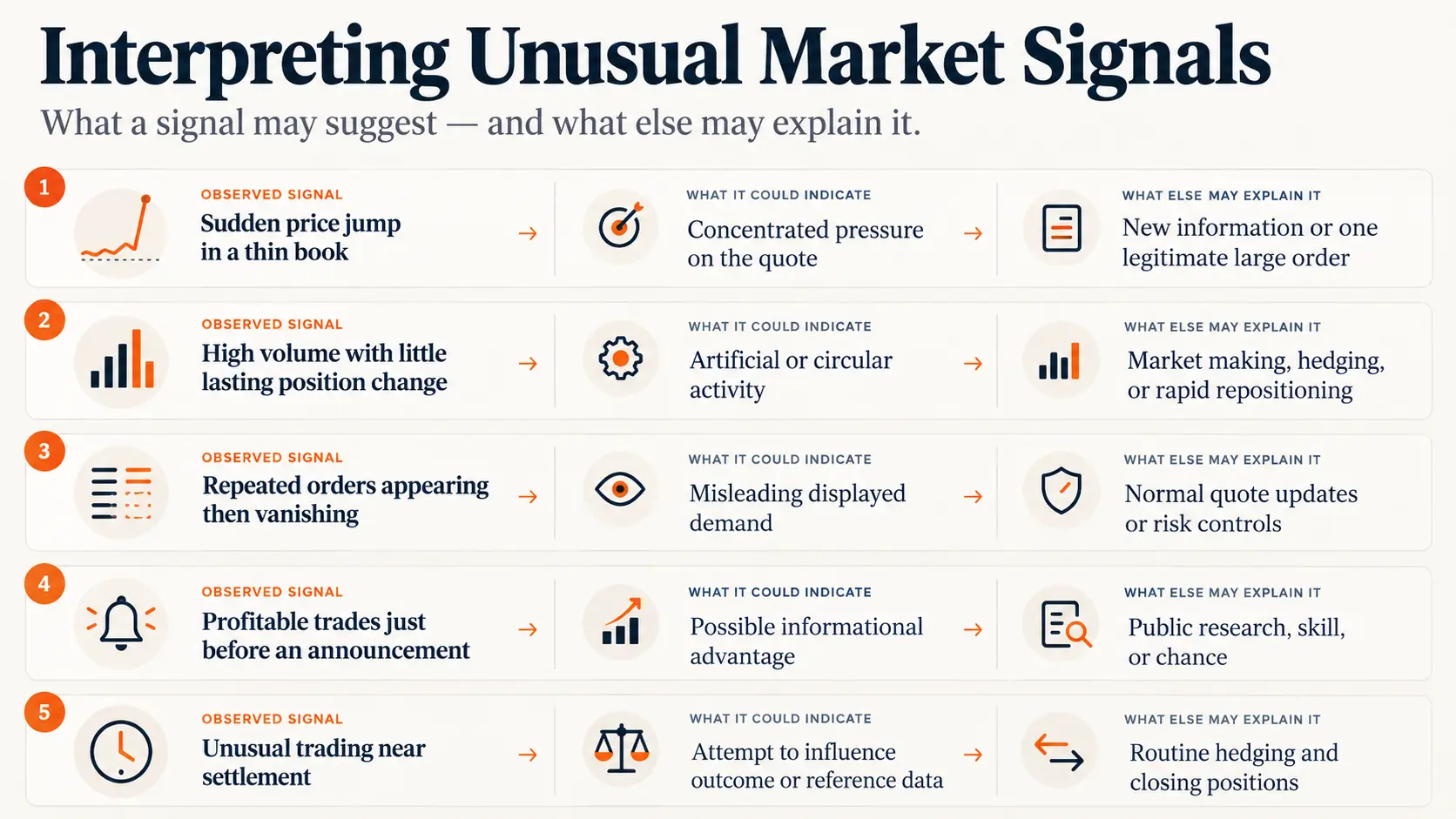
These observations should start a closer review, not end one. A pattern is more persuasive when it recurs, lacks an evident news explanation, involves economically linked accounts, or coincides with an incentive to change the settlement result. Outside observers rarely have all the identity, account, and order lifecycle records needed to establish intent. Public blockchains provide useful transaction histories on some platforms, but visibility does not automatically reveal who controls a wallet or why it traded.
How to assess a questionable market without overreacting
Start with the contract rather than the chart. Read the event's precise wording, resolution source, time boundaries, and conditions for a valid result. A vague settlement rule is a different risk from a manipulated trading price. Next, compare the price movement with a timeline of verifiable information. Was there an earnings release, an official announcement, a revised data series, or merely an unsourced post? A market moving after an identifiable public development presents a different picture from one moving without any clear catalyst.
Then look for breadth and persistence. Did the bid and ask tighten after the movement, or is a single isolated print carrying the headline? Has the price held across several independent trades? Can the market accommodate a modest new order without a dramatic change in execution price? These observations cannot prove fair dealing, but they help distinguish a potentially informative forecast from a brittle quote. If the activity appears unlawful, preserve the market identifier, timestamps, rules, screenshots, and transaction records, and use the platform's integrity reporting channel rather than making public allegations based on an unexplained spike.
What exchanges and regulators can do
Effective safeguards combine clear event design with monitoring after a market opens. Platforms can restrict conflicted participants, maintain audit trails, detect linked account activity, investigate suspicious order behavior, and establish procedures for disputed resolutions. In the United States, CFTC regulated designated contract markets have surveillance and rule enforcement obligations. The CFTC's February 2026 advisory explicitly discussed misuse of nonpublic information, wash sales, disruptive trading, fraud, and manipulation. Enforcement and platform rules are not identical across every venue or jurisdiction, so a trader should not assume the protections on one platform apply to another.
Both Kalshi and Polymarket publicly describe market integrity measures, including prohibitions on wash trading and other abusive activity. Those statements are useful for understanding policies, but they do not mean surveillance is infallible or that all suspicious trades have already been detected. Transparency, independent review, accountable enforcement, and clearly described settlement sources matter more than broad assurances that a market is safe.
What manipulation risk means for business decisions
Founders, analysts, and operators increasingly encounter prediction market prices in news coverage and planning discussions. The temptation is to turn the latest percentage into a decision input without asking how it was formed. That is especially risky for niche markets about product launches, regulatory announcements, or company events where a small number of informed or interested participants may dominate trading. A price can still be informative, but it should be interpreted alongside primary sources, conventional forecasts, and the cost of being wrong.
A more useful habit is to treat the price as one observation with a confidence level of its own. Ask how deep the market is, whether its outcome can be independently verified, and whether the trading population has meaningful diversity. If those conditions are weak, explain the uncertainty to decision makers rather than displaying the latest percentage as though it were an established probability. Market manipulation threatens trust in the signal, but disciplined interpretation also protects against innocent noise.
FAQ
Can prediction markets be manipulated?
Yes. Like other markets, they can face artificial volume, deceptive order activity, misuse of confidential information, and attempts to influence the event or settlement process. The likelihood and consequences depend on market design, liquidity, surveillance, and applicable rules.
Does a large trade prove that a market is manipulated?
No. A large trade may reflect a well supported view, risk management, or a legitimate change in expectations. Evidence of deceptive conduct requires more than trade size or a sudden change in price.
Is wash trading the same as insider trading?
No. Wash trading creates misleading trading activity or volume. Insider trading concerns the improper use of material nonpublic information under applicable duties, rules, and laws. The two raise different questions and require different evidence.
How can readers reduce the risk of trusting a misleading probability?
Check the contract rules, order book conditions, information behind recent price moves, and the credibility of the resolution source. Compare the market with independent evidence and avoid treating one thinly traded quote as a definitive forecast.

Masoumeh Jahangard
Markets & Economy Writer at PinerookMasoumeh Jahangard covers markets, economic trends, and business conditions for Pinerook, focusing on how they affect startups and growing companies.
 Seen first.