
Corporate prediction markets are private forecasting systems in which employees estimate the likelihood of measurable business events, often by trading virtual contracts or points. Instead of asking only what managers expect, a company can aggregate what people across sales, engineering, operations, and finance believe will happen. The result is an evolving probability estimate that may reveal risks before they appear in a formal status report.
These systems are a business application of Prediction Markets. Their purpose is not to make employees gamble on their employer. It is to improve decisions about product launches, sales targets, delivery schedules, and other uncertain outcomes. They are most useful when relevant knowledge is distributed across teams, the event can be resolved objectively, and management is prepared to learn from an uncomfortable forecast.
What Are Corporate Prediction Markets?
A corporate prediction market asks a precise question about the future and gives participants a structured way to express their expectations. A contract might ask, “Will the new customer portal launch to all paying customers by November 30?” A Yes price of 0.65 in a conventional binary design can be read as an approximate 65% market implied chance, subject to participation, liquidity, incentives, and the platform’s rules.
The market is internal when participation and underlying information are restricted to authorized employees or invited partners. Some programs use virtual currency and leaderboard points. Others use probability forecasts without money changing hands. What matters is not the appearance of trading but whether the design gives informed people a reason to update their estimates as evidence changes.
This is different from publicly traded contracts about a company’s earnings, leadership changes, or acquisition plans. Those external markets raise separate concerns about confidential information and market conduct. An internal forecasting project should not be confused with permission for staff to trade public event contracts based on information learned at work.
How an Internal Prediction Market Works
Start with a question that has one verifiable answer
A useful market has a deadline, a measurement source, and an unambiguous definition of success. “Will our launch go well?” is too subjective. “Will the product reach general availability by 5 p.m. UTC on November 30, according to the release log?” is much easier to settle. Rules should also cover canceled projects, revised targets, and missing data before anyone submits a forecast.
Collect forecasts from people with different information
Engineering may understand technical dependencies, customer success may see adoption problems, and sales may hear about purchasing delays. A good program makes room for all of them rather than allowing one department to dominate. Participation can be anonymous to colleagues while remaining accountable to an authorized administrator. Employees need clear instructions on uncertainty and enough time to revise estimates after material developments.
Treat the price as a signal, not an instruction
Suppose a release has a market implied on time probability of 35%, while the project plan still shows green status. That disagreement deserves investigation. It could reflect a dependency managers have missed, but it could also arise from a small participant pool or a few unusually pessimistic trades. The sensible response is to identify assumptions, gather evidence, and decide whether to change the plan, not to punish whoever moved the probability.
Close the market and learn from the outcome
Once the agreed result is recorded, the market resolves and participants receive the incentives specified in advance. The business should preserve the forecasts made at consistent dates before resolution. Comparing these snapshots with actual outcomes shows whether the market added information early enough to support a better decision.
Where Companies Can Use Prediction Markets
Internal markets are best suited to decisions where different teams hold partial evidence and the answer will become observable. They are less valuable for questions that depend mainly on an executive’s private, discretionary decision. The following examples show how market questions can be linked to specific actions rather than collected as interesting statistics.
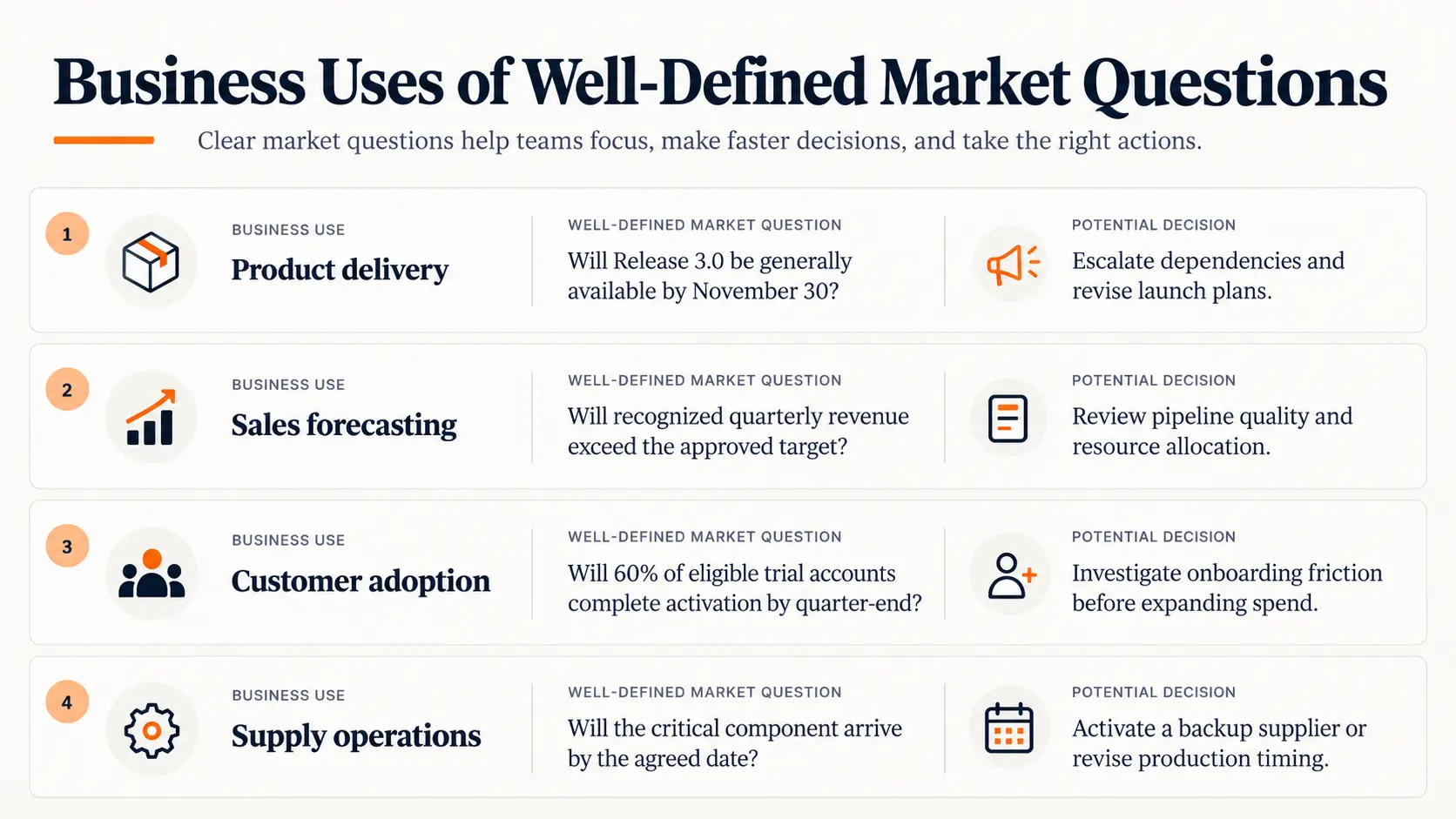
A market should answer a question that someone can act on. If no team owns the decision, even an accurate probability may have little practical value. Some firms may find that an anonymous forecast survey or structured expert review delivers most of the benefit with less operating complexity.
What the Evidence From Google and Other Firms Shows
Corporate prediction markets are not a new invention. Hewlett Packard experimented with employee markets for printer sales forecasts in the late 1990s. Google later used internal markets to estimate developments such as product launch dates, and researchers examined similar programs at Ford and another large company. These are documented examples, not evidence that every business is running such a system today.
In a study published in the Review of Economic Studies in 2015, researchers Bo Cowgill and Eric Zitzewitz analyzed markets at Google, Ford, and an unnamed firm. Across the settings they studied, internal markets sometimes improved upon expert forecasts, with reductions in mean squared error of up to 25%. The same work highlighted thin participation, incentives, and optimism as potential weaknesses. This is a result from particular organizations and questions, not a promised improvement for a new pilot.
Google described another internal forecasting initiative in a 2021 Google Cloud article. Its team reported analyzing more than 175,000 predictions made by over 10,000 employees, covering issues such as engineering milestones and emerging technology trends. Scale can make diverse participation easier, but the transferable lesson is the disciplined design of questions, incentives, and feedback, not the need for thousands of traders.
In February 2026, Deloitte argued that internal markets deserve renewed attention as a way to surface information scattered across organizations. That argument is especially relevant when dashboards describe what has already happened but frontline employees can see a likely obstacle before it becomes measurable.
Why These Markets Sometimes Fail
Too few people contribute independent information
A dozen employees who share the same meetings may produce a neat looking price without adding much independent knowledge. A market cannot manufacture diversity of evidence. Small organizations should first assess whether the people they can recruit truly know different things. If not, a short confidential survey may be the more honest tool.
Organizational incentives distort forecasts
Employees may hesitate to place a low probability on a project championed by senior leadership. Others may exaggerate risk to attract resources, or follow an influential colleague rather than use their own judgment. Research on Google’s markets documented optimism bias and correlated trading among employees with close working relationships. Confidentiality, neutral framing, and rewarding calibration rather than agreement with management can help, but they do not remove every bias.
Forecasts can create conflicts of interest
A person whose job affects the forecast outcome may have an incentive to influence the event rather than simply predict it. Sensitive subjects such as employee dismissals, individual performance, mergers, and unpublished financial results also create privacy or legal concerns. Programs must be designed with legal, compliance, HR, and information security input where relevant. A workplace forecasting tool is not a workaround for market abuse or confidentiality obligations.
The organization does nothing with the answer
A low probability is operationally useful only if a decision maker can respond. Markets fail as management tools when uncomfortable estimates are ignored, treated as votes of confidence, or used to identify “disloyal” employees. Their role should be to trigger investigation, scenario planning, or contingency actions while managers retain responsibility for decisions.
How to Run a Corporate Prediction Market Pilot
A sensible first experiment is deliberately small. The goal is not to launch a permanent marketplace; it is to test whether collecting decentralized expectations improves on existing forecasting methods. A six week or eight week pilot is an illustrative starting point, not a universal requirement. Choose its length according to how often events resolve.
1. Select a small set of consequential, measurable questions
Choose three to five questions that have reliable outcome data and a real decision attached. Avoid items with no clear owner or with answers that can be changed arbitrarily by the people trading. Specify the resolution source, deadline, and treatment of edge cases in writing.
2. Record the forecast you already use
Before collecting employee predictions, save the manager forecast, project status estimate, or quantitative model on the same question and date. Otherwise, it will be impossible to tell whether a new market improved accuracy or simply produced an interesting number after the fact.
3. Invite relevant teams and choose low risk incentives
Recruit employees with distinct perspectives, explain probability thinking, and allow updates as new evidence arrives. Recognition or noncash points may be preferable to monetary rewards, subject to company policy and local legal advice. Protect participants from retaliation for forecasts that disagree with official plans.
4. Review changes and outcomes without turning prices into targets
Watch for sudden shifts, unusually low participation, and large gaps between market and baseline forecasts. Ask what new facts or assumptions could explain differences. After settlement, review what changed and whether managers were able to act early enough. Keep market participation separate from individual performance reviews.
How to Tell Whether the Pilot Worked
Accuracy matters, but a company should not judge a market by one correct prediction. Compare a series of questions at matching horizons using a consistent probability scoring method, such as the Brier score. Also compare whether forecasts were well calibrated, whether participants updated them before important events, and whether they added meaningful information beyond a baseline model or manager estimate.
Decision quality matters just as much. Did an early warning lead to a realistic contingency plan? Did a forecast reveal a dependency no team had escalated? Were employees comfortable reporting unwelcome evidence? A slightly more accurate number may not justify a complicated system if no decision changed. Conversely, one timely and well supported warning can make a limited pilot valuable without proving long run statistical superiority.
The key is to keep the comparison fair. Select questions in advance, include misses as well as successes, record all forecast snapshots, and do not quietly discard events that were hard to resolve. These checks reduce the temptation to tell a success story from a handful of convenient examples.
When a Simpler Forecasting Method Is Better
A corporate prediction market is often the wrong starting point when the team is tiny, outcomes are vague, employees lack independent information, or the company cannot protect confidentiality. In these cases, structured estimation meetings, anonymous probability surveys, premortems, and ordinary forecasting models may be cheaper and easier to govern. These approaches can also run alongside a market as useful benchmarks.
The strongest justification is not that a market feels innovative. It is that decision relevant knowledge is fragmented, forecasts can be evaluated fairly, and leaders will respond to the signal. Used on those terms, a corporate prediction market can become a practical supplement to planning rather than another dashboard nobody trusts.
How can a company measure prediction market accuracy?
Save probability estimates at fixed dates, compare them with resolved outcomes, and evaluate a sufficiently broad set of questions. Proper scoring rules and calibration checks help, but results should also be compared with a baseline forecast and interpreted in light of sample size and participation.
FAQ
Are corporate prediction markets legal?
Legality depends on jurisdiction, market design, rewards, participants, and the information involved. An internal points based forecasting exercise is not identical to a publicly offered cash event contract. Companies should review their structure with legal and compliance advisers before launch, particularly if incentives or sensitive nonpublic information are involved.
Can a small startup run an internal prediction market?
Yes, but small teams may not have enough independent participants to produce useful market prices. A probability survey or forecasting tournament may be a better first test. A market becomes more compelling when several groups possess genuinely different information.
Do corporate prediction markets replace financial forecasts?
No. They can complement budgets, models, and management forecasts by highlighting uncertainty or information outside the formal reporting chain. A business should compare methods on the same questions and keep managers accountable for final decisions.
What types of questions should companies avoid?
Avoid personally sensitive questions, outcomes driven by individuals who can benefit from their own positions, questions with vague settlement rules, and topics that could expose confidential information. Forecasting should not become a vehicle for employee surveillance or retaliation.

Masoumeh Jahangard
Markets & Economy Writer at PinerookMasoumeh Jahangard covers markets, economic trends, and business conditions for Pinerook, focusing on how they affect startups and growing companies.
 Seen first.