
An election poll might find 49% support for a candidate while a contract on the same candidate winning trades near 65 cents. Those figures can both be reasonable because they answer different questions. Polls measure what a selected sample says now; event market prices reflect the amount traders are willing to pay for a future outcome. Prediction markets turn expectations into tradable prices, but neither a price nor a survey result removes uncertainty.
That distinction matters well beyond election headlines. Analysts, founders, and journalists increasingly encounter these signals together and need to know when disagreement reveals new information and when it is simply a difference in measurement.
The central difference is preference versus probability
A conventional voting intention poll asks a sample whom they favor, often reporting estimated vote shares after weighting responses. A prediction market asks whether a defined event will occur, such as a particular candidate winning an election. The contract has a stated resolution rule, and trading generates a market price associated with that outcome.
A 49% polling figure does not mean a 49% chance of victory. A candidate can receive less than half of surveyed preferences and still have a substantial chance of winning, depending on undecided voters, the electoral system, turnout, and the distribution of possible vote changes. Similarly, a Yes contract quoted at 65 cents is usually read as about 65% market implied probability, not as 65% of voters supporting the candidate.
Prediction markets vs polls at a glance
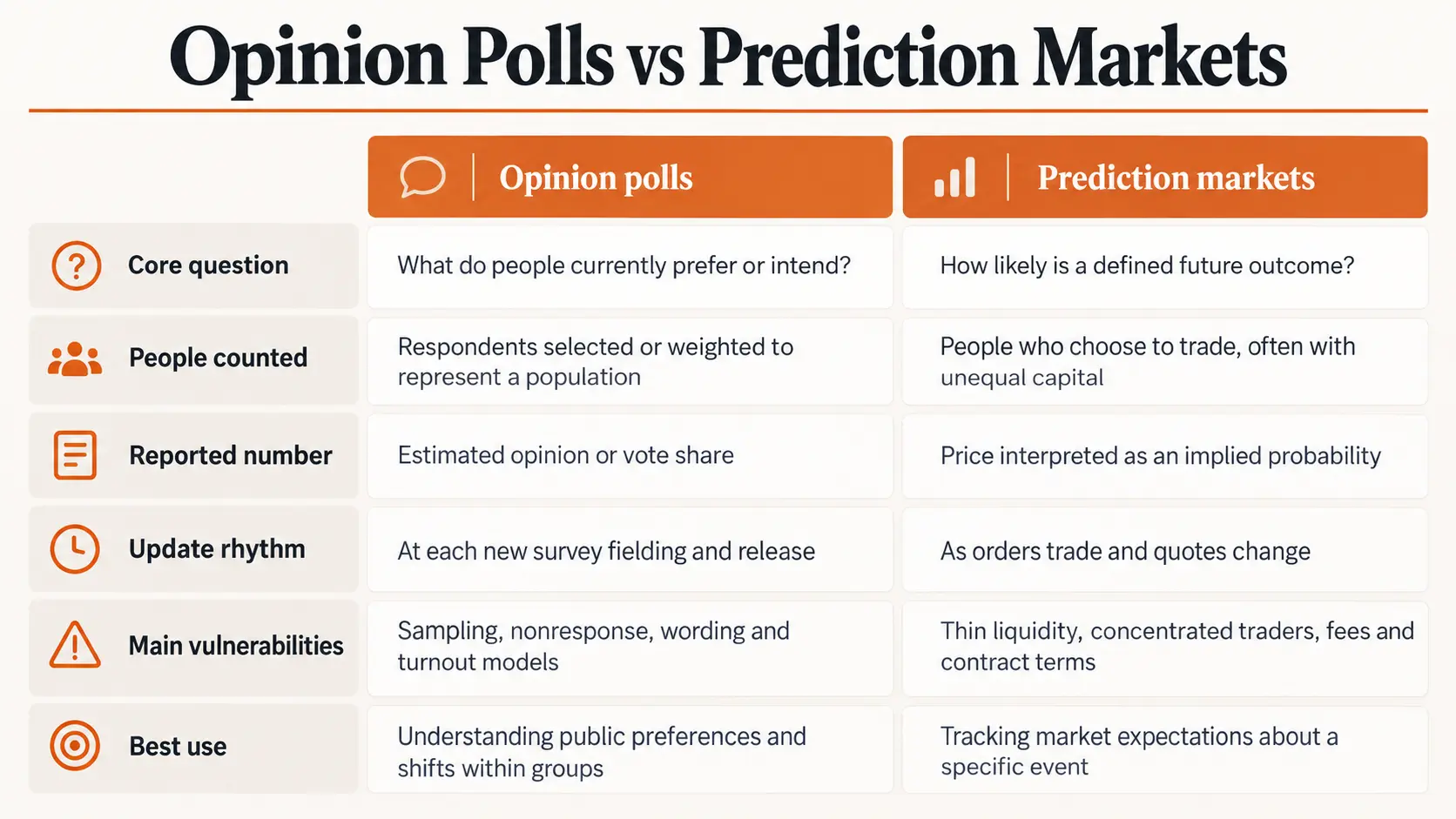
Why a close poll can coexist with a strong market favorite
Consider a purely illustrative race: Candidate A polls at 49%, Candidate B at 47%, and 4% remain undecided. On an outcome contract, A trades around 65 cents. The poll describes current stated voting intention among the measured group. The contract prices the likelihood that A ultimately satisfies the market’s winning condition.
Traders may be factoring in recent district level results, candidate strength in pivotal locations, turnout expectations, or their own statistical models. They may also be reacting to narratives that other traders share. The 65% quote should not be mechanically derived from the 49% poll, and it should not be treated as a guaranteed forecast. The example demonstrates how two percentages with different denominators can appear to disagree without being mathematically inconsistent.
How each method collects and updates information
Polls gain meaning from research design
A credible poll defines a target population, recruits respondents through a documented process, asks consistent questions, and adjusts for known imbalances when appropriate. Repeated surveys can show changing sentiment and differences among demographic groups. Those are questions an event contract cannot answer directly.
The published margin of sampling error is useful but incomplete. It does not capture every source of uncertainty, including biased nonresponse or problems estimating who will actually vote. The American Association for Public Opinion Research emphasizes that election polls are estimates of current attitudes, not direct predictions of the final winner.
Markets update continuously, but only through trading
Market quotes can respond quickly to breaking news because no new fieldwork is needed. That speed is useful when a clearly defined event approaches. However, the quote is set by trading activity rather than a representative sample. A small or highly concentrated market may produce dramatic price moves without a comparable change in broad public expectations.
The displayed price may also differ from the amount a reader could actually trade at, especially when buy and sell quotes are far apart. Speed of updating should therefore be separated from quality of information.
Which has been more accurate? The evidence is conditional
Historical studies have sometimes found that election markets predicted outcomes better than individual polls, particularly at longer horizons. Other comparisons found that properly transformed poll information can compete well, and research on directly elicited probability judgments found that combining survey beliefs with market prices can improve forecasts. The conclusion is not that one method wins every race, country, or time period.
A fair accuracy test must compare the same target. Comparing a 52% vote share estimate to a 70% win probability is not an accuracy test because the numbers describe different quantities. Analysts can compare eventual vote shares against poll estimates, or compare event probabilities using many resolved outcomes and a scoring rule such as the Brier score. They must also match forecast dates and account for the information available at that time.
A single prominent election is a weak benchmark. Sample size, forecast horizon, liquidity and the way markets resolve outcomes can change performance. A high price shortly before an expected result is less informative than a reliable record across many diverse and difficult events.
A disciplined way to read conflicting signals
First, establish that both sources refer to the same event, geographic area and date. A national preference poll cannot by itself answer a question about an electoral college result, and a contract’s settlement condition may differ from a headline’s wording.
Second, inspect each source on its own terms. For a poll, examine who conducted it, the field dates, sample, weighting and question wording. For a market, examine contract rules, current bid and ask quotes, available depth, participation, fees and potential restrictions on access.
Third, look for explanations instead of picking a winner. Markets may be incorporating turnout scenarios that are not visible in a headline poll. Polls may be identifying shifts within groups that a single binary market price conceals. When both signals change together for similar reasons, that agreement can be useful, but it is not independent confirmation if market traders are simply responding to the poll.
For a company monitoring an election related policy, the practical goal is not to predict a winner with certainty. It is to stress test the operating plan under both outcomes. Survey findings can explain public attitudes; market prices can indicate which scenarios traders currently weight more heavily.
The more useful question is which decision needs evidence
Prediction markets and polls are complements when used for their intended purposes. Polls are better suited to measuring stated preferences across a population and tracking how those preferences change. Liquid, clearly specified markets can provide timely expectations about an eventual event. Neither should become a substitute for examining uncertainty, incentives and source quality.
For Pinerook readers, the strongest approach is to define the decision first and then choose the right signal. If the question is what people think, start with sound survey research. If the question is what traders expect to happen, inspect the market. If the question is how to plan under uncertainty, use both carefully and build scenarios that remain viable when either signal turns out wrong.
FAQ
Are prediction markets better than polls?
Not consistently. Markets may respond faster to new information, while well designed polls measure public preferences in ways a trading venue cannot. Relative forecasting performance depends on the event, timing, participants and evaluation method.
Why can a candidate poll at 48% but have a 70% chance of winning?
The poll estimates stated vote share; the market prices a future outcome. A relatively small polling lead can correspond to a stronger probability of victory under some turnout, geographic and uncertainty assumptions. The percentages do not share the same denominator.
Do prediction markets represent public opinion?
Not directly. People who trade are self selected and may have unequal financial influence. A representative poll is designed to estimate opinions within a defined population, subject to sampling and other research limitations.
Can polls and prediction markets both be wrong?
Yes. Polls can miss population behavior or late changes, while markets can be distorted by thin trading, shared beliefs or ambiguous resolution rules. Combining them can improve context, but it cannot eliminate uncertainty.

Masoumeh Jahangard
Markets & Economy Writer at PinerookMasoumeh Jahangard covers markets, economic trends, and business conditions for Pinerook, focusing on how they affect startups and growing companies.
 Seen first.