Prediction market regulation determines who may offer event contracts, which outcomes can be traded, and what protections apply when a market is disputed. In the United States, many event contracts fall within derivatives oversight, but the boundaries between federal financial regulation and state gambling law remain contested. The practical answer is therefore more precise than either 'prediction markets are legal' or 'prediction markets are gambling': it depends on the contract, the operator, the jurisdiction, and the rules in force when the trade is placed.
For readers familiar with how Prediction Markets turn future outcomes into tradable prices, the regulatory question starts one step earlier: who supervises the exchange, what makes a contract eligible for listing, and what recourse exists if trading or settlement goes wrong? These distinctions matter to individual traders, businesses considering event risk, and founders using market data in forecasts. They also explain why two services displaying similar Yes or No questions may have very different legal and operational obligations.
Are Prediction Markets Legal? The Short Answer
Prediction markets are not governed by one universal legal category. Some U.S. platforms operate as registered derivatives exchanges under the Commodity Futures Trading Commission, or CFTC. Other services may offer offshore or blockchain based contracts subject to a different set of local rules and restrictions. Still other products can fall within a country's gambling or financial products regime. Registration of a platform does not mean every imaginable event contract is permitted, and accessibility through an app does not by itself establish that a trade is lawful in a particular location.
An important distinction is between a platform's regulatory standing and the legal status of a specific market. A recognized exchange can face challenges over a category of contracts even while its other contracts continue trading. Sports based markets illustrate this especially clearly in 2026: federal and state authorities have taken conflicting positions about how these contracts should be classified.
How the CFTC Regulates Event Contracts
The U.S. Commodity Exchange Act provides the main federal framework for commodity derivatives. A market that makes swaps or futures contracts available to the U.S. public generally needs the appropriate registration, such as designation as a Designated Contract Market (DCM). A registered exchange must maintain market surveillance, enforce its rules, supervise trading conduct, and design contracts that are not readily susceptible to manipulation. Exchanges and their intermediaries also operate under requirements concerning disclosures, records, and customer protections.
What a registered exchange can and cannot promise
CFTC oversight is not a prediction accuracy guarantee or an endorsement of a particular contract. Rules are designed to govern the marketplace and address misconduct, not to ensure that participants make profitable decisions. Contracts still have market risk, gaps in liquidity, and potential disagreements about whether an event meets its settlement criteria. Traders should be able to find published contract terms, the named resolution source, applicable fees, and the exchange's procedures for correcting or disputing an outcome.
How event contracts reach the market
A registered exchange may use established product submission procedures, including self certification for certain contracts or a request for prior CFTC approval. The distinction matters: a filing or listing on a registered exchange should not be described casually as the CFTC having personally approved every feature of that market. The regulator retains oversight and enforcement powers, and special restrictions can apply when the event type raises public interest concerns.
Which Event Contracts Face Special Regulatory Scrutiny?
Federal law creates a special review mechanism for certain event contracts involving activities such as gaming, terrorism, assassination, war, or unlawful conduct. The question is not simply whether an event is controversial. Regulators examine the statutory category, the contract's design, and whether the applicable public interest test is met. In June 2026 the CFTC proposed changes to Regulation 40.11 to clarify how it would evaluate such contracts. As of this article's October 2026 review, that June proposal is a proposal, not a blanket final authorization or prohibition of every sports or political market.
Market integrity is another independent concern. In September 2026, CFTC staff highlighted the heightened manipulation risk in 'mention markets' that settle on whether a person says particular words, appears at an event, or undertakes a similarly controllable action. A contract with an apparently clear Yes or No answer can still be problematic if one person can deliberately cause the outcome, or if the resolution evidence is ambiguous. These risks affect product design and oversight even when there is no dispute about the platform's registration.
Why Federal and State Rules Still Conflict
A major live dispute concerns whether federal derivatives law displaces state gambling rules for sports event contracts. The CFTC has argued that it has exclusive authority over derivatives traded on registered exchanges and has challenged state attempts to restrict certain prediction markets. Several state regulators contend that sports related products remain subject to their gambling laws. It is an unsettled legal dispute rather than a simple question of which agency has the more prominent website.
On September 25, 2026, the U.S. Court of Appeals for the Sixth Circuit ruled in litigation involving Kalshi and authorities in Ohio and Tennessee that the sports contracts at issue had not been shown to fall within the statutory definition of swaps, and that federal law did not preempt the states' gambling laws even under an alternative assumption. The decision concerned requests for preliminary injunctions and was not a universal final judgment about every event contract nationwide. Its significance is practical: a CFTC registered exchange can face state specific restrictions or litigation relating to certain products, and the law may evolve further through appeals, new rules, or subsequent decisions.
For a user, this means 'available in the United States' should never be read as 'every contract is available in every state without legal uncertainty.' Contract categories, court orders, and the platform's own access restrictions can change. Confirm current eligibility using the operator's official terms and regulatory notices rather than a promotional statement or an outdated comparison article.
Regulation Depends on the Platform and the Country
Different platforms may show similar event probabilities while operating under different structures. Kalshi describes itself as a CFTC regulated DCM. Polymarket's U.S. product is separate from Polymarket International, which serves users in permitted locations outside the United States and publishes geographic restrictions. The distinction is essential: an overseas blockchain interface should not be treated as interchangeable with a U.S. regulated exchange simply because they share branding or list familiar events.
Outside the United States, legal classification can be very different. In Great Britain, the Financial Conduct Authority has stated that financial prediction market products within its remit are currently viewed as binary options and remain subject to its retail sale ban, while the Gambling Commission considers products that meet the definition of gambling under its own licensing framework. Therefore, a general claim that prediction markets are globally legal or globally illegal is not reliable. Jurisdiction, contract type, platform permissions, and the user's location all matter.
What Regulation Means for Traders and Businesses
A regulated venue can offer important structural protections: disclosed rules, defined oversight, mechanisms for addressing manipulation, and clearer avenues for complaints. It cannot eliminate financial loss, thin order books, errors in judgment, or sudden changes in a contract's value. A trader could be correct about the underlying event and still receive an unattractive execution price or misunderstand the conditions required for a Yes settlement.
For startup founders or corporate analysts, legal due diligence extends beyond whether a market is convenient to follow. Data may be used in internal dashboards without placing a trade, while direct trading creates separate questions about account eligibility, authorization, conflicts of interest, and use of sensitive business information. Employees who possess material confidential information should not assume that an event based product falls outside misuse or market integrity rules merely because it is not a conventional stock.
A Practical Compliance Check Before Trading
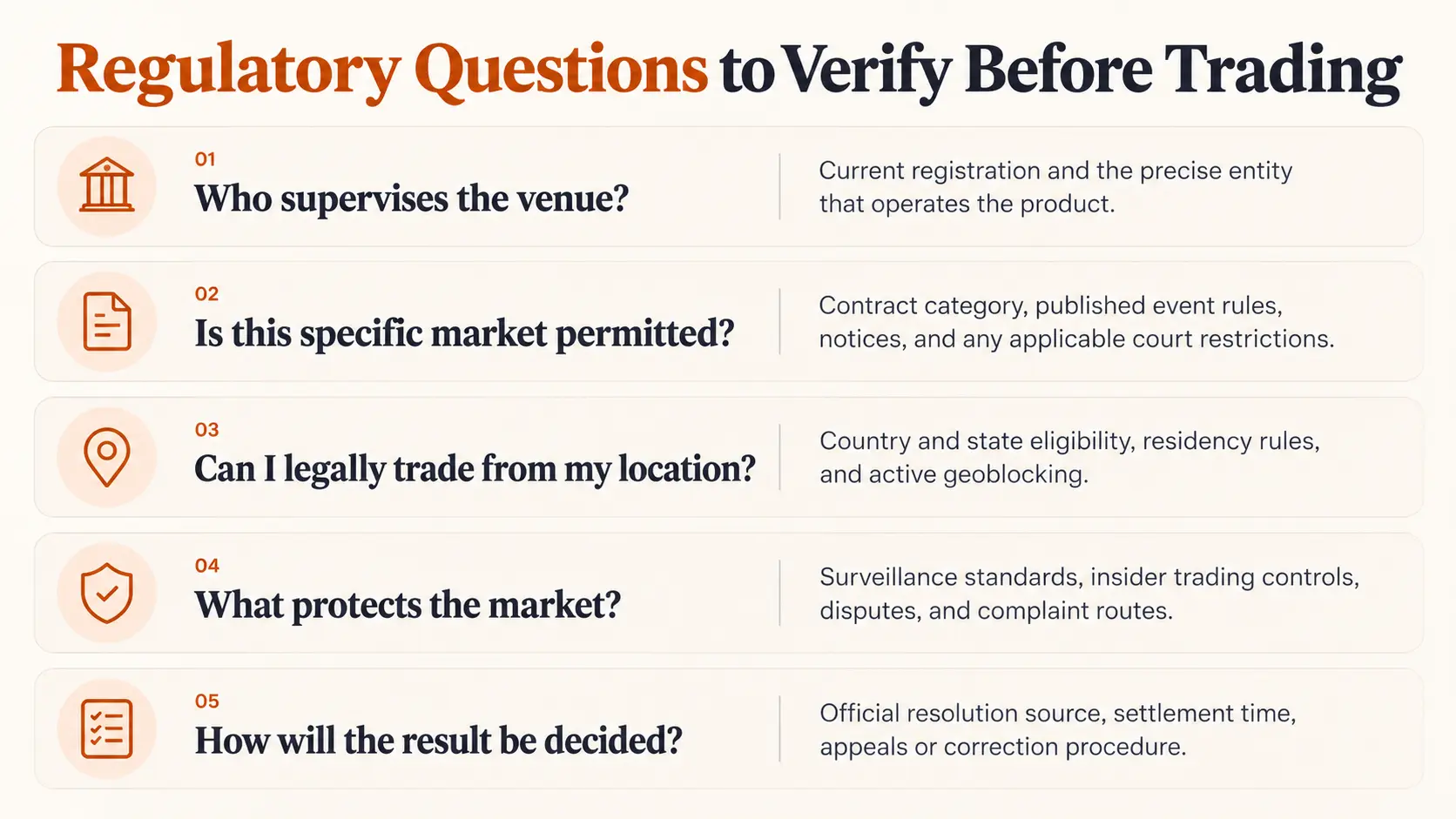
Start by identifying the exact legal entity operating the service and checking its regulatory registration, if any. Next, read the specific market's contract terms rather than relying on its headline. Pay particular attention to the event definition, resolution evidence, cutoff times, possible cancellation terms, and the route for reporting suspected wrongdoing. Then verify the current access restrictions for your country and state, including the limits imposed by the service itself.
Finally, separate legal access from trading judgment. Check the spread, market depth, total possible loss, and fees before entering a position. Keep transaction and confirmation records, and know where an official complaint can be lodged. When a contract category is actively contested in court, the sensible approach is to follow updates from the exchange, regulator, and relevant courts. Neither an available trading button nor a familiar company name is a substitute for those checks.
What May Change Next in Prediction Market Regulation?
The central questions in late 2026 concern the treatment of sports linked contracts, public interest review of sensitive events, controls against market manipulation, and the allocation of authority between federal and state regulators. The CFTC's March 2026 request for comments and June 2026 rule proposal show that the regulatory framework is still being tested and refined. Court decisions add a separate layer that may not move in a straight line. Readers should treat this guide as a framework for interpreting the rules, not as a static list of jurisdictions or a substitute for legal advice.
Prediction market regulation is best understood as a sequence of questions: which entity operates the market, how the contract is classified, what conduct the rules allow, and whether the user is eligible to trade it. Federal oversight can provide meaningful protections, but it does not settle every dispute over sports contracts, geographic access, or market outcomes. Clear rules and current verification matter more than a blanket label of legal, illegal, regulated, or decentralized.
FAQ
Does CFTC registration mean every prediction market contract is legal?
No. Registration concerns the exchange's legal status. Individual contracts must also comply with applicable rules, and some categories face special review or litigation. State level restrictions may also be disputed for specific products.
Are prediction markets classified as gambling in the United States?
Not uniformly. Federal regulators often address qualifying event contracts as derivatives, while some states seek to regulate certain sports products under gambling laws. The classification and consequences depend on the contract and jurisdiction.
Can U.S. residents trade on Polymarket International?
Polymarket International lists the United States among its restricted jurisdictions. The company describes a separate U.S. product with distinct accounts and access rules. Readers should use the current official eligibility information for the particular service.
What should I do if I suspect manipulation or an incorrect settlement?
Preserve the contract terms, trading confirmations, timestamps, and supporting evidence. Follow the venue's published dispute process. Where applicable, regulated market customers

Masoumeh Jahangard
Markets & Economy Writer at PinerookMasoumeh Jahangard covers markets, economic trends, and business conditions for Pinerook, focusing on how they affect startups and growing companies.
 Seen first.