Understanding what do VCs look for is useful for any founder preparing to raise institutional capital. Venture capital investors are not simply searching for interesting ideas or polished pitch decks. They are looking for companies that can turn an important customer problem into a large, defensible, and rapidly growing business.
Within Venture Capital, investors evaluate a combination of people, market opportunity, product strength, customer behavior, growth, economics, competition, and future potential. No single factor guarantees investment. A strong founding team cannot completely compensate for a tiny market, just as impressive revenue growth can become less attractive when retention is weak or customer acquisition is becoming increasingly expensive.
The weight given to each factor also changes as a startup develops. At pre seed, investors often make decisions with limited operating evidence and place greater emphasis on founders, customer insight, market potential, and early validation. At Series A and beyond, investors increasingly expect measurable evidence that customers stay, revenue grows, acquisition becomes repeatable, and the organization can scale.
What Do VCs Look For in a Startup?
VCs generally look for startups with the potential to become substantially more valuable than they are today. Because early stage investing involves considerable uncertainty, investors are trying to determine whether the possible upside is large enough to justify the risk.
This means they evaluate both the current company and its future potential. A startup may have limited revenue today but operate in a rapidly expanding market with exceptional founders and unusually strong customer engagement. Another company may already generate meaningful revenue but have weak retention, low margins, limited differentiation, or little room for expansion.
The investor therefore tries to build a complete investment thesis rather than relying on one attractive metric. Founders, market, product, traction, growth, economics, competition, defensibility, capital requirements, and potential outcomes all contribute to that thesis.
The Main Factors VCs Look For
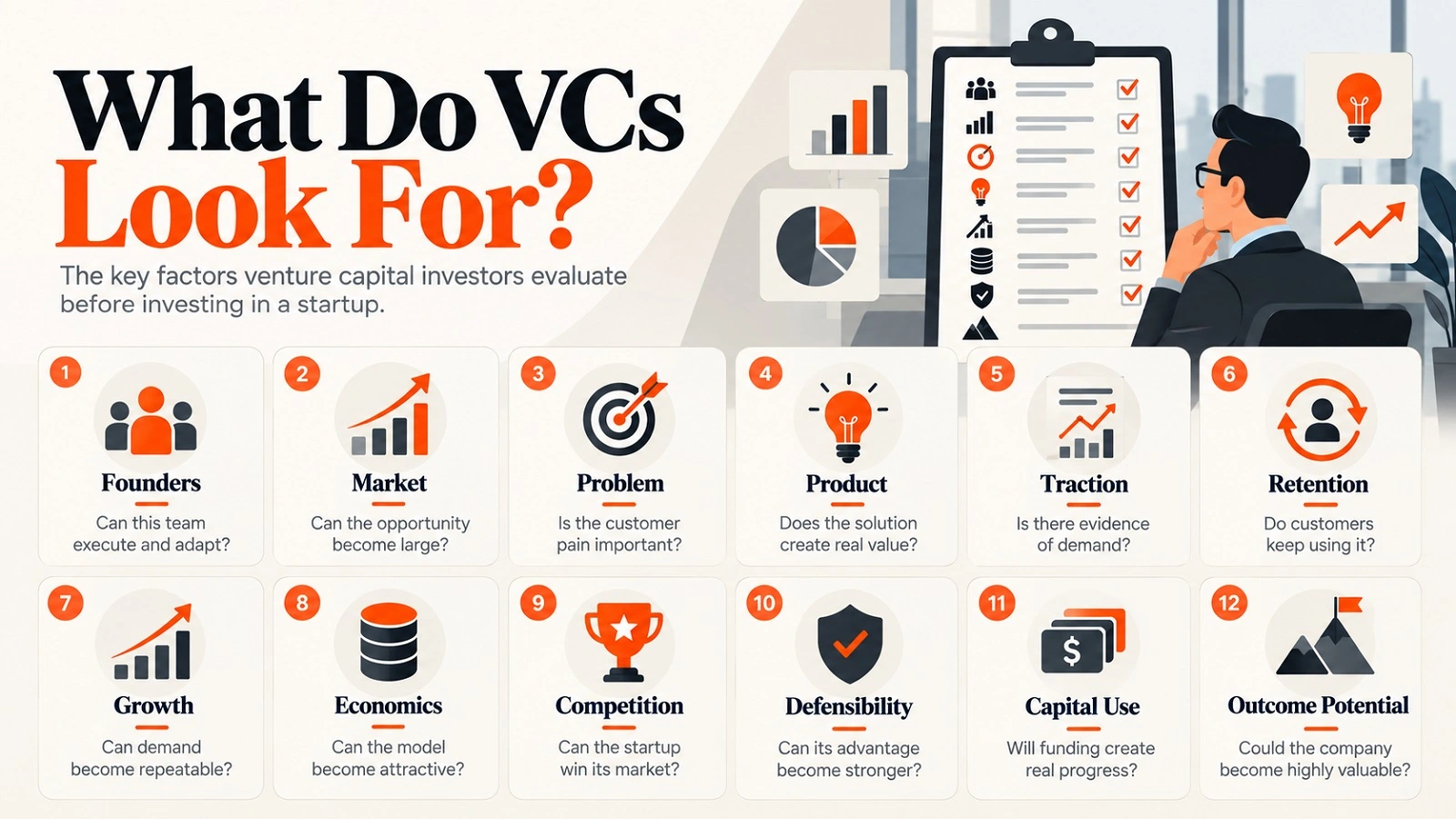
These factors should not be interpreted as an investor checklist where every category receives an equal score. Venture investing is more contextual. A weakness in one area may be acceptable when another part of the investment case is unusually strong, particularly at the earliest stages.
Strong Founders
At early stages, founders are often one of the most important parts of the investment decision because much of the company has not yet been proven. Products change, customer segments evolve, pricing gets redesigned, and initial strategies frequently fail.
Investors therefore want founders who can operate effectively when circumstances change. They look for judgment, adaptability, persistence, speed of learning, communication, leadership, and the ability to turn limited resources into meaningful progress.
A founder does not need to have every answer. Investors often become more confident when founders understand what they do not yet know and can explain how they intend to find the answer. Intellectual honesty can be more convincing than excessive certainty.
Founder Market Fit
Founder market fit describes why a particular founding team may have an unusual advantage in understanding and solving the problem.
A founder might have worked inside the industry for years, experienced the problem personally, built related technology, managed the target customer, or developed relationships that provide direct access to buyers. Those experiences can create insights that competitors may need years to develop.
VCs do not simply look for prestigious resumes. They want to understand whether the founders' experience actually improves their ability to identify customer needs, build the right product, distribute it effectively, and respond to changes in the market.
Founder Commitment
Investors also want to understand how committed the founders are to building the company. Startups can take years to develop, and the journey usually includes periods of uncertainty, failed experiments, difficult fundraising conditions, and operational pressure.
Founder commitment can appear through previous decisions, time invested in the problem, personal understanding of the market, and the way founders talk about long term company development. Investors may become cautious when the business appears to be one of several temporary projects rather than a company the founders genuinely intend to build.
Commitment alone does not make a startup investable, but a lack of commitment can undermine otherwise attractive opportunities.
Ability to Recruit Strong People
A startup cannot scale through founder effort alone. As the company grows, it needs engineers, product leaders, salespeople, marketers, operators, finance professionals, and other specialists.
VCs therefore pay attention to the quality of early employees and the founders' ability to convince talented people to join. Strong candidates usually have multiple career options, so their decision to join an uncertain startup can provide an indirect signal about the founders and the opportunity.
Investors may also examine whether founders understand which capabilities are missing. A founder who can identify future leadership needs demonstrates greater organizational awareness than one who assumes the existing team can handle every stage of growth.
Deep Customer Understanding
VCs want founders to understand customers at a level that goes beyond demographics or broad market research. They want to know what customers are trying to accomplish, what prevents them from doing it efficiently, what alternatives they currently use, and why they would change their behavior.
This understanding can come from customer interviews, product usage, sales conversations, pilots, support interactions, renewals, or direct industry experience. The strongest founders can often describe customer behavior with considerable precision because they have spent significant time close to the problem.
Deep customer understanding also helps investors believe that the startup can continue improving the product after financing. The company is not simply betting on one initial idea; it has developed a process for learning from the market.
A Problem Worth Solving
VCs generally prefer startups addressing important problems because important problems create stronger customer motivation.
The problem may cost customers money, consume significant time, create operational risk, reduce productivity, prevent growth, or produce another meaningful negative outcome. The stronger the consequence, the easier it becomes to understand why customers would allocate budget to solving it.
Investors often ask what customers currently do when the startup's product does not exist. Existing workarounds can reveal the true importance of the problem. Customers using spreadsheets, consultants, internal teams, outdated software, or complicated manual processes may already be demonstrating demand for a better solution.
Customer Urgency
Problem importance and customer urgency are related but not identical. A customer may acknowledge that a problem exists without feeling enough urgency to change behavior.
VCs therefore look for evidence that customers are willing to act. Paid pilots, signed contracts, repeat purchases, product adoption, implementation effort, or changes to existing workflows can all demonstrate stronger urgency than positive feedback alone.
This distinction matters because startups sometimes receive enthusiastic responses during customer interviews but struggle to convert those conversations into actual usage or revenue. Investors generally place more weight on behavior than stated interest.
A Large Market
Venture funds typically need some portfolio companies to produce very large outcomes. Market size therefore becomes an important part of investment selection.
Investors want to understand how many potential customers exist, how much economic value is available, how quickly the market is changing, and whether the company can eventually expand beyond its initial customer segment.
The initial market does not always need to be enormous. A startup can begin with a narrow segment when that segment provides a credible entry point into a much larger opportunity. What matters is whether there is a realistic path from the initial wedge to a company large enough to matter within a venture portfolio.
A Credible Market Expansion Story
A strong market thesis usually explains both where the company starts and where it can go next. Investors want more than a large total addressable market number.
A startup might begin with one type of customer before expanding into adjacent customer segments. It may start with one product and later add complementary products. Geographic expansion can also increase the opportunity when the underlying problem exists across multiple markets.
The expansion story needs to follow logically from the company's capabilities. A list of unrelated future markets is less persuasive than an expansion strategy built around the same customer relationships, technology, distribution, or data advantages.
Market Timing
Even a large market can be difficult when the timing is wrong. VCs therefore ask why the opportunity is becoming attractive now rather than several years earlier or later.
Technological improvements, lower infrastructure costs, regulatory changes, shifts in customer behavior, new distribution channels, or changes in industry structure can create new opportunities.
A convincing timing argument helps explain why customer adoption may accelerate and why existing companies have not already captured the opportunity.
Product Value
Investors want to know what changes for the customer after using the product. A long feature list does not necessarily demonstrate meaningful value.
A strong product may save customers money, increase revenue, improve productivity, reduce risk, remove complexity, automate expensive work, or enable something that was previously impossible.
The clearer the relationship between the problem and the value created by the product, the easier it becomes for investors to understand why customers might adopt and pay for it.
Product Differentiation
A valuable product still needs a reason for customers to choose it over available alternatives. VCs therefore examine differentiation.
That differentiation might come from technology, user experience, speed, pricing, proprietary data, distribution, integrations, customer service, brand, or another factor. Investors care less about whether the difference sounds technically impressive and more about whether customers actually value it.
They also want to understand how long the advantage can last. A feature that competitors can reproduce quickly may help the company acquire initial customers without creating a durable position.
Evidence of Product Market Fit
Product market fit is rarely represented by one universal number. Investors look for patterns suggesting that the product has become important to a meaningful group of customers.
Those patterns can include strong retention, repeat purchases, increasing usage, customer referrals, expansion revenue, short sales cycles, growing inbound demand, or customers becoming increasingly dependent on the product.
At early stages, investors may accept incomplete evidence. As the startup matures, they expect product market fit to become visible through increasingly consistent customer behavior.
Traction
Traction gives VCs evidence that the company is moving beyond assumptions. However, the most relevant traction metric depends on the business model.
A SaaS startup may emphasize recurring revenue, active customers, retention, and expansion. A marketplace may focus on transaction volume, liquidity, repeat usage, and growth on both sides of the market. Consumer businesses may rely more heavily on engagement, retention, organic acquisition, and repeat behavior.
VCs therefore ask what the traction actually proves. Large numbers are less persuasive when they do not demonstrate customer value or economic potential.
Traction Signals by Business Model
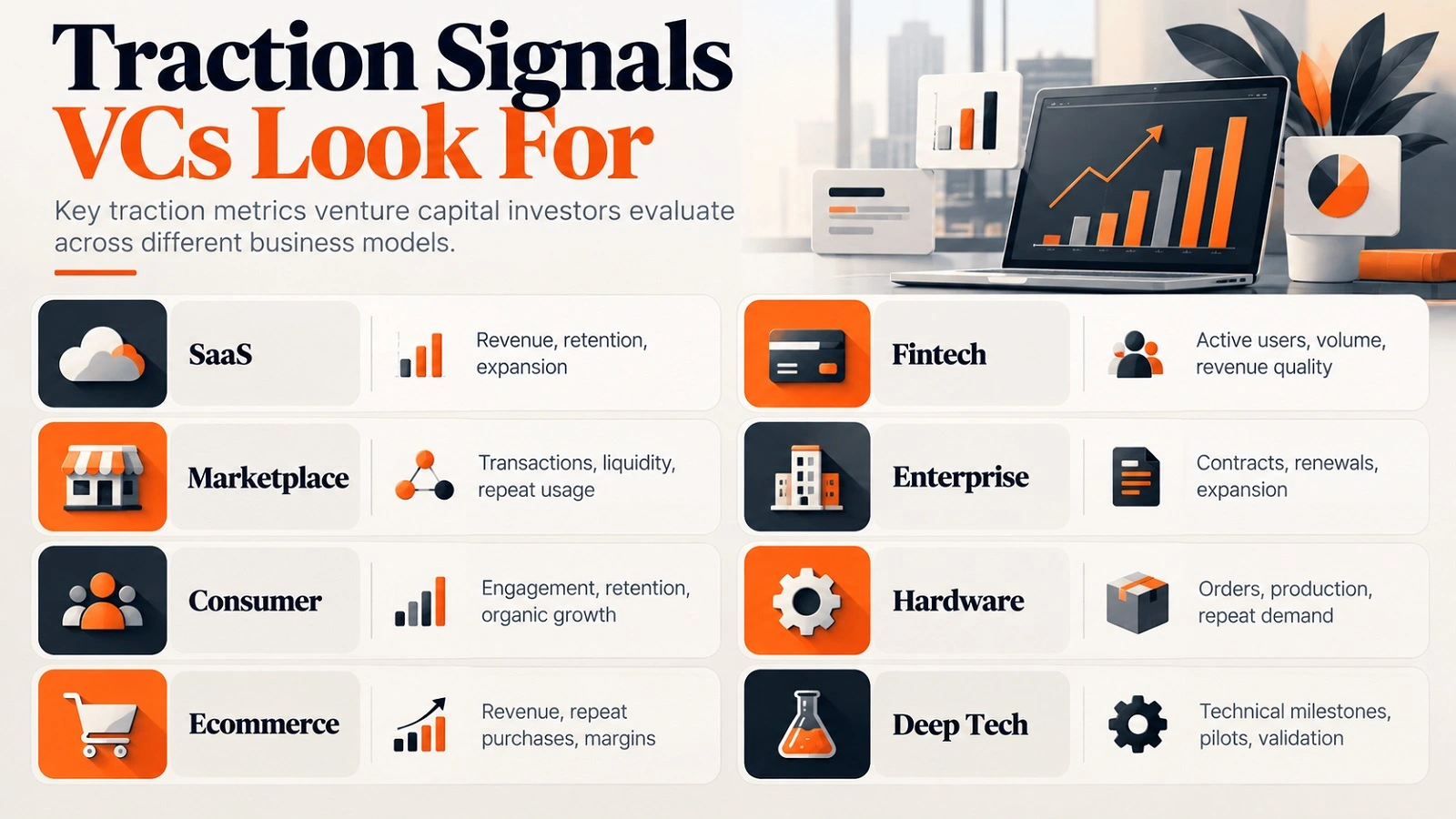
There is no universal traction metric that makes every startup attractive. Investors want evidence that fits the underlying economics and customer behavior of the specific company.
Strong Retention
Retention tells investors whether customers continue receiving value after the initial purchase or signup. It is particularly important because acquisition can temporarily hide weaknesses in a product.
A company can continue adding new customers while losing older ones at a similar rate. Headline growth may appear positive even though the underlying customer base is unstable.
Strong retention changes this dynamic. Each new cohort can add to previous cohorts, allowing customer value and revenue to compound rather than constantly replacing what has been lost.
Improving Cohorts
VCs may also examine whether newer groups of customers behave better than earlier groups. This can reveal whether product improvements, onboarding changes, pricing adjustments, or better customer targeting are strengthening the business.
Improving cohorts can be attractive even when absolute retention is not yet perfect. They show that the company is learning and that management can translate customer information into better outcomes.
For early startups, the direction of improvement can sometimes matter almost as much as the current metric.
Fast but Healthy Growth
Venture investors look for growth because large venture outcomes usually require companies to expand significantly. However, speed alone is not enough.
Investors want to understand where growth comes from, how expensive it is, and whether it can continue. A company growing rapidly because it is spending unsustainably on acquisition may have a weaker investment case than a company with more efficient growth.
VCs therefore examine the mechanisms behind growth. Organic acquisition, referrals, strong retention, customer expansion, improving conversion, and repeatable sales can all make growth more credible.
Repeatable Customer Acquisition
Investors want evidence that customer acquisition can become a process rather than a series of isolated successes.
A founder may personally close the first customers through relationships and persistence. That can be appropriate early on. As the company grows, however, investors want to see whether marketing channels, sales processes, partnerships, product led growth, or other systems can repeatedly generate demand.
Repeatability matters because the company needs to continue acquiring customers after the current fundraising round.
Revenue Quality
Revenue tells investors that customers are willing to pay, but VCs often look beyond the headline number.
Recurring revenue, renewals, customer diversification, expansion revenue, predictable contracts, and healthy margins can increase the quality of revenue. Heavy customer concentration or irregular one time revenue can create additional risk.
The right revenue profile depends on the business model. Investors usually compare a startup with similar businesses rather than applying the same standard to every company.
Customer Concentration
A startup can generate meaningful revenue while depending heavily on one or two customers. Investors may view this as a risk because losing a major account could materially affect the company.
Customer concentration is often understandable at early stages because the company has not had enough time to build a diversified base. The key question is whether concentration should decline as new customers are added.
VCs may also examine whether the largest customers are representative of a broader market or unusual deals that would be difficult to repeat.
Attractive Unit Economics
VCs want to understand whether the economics of acquiring and serving customers can eventually support a strong business.
Depending on the model, they may examine customer acquisition cost, lifetime value, gross margin, contribution margin, sales efficiency, payback periods, transaction economics, or other relevant measures.
Early startups may still have inefficient economics because the organization has not reached scale. Investors can accept this when there is a credible reason to believe efficiency will improve as the product, pricing, sales process, or infrastructure matures.
Gross Margin
Gross margin helps investors understand how much economic value remains after the direct costs of delivering the product or service.
The appropriate margin varies substantially by business model. Software companies, marketplaces, hardware businesses, and logistics companies naturally operate with different cost structures.
VCs therefore examine both the current margin and its direction. Improving margins can suggest that scale is strengthening the economics of the business.
Capital Efficiency
Investors also look at how effectively previous capital has been converted into progress.
A startup that has built a strong product, acquired customers, and reached meaningful milestones with relatively limited funding may demonstrate disciplined execution. A capital intensive company may reasonably require more funding when its technology or industry demands it.
The important issue is not simply how much the startup spends. Investors want to understand what the spending produces.
Burn and Runway
Burn shows how quickly the startup is using cash, while runway indicates how long the company can continue operating before it needs additional financing or reaches sustainability.
VCs examine these figures because they reveal both financial discipline and financing risk. A company that spends aggressively without approaching meaningful milestones may become dependent on another round before it has strengthened its position.
Higher burn can still make sense when the company has a clear opportunity to accelerate growth. Investors want the relationship between spending and progress to be deliberate rather than uncontrolled.
A Scalable Business Model
A startup may have strong customer demand but still struggle to become a venture scale business if every additional customer requires proportionally more people, infrastructure, or capital.
VCs therefore examine whether revenue can grow faster than the resources required to support that growth. Technology, automation, standardized processes, recurring revenue, network effects, and efficient distribution can all contribute to scalability.
Scalability does not mean costs disappear. It means the economic structure of the company can become more attractive as the business grows.
Competitive Advantage
VCs want to understand why customers will choose the startup when alternatives exist.
Competition includes more than companies selling similar products. Customers may use spreadsheets, internal teams, agencies, manual workflows, legacy software, or simply choose not to solve the problem.
A strong competitive position exists when the startup provides enough additional value to convince customers to change from those alternatives.
Defensibility
Investors also ask what happens when the startup succeeds and competitors begin responding.
Defensibility can come from proprietary technology, unique data, network effects, switching costs, distribution advantages, regulatory positioning, brand, customer relationships, or operational expertise.
The strongest advantages often become more powerful as the company grows. More customers may create more data, stronger network effects, deeper integrations, or greater brand recognition, making the company progressively harder to replace.
A Strong Team Beyond the Founders
As the company develops, investors increasingly evaluate the broader organization. Strong founders eventually need experienced people who can own major functions.
VCs may examine the quality of engineering, product, sales, marketing, finance, operations, and other leadership depending on the company's needs.
They do not expect every role to be filled immediately. They do expect founders to understand which capabilities will become necessary and demonstrate that the company can attract people capable of building them.
Founder Dynamics
When there are multiple founders, investors pay attention to how the team works together. Founder conflict can become one of the most damaging risks inside a startup.
VCs may examine role clarity, ownership, decision making, commitment, communication, and how disagreements are handled.
Strong founding teams do not necessarily agree on everything. What matters is whether they can disagree productively and continue making decisions without damaging execution.
Clear Governance
Governance becomes more important when outside investors enter the company. VCs may examine board structure, voting rights, capitalization, existing shareholder agreements, intellectual property ownership, and other corporate matters.
Unresolved governance problems can make future financing more difficult. Investors therefore want the basic ownership and decision making structure to be clear.
Good governance does not require unnecessary bureaucracy. It creates enough clarity that founders, employees, and investors understand how major decisions are made.
Clean Cap Table
The capitalization table shows who owns the company and how that ownership may change after financing.
VCs look for unusual ownership arrangements, excessive early dilution, unresolved promises of equity, complicated shareholder structures, or other issues that could make future financing difficult.
A clean cap table makes the investment easier to understand and leaves enough ownership available to motivate founders, employees, and future investors.
A Sensible Valuation
A VC can strongly believe in a startup and still decline to invest when the valuation makes the potential return unattractive.
Valuation determines how much ownership the investor receives for the capital provided. Investors therefore consider the current valuation alongside the company's stage, traction, market potential, risk, and likely future financing.
For founders, maximizing valuation is not always the only objective. An excessively high valuation can create pressure in the next round if company performance does not increase enough to support a higher future price.
Meaningful Ownership Potential
Venture firms often have ownership targets because successful investments need to contribute enough to the overall fund.
A large fund may find a very small investment unattractive even when it likes the company because the resulting ownership would have little impact on total fund performance.
This explains why investor fit matters. The same startup can be appropriately sized for one venture fund and too small for another.
A Clear Use of Capital
Investors want to know what the startup will accomplish with the money being raised.
A credible plan connects capital with specific business milestones. Funding might support product development, important hires, customer acquisition, infrastructure, regulatory work, geographic expansion, or another objective.
The important part is the relationship between spending and company value. Investors want the new capital to reduce important risks and move the startup into a stronger position.
A Path to the Next Milestone
VC financing usually occurs across multiple stages, so investors also consider what the company should look like after the current capital has been deployed.
The next milestone may involve revenue, retention, customers, product development, market expansion, technical validation, or operating efficiency.
A strong financing plan gives the company enough time and resources to reach milestones that materially strengthen the next financing conversation.
Realistic Financial Thinking
Early stage financial forecasts are inherently uncertain, so investors generally do not expect them to predict the future precisely.
They do expect the assumptions behind those forecasts to make sense. Hiring plans, revenue expectations, customer acquisition, margins, and spending should connect logically to the company's strategy.
Financial models become useful when they reveal how founders think about the business rather than when they simply display aggressive growth projections.
Risk Awareness
Investors know that startups are risky. Founders do not strengthen their pitch by pretending otherwise.
VCs often want to see whether founders understand the most important product, market, technical, regulatory, financing, competitive, and organizational risks facing the company.
Strong founders can identify those risks and explain what evidence or actions will reduce them. This demonstrates both strategic awareness and intellectual honesty.
What VCs Look For at Different Startup Stages
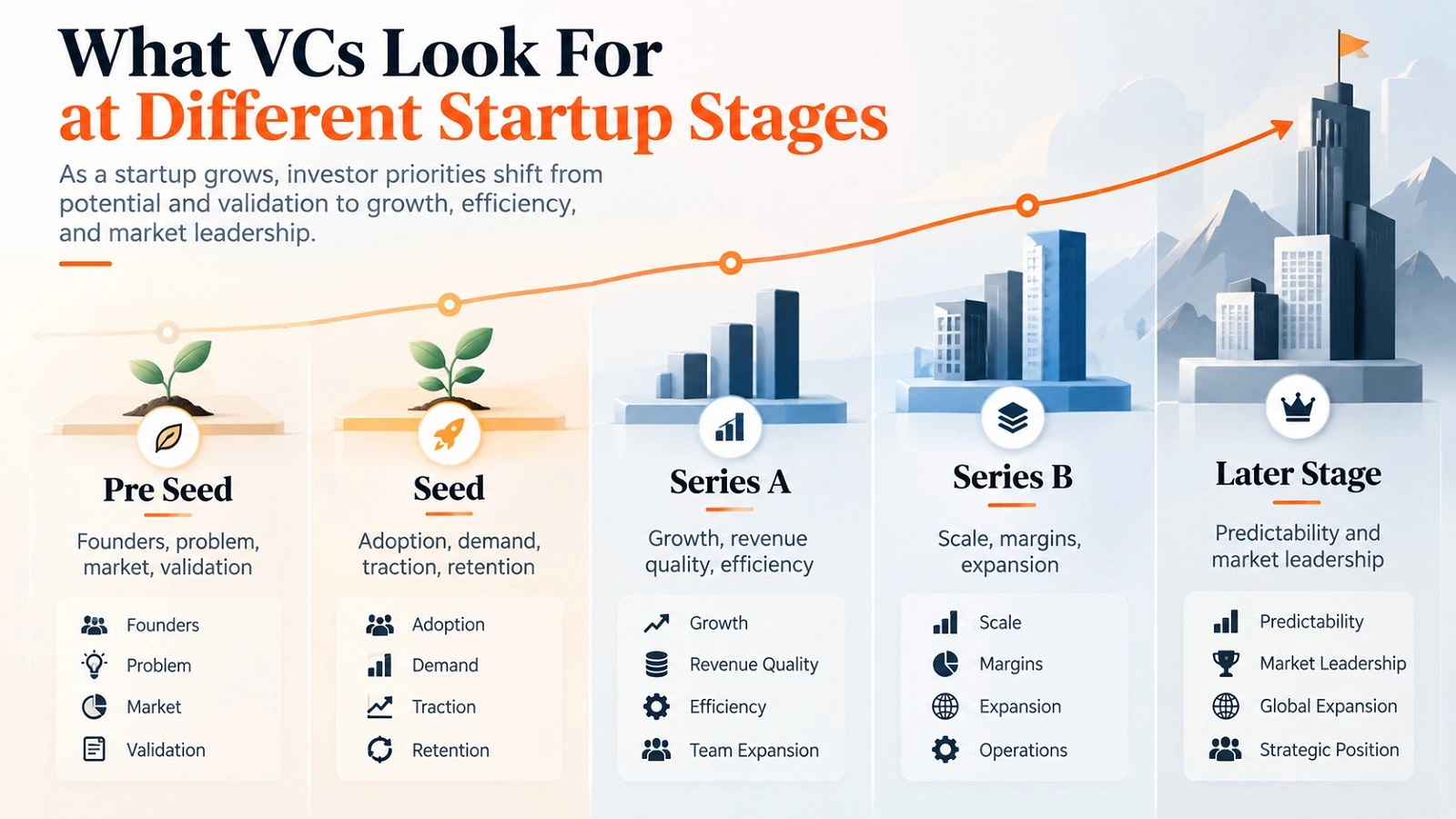
This progression reflects a broader principle in venture investing. Early stage investors make decisions with more uncertainty, while later stage investors expect increasingly strong evidence.
How Investor Priorities Change as a Startup Grows
AreaEarly StageGrowth StageFoundersInsight and adaptabilityLeadership and organizationMarketPotential opportunityProven expansion opportunityProductInitial customer valueScalable product platformTractionEarly demand signalsRepeatable performanceRevenueLimited evidenceQuality and predictabilityEconomicsInitial assumptionsMeasured efficiencyRiskProduct and market riskExecution and scaling risk
Founders should therefore avoid using the same fundraising story at every stage. The evidence expected from the company changes as the business becomes more mature.
What VCs Look For in a Pitch Deck
The pitch deck helps investors understand the company efficiently, but it is not a substitute for the underlying business.
VCs generally want to understand the problem, product, market, customer, traction, business model, competition, team, financial direction, fundraising requirement, and use of capital.
The strongest decks connect these elements into one coherent investment narrative. The customer problem explains why the product matters. Customer behavior provides evidence of demand. The market shows how large the opportunity could become. The business model explains how the company captures value.
What VCs Look For in Founder Meetings
Founder meetings allow investors to evaluate things that are difficult to capture in slides. They can see how founders think, communicate, respond to uncertainty, and handle difficult questions.
VCs may deliberately challenge assumptions to understand whether founders can defend their reasoning without becoming defensive. They also look for consistency between the story, the numbers, and what different members of the founding team say.
A strong meeting does not require instant answers to every question. Clear reasoning and an ability to acknowledge uncertainty can create more confidence than unsupported certainty.
What VCs Look For During Due Diligence
Once investor interest becomes serious, the process moves from narrative toward verification.
VCs may review financial records, customer data, contracts, legal documents, capitalization, intellectual property, employment arrangements, product metrics, security practices, and other information relevant to the business.
They may also speak with customers, employees, previous colleagues, industry experts, or existing investors. These conversations help determine whether the investment thesis remains credible when tested against independent evidence.
Reference Checks
Founder references can provide information that is difficult to obtain directly during fundraising conversations.
Investors may ask former colleagues or employees how a founder operates under pressure, whether they recruit strong people, how they handle disagreement, and whether they follow through on commitments.
Reference checks can become particularly important at early stages because founder quality represents such a large part of the investment case.
Customer References
Customer references allow investors to test whether the value proposition described by the founders matches actual customer experience.
VCs may ask why the customer purchased the product, what alternatives were considered, how frequently the product is used, what still needs improvement, and whether the customer expects to continue using it.
Customers who describe the product as increasingly important to their normal operations can provide particularly strong validation.
Potential for a Large Outcome
Venture capital economics require investors to consider what the company could become if things go well.
The VC may think about potential future revenue, market leadership, strategic value, acquisition possibilities, or public market potential. These are not precise forecasts. They help the investor understand whether success could produce an outcome large enough to matter to the fund.
A startup can therefore be a good business without being an obvious venture investment. Venture investors specifically need businesses where the upside can become unusually large.
Exit Potential
VCs eventually need liquidity to return capital to their own investors. This means they consider whether the startup could eventually create a realistic exit opportunity.
Possible outcomes may include an acquisition, public listing, or another transaction that creates liquidity for shareholders.
Investors do not need founders to know exactly how or when an exit will happen. They do want to believe that the company could become valuable and strategically important enough for meaningful liquidity to become possible.
Fund Fit
A startup can satisfy many investment criteria and still receive a rejection because it does not fit the VC fund.
Venture firms have specific strategies around stage, industry, geography, check size, ownership, and portfolio construction. Some specialize in pre seed companies, while others invest only after significant revenue has been established.
This means founders should distinguish between a weak startup and a weak investor match. Targeting funds that naturally fit the company can make fundraising significantly more efficient.
What Can Make a VC Say No?
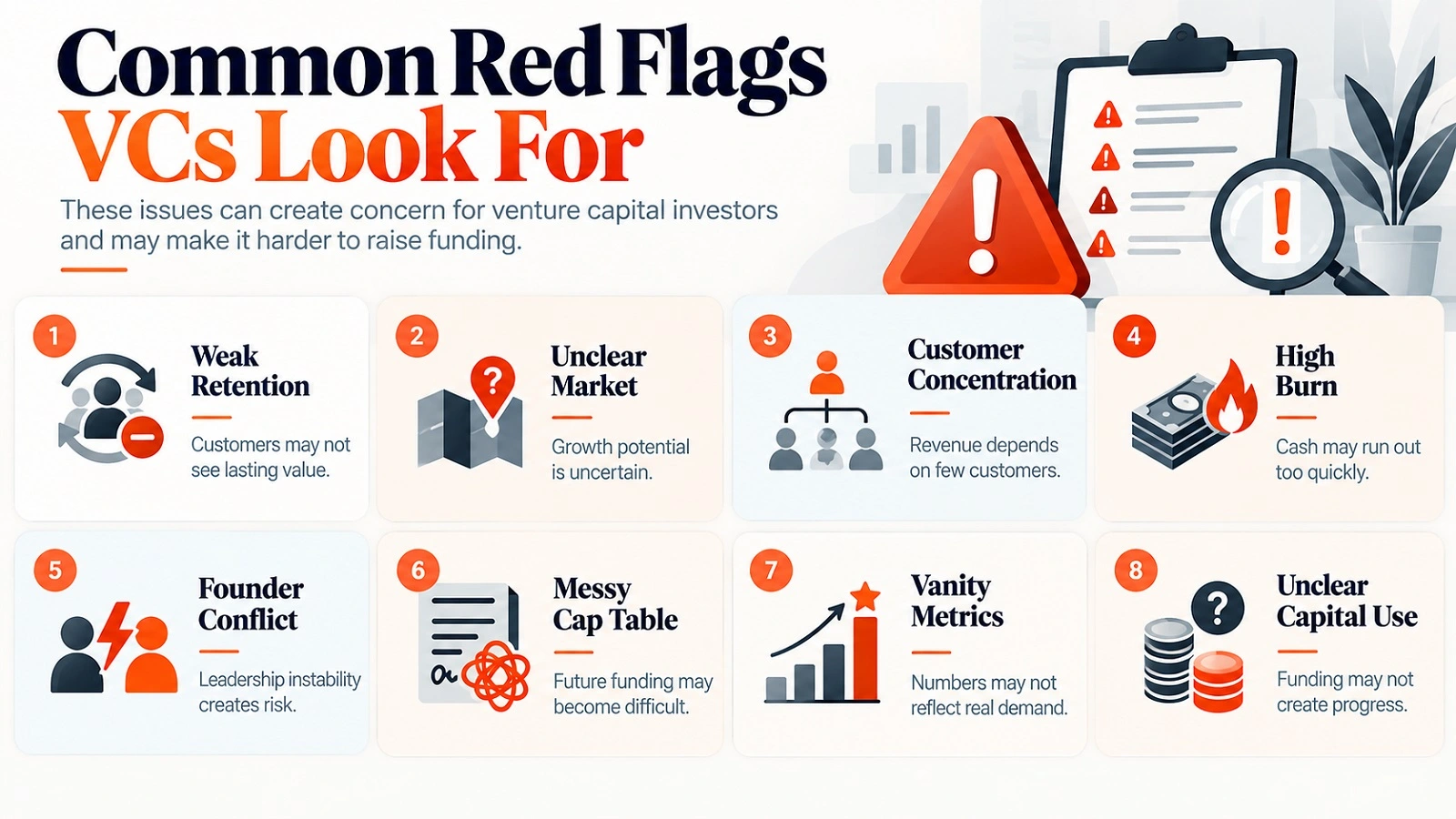
They may also decline because the startup competes with an existing portfolio company or because the round is too small or too large for the fund.
Some rejections simply mean the investor needs more evidence. A startup that is too early today may become attractive after reaching stronger product, customer, or revenue milestones.
Red Flags VCs May Notice
Red FlagWhy It Creates ConcernWeak RetentionCustomers may not receive lasting valueUnclear MarketGrowth potential is difficult to establishCustomer ConcentrationLosing one account could materially hurt revenueHigh BurnThe startup may require funding too quicklyFounder ConflictLeadership instability can damage executionMessy Cap TableFuture financing may become complicatedVanity MetricsHeadline growth may not reflect real demandUnclear Capital UseFunding may not create meaningful progress
A red flag does not always end an investment process. What matters is its severity, whether founders understand it, and whether there is a credible plan to address it.
Common Founder Mistakes
One common mistake is trying to present the startup as if it has no weaknesses. Experienced investors expect uncertainty. Avoiding difficult issues can create more concern than discussing them clearly.
Another mistake is relying too heavily on vanity metrics. Downloads, signups, social followers, website visits, and press attention can look impressive without proving that customers receive enough value to build a durable business.
Founders can also focus too heavily on the size of the market while failing to explain how they will actually reach customers. A large opportunity becomes meaningful only when the startup has a credible entry strategy.
What Makes a Startup Stand Out to VCs?
The strongest opportunities usually combine several positive signals. The founders understand customers deeply, the problem is important, the market has room to grow, the product creates measurable value, and customer behavior supports the story.
Momentum strengthens the case further. Improving retention, faster product development, stronger hiring, more efficient acquisition, increasing customer expansion, and better economics can show that the startup is becoming stronger over time.
VC conviction often emerges when several independent signals begin pointing toward the same conclusion.
How Founders Can Prepare
Founders should understand their own company more deeply than anyone else in the fundraising conversation. That includes customers, competitors, market dynamics, product usage, revenue, retention, acquisition, margins, burn, runway, ownership, and the specific metrics that matter to their business model.
Preparation should also include understanding weaknesses. Founders who know where the company is vulnerable can explain what they are doing about it rather than being surprised when investors identify the same issue.
The objective is not to memorize ideal answers. It is to build enough understanding that difficult investor questions can be answered with evidence and clear reasoning.
The Real Answer to What Do VCs Look For?
VCs look for evidence that a startup has the potential to create an unusually large outcome despite the uncertainty that exists today. That usually requires capable founders, an important customer problem, a sufficiently large market, a valuable product, evidence of demand, a scalable business model, and a credible path toward stronger competitive advantages.
As the startup develops, expectations change. Founder vision and early validation gradually need to become retention, revenue quality, repeatable acquisition, improving economics, organizational strength, and predictable execution.
There is no single metric that guarantees investment. The strongest venture opportunities are companies where multiple signals reinforce each other and give investors a credible reason to believe that the business can become substantially larger, stronger, and more valuable over time.
FAQ
What do VCs look for first in a startup?
At early stages, VCs commonly focus on the founders, customer problem, market opportunity, and initial evidence that customers care about the solution. As the company develops, traction and operating metrics become increasingly important.
What makes a startup attractive to VCs?
A startup becomes attractive when strong founders, meaningful customer demand, a large market, differentiated product value, growth potential, and a scalable business model combine into a credible investment opportunity.
What do VCs look for in founders?
Investors commonly look at judgment, adaptability, customer understanding, execution ability, communication, recruiting, leadership, commitment, and the founders' ability to make decisions under uncertainty.
Do VCs care more about the team or the idea?
The balance depends on stage. At very early stages, the founding team can carry significant weight because the product and business model are still developing. As the company matures, actual operating evidence becomes more important.
Do VCs require revenue?
Not always. Pre seed and some seed investors may invest before meaningful revenue exists. In those situations, they usually want other evidence such as customer validation, usage, pilots, product engagement, or strong founder insight.
Why do VCs care about market size?
Venture funds need some portfolio companies to generate very large outcomes. A sufficiently large market gives a successful startup enough room to grow into a company capable of producing those outcomes.
What traction do VCs look for?
The answer depends on the business model. Investors may examine revenue, active customers, retention, transactions, product usage, repeat purchases, pilots, contracts, or technical validation.
What financial metrics do VCs look for?
Depending on the stage and business, investors may examine revenue growth, gross margin, burn, runway, customer acquisition cost, lifetime value, payback periods, customer concentration, and sales efficiency.
What do VCs look for in a pitch deck?
VCs generally want a clear explanation of the problem, product, market, customers, traction, business model, competition, team, financial direction, fundraising requirement, and use of capital.
What are the biggest red flags for VCs?
Potential concerns include weak retention, unclear customer demand, founder conflict, excessive burn, poor financial controls, a complicated cap table, high customer concentration, limited differentiation, and no clear use of new capital.
Why would a VC reject a good startup?
The company may not fit the fund's stage, sector, geography, check size, ownership requirements, portfolio strategy, or return expectations. A rejection does not always mean the underlying business is weak.
Do VCs care about profitability?
Early stage investors do not always require profitability. They generally want evidence that the business can eventually develop attractive economics and that current spending is producing meaningful progress.
How important is defensibility to VCs?
Defensibility matters because successful markets attract competition. Investors want to understand whether technology, data, network effects, distribution, switching costs, brand, or another advantage can strengthen the company's position over time.
How can founders improve their chances of attracting VC investment?
Founders can strengthen their position by developing deeper customer understanding, improving retention, demonstrating meaningful traction, building a strong team, knowing their metrics, managing capital carefully, and clearly explaining how the next financing round will create measurable progress.

Mobina Khanki
Venture & Funding Writer at PinerookMobina Khanki covers venture capital, startup funding, fundraising, and startup finance for Pinerook, focusing on founders and investors.
 Seen first.