Understanding how VCs evaluate startups gives founders a much clearer view of what actually happens behind an investment decision. Venture investors rarely decide based on one metric, a polished pitch deck, or a strong first meeting. They build an investment case by combining evidence about the founders, market, product, traction, customer behavior, economics, competition, risk, and the potential size of the outcome.
Inside Venture Capital, startup evaluation is the process that turns initial curiosity into investment conviction. A company may look exciting during the first conversation, but the investor still needs to understand whether the team can execute, whether customers genuinely care, whether the market can support a large company, and whether the business could eventually create a return that matters to the fund.
The evaluation process also changes as the startup matures. A very early company may have limited revenue and little historical data, so investors rely more heavily on founder quality, customer insight, product direction, and early signs of demand. Later stage companies are expected to provide much stronger evidence around retention, revenue quality, growth efficiency, margins, predictability, and organizational execution.
What Does VC Startup Evaluation Actually Mean?
VC startup evaluation is the process investors use to decide whether a company deserves deeper diligence and, eventually, capital. It combines qualitative judgment with quantitative evidence. The investor is not only asking whether the startup appears promising today. The deeper question is whether the company could become substantially more valuable over time.
Qualitative evaluation includes the founders, their understanding of the market, the importance of the customer problem, product differentiation, strategic judgment, and competitive positioning. Quantitative evaluation may include revenue, customer growth, retention, product usage, gross margin, acquisition efficiency, transaction volume, or other measures that fit the business model.
The balance changes by stage. At pre seed, investors may have very little data and therefore need to make decisions with considerable uncertainty. At Series A and beyond, the company has had more time to create evidence, so assumptions are expected to be replaced by measurable operating results.
The Main Areas VCs Evaluate
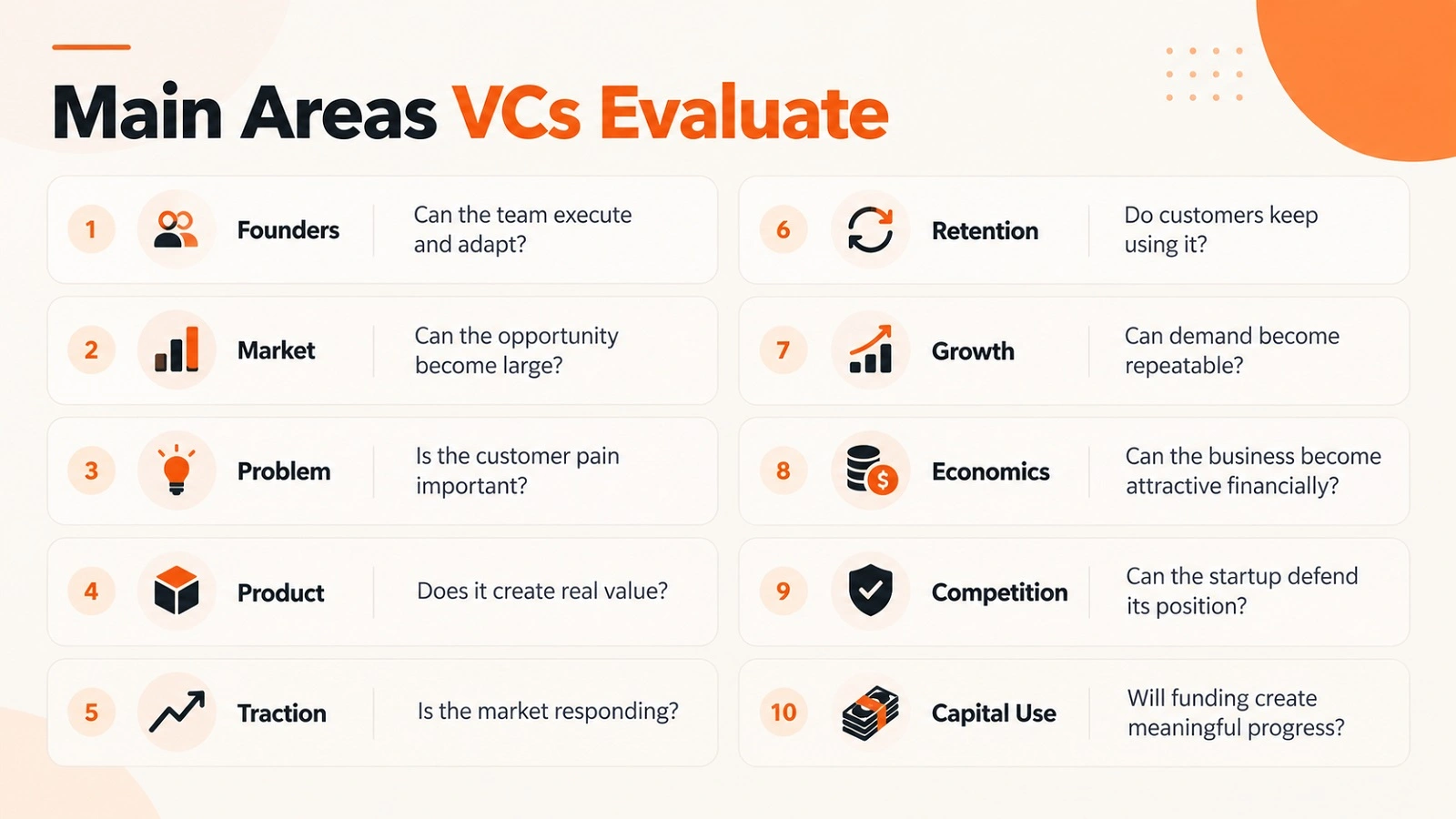
VCs rarely examine these categories in isolation. A startup with limited current revenue may still be highly attractive if the founders are exceptional, customer engagement is strong, and the market could become enormous. Another company may have much higher revenue but appear weaker because customers leave quickly, margins are poor, or growth requires increasingly expensive acquisition.
Founder Quality Is Central to Early Evaluation
At early stages, the founders often receive more attention than almost any other part of the company. This happens because many elements of the startup are still uncertain. The product may change, the target customer may evolve, pricing may be rewritten, and the original business model may not survive the next year.
Investors therefore need confidence that the founding team can respond when assumptions fail. They look at how founders make decisions, how quickly they learn, how deeply they understand customers, and whether they can attract talented people. Technical expertise or industry experience can strengthen the case, but adaptability and execution are equally important.
The fundraising process itself becomes part of this evaluation. Clear communication, accurate numbers, thoughtful responses, and consistency across meetings can increase investor confidence. Defensive answers or changing explanations can create the opposite effect.
Founder Market Fit
Founder market fit describes the relationship between the founding team and the problem it is trying to solve. Investors want to understand why this particular team discovered the opportunity and why it may understand the market better than others.
A founder may have experienced the problem directly, worked inside the industry, built relevant technology, managed the customer type being targeted, or developed relationships that provide unusual access to the market. These advantages can help the startup learn faster and avoid mistakes that outsiders might make.
Strong founder market fit does not guarantee success. It simply gives the investor a reason to believe that the team has useful insight and may be better positioned to execute than a founder entering the market with little context.
How VCs Evaluate the Problem
A startup can have an impressive product and still fail if the underlying customer problem is not important enough. Investors therefore spend time understanding the problem before becoming too focused on the solution.
They may ask how frequently the problem occurs, how much it costs customers, what customers currently do instead, and what happens if the problem remains unsolved. They also want to know whether customers feel enough urgency to change their existing behavior.
The strongest startup problems usually have evidence around them. Customers are already spending money, time, or effort trying to solve the issue. That makes the market easier to believe because the startup is not trying to create demand from nothing.
Problem Severity and Customer Urgency
VCs often distinguish between a product that is useful and a product that solves an urgent problem. Useful products can attract users, but urgent problems usually create stronger willingness to pay and more durable customer behavior.
Investors may look for signs that customers actively search for solutions, tolerate imperfect alternatives, or commit budget before the startup has built a complete product. Those actions often provide stronger evidence than positive survey responses.
For founders, this means customer behavior matters more than customer compliments. An enthusiastic interview is useful, but a customer willing to pay, sign a pilot, or change an existing workflow provides a much stronger signal.
How VCs Evaluate Market Size
Market size matters because venture funds usually need some portfolio companies to become extremely valuable. A startup can become profitable and successful without becoming large enough to generate a meaningful venture return.
Investors therefore examine how many potential customers exist, how much those customers might spend, how the market could evolve, and whether the startup has room to expand beyond its initial segment. Regulation, technology shifts, demographic changes, and changing customer behavior can all affect the size of the future opportunity.
A credible market story usually combines a focused starting point with a much larger expansion path. The company needs to explain where it can win first and why that position can eventually lead into a broader market.
TAM Is Only the Starting Point
Founders often use total addressable market to demonstrate that an opportunity is large. Investors may consider that useful, but a large theoretical market does not prove that the startup can capture meaningful value.
The VC wants to understand which customers the startup can reach first, how those customers buy, what competition looks like, how pricing works, and what distribution channels make the opportunity accessible. A huge market becomes less persuasive when the company has no realistic path into it.
A smaller but well supported market estimate can therefore be more credible than a very large number based on broad assumptions.
Market Timing
A large market is not enough if the timing is wrong. Investors also evaluate whether the market is ready for the product now.
Changes in regulation, infrastructure, customer behavior, technology, costs, or distribution can create conditions that make a previously difficult business possible. Investors want to understand what has changed and why the opportunity is becoming more attractive at this moment.
Founders who can explain both the size of the market and the timing of the opportunity usually present a stronger investment case.
Product Evaluation
VCs want to know whether the product creates meaningful value for customers. Depending on stage, this may involve product demonstrations, customer interviews, usage data, feature adoption, retention, and technical analysis.
At early stages, an incomplete product can still be investable. The key question is whether the founders have discovered something important about the customer and whether product development is moving toward stronger value.
Later stage investors usually require more evidence. They want to see that customers repeatedly use the product, that the experience scales, and that the product remains valuable as the customer base grows.
Product Differentiation
A useful product is not automatically a differentiated product. Investors want to understand why customers would choose the startup instead of available alternatives.
Differentiation can come from technology, user experience, price, data, distribution, speed, customer service, workflow integration, brand, network effects, or another advantage. The important point is that the difference must matter to the customer.
VCs also consider whether competitors could copy that advantage quickly. A feature that can be reproduced in a few weeks may create temporary differentiation without building a durable position.
Product Quality vs Product Potential
VCs often evaluate both what the product is today and what it could become. An early product may still contain weaknesses, but the investor may believe the underlying architecture, customer insight, or team capability creates significant future potential.
This is especially relevant in early stage investing. Investors do not expect the product to look finished. They do expect the product to be improving quickly and moving in a direction supported by customer behavior.
A startup that learns quickly from customers can sometimes appear more attractive than a more polished competitor that is improving slowly.
Traction Shows That the Market Is Responding
Traction provides evidence that the company is moving beyond theory. The form of traction differs by business model, so investors should not evaluate every startup with the same metric.
A software company may demonstrate recurring revenue and active accounts. A marketplace may show transaction volume and repeat usage. A consumer product may rely more heavily on retention, engagement, and organic adoption. A young enterprise company may demonstrate strong pilots or signed contracts before meaningful revenue appears.
What matters most is whether the traction metric reflects real customer behavior rather than a number that looks impressive but has little connection to business value.
How Traction Expectations Change by Stage
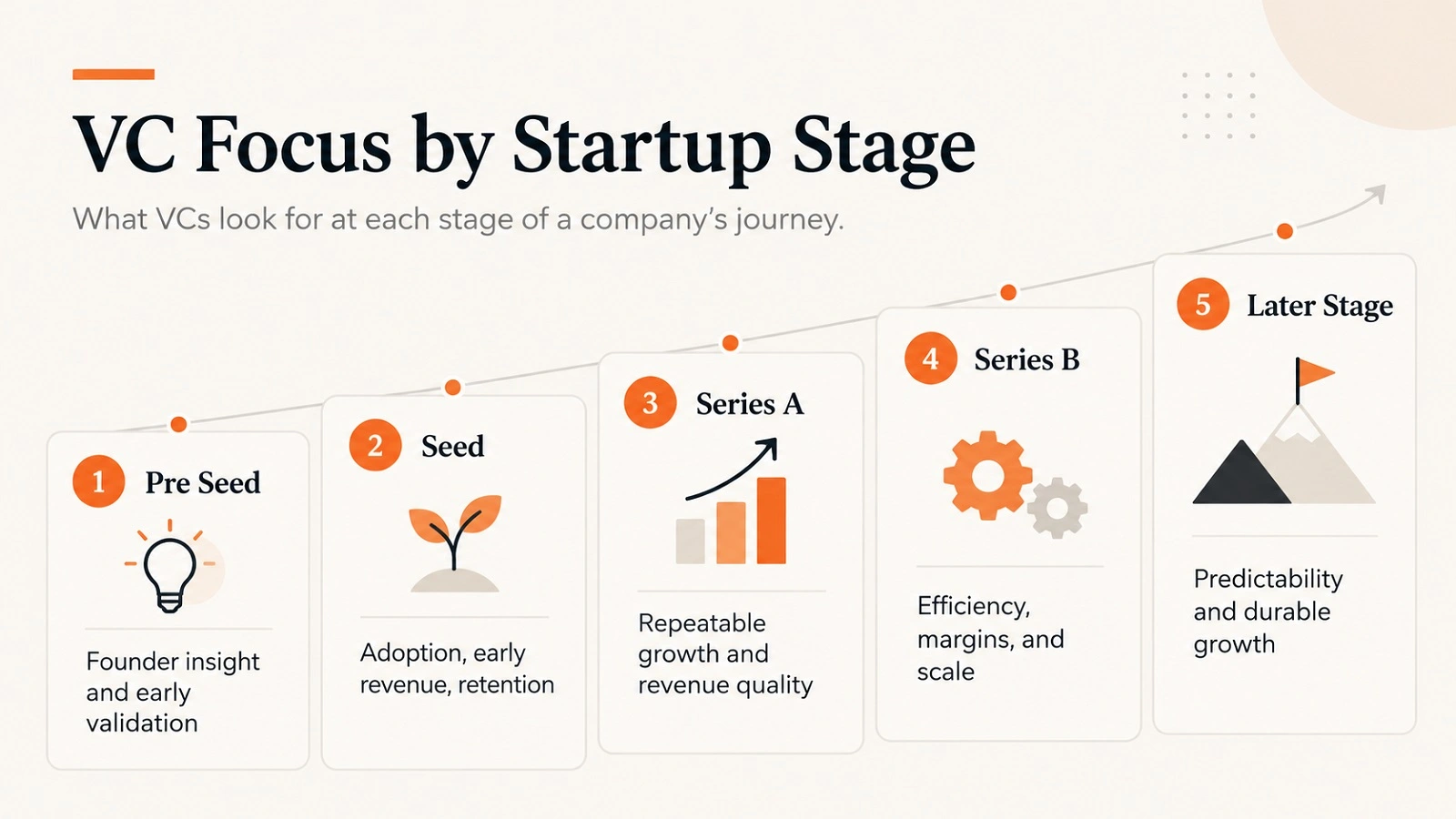
Investor expectations rise as the company develops. Early stage investors can accept more uncertainty because the company has had less time to create evidence. Later stage investors expect assumptions to become measurable facts.
Retention Matters More Than Many Founders Expect
Retention shows whether customers continue receiving value after the first interaction. A company can acquire many users and still have a weak business if most of those users disappear quickly.
Strong retention means each new group of customers adds to the existing base rather than simply replacing customers who leave. This can make growth compound over time and improves the economics of customer acquisition.
Depending on the business, investors may study customer churn, revenue retention, renewal rates, repeat purchases, cohort behavior, product engagement, or another measure of continued usage.
Cohort Behavior
Cohort analysis helps investors understand whether customer behavior changes over time. Instead of looking only at total users or total revenue, the VC can study groups of customers that joined during similar periods.
This makes it easier to see whether retention is improving, whether newer customers behave better than older ones, and whether product changes are creating stronger outcomes.
For growing startups, improving cohorts can be especially powerful because they show that the company is learning rather than simply becoming larger.
Growth Quality Matters More Than Growth Alone
Rapid growth often attracts investor attention, but VCs want to understand what is creating that growth. A company that doubles revenue by dramatically increasing acquisition spending may be less attractive than one growing slightly slower with much stronger efficiency.
Investors may examine sales productivity, conversion, acquisition cost, referrals, organic growth, customer expansion, and the time required to recover acquisition spending.
The strongest growth becomes easier to repeat as the company learns. The company develops better distribution, stronger retention, clearer positioning, or more efficient operations instead of relying only on increased spending.
Revenue Quality
Investors do not treat all revenue as equally valuable. Revenue that is recurring, diversified, and predictable may be more attractive than revenue dependent on irregular projects or a small number of customers.
VCs may examine customer concentration, contract duration, renewal behavior, expansion revenue, discounts, and whether the revenue reflects genuine ongoing demand.
A company can report strong total revenue while still creating concern if one customer represents a large share of the business or if contracts rarely renew.
Customer Concentration
Customer concentration becomes an important risk when a small number of customers account for a large share of revenue. Losing one customer could materially affect the company.
Early enterprise startups often have some concentration because they have only a limited number of customers. Investors do not necessarily expect complete diversification at that stage.
What matters is whether concentration decreases as the startup grows and whether the company has evidence that other customers can be acquired using a repeatable process.
Unit Economics
Unit economics help investors understand whether the basic financial structure of the business can become sustainable. A startup does not always need to be profitable before raising venture capital, but investors want to see that the company can eventually create more value from customers than it spends acquiring and serving them.
Relevant measures can include customer acquisition cost, customer lifetime value, gross margin, contribution margin, sales efficiency, payback period, and transaction economics.
The exact metric depends on the business model. The investor wants to understand whether the company becomes economically stronger as it grows rather than simply generating more revenue while also creating more losses.
Gross Margin
Gross margin helps investors understand how much value remains after the direct costs required to provide the product or service.
VCs normally compare gross margin with businesses that operate under similar models because software, marketplaces, logistics companies, and hardware businesses naturally have different cost structures.
The direction of the metric is also important. A company with improving margins may show that scale is creating efficiency, while declining margins can indicate that growth is becoming increasingly expensive.
Customer Acquisition
Investors want to understand how customers discover, evaluate, and purchase the product. Distribution is often just as important as the product itself because a strong product can still fail if the company cannot reach customers efficiently.
VCs may evaluate paid marketing, direct sales, partnerships, referrals, organic search, product led adoption, communities, or other channels. They want to know which channels are already working and whether those channels can support a much larger business.
At an early stage, the acquisition engine does not need to be fully optimized. The company should still have evidence that customer acquisition can become repeatable.
Sales Cycle
For enterprise startups, the sales cycle can heavily influence growth and capital needs. A product may generate strong customer interest but still require many months to close each contract.
Investors may examine how long deals take, which stakeholders participate, how sales cycle length changes by customer type, and what happens after initial contact.
A shorter or increasingly predictable sales cycle can improve investor confidence because the company can forecast growth more effectively.
Competitive Position
VCs want founders to understand the competitive landscape clearly. Claiming that a company has no competition rarely makes the opportunity more attractive.
Customers almost always have alternatives. They may use another product, rely on internal processes, hire people to solve the problem manually, or simply continue without solving it.
Investors want to understand why the startup wins against those alternatives and why that advantage could become more important as the company grows.
Defensibility
Defensibility describes what could make the startup more difficult to replace or copy over time. Investors do not always expect a young company to have a complete competitive moat, but they want to see a credible path toward stronger protection.
Possible sources include proprietary technology, unique data, network effects, switching costs, regulatory advantages, distribution, brand, customer relationships, or operational expertise.
The strongest forms of defensibility often improve as the company grows. More customers may create more data, stronger networks, deeper integrations, or greater brand recognition.
Business Model
VCs evaluate how the company converts customer value into revenue. They want to understand who pays, how pricing works, how often customers pay, and whether revenue grows when product usage grows.
A business model should fit how customers naturally receive value. Poor pricing can limit a strong product because customers may hesitate to buy or the company may capture too little of the value it creates.
Investors also consider whether the model improves with scale. Businesses where costs increase almost as quickly as revenue may require a very different investment case from models where margins improve significantly over time.
Pricing Power
Pricing power gives investors information about how much value customers believe the product creates. If customers consistently resist small price changes, the product may be less essential than the company believes.
Strong pricing power can come from high customer value, limited alternatives, integration into critical workflows, or strong differentiation.
At the same time, investors do not expect every early startup to have optimized pricing. They want founders to understand how pricing connects to customer value and how that relationship may develop.
Capital Efficiency
Capital efficiency shows how effectively the company converts funding into progress. Investors may compare the amount of money previously raised with what the startup has achieved.
A company that has created meaningful traction with limited capital may signal disciplined execution. Another business may need much more capital because its industry requires expensive infrastructure, research, regulation, or hardware.
VCs therefore do not judge spending without context. The question is whether the progress created by that spending is reasonable for the type of business being built.
How VCs Evaluate the Use of New Capital
VCs want to know what the current fundraising round will allow the company to accomplish. A vague plan to hire more people and grow faster is usually less convincing than a clear set of milestones.
Those milestones may include product launches, customer growth, revenue targets, expansion into new markets, key hires, technical development, or stronger economics.
The important question is whether the new capital moves the startup into a meaningfully stronger position. Ideally, the company should emerge from the round with evidence that reduces major risks and prepares it for the next stage.
Runway and Burn
Investors also look at how quickly the startup is spending capital and how much time remains before additional funding is required. These measures help them understand financial discipline and financing risk.
High spending is not automatically negative. A company may intentionally invest heavily because an important market opportunity requires speed. The investor wants to know whether the spending has a clear purpose and whether progress justifies it.
Weak control over burn can create concern because the company may be forced to raise again before it has reached meaningful milestones.
Risk Evaluation
Every startup contains significant risk. Venture investors are not looking for companies where risk has disappeared because those opportunities rarely offer venture level returns.
Instead, they want to identify the biggest sources of uncertainty and determine whether those risks can be reduced. Product risk, market risk, technical risk, regulatory risk, team risk, distribution risk, financing risk, and competitive risk can all matter.
Strong founders usually understand their major risks. They can explain what could go wrong and what evidence the company is gathering to reduce uncertainty.
How Risk Changes by Stage
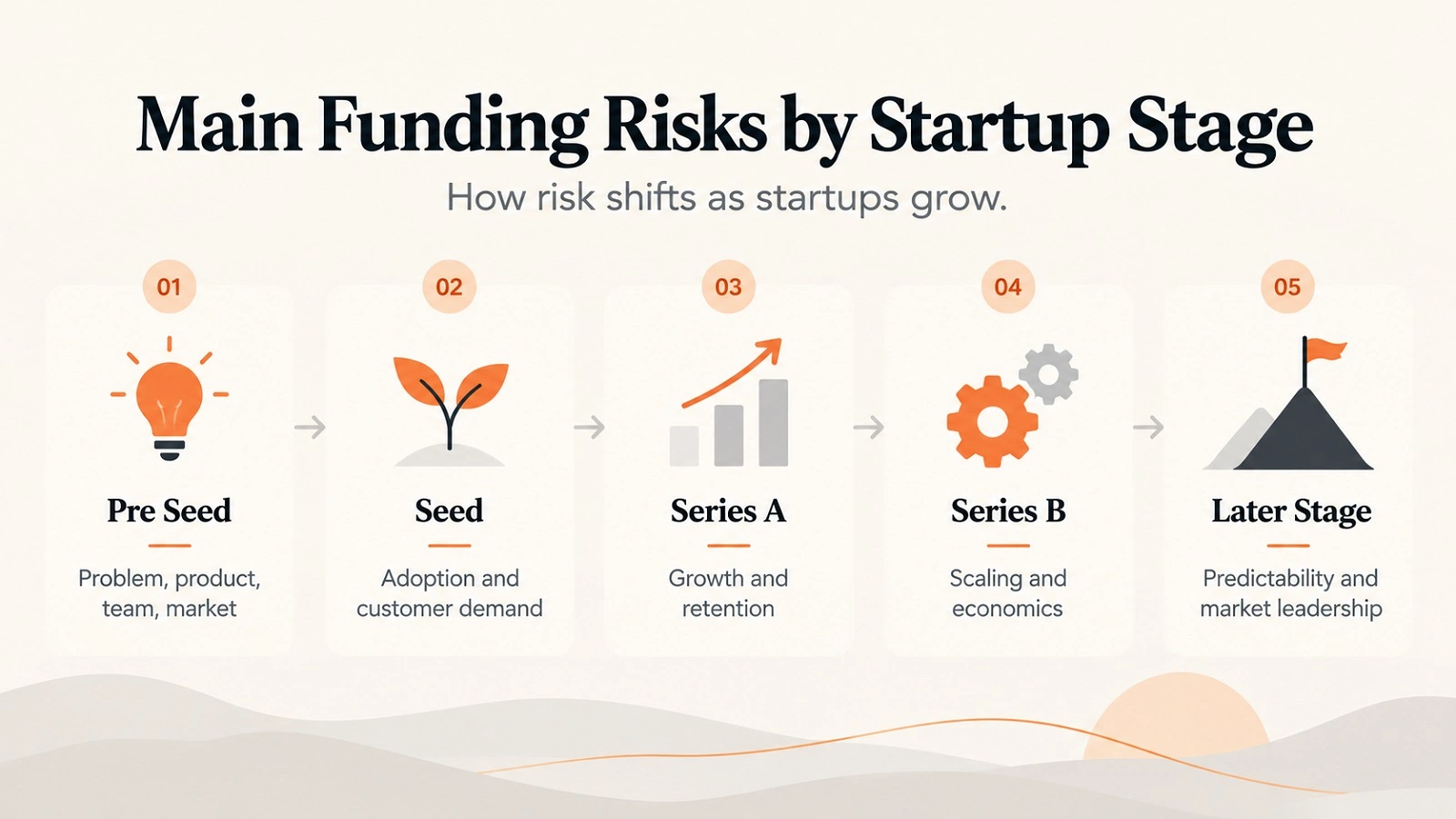
As a startup moves forward, the main risks should change. If a Series B company still faces exactly the same basic product uncertainty that existed at pre seed, investors may question whether enough progress has been made.
Reference Checks
When an investment becomes serious, VCs may speak with people who have previously worked with the founders. These conversations can include former colleagues, employees, previous investors, customers, or industry contacts.
Reference checks help investors understand how founders operate when conditions become difficult. They may ask whether the founder can recruit talented people, whether communication is reliable, and how the person responds to disagreement.
At early stages, these checks can matter significantly because founder quality represents such a large part of the investment case.
Customer References
Investors may also speak directly with customers to understand how much value the product creates in practice.
A customer can explain why the product was purchased, how frequently it is used, what alternatives were considered, what still needs improvement, and what would happen if the product disappeared.
Strong customer references provide independent evidence that the company is solving a meaningful problem. Investors are especially interested when customers describe the product as increasingly important to their normal workflow.
Team Beyond the Founders
As startups grow, the broader leadership team becomes more important. The founders cannot manage every function forever.
VCs may evaluate leadership in engineering, sales, marketing, finance, operations, product, or other critical areas depending on the company.
A startup does not need every executive role filled before investment. Investors do want founders to understand which capabilities are missing and whether the company can attract the people required for the next stage.
Hiring Ability
The ability to recruit talented people can become a major indicator of founder quality. Strong candidates usually have several career options, so their willingness to join a young startup can provide another signal about leadership and company potential.
Investors may look at the quality of existing hires, employee retention, recruiting pace, and whether the founders can attract people with experience beyond their own.
A startup that repeatedly upgrades the quality of its team can become more attractive even before financial metrics change dramatically.
Founder Dynamics
VCs may examine how well the founders work together. Misalignment among founders can create serious problems later, particularly when the company faces pressure or major strategic choices.
Investors may ask how responsibilities are divided, how disagreements are resolved, and how equity has been allocated. They may also consider whether each key founder remains committed to the business.
Strong founder relationships do not require constant agreement. Investors want to see that disagreements can be handled without damaging execution.
Governance
Governance becomes more important as the company raises institutional capital. Investors may review board structure, voting rights, ownership arrangements, and existing investor agreements.
Unclear governance can create problems during future financing or major company decisions. VCs therefore want to understand whether control and decision making are structured in a way that supports the next stage of growth.
For early startups, governance may still be simple. What matters is that the basic structure is clear and does not contain unresolved conflicts.
Valuation
A VC can believe that a startup is excellent and still decline to invest because the proposed valuation makes the economics unattractive.
The investor needs to consider how much ownership the fund receives, how much the company could eventually become worth, and how future financing may dilute that ownership.
A higher valuation benefits founders by reducing immediate dilution, but it can also increase future expectations. The company may need to achieve much stronger results before the next round can justify another increase in value.
Ownership Potential
Venture firms often have ownership targets because a successful company needs to contribute enough to the overall fund.
An investor may therefore evaluate not only whether the company is attractive but also whether enough ownership is available. A small allocation may not be meaningful for a large fund.
This is one reason startups sometimes receive different responses from different investors even when both firms believe the business itself is strong.
Exit Potential
VCs do not need to know exactly how a startup will eventually create liquidity, but they do need to believe that meaningful outcomes are possible.
The investor may consider potential acquisitions, public market opportunities, strategic buyers, industry consolidation, or other routes that could eventually create liquidity.
Exit analysis is not a precise prediction. It is another way of asking whether the company could become valuable enough for the investment to matter to the fund.
Why Different VCs Evaluate the Same Startup Differently
Startup evaluation contains judgment, so two experienced investors can study the same company and reach different conclusions. One investor may believe the market is about to expand, while another sees limited demand. One may see an exceptional founder, while another may worry about missing experience.
Fund economics also matter. Firms have different fund sizes, check sizes, ownership targets, sectors, stages, and return expectations.
A rejection should therefore be interpreted in context. It represents one investor's view of the opportunity, not an objective statement that the startup cannot succeed.
How VC Evaluation Changes by Stage
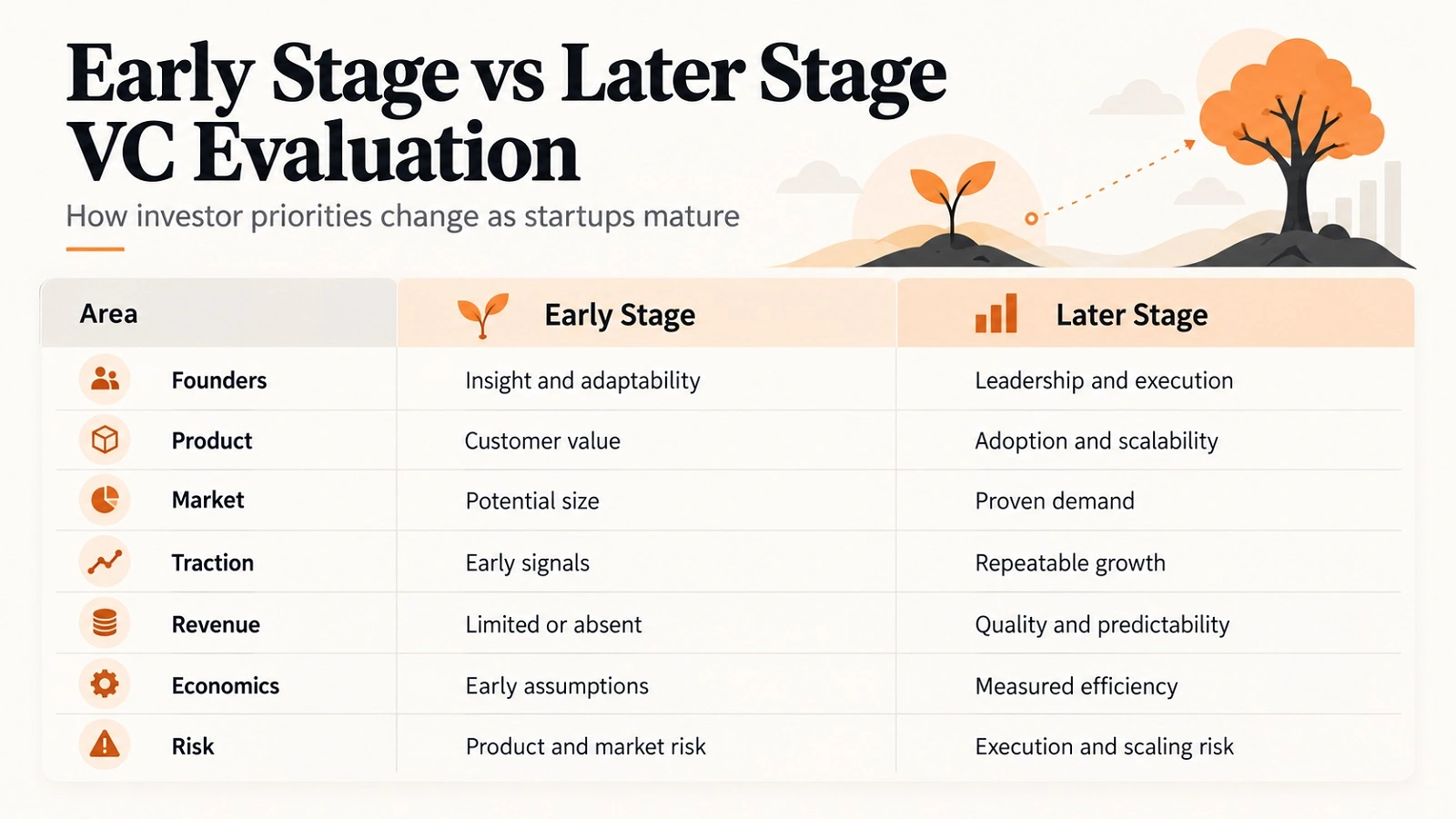
The pattern is straightforward. The more mature the startup becomes, the less investors need to rely on assumptions. Evidence becomes increasingly important.
What Happens After the First Investor Meeting?
The first meeting usually determines whether the investor wants to continue learning. If interest remains strong, the VC may ask for company metrics, financial information, customer references, product demonstrations, ownership details, or additional meetings with other members of the team.
As the process advances, the questions become more specific. Early conversations may focus on vision and market opportunity, while later meetings examine retention, unit economics, customer concentration, hiring plans, legal structure, and financing terms.
The investor gradually moves from asking whether the company is interesting to deciding whether the available evidence is strong enough to justify investment.
What Makes VC Conviction Grow?
Investor conviction usually grows when several parts of the company begin supporting the same story. Strong founders are more persuasive when customers clearly value the product. Strong traction becomes more compelling when retention is healthy. A large market becomes more believable when the company has an effective way to reach customers.
Momentum can also matter. If the company becomes stronger between investor conversations, new customers, improving retention, better economics, product progress, and strong hiring can all increase confidence.
VCs often invest when evidence across multiple areas starts pointing toward the same conclusion.
Common Founder Mistakes During VC Evaluation
Founders sometimes focus too heavily on making every number look positive. This can create problems when investors discover weaknesses later during diligence. Experienced VCs generally expect startups to have problems, so honest discussion of risks can be more credible than pretending those risks do not exist.
Another mistake is relying on generic answers. Investors want to understand what is specific about this market, this product, this customer behavior, and this team. Answers that could describe almost any startup rarely build strong conviction.
A polished pitch deck also cannot replace business evidence. Design and storytelling help investors understand the company, but customer demand, retention, founder insight, growth quality, and economics remain far more important.
How Founders Can Prepare for VC Evaluation
Preparation starts with understanding the company's most important evidence. Founders should know their market logic, customer behavior, key metrics, competition, business model, ownership structure, major risks, and use of capital before serious fundraising begins.
They should also know where the company is weak. Investors are likely to discover these weaknesses eventually, so founders benefit from understanding them before entering the meeting.
Strong preparation does not require perfect answers. It requires clear thinking, accurate information, and a credible explanation of how the company is reducing uncertainty.
What Makes a Startup Stand Out?
The most attractive startups often combine several strong characteristics rather than depending on one extraordinary metric. The founders understand customers deeply, the product solves an important problem, the market can become large, and early evidence suggests the company is learning quickly.
A strong startup also tends to improve over time. Product quality rises, customer behavior becomes stronger, acquisition becomes more repeatable, the team improves, and the company reduces the biggest risks facing the business.
That pattern of improvement can sometimes matter as much as the absolute level of the metrics today.
What Does Not Automatically Impress VCs?
Large market slides, strong branding, media coverage, awards, famous advisers, or large signup numbers can help create attention, but none of these automatically makes a startup investable.
The investor still needs to understand whether customers receive meaningful value and whether the business can become very large. A startup with fewer users but strong retention may be more attractive than one with a large audience and very little continued engagement.
VCs ultimately need evidence that the company can create durable value rather than temporary attention.
The Real Way VCs Evaluate Startups
VCs do not evaluate startups through one universal score. They combine founder quality, customer problems, market size, product value, traction, retention, growth, economics, competition, risk, ownership, and potential outcomes into an overall investment view.
At early stages, the decision may depend heavily on founders, insight, and the direction of the opportunity. As the company matures, operating evidence becomes increasingly important. Retention, revenue quality, efficiency, predictability, and organizational strength carry more weight.
For founders, the goal should not be to optimize the company for an investor checklist. The stronger approach is to build real evidence that customers want the product, the team can execute, and the opportunity can become significantly larger than it is today.
FAQ
How do VCs evaluate startups?
VCs evaluate founders, market size, customer problems, product quality, traction, retention, growth, economics, competition, risk, ownership, and how additional capital could increase the value of the company.
What do VCs look at first?
At early stages, investors often focus heavily on the founders, customer problem, market opportunity, and early evidence of demand. At later stages, operating and financial evidence becomes more important.
Do startups need revenue before VCs invest?
Not always. Pre seed and some seed investors may invest before meaningful revenue exists, but they usually expect other evidence such as customer discovery, product engagement, pilots, or early adoption.
Why do VCs care about market size?
Venture funds need some investments to produce very large outcomes. A limited market can restrict the potential value of the company even if the business itself becomes profitable.
Why is retention important?
Retention shows whether customers continue receiving value after the first interaction. Strong acquisition combined with weak retention can create temporary growth without building a durable business.
What startup metrics do VCs evaluate?
The exact metrics depend on stage and business model. Common areas include revenue, growth, retention, gross margin, customer acquisition, product usage, customer concentration, transaction volume, and sales efficiency.
Do VCs evaluate founders personally?
Yes. Especially at early stages, investors often evaluate founder judgment, adaptability, communication, industry understanding, recruiting ability, and how the team responds under pressure.
How important is competition?
Competition helps investors understand whether the startup can build a strong market position. VCs want founders to understand existing alternatives and explain why customers will choose the startup instead.
Can a strong startup still be rejected by a VC?
Yes. A startup may not fit the investor's stage, sector, fund size, ownership requirements, portfolio strategy, or valuation expectations even when the underlying business is strong.
How should founders prepare for VC evaluation?
Founders should understand their customers, market, product, metrics, competition, risks, business model, ownership, financial position, and use of capital. They should also prepare clear answers to difficult questions rather than focusing only on the pitch presentation.

Mobina Khanki
Venture & Funding Writer at PinerookMobina Khanki covers venture capital, startup funding, fundraising, and startup finance for Pinerook, focusing on founders and investors.
 Seen first.