Venture capital is one of the most influential forms of financing in the startup world because it allows young companies to access significant capital before they become large, mature, or consistently profitable businesses. In exchange, investors receive ownership and become financially connected to the future value of the company.
For founders, venture capital is not simply a way to get more money into the bank. It changes ownership, growth expectations, governance, reporting, and often the strategic direction of the company. A startup that accepts venture investment is usually choosing a path built around creating substantial enterprise value rather than simply reaching profitability as quickly as possible.
That distinction matters because venture capital is not appropriate for every startup. Some businesses can grow effectively through customer revenue, founder capital, debt, or other sources. Others operate in markets where speed, product development, network effects, or infrastructure require more capital than the company could reasonably generate on its own.
Understanding how venture capital works therefore helps founders answer a more important question than how to raise money: whether venture financing actually matches the company they want to build.
What Is Venture Capital?
Venture capital is a form of private investment in companies that investors believe can grow significantly in value.
Unlike a traditional lender, a venture investor does not primarily expect the company to repay the capital through scheduled payments. The investor normally receives equity and hopes that the value of that ownership increases as the startup develops.
The investment model accepts that many startups are uncertain. Some may fail, some may produce modest outcomes, and a smaller number may become extremely valuable. Venture investors therefore look for businesses capable of generating outcomes large enough to make the overall investment portfolio attractive.
This helps explain why venture capital often concentrates on companies with large potential markets, scalable business models, strong technology, network effects, or another advantage capable of supporting substantial growth.
Why Venture Capital Exists
Startups often face a financing problem that traditional businesses do not.
A young company may have a promising product and a large market opportunity while producing little revenue. It may need to hire engineers, build infrastructure, acquire customers, or spend years developing technology before the economics of the business become mature.
Traditional lenders can find these companies difficult to finance because there may be limited assets, uncertain cash flow, and no long operating history.
Venture capital addresses that gap by providing risk capital in exchange for ownership. The investor accepts substantial uncertainty because the potential value of a successful company may be much larger than the original investment.
For founders, this means they can finance growth before the business itself is capable of generating enough cash to support that growth.
How Venture Capital Fits Into the Startup Funding Journey
Venture capital can appear at several stages of startup development, but expectations change as the company matures.
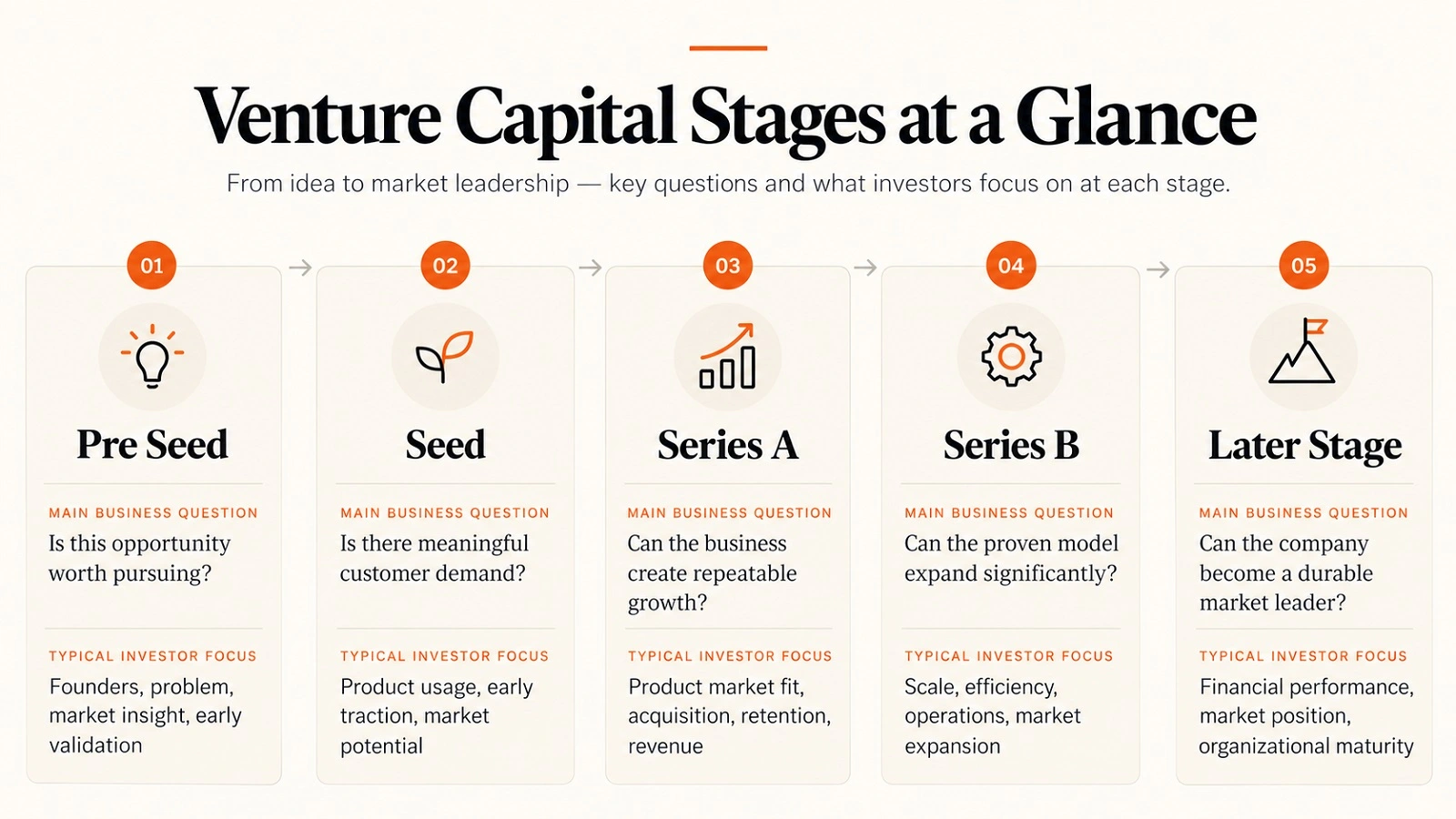
At the earliest stages, investors may rely heavily on founder quality and market insight because there is limited operating data. As the startup develops, the investment case becomes increasingly dependent on measurable performance.
The company therefore needs different evidence at different stages. What may be sufficient for an early seed investor would usually be far too weak for a later growth investor.
How Venture Capital Works
Founders often think about venture capital from the perspective of raising a round, but the investor is operating inside a larger financial system.
Most venture firms raise money from outside investors and manage that capital through one or more funds. Those funds invest across a portfolio of startups over several years. The venture firm then tries to increase the value of those investments before eventually returning capital to its own investors.
Understanding How Venture Capital Works helps founders see why venture investors care so much about market size, ownership, future financing, growth potential, and exit opportunities. The investor is not simply evaluating whether the startup can become profitable. The investor needs the company to have enough upside to create a meaningful return within the economics of the fund.
This is one reason a good small business can be unattractive to venture capital. The business may be profitable and well managed but still lack the scale required to produce a venture level outcome.
Who Provides Venture Capital?
Venture capital can come from different types of investors, each with its own strategy.
Traditional venture firms manage dedicated investment funds and usually specialize by company stage, industry, geography, or check size. Some concentrate on very early companies, while others invest only after a business has reached significant scale.
Corporate investors may invest because the startup has strategic relevance to an existing business. Government backed funds may support industries considered economically or technologically important. Family offices and institutional investors may also participate directly in private company financing.
For founders researching Venture Capital Firms, the important point is that investors should not be treated as interchangeable sources of capital. A firm that invests in early enterprise software companies has a very different mandate from one focused on later stage consumer businesses.
Investor fit can determine whether a fundraising conversation is relevant before the pitch even begins.
How Venture Funds Are Structured
Most venture firms invest money on behalf of limited partners.
These limited partners can include pension funds, endowments, family offices, foundations, corporations, and other institutional investors. The venture firm acts as the general partner and manages the investment strategy.
The fund usually has a defined amount of capital, an investment period, and a longer lifecycle in which the portfolio companies develop and eventually create liquidity through acquisitions, public offerings, secondary transactions, or other outcomes.
This structure shapes how venture investors behave.
A fund that is near the end of its investment period may behave differently from a newly raised fund. A large fund may require larger potential outcomes than a small early stage fund because each successful investment needs to contribute meaningfully to total fund returns.
Founders benefit from understanding the fund behind the investor rather than evaluating only the individual partner sitting across the table.
How Venture Capital Firms Find Startups
Venture firms build investment pipelines through founder referrals, existing portfolio companies, accelerators, other investors, events, direct outreach, industry research, and relationships across the startup ecosystem.
Some firms receive thousands of startup introductions, which means attention itself becomes scarce.
A strong referral may help create context, but founders do not always need a warm introduction. Direct outreach can work when the message is relevant, concise, and supported by evidence that matches the investor’s strategy.
The most important factor is usually fit.
A startup may have strong traction and still receive little interest from an investor whose fund does not operate at that stage or in that category.
The Venture Capital Investment Process
The process from first conversation to completed investment can involve several stages.
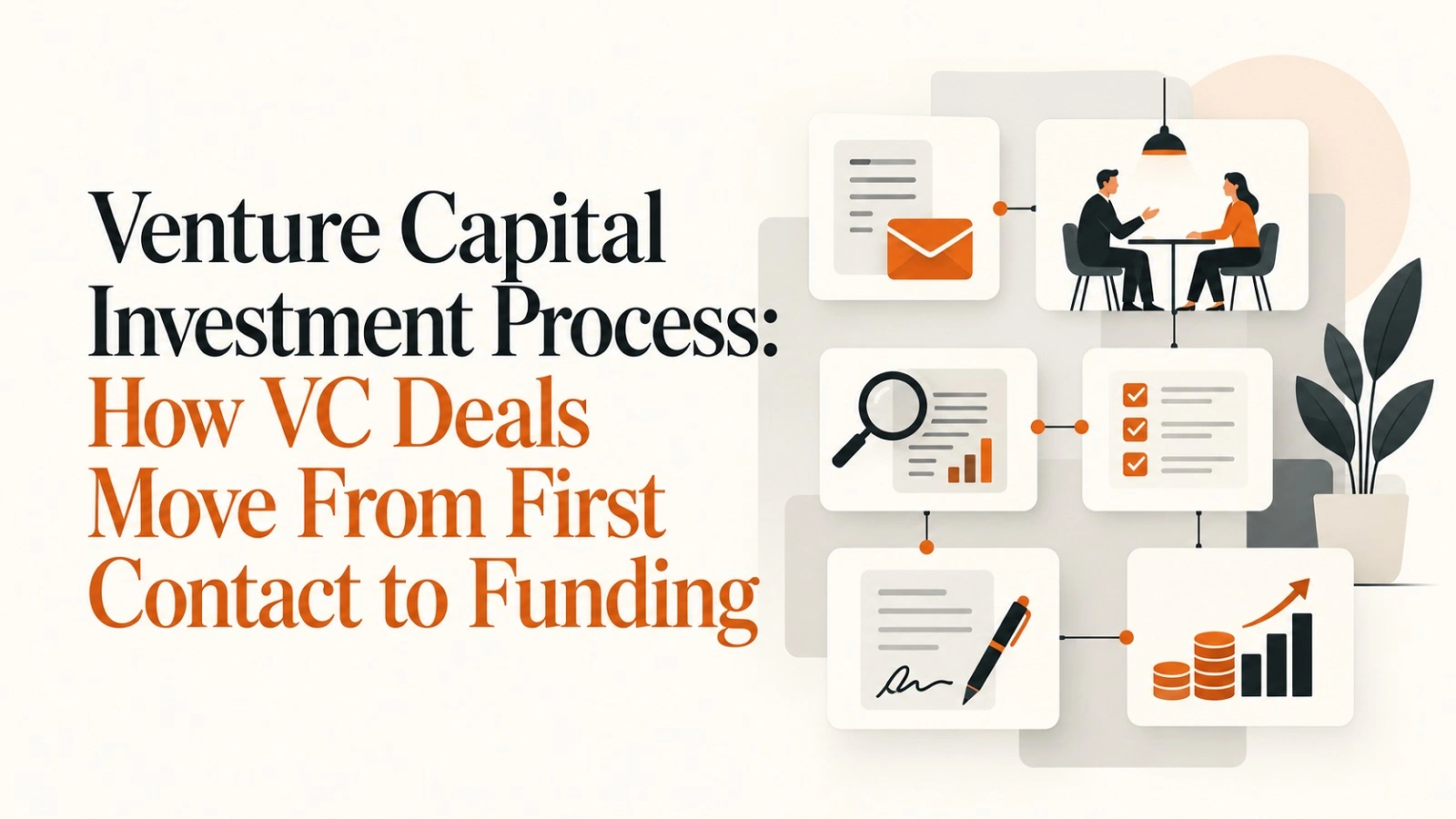
Understanding the Venture Capital Investment Process helps founders prepare for what happens after an investor expresses interest. Initial meetings usually focus on the problem, founders, market, product, and traction. If interest grows, the investor may conduct deeper meetings, speak with customers, examine financial information, evaluate competitors, and involve other partners inside the firm.
Later stages may include due diligence, reference checks, internal investment committee discussions, term sheet negotiations, and final legal documentation.
The process can move quickly when investor conviction is strong, but it can also take substantial time. Founders should therefore avoid assuming that positive early meetings mean capital is guaranteed.
What Happens in an Investor Meeting?
A good investor meeting is not simply a presentation.
The pitch deck creates structure, but investors are also evaluating how founders think. They may challenge assumptions around customers, competition, pricing, growth, hiring, market size, and financial performance.
Strong founders usually know where uncertainty remains. They do not need to pretend every question has a perfect answer.
In many cases, an investor is evaluating whether the founding team understands the company deeply enough to make good decisions as conditions change.
The quality of the conversation can therefore matter as much as the quality of the slides.
How VCs Evaluate Startups
The framework behind How VCs Evaluate Startups changes by stage, but investors are usually trying to understand whether the company combines a large opportunity with a team capable of capturing it.
At an early stage, that may mean evaluating founder experience, customer understanding, product insight, and the size of the market. At later stages, investors can examine retention, revenue growth, acquisition efficiency, margins, sales productivity, and organizational maturity.
Investors are not only asking whether the company looks attractive today. They are trying to estimate how much stronger the business could become if additional capital is deployed successfully.
That requires both evidence and judgment because startup investing always involves uncertainty.
What Venture Capitalists Look For
Founders often search for What Do VCs Look For because they want a checklist that predicts whether investors will say yes. In practice, there is no universal formula, but several areas consistently matter.
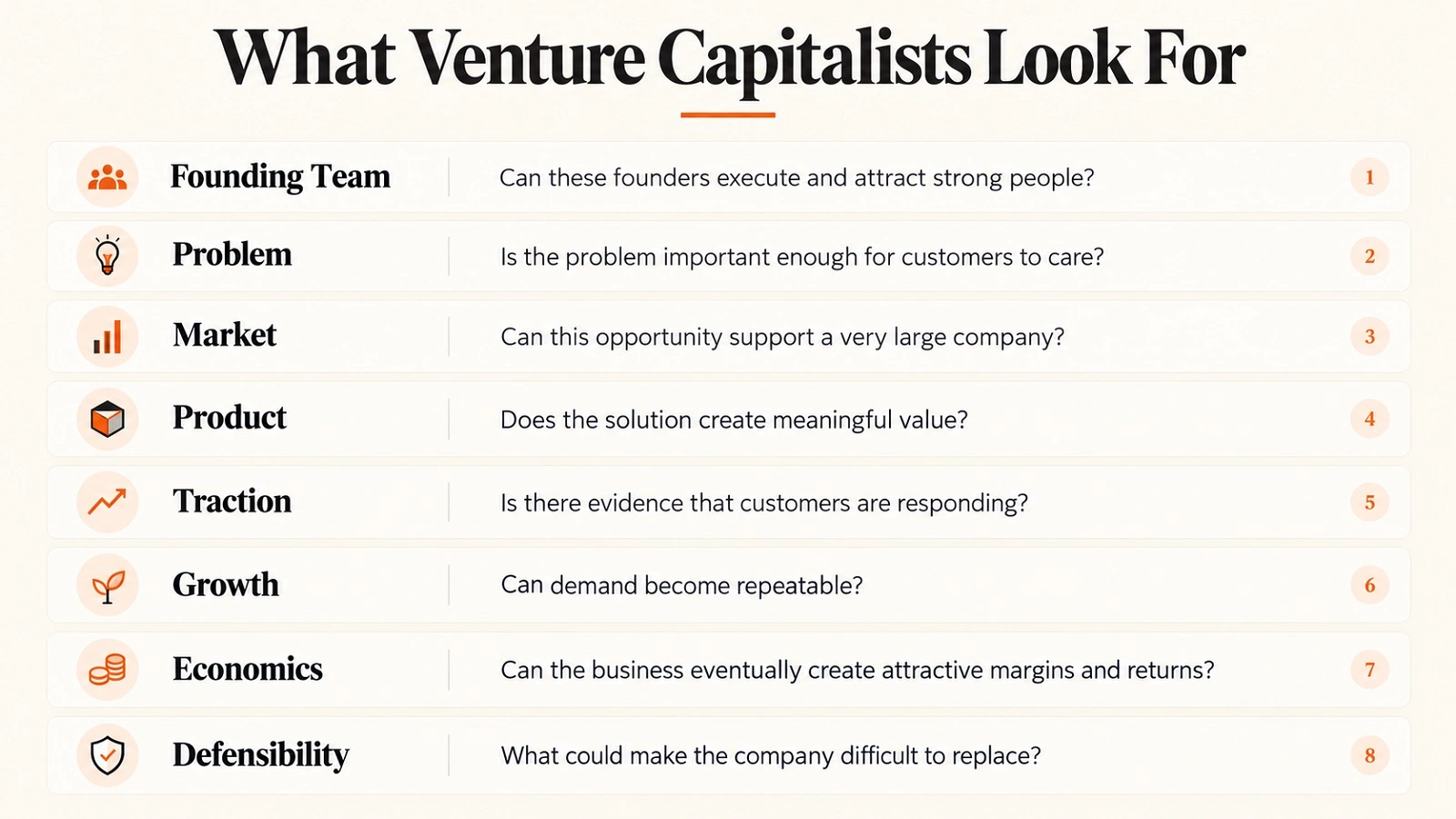
The relative importance of each category changes over time. A pre seed company may have limited revenue but exceptional founder market fit. A Series B company, by contrast, is expected to provide much more substantial evidence around growth and business performance.
Market Size and Venture Capital
Market size matters because venture investors need large potential outcomes.
A startup can execute extremely well but still struggle to create venture level returns if the available market is too small.
Investors therefore examine not only the number of possible customers but also how much those customers may spend, how rapidly the market can grow, and whether the startup has a credible path toward capturing a meaningful position.
Founders sometimes make the mistake of presenting an enormous theoretical market without explaining which customers they can actually reach.
A stronger market argument connects a large opportunity to a realistic entry point and expansion path.
Why Founder Quality Matters So Much
Early startups contain limited evidence, so much of the investment decision rests on the founders.
Investors may examine how deeply the founders understand the customer, whether the team has relevant technical or industry expertise, how quickly they learn, how they recruit, and how they respond to difficult questions.
Founder market fit becomes especially valuable when the team has knowledge that outsiders would take years to develop.
A strong team does not guarantee success, but investors know that the original product or strategy may change many times. They are therefore partly investing in the founders’ ability to adapt while continuing to build.
Product Market Fit and Venture Capital
Product market fit becomes increasingly important as the company develops.
Investors want evidence that customers are not merely trying the product but receiving enough value to continue using or paying for it.
Depending on the business, that evidence may include retention, recurring revenue, repeat purchasing, expansion revenue, product engagement, referrals, or customer satisfaction.
A startup may be able to raise early capital before strong product market fit exists. It becomes much harder to justify aggressive scaling if retention and customer behavior suggest the product still needs fundamental improvement.
Capital can accelerate growth, but it cannot permanently hide weak demand.
Growth and Scalability
Venture investors typically care about whether growth can continue as the company becomes larger.
A startup might grow rapidly from ten customers to one hundred customers while relying heavily on founder relationships. The important question is whether the same company can move from one hundred to thousands of customers through systems that become repeatable.
This is why investors examine acquisition channels, sales processes, conversion, retention, gross margins, and operational capacity.
Scalability does not mean growth must be effortless. It means the economics and systems of the business should have a credible path toward supporting a much larger organization.
The Difference Between Angel Investors and Venture Capital
Founders often encounter both angel investors and venture firms during early fundraising.
The comparison between Angel Investors vs Venture Capital is useful because the two groups may invest in similar companies while operating very differently.
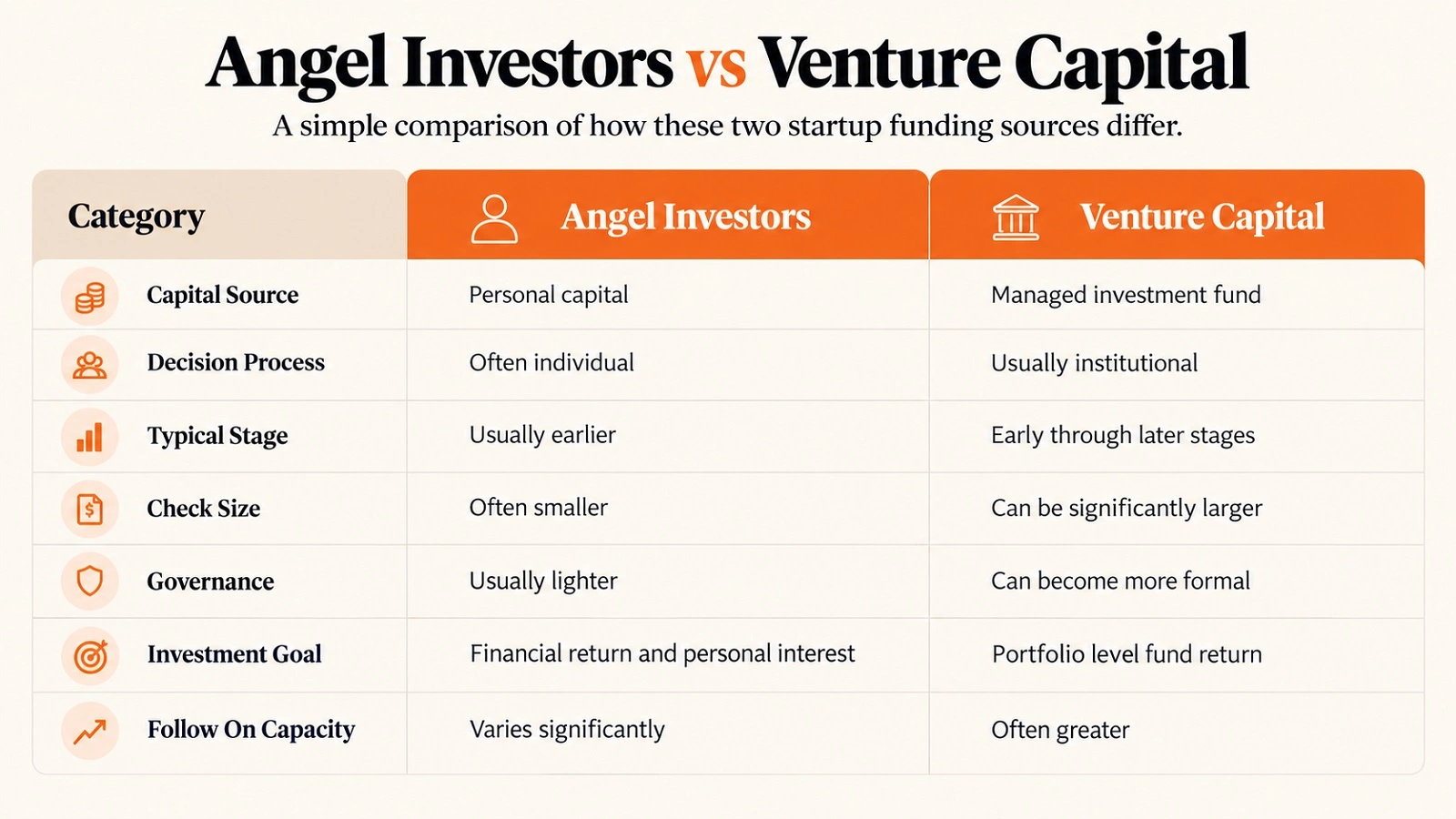
Angels may make decisions faster and can be valuable when the startup is still too early for institutional capital. Venture firms generally bring larger pools of capital, more structured diligence, and greater capacity to support future rounds.
Corporate Venture Capital
Corporate Venture Capital refers to investment activity carried out by established companies rather than traditional independent venture firms.
Corporations may invest because a startup creates strategic value around technology, customers, supply chains, distribution, or future markets. For the startup, this type of investor can provide much more than money.
A strong corporate relationship might create access to customers, infrastructure, manufacturing, technical resources, or industry expertise.
However, strategic capital can also create complications. A partnership with one major company may make competitors less comfortable working with the startup, and the corporation’s strategic priorities can change over time.
Founders should therefore evaluate both financial and commercial consequences before accepting this kind of capital.
Venture Capital vs Bootstrapping
Venture capital and bootstrapping represent very different growth strategies.
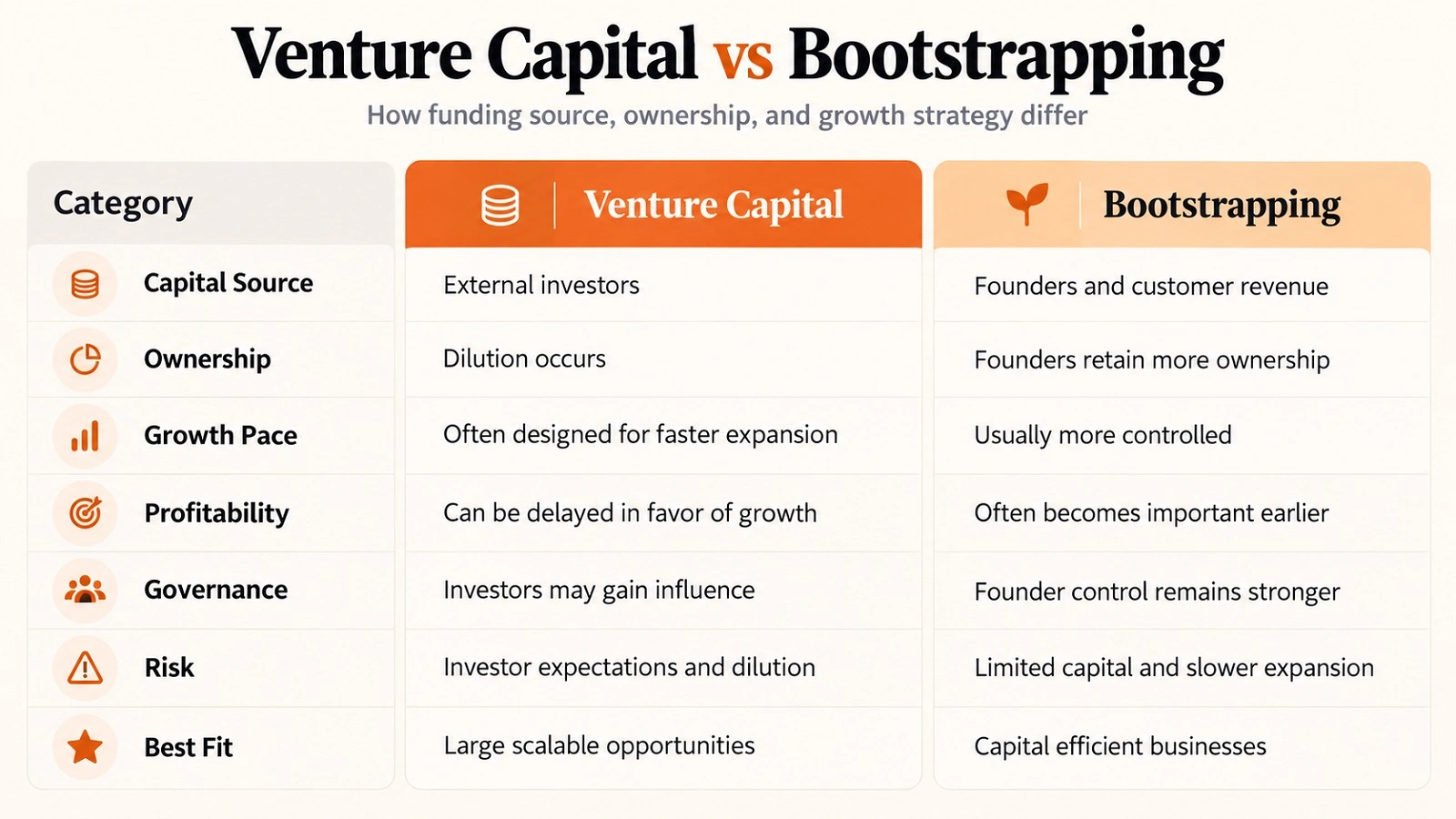
Neither model is universally better.
A startup that can grow efficiently from customer revenue may not need institutional capital. Another company may be unable to pursue its opportunity without substantial external investment.
The right choice depends on the economics of the opportunity.
Venture Capital vs Debt
Debt and venture capital create fundamentally different obligations.
Debt allows founders to retain more ownership, but the company must repay the capital according to agreed terms. Venture capital does not require traditional repayment, but investors receive equity.
Debt becomes more practical when cash flow is predictable. Very early startups may find debt risky because payments still need to be made even if revenue develops more slowly than expected.
Venture investment shifts more of the financial risk toward investors, but founders give up part of the future value of the company.
The decision therefore depends on whether ownership dilution or repayment pressure represents the more appropriate risk for the business.
What Is a Term Sheet?
A term sheet outlines the major commercial terms under which an investor is prepared to finance the company.
It may describe valuation, investment amount, ownership, board representation, voting rights, liquidation preferences, option pools, future participation rights, and other important conditions.
Founders sometimes focus almost entirely on valuation, but the rest of the term sheet can be equally important.
Two offers with identical valuations can create very different outcomes depending on the underlying terms.
Professional legal advice is essential, but founders should also understand the business implications themselves.
Valuation and Ownership
Valuation determines how much of the company investors receive for their capital.
A higher valuation generally reduces immediate dilution, which makes it attractive to founders. However, valuation should not be optimized without considering what happens next.
If a company raises at a price that future performance cannot support, the next financing round may become difficult.
Founders therefore need to balance ownership preservation with realistic expectations.
The best valuation is not necessarily the largest number available. It is one that provides enough capital while leaving the company in a credible position for future growth.
Understanding Dilution
Dilution occurs when new shares are issued and the percentage ownership of existing shareholders becomes smaller.
For example, founders may own most of the company before outside financing, but their percentage gradually falls as investors and employees receive equity.
This is a normal part of venture financing.
The relevant question is whether the capital creates enough value to justify the ownership exchanged.
A founder may prefer owning a smaller percentage of a significantly more valuable company rather than retaining complete ownership of a business that cannot reach its full opportunity.
The challenge is managing dilution intentionally across multiple rounds rather than evaluating each round in isolation.
How Venture Capital Changes Governance
Outside investment can change how major decisions are made.
Investors may receive board seats, voting rights, information rights, and approval rights over certain strategic decisions.
This introduces additional oversight, which can be valuable when investors bring experience and help management improve decision making.
It can also reduce founder autonomy.
The effect depends heavily on investor quality, company stage, and the terms of the financing.
Founders should therefore evaluate governance before accepting investment rather than assuming these issues can be addressed later.
What Happens After Venture Capital Investment?
Closing the round is the beginning of a new relationship rather than the end of fundraising.
Investors may participate through board meetings, financial reporting, hiring introductions, customer relationships, strategic discussions, and future financing support.
Founders are also expected to execute against the milestones connected to the round.
If the company raised money to accelerate customer acquisition, investors will eventually want evidence that growth has become stronger. If the round was intended to support international expansion, the company should demonstrate whether that strategy is working.
The quality of post investment execution determines whether the company enters the next round from a stronger position.
Startup Investor Relations
Strong Startup Investor Relations become increasingly important as the capitalization table grows.
Founders need to communicate enough information for investors to understand the company without turning reporting into a constant distraction. Useful updates often explain business performance, major wins, important problems, hiring needs, strategic decisions, and areas where investors may be able to help.
Transparency matters particularly when the company is facing difficulty. Surprising investors with a problem at the last possible moment can weaken trust.
A strong relationship does not require founders to agree with investors on every decision. It requires clear communication and a shared understanding of the company’s situation.
How Venture Capital Investors Make Money
Venture investors generally make money when the value of their ownership becomes much greater than the amount originally invested.
Liquidity can occur through an acquisition, public offering, secondary transaction, or another event where shares become sellable.
Until that point, increases in valuation are mostly unrealized.
This means venture investing can require patience. A company may grow for many years before investors receive actual cash returns.
Because some portfolio companies will fail or produce modest outcomes, venture funds often depend on a smaller number of successful investments to generate substantial returns.
That portfolio logic influences how investors evaluate startups from the beginning.
Why Venture Capital Pushes for Large Outcomes
A profitable company is not necessarily a successful venture investment.
Imagine a venture fund invests in many startups. If most fail and several produce only modest returns, the remaining successful companies need to create enough value to offset those outcomes and still generate an attractive return for the fund.
This creates strong incentives to invest in markets where companies can potentially become very large.
Founders should understand this before taking venture capital.
Once institutional investors are involved, building a stable small business may no longer satisfy the financial logic behind the investment.
When Venture Capital Makes Sense
Venture capital makes the most sense when the startup has an opportunity where additional money can create significantly more enterprise value.
That may happen when the market is large, speed matters, technology requires significant development, network effects reward rapid expansion, or the company already has a proven growth engine that can absorb more capital.
The key question is whether additional resources can accelerate something valuable.
If the startup knows that more engineering capacity, sales coverage, infrastructure, or geographic expansion can create substantial growth, venture financing may be highly useful.
When Venture Capital May Be the Wrong Choice
Not every startup should raise venture capital.
A company may have a smaller market that can support a strong profitable business but not a venture scale outcome. Another company may be able to grow efficiently through customer revenue without accepting dilution.
Founders who prioritize control, sustainable profitability, or long term independence may also prefer a different financing model.
The problem occurs when companies raise venture money because it appears to be the normal startup path rather than because the economics actually justify it.
Capital should fit the business. The business should not be reshaped purely to fit the capital.
Venture Capital Trends
The startup financing environment evolves as technology, capital markets, investor preferences, regulation, and economic conditions change. Venture Capital Trends can influence which sectors receive attention, how investors think about valuations, how much evidence they expect, and which business models appear attractive.
Founders should pay attention to these shifts because the same company can encounter a different fundraising environment at different points in the market cycle.
However, founders should not rebuild the entire company around temporary investor enthusiasm. Trends can create opportunities, but durable businesses still depend on customers, products, and economics that remain valuable after investor attention moves elsewhere.
How Founders Should Prepare Before Contacting VCs
Preparation begins before the pitch deck.
Founders should understand the customer, market, competition, product, business model, traction, team, and use of funds well enough to answer detailed questions without relying entirely on slides.
They should also understand which investors are actually relevant.
A carefully researched list of investors is usually more useful than sending the same pitch to hundreds of firms.
The startup should have organized financial, legal, ownership, and product information so that serious investor interest can progress into diligence without unnecessary delays.
Fundraising preparation is therefore partly about storytelling and partly about operational readiness.
How Much Venture Capital Should a Startup Raise?
The right amount depends on what the company needs to accomplish before the next major milestone.
Founders should work backward from that milestone and estimate the cost of product development, hiring, customer acquisition, infrastructure, operations, and normal uncertainty.
The objective is not to raise the maximum amount available.
Too little capital can force the company back into fundraising before enough progress has been made. Too much can increase dilution, spending, and investor expectations before the organization is ready.
A strong round gives the company enough runway to create a meaningfully stronger investment case next time.
How Venture Capital Changes at Different Startup Stages
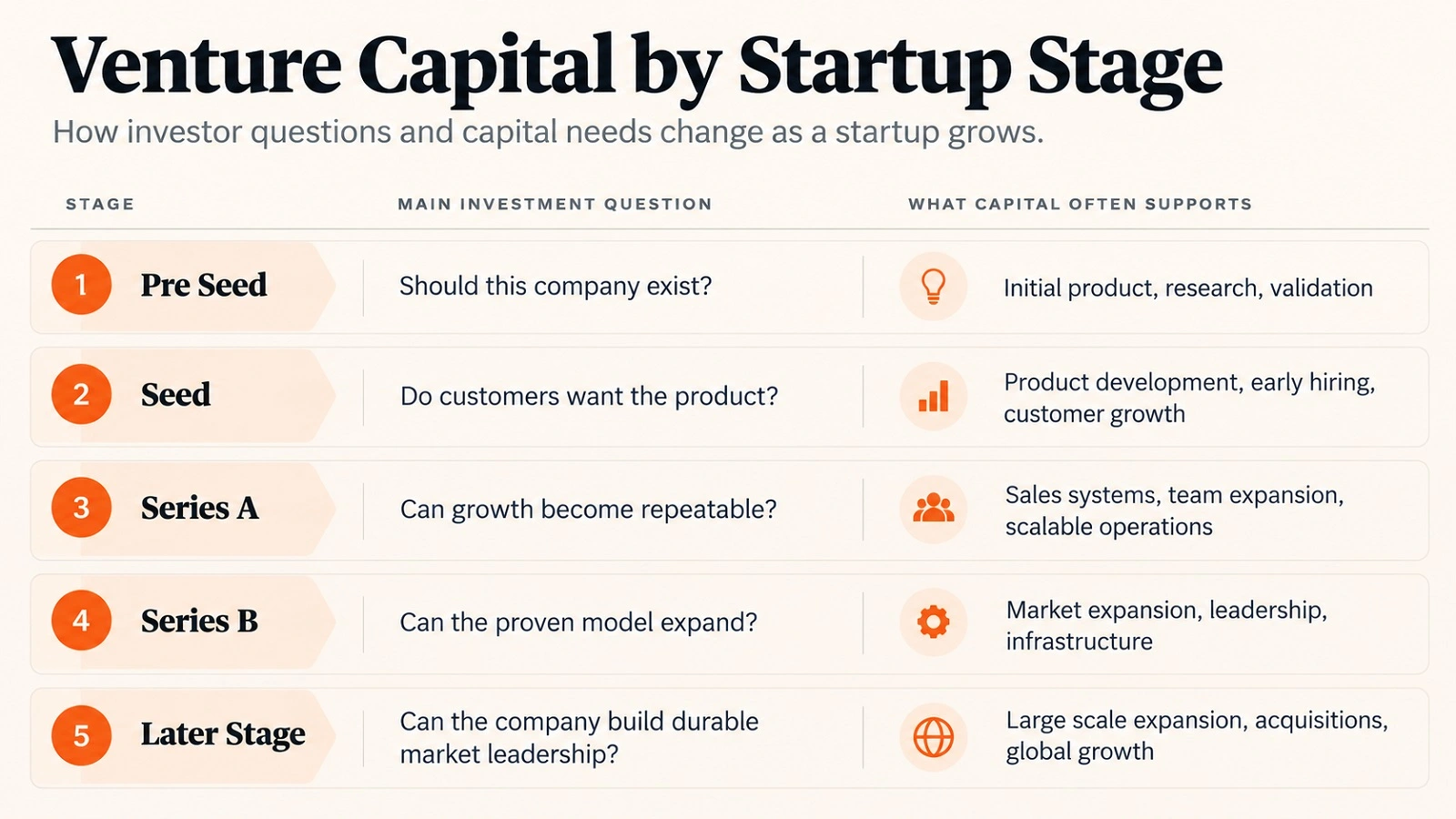
The role of capital changes with the company. Early money reduces uncertainty, while later money increasingly supports expansion.
Founders should therefore avoid treating every financing round as the same event with a larger number attached.
Common Venture Capital Mistakes
One common mistake is raising before founders understand what the capital is supposed to achieve. Money without a milestone can increase activity without increasing business quality.
Another mistake is choosing investors based only on valuation. The investor relationship, governance terms, strategic fit, and future financing support can matter for many years.
Founders can also scale before strong customer demand exists, hire too quickly after a round, or allow burn to increase faster than business evidence.
Another mistake is assuming that fundraising itself validates the company. Investors can believe in future potential while customers remain unconvinced.
The strongest venture backed companies continue treating customer behavior as the primary evidence that the business is working.
The Real Purpose of Venture Capital
Venture capital is not simply money for startups.
It is a financial model designed to help companies pursue opportunities that could become much larger than their current resources allow.
For founders, the value of venture capital comes from what the capital makes possible. It can provide time to develop difficult technology, accelerate a working growth engine, recruit a stronger team, expand into new markets, or build infrastructure before customer revenue could finance those activities alone.
The tradeoff is ownership, governance, and higher expectations.
A strong venture decision therefore begins with alignment. The startup needs an opportunity capable of benefiting from significant capital, while the investor needs a company capable of creating enough future value to justify the risk.
When those incentives align, venture capital can accelerate a startup dramatically. When they do not, raising money can create pressure without creating a better business.
FAQ
What is venture capital?
Venture capital is private investment provided to companies with significant growth potential. Investors usually receive equity and seek financial returns through increases in the future value of the company.
How does venture capital work?
Venture firms usually invest capital from managed funds into a portfolio of private companies. They aim to increase the value of those investments and eventually generate returns through acquisitions, public offerings, secondary transactions, or other liquidity events.
What do venture capital investors look for?
Investors commonly evaluate the founding team, market size, customer problem, product, traction, growth potential, business economics, scalability, and defensibility.
Does venture capital need to be repaid?
Traditional venture equity does not work like a normal loan with scheduled repayment. Investors receive ownership and seek returns from increases in company value. Specific financing structures can differ, so founders should understand the terms of each investment.
Does venture capital reduce founder ownership?
Yes. New equity investment normally creates dilution because investors receive ownership in the company. The amount depends on valuation, round size, and the existing ownership structure.
Is venture capital only for technology startups?
No, but venture capital is most commonly associated with businesses that have the potential to scale significantly. Technology companies frequently fit this profile because software and digital products can sometimes reach large markets efficiently.
When should a startup raise venture capital?
Venture capital becomes more relevant when the startup has a large opportunity and external capital can meaningfully accelerate product development, customer growth, hiring, infrastructure, or expansion.
Can a startup succeed without venture capital?
Yes. Many companies grow through founder capital, customer revenue, debt, grants, or other financing methods. Venture capital is one financing strategy, not a requirement for startup success.
What happens after a VC invests?
The company usually continues executing against agreed growth objectives while communicating with investors through reporting, board meetings, strategic discussions, and other forms of investor engagement.
Is venture capital right for every startup?
No. Venture capital is best suited to businesses with large growth potential and a credible ability to use significant external capital productively. A profitable company with a smaller market or strong customer funded growth may be better served by another financing model.

Mobina Khanki
Venture & Funding Writer at PinerookMobina Khanki covers venture capital, startup funding, fundraising, and startup finance for Pinerook, focusing on founders and investors.
 Seen first.