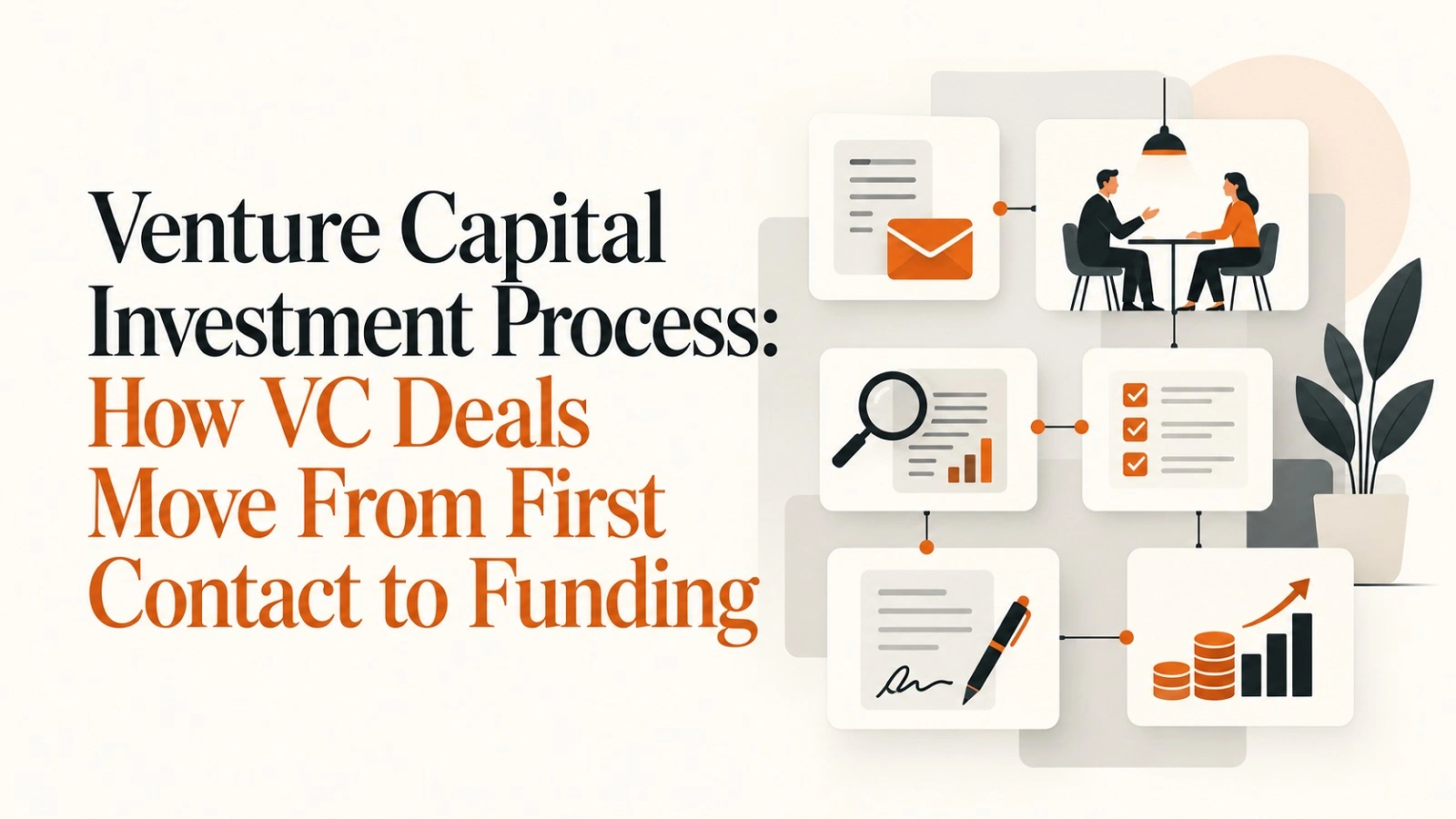
The venture capital investment process follows a clear series of stages. A startup does not simply pitch an investor and receive funding. Before a VC commits capital, the firm usually evaluates the founders, market, product, traction, financial position, risks, valuation, and potential return.
For founders, understanding this process makes fundraising easier to manage. A first meeting is not the same as due diligence. Strong interest is not the same as an approved investment. Even a signed term sheet does not always mean the money has reached the company. Each stage answers a different question and brings the startup closer to a final decision.
Within Venture Capital, the investment process is what turns investor interest into an ownership transaction. Founders who understand that process can prepare information at the right time, read investor signals more accurately, manage several conversations at once, and reduce delays before closing.
What Is the Venture Capital Investment Process?
The venture capital investment process is the sequence a VC firm uses to discover, evaluate, approve, negotiate, and complete an investment in a startup. The exact workflow differs between firms, but most deals move through similar stages.
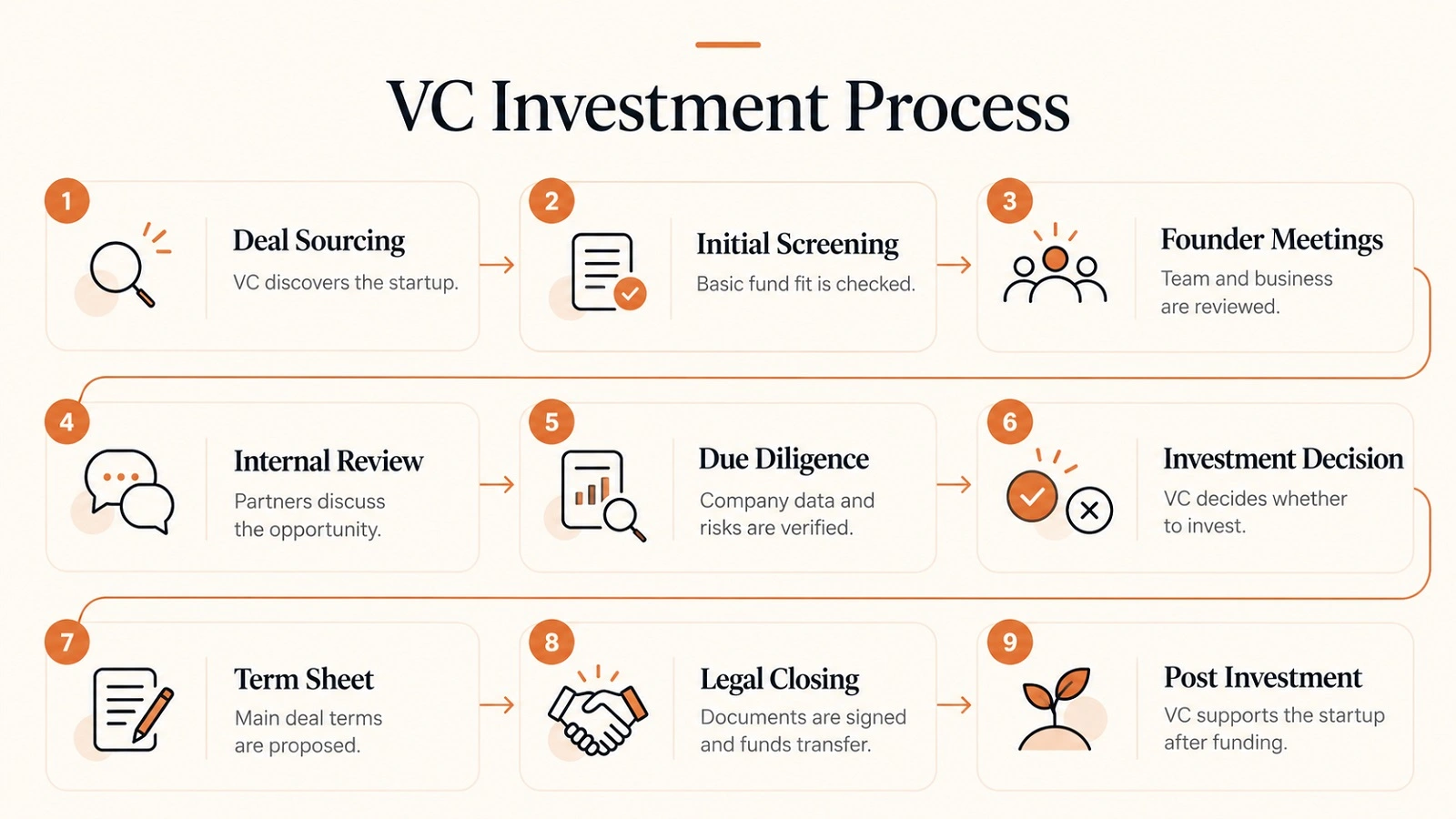
The process usually begins when the investor discovers the company. It then moves through screening, founder meetings, internal review, deeper evaluation, due diligence, investment approval, term sheet negotiation, legal documentation, and closing.
The purpose is not to remove every risk. Startup investing always involves uncertainty. Instead, the VC gathers enough evidence to decide whether the potential value of the company justifies the risk of investing.
The Venture Capital Investment Process at a Glance
Stage 1: Deal Sourcing
The process begins when a venture firm discovers a startup. This can happen through founder outreach, referrals, portfolio companies, accelerators, lawyers, events, professional networks, or direct research by the investment team.
Some firms receive many startup pitches every week. Others actively search for companies that fit a specific thesis. Partners and associates may study emerging markets, follow founders, monitor new products, and contact startups before they formally begin raising capital.
A trusted introduction can help a founder get attention, but it does not determine the final result. The startup still needs to fit the fund and convince the investor that the opportunity is worth pursuing.
Stage 2: Initial Screening
Initial screening is usually fast. The investor is not yet trying to understand every detail of the business. The goal is to decide whether the company deserves a deeper review.
The VC may look at the startup stage, industry, geography, founders, fundraising amount, business model, current traction, and expected use of capital. The investor also checks whether the opportunity fits the fund's normal check size and ownership expectations.
Many companies are rejected at this stage because of fit rather than quality. A strong startup can still be unsuitable for a fund that invests at a different stage or in a different market.
What VCs Usually Screen First
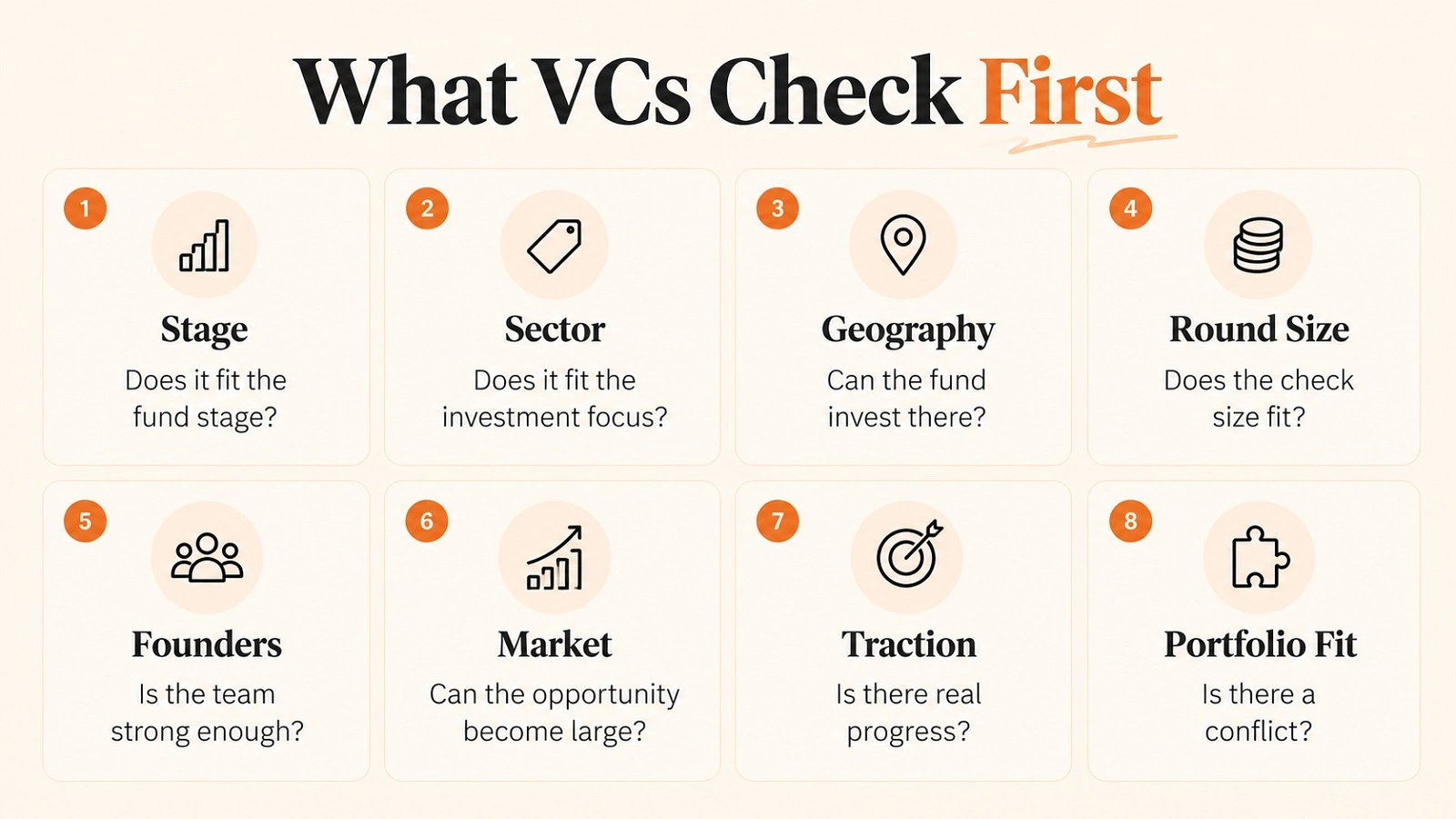
Stage 3: The First Investor Meeting
If the startup passes screening, the founders usually meet with members of the investment team. These conversations help the investor understand the company beyond the pitch deck.
The first meeting often covers the customer problem, product, market, founders, traction, financing target, and use of capital. The investor may also ask why the company exists, why the timing is attractive, and what makes the founders particularly suited to build it.
The purpose is not to remove every concern. Investors are trying to decide whether the opportunity is interesting enough to justify more time, research, and internal attention.
What Founders Need to Demonstrate Early
Early in the process, founders need to create confidence around the team, the opportunity, and the evidence already available. The investor needs a reason to believe that the founders understand the problem and that customers may care enough for the company to become valuable.
The type of proof depends on company stage. A very early startup may show customer interviews, prototypes, pilot users, early product engagement, or founder expertise. A more mature company may need to show revenue, retention, customer growth, margins, and repeatable acquisition.
The strongest early conversations connect the company's current evidence with a much larger future opportunity.
Stage 4: Internal VC Review
A large part of the investment process happens when the founders are not in the room. The investor leading the opportunity usually needs to explain the company to other people inside the firm.
Partners may discuss the founders, market size, traction, competitive position, valuation, ownership, financing needs, and potential returns. They may also compare the startup with other opportunities competing for the same fund capital.
This is why an internal champion matters. A partner who understands the startup clearly can explain the investment case, answer objections, and keep the opportunity moving through the firm's decision process.
Stage 5: Deeper Startup Evaluation
If the firm remains interested, the analysis becomes more detailed. The VC now wants to understand whether the operating evidence supports the story presented by the founders.
For a software startup, the investor may look at revenue quality, customer retention, product usage, gross margin, sales efficiency, and customer concentration. A marketplace may be judged through transaction volume, repeat behavior, supply and demand balance, and the economics of each transaction.
Different businesses require different metrics, but the underlying question remains the same. Does the available evidence suggest that the company can grow into a much more valuable business?
How VCs Evaluate the Founders
Founder evaluation continues throughout the process. Investors want to understand whether the team can operate well when the company faces uncertainty, pressure, competition, and changing customer needs.
VCs may look at how founders make decisions, how deeply they understand their market, how they respond to difficult questions, and whether they can attract talented employees. Relevant industry or technical experience can help, but the ability to learn and adapt is also important.
The process itself becomes part of the evaluation. Clear communication, accurate information, and thoughtful responses can increase investor confidence. Inconsistent answers or unclear company data can have the opposite effect.
How VCs Evaluate the Market
Venture funds generally need some portfolio companies to become very large. Market size therefore plays an important role in the investment decision.
Investors may study how many potential customers exist, how much those customers spend, how quickly the market is changing, and how strong the competition is. They also want to know whether the startup can expand beyond its first customer segment.
A strong market case does more than present a large number. It explains where the startup begins, why it can win there, and how that position can lead to a much larger opportunity.
How VCs Evaluate the Product
The investor wants to know whether the product solves a real and important customer problem. Product evaluation can include demonstrations, user behavior, customer feedback, product usage, feature adoption, and retention.
At an early stage, the product may still be incomplete. Investors may accept that if they believe the founders have discovered an important customer insight and are improving the product quickly.
At later stages, the standard becomes higher. The VC usually expects stronger evidence that customers receive ongoing value and that the product can support continued growth.
How VCs Evaluate Traction
Traction shows that the market is responding to the company. Revenue can be one sign, but it is not the only one.
Depending on the business, investors may look at paid customers, active users, contracts, pilots, repeat purchases, retention, transaction volume, conversion, or product usage. The most useful metric is the one that best demonstrates real demand for that particular business model.
Investors also look at the quality of traction. Rapid customer growth matters less if users leave quickly or if each new customer costs more than the business can reasonably recover.
Stage 6: Due Diligence
Due diligence begins when the investor wants to verify the information behind the investment case. This is one of the most important stages because the VC moves from understanding the founder's story to checking the underlying evidence.
The firm may review financial statements, capitalization records, customer contracts, corporate documents, intellectual property, employee agreements, product data, customer metrics, legal matters, forecasts, and other important records.
The investor may also speak with customers, industry experts, previous colleagues, or existing shareholders. These conversations help confirm whether the company and founders are being represented accurately.
What Is a Startup Data Room?
A data room is an organized collection of company information that can be shared with serious investors. It helps the VC review important records without repeatedly asking the founders to locate individual documents.
The exact contents depend on company stage. Common areas include financial information, company ownership, customer metrics, contracts, corporate documents, employment records, intellectual property, previous financing documents, and product information.
A clean data room does not guarantee that the startup will receive funding. It does, however, make the process easier and shows that the founders can manage important company information professionally.
What Can Slow Due Diligence?
Due diligence often becomes slower when company information is incomplete or inconsistent. For example, a pitch deck may show one revenue number while the financial records show another. The investor then needs to understand which figure is correct and why the difference exists.
Legal and ownership issues can create similar problems. Missing agreements, unclear intellectual property ownership, inaccurate capitalization records, or unresolved founder equity questions can delay the process.
Founders should therefore prepare important company records before serious fundraising begins. Solving obvious issues in advance is usually easier than explaining them after an investor discovers them.
Stage 7: Partner Meeting or Investment Committee
Once enough information has been collected, the opportunity may move to the senior decision makers inside the VC firm. Some firms use formal investment committees, while others make decisions through partner meetings.
The person leading the deal usually presents the startup and explains why the firm should invest. The discussion can include the founders, market, product, traction, major risks, proposed investment amount, valuation, ownership, and expected return.
Other partners may challenge the investment case. They may question assumptions about growth, competition, customer behavior, or market size. The goal is to decide whether the opportunity is attractive enough to justify the remaining risk.
What the Investment Committee Is Really Deciding
An investment committee is not simply asking whether the startup looks good. It is deciding whether this specific fund should invest in this specific company under the proposed terms.
A strong company can still be rejected because the valuation is too high, the available ownership is too small, the market does not appear large enough, or another investment currently looks more attractive.
This distinction is important for founders. A VC rejection is not always a judgment that the company cannot succeed. It can simply mean that the investment does not fit the economics of that particular fund.
Stage 8: The Term Sheet
When the VC decides to proceed, the firm may issue a term sheet. This document outlines the major economic and governance terms of the proposed financing.
Valuation usually receives the most attention, but founders should also understand ownership, board structure, voting rights, liquidation terms, employee option pools, future participation rights, and investor information rights.
The term sheet can influence company ownership and governance for years. Founders should evaluate the complete structure rather than focusing only on the headline valuation.
Key Areas Founders Should Review in a Term Sheet
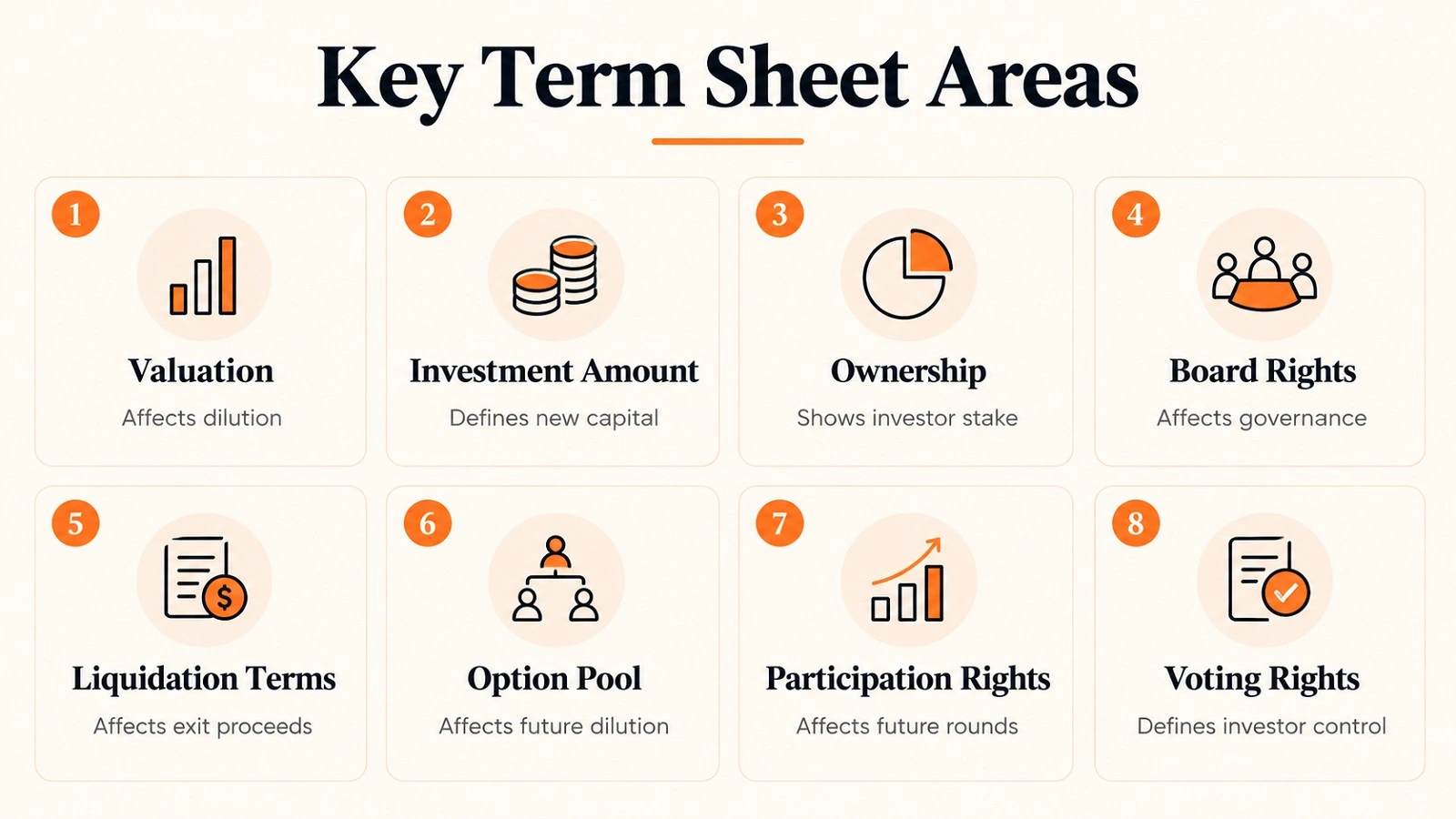
Negotiating the Term Sheet
Term sheet negotiation is not simply a contest between founders and investors. Both sides need a structure that can continue to work through future rounds and changes in the company.
Founders should understand which terms affect ownership, which affect control, and which can influence future financing. An experienced startup lawyer can be useful because small differences in legal language may create large differences later.
Negotiation can also reveal a great deal about the investor. The way a VC handles disagreement during this stage can help founders understand what future board discussions may feel like.
Stage 9: Final Legal Documentation
A signed term sheet usually does not complete the financing. Lawyers still need to prepare the final legal documents that turn the agreed terms into binding agreements.
These documents can cover share issuance, investor rights, voting arrangements, governance, information access, and other parts of the financing. The legal review may also confirm that the company's corporate records and ownership structure are accurate.
Founders should not treat this stage as a simple administrative step. Serious problems found during legal review can delay the transaction and may even cause the investor to reconsider the deal.
Stage 10: Closing and Capital Transfer
The financing closes after the required documents are signed, any closing conditions are completed, and the investment capital is transferred according to the agreements.
The investor then becomes an official shareholder. The company's capitalization changes, and any new board or governance rights become effective.
This is the end of the fundraising transaction, but it is the beginning of the investor relationship. The promises and expectations discussed during fundraising now become part of the company's operating reality.
What Happens After the Investment?
After closing, founders usually begin executing the plan that justified the financing. The capital may support hiring, product development, customer acquisition, new markets, infrastructure, or another important growth objective.
The VC may begin receiving company updates and joining board meetings. The investor can also help with recruitment, customer introductions, future fundraising, partnerships, and strategic decisions.
Good communication matters from the beginning. Investors need enough information to understand company performance, while founders still need room to run the business.
Why VC Firms Reserve Capital for Future Rounds
Many venture firms do not invest all the capital they may eventually commit to a company in the first round. They often reserve part of the fund for future investments in successful portfolio companies.
This allows the VC to maintain ownership and invest more capital when the company continues performing well. From the founder's perspective, an existing investor can become an important source of future financing because the firm already understands the business.
Still, founders should not assume that future capital is guaranteed. Every new financing round creates another investment decision.
How Long Does the Venture Capital Investment Process Take?
There is no fixed timeline. The process can vary based on startup stage, investor familiarity, round size, company complexity, market conditions, and the amount of diligence required.
An early stage investment may sometimes move quickly because there is less historical information to review. A larger later stage round can require much deeper financial, commercial, technical, and legal analysis.
Founders should begin fundraising before cash becomes critically low. More runway gives the company time to manage investor conversations and prevents unnecessary pressure during negotiation.
What Makes the VC Process Move Faster?
A clear company story can speed up fundraising. Investors need to understand what the company does, why customers care, how the market can become large, and what the new capital will make possible.
Organized financial records and company documents also reduce delays. When founders can answer questions quickly and provide consistent information, investors spend less time resolving basic uncertainty.
Genuine investor competition can also create momentum. When several credible firms are seriously evaluating the company, investors may have more reason to reach decisions quickly.
Why Venture Capital Processes Stall
A fundraising process can slow even after several positive meetings. Sometimes the VC likes the company but does not have enough conviction to make an investment.
The investor may also discover weak retention, unclear metrics, legal concerns, valuation issues, or disagreement among partners. Changes inside the VC fund or broader market conditions can also affect the decision.
Founders should watch investor actions rather than relying only on positive language. Deeper data requests, partner introductions, reference checks, and term discussions usually provide stronger evidence of progress.
Signs That a VC Is Seriously Interested
Serious interest often becomes visible when the investor begins committing more time and internal resources. More partners may join meetings, detailed metrics may be requested, customer references may be checked, and specific discussions about valuation or ownership may begin.
No single signal guarantees an investment. Even advanced discussions can still end without a deal.
Founders should therefore continue speaking with other relevant investors until the financing becomes sufficiently secure.
Managing Multiple VC Conversations
Fundraising often involves several investors at different stages of the process. One firm may be completing initial screening while another is reviewing data and another is preparing an internal decision.
Founders should know where each investor stands and what the next required step is. This helps maintain momentum and prevents important conversations from being forgotten or delayed.
Having several genuine options also gives founders more ability to compare investors based on partner quality, governance, expertise, reputation, and future support rather than choosing solely because one investor moved first.
What Founders Should Ask Investors
The VC is evaluating the startup, but founders should also evaluate the VC throughout the process. They should understand how the firm makes investment decisions, who controls approval, how much capital is available for future rounds, and what level of involvement the investor expects after financing.
Speaking with existing portfolio founders can provide even more useful information. They can explain how the investor behaves when growth is strong, when performance becomes difficult, and when founders disagree with the board.
The investment process is therefore not only about convincing the investor. It is also the period when founders decide whether they want this firm as a long term shareholder.
Common Mistakes During the Venture Capital Investment Process
One common mistake is treating every stage of fundraising the same way. The first meeting is designed to build interest. Due diligence is designed to verify evidence. The term sheet stage is about ownership, economics, and governance. Each part of the process requires a different type of preparation.
Another mistake is waiting until diligence begins to organize financial, legal, ownership, and customer information. This can create unnecessary delays and reduce investor confidence.
Founders can also become too dependent on one investor after receiving positive verbal feedback. Interest can disappear for many reasons, so other conversations should normally continue until the deal becomes much more certain.
Why Investor Fit Still Matters
The pressure to close a financing round can cause founders to focus only on whether an investor is willing to provide capital. That can be a mistake because the investor may remain involved with the company for many years.
The fundraising process gives founders several chances to evaluate the relationship. Communication style, response speed, questions, negotiation behavior, and feedback from portfolio founders can all reveal how the investor may behave later.
A successful VC process should produce more than money. It should create a shareholder relationship that supports the company founders actually want to build.
The Real Purpose of the Venture Capital Investment Process
The venture capital investment process helps investors and founders reduce uncertainty before entering a long term financial relationship. It cannot remove risk, and it is not designed to. Each stage simply provides more information for deciding whether the opportunity is worth pursuing.
Sourcing creates access. Screening establishes basic fit. Founder meetings build interest. Deeper evaluation tests the business case. Due diligence verifies the evidence. Internal approval determines whether the fund will invest. The term sheet defines the proposed structure, and legal closing turns that proposal into an actual financing.
For founders, understanding these stages makes investor behavior easier to interpret. A good meeting matters, but genuine progress becomes clearer when the VC continues committing time, people, diligence resources, and eventually capital.
FAQ
What is the venture capital investment process?
The venture capital investment process is the series of stages a VC firm uses to discover, evaluate, approve, negotiate, and complete an investment in a startup.
What is the first stage of the VC investment process?
The process usually begins with deal sourcing. The investor discovers the startup through outreach, referrals, research, networks, or other channels before deciding whether to screen the opportunity.
What happens during initial VC screening?
The VC checks whether the startup fits the fund's stage, sector, geography, check size, market expectations, and existing portfolio.
What happens during VC due diligence?
The investor verifies important information about the company. This can include financial records, ownership, customer data, contracts, legal documents, intellectual property, and business metrics.
What is an investment committee?
An investment committee is a group of senior investors that reviews an opportunity and decides whether the fund should commit capital.
Does a term sheet mean the startup has received funding?
No. A term sheet usually describes the main proposed terms. Final legal documents, remaining diligence, signatures, and capital transfer still need to happen before the financing is complete.
How long does the venture capital investment process take?
There is no standard timeline. The process depends on company stage, round size, investor familiarity, business complexity, market conditions, and the amount of diligence required.
What should founders prepare before due diligence?
Founders should organize financial records, ownership information, company documents, customer metrics, contracts, intellectual property records, employment information, and other important business materials.
Can a VC change its decision late in the process?
Yes. New information, internal disagreement, valuation concerns, legal issues, portfolio conflicts, or market changes can cause an investor to change direction.
What happens after a venture investment closes?
The VC becomes a shareholder and may begin participating through company updates, board meetings, recruiting support, customer introductions, strategic guidance, and future financing discussions.

Mobina Khanki
Venture & Funding Writer at PinerookMobina Khanki covers venture capital, startup funding, fundraising, and startup finance for Pinerook, focusing on founders and investors.
 Seen first.