
Venture capital firms play a central role in startup financing because they connect institutional capital with private companies capable of significant growth. From a founder’s perspective, however, a VC firm should not be viewed simply as a source of money. Every firm operates with its own fund structure, investment strategy, preferred company stages, sectors, check sizes, ownership targets, decision process, and expectations about what a successful investment should eventually become.
Within Venture Capital, understanding how these firms operate helps founders avoid one of the most common fundraising problems: approaching investors who were never realistic candidates for the round. A startup may have strong founders, meaningful traction, and a compelling market opportunity but still receive an immediate rejection because the investor does not operate at that stage, does not invest in that category, or cannot write a check that fits the size of the round.
Understanding venture capital firms therefore means looking beyond lists of famous investors. Founders need to know how firms raise and deploy capital, why different VC models exist, how investors evaluate opportunities, how internal decisions are made, what firms can provide after investing, and how to identify a partner whose incentives are compatible with the company they are trying to build.
What Is a Venture Capital Firm?
A venture capital firm is an investment organization that manages capital and invests it into privately held companies with significant growth potential. Most firms raise money from outside investors, organize that capital into one or more funds, and deploy those funds across a portfolio of startups over several years.
The people inside the firm are responsible for finding opportunities, evaluating founders and markets, negotiating investments, supporting portfolio companies, and eventually helping create liquidity from successful outcomes. That liquidity may come through an acquisition, public offering, secondary transaction, or another event that allows investors to realize the value of their ownership.
Unlike a traditional lender, a venture firm generally does not expect the startup to repay the investment through scheduled payments. The investor usually receives equity or equity linked rights and depends on the future value of that ownership to generate returns. Once the transaction closes, the VC becomes financially connected to the long term performance of the startup.
Venture Capital Firm vs Venture Fund
A venture capital firm and a venture fund are closely connected, but they are not the same thing. The firm is the organization that employs the investment team, develops strategies, raises capital, evaluates startups, and manages portfolio relationships. The fund is a specific pool of capital created and managed by that firm.
A single VC firm may manage several funds simultaneously. One fund may focus on early stage investments, another may provide capital to more mature companies, and another may be designed to continue investing in successful portfolio companies as they raise larger rounds. Each fund can therefore have its own size, mandate, investment period, and return expectations.
This distinction matters because founders are not receiving capital from the abstract brand of the venture firm. They are usually receiving capital from a specific fund, and the economics of that fund can affect check size, ownership requirements, follow on capacity, and how large a financial outcome the investor ultimately needs.
Where Venture Capital Firms Get Their Money
Most venture capital firms invest capital that comes from outside investors known as limited partners. These investors may include pension funds, university endowments, family offices, foundations, insurance companies, corporations, sovereign institutions, and wealthy individuals.
The limited partners commit money to the fund because they want exposure to private companies and the possibility of attractive long term investment returns. The venture firm acts as the general partner and is responsible for deciding how that capital is deployed across startup investments.
This creates an important financial chain. Limited partners provide capital to the fund, the venture firm selects companies, startups receive investment, and successful portfolio companies may eventually generate returns that flow back through the fund to the limited partners. A founder negotiating with a VC is therefore participating in a much larger investment structure.
How Venture Capital Firms Are Structured
Venture firms differ in size and internal organization, but several roles appear frequently.
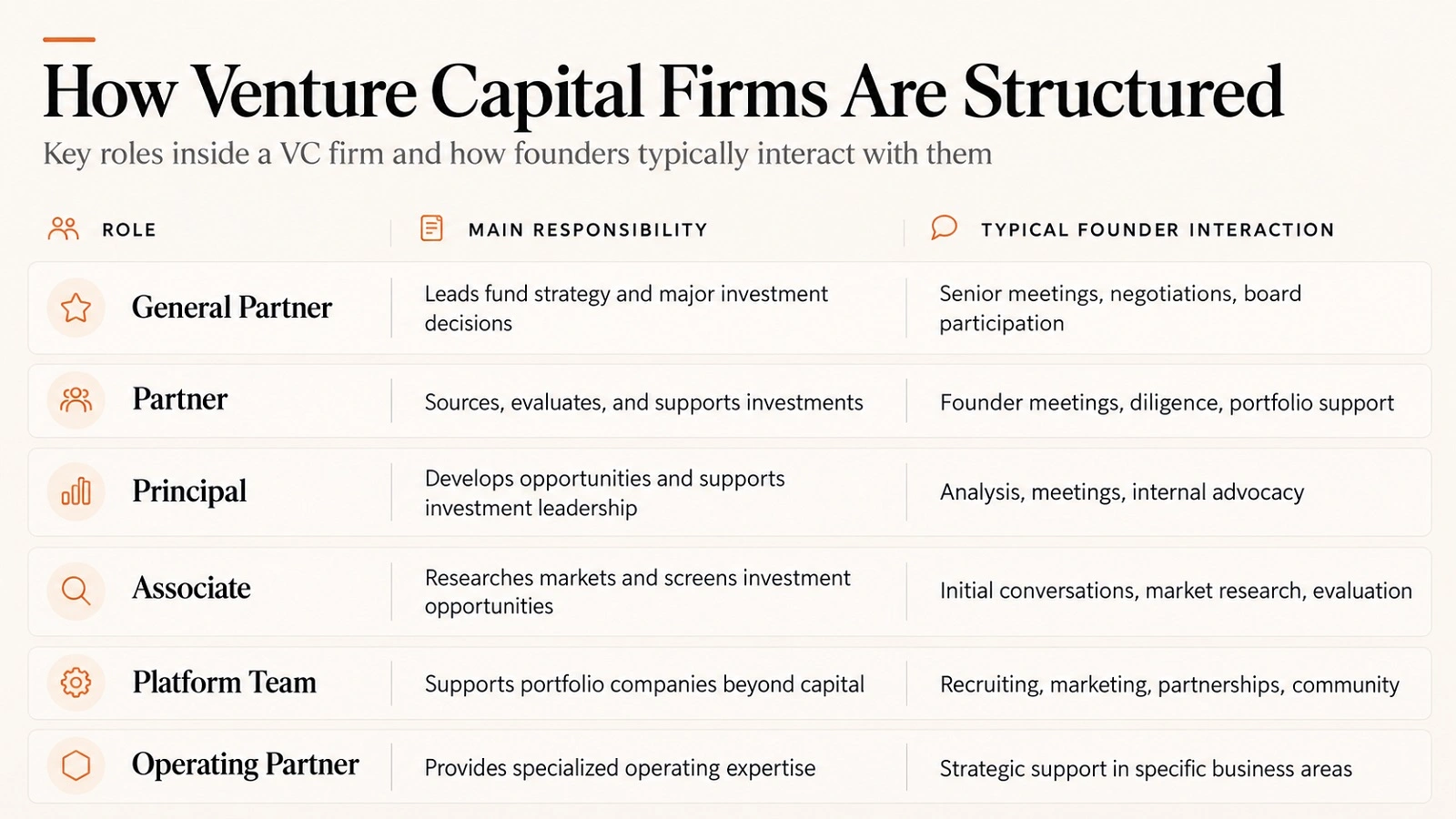
Titles do not always indicate how much decision making authority someone has. An associate may be the first person to speak with a founder and may become an important internal advocate, but the final investment could still require approval from several senior partners.
For founders, the important question is who inside the firm can ultimately champion the opportunity when the startup reaches internal investment discussions.
How Venture Capital Firms Make Money
Venture firms generally make money by managing investment funds and participating in the financial returns those funds create. Their economic model is therefore different from a bank, lender, or ordinary operating company.
The firm raises capital from limited partners and manages that money over a long period. During that lifecycle, it identifies startups, makes investments, reserves capital for future rounds, supports portfolio companies, and eventually seeks liquidity from successful investments.
Because startup investing is highly uncertain, not every company in the portfolio needs to succeed for a fund to perform well. Some investments may fail completely, others may produce moderate returns, and a smaller number may create much larger outcomes. Those large winners can have an outsized effect on total fund performance.
This is one of the reasons VC firms care so much about market size and scalability. A company may become profitable and valuable without ever becoming large enough for the investment to materially affect the performance of a venture fund.
Why Fund Size Changes Investor Behavior
Fund size directly influences how a venture firm evaluates opportunities because the same startup outcome can have very different financial significance for different investors. A smaller fund may generate meaningful performance from a company that reaches a moderate exit because the investment represents a larger share of its overall portfolio, while a much larger fund may need the same company to become dramatically more valuable before the return meaningfully affects fund performance.
This helps explain why one VC firm may be excited about a company while another concludes that the opportunity is too small. Both investors can believe the founders are capable and the business is attractive while reaching completely different investment decisions because their funds operate under different economics.
Founders should therefore understand fund size before interpreting investor interest or rejection. A company can be an excellent startup and still be a poor fit for a specific fund.
Why Venture Capital Firms Specialize
Many VC firms specialize by stage, sector, geography, business model, or technology. This focus can help investors develop stronger expertise, networks, customer relationships, recruiting pipelines, and pattern recognition within particular markets.
A financial technology investor may understand regulation, banking partnerships, payments infrastructure, and relevant executives far better than a generalist fund. A healthcare specialist may have access to customers, researchers, regulators, and operators who would be difficult for another investor to reach.
That specialization can create significant value after investment, but it also limits the number of startups that fit the firm’s mandate. A founder cannot normally compensate for a fundamental thesis mismatch simply by delivering a stronger presentation.
Types of Venture Capital Firms
Different VC firms are designed to support companies at different points in their development.
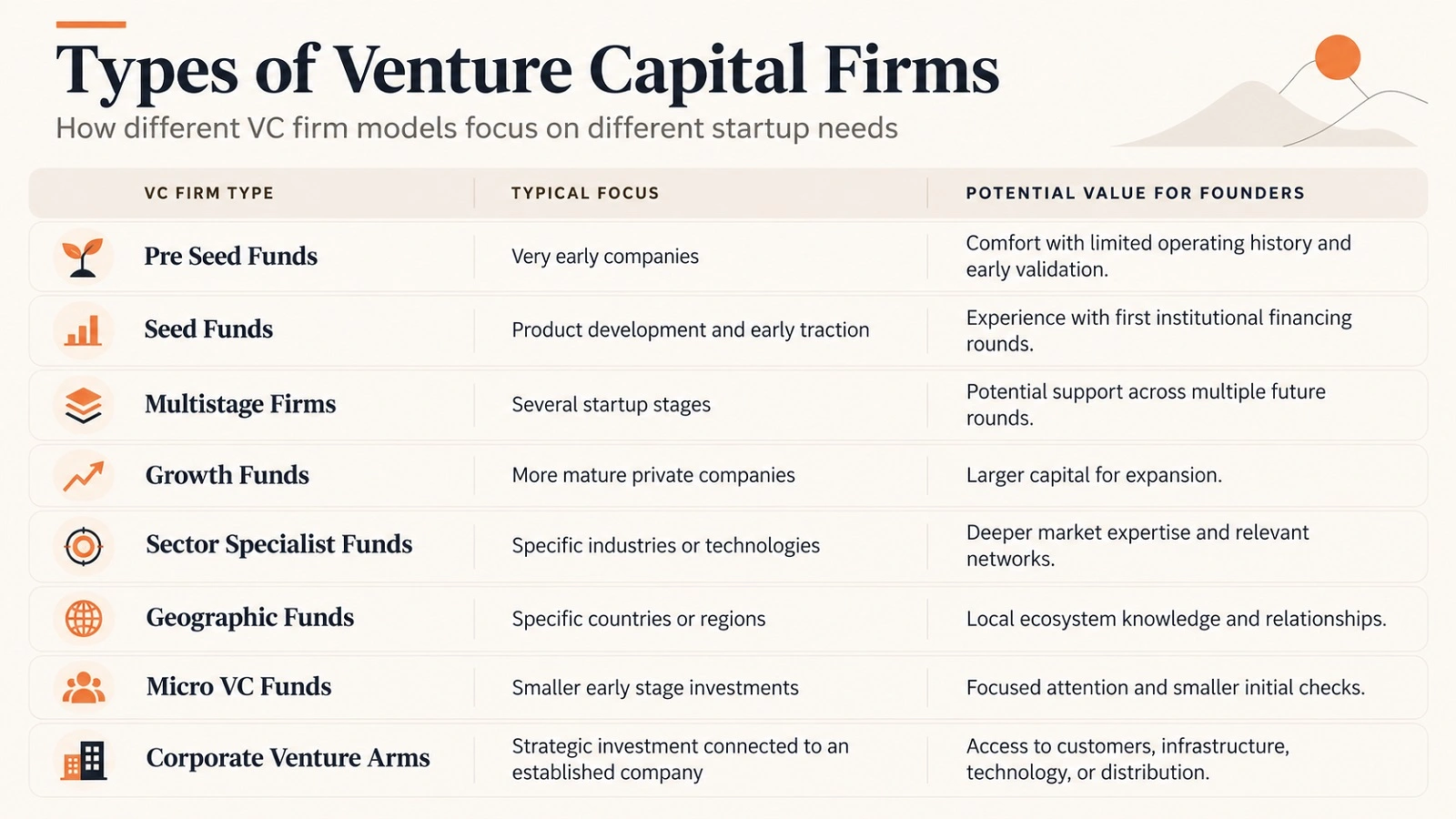
The most famous category is not automatically the most useful one. The better choice is the type of investor that matches the company’s current maturity, funding needs, market, and long term ambitions.
The Investment Thesis
Most venture capital firms operate around an investment thesis that defines the kinds of opportunities the fund is designed to pursue. That thesis may specify stage, sector, geography, business model, typical check size, ownership goals, market characteristics, or other strategic constraints.
A seed fund focused on enterprise software may have no reason to evaluate a mature consumer company even if the business is performing well. A regional investor may avoid opportunities outside its target geography regardless of the strength of the founders.
This is why investor research should happen before outreach. A founder can spend significant time improving a pitch without changing the fact that the company falls outside the fund’s mandate.
Stage Focus
Startup stage is one of the strongest filters used by venture firms because the type of evidence available changes dramatically as a company develops. Early investors are comfortable making decisions with limited operating history and may focus on founder market fit, customer research, prototypes, pilot programs, and early product usage.
Later stage investors usually expect much stronger evidence. They may examine recurring revenue, retention, margins, sales productivity, customer acquisition, operational maturity, and financial predictability. Their investment decision relies less on what the company could theoretically become and more on what the existing data suggests.
Founders should therefore target investors whose stage focus matches what the startup can credibly demonstrate today rather than where the company hopes to be after the next round.
Check Size
Venture firms also differ in how much they typically invest. A small early stage fund may write relatively modest first checks, while a large multistage firm may deploy substantially more capital in each transaction.
The appropriate check size is influenced by fund size, ownership targets, startup stage, and portfolio strategy. This matters because the investor needs to participate in the round at a level that is economically meaningful for the fund.
A startup raising a relatively small round may waste significant time approaching investors whose minimum check exceeds the total financing target. The opposite problem occurs when a company needs more capital than a smaller fund can reasonably provide.
Matching round size with realistic investor check sizes makes fundraising much more efficient.
Ownership Targets
Many VC firms think explicitly about how much ownership they want when making an investment. A meaningful ownership position increases the financial impact of a successful company on the fund, which can influence check size, valuation discussions, and whether the investor wants to lead the round.
This becomes especially important when several investors want to participate in the same financing. A firm that needs a significant percentage of ownership may be unwilling to join a round where most of the available equity has already been allocated to other investors.
Founders therefore need to think about round construction as well as total capital. The amount being raised, valuation, ownership available, and investor expectations need to fit together.
Lead Investors and Participating Investors
Investors inside the same financing round can play very different roles. A lead investor usually takes greater responsibility for evaluating the company, negotiating major terms, committing a meaningful portion of the capital, and helping organize participation from other investors.
Participating investors may join after the main terms have been established and can contribute smaller amounts of capital. Their involvement may still be valuable, but they generally have less influence over the structure of the round.
Securing a credible lead can make fundraising easier because other investors may become more comfortable once an experienced firm has committed. At the same time, founders should evaluate the lead carefully because this investor may receive a board seat and maintain significant influence for years.
How Venture Capital Firms Find Startups
VC firms build investment pipelines through founder referrals, portfolio companies, other investors, startup accelerators, lawyers, professional networks, industry events, direct founder outreach, internal research, and inbound pitches. Some firms also proactively identify companies that match their investment thesis before those founders formally begin fundraising.
A warm introduction can provide useful context, but it is not a substitute for investor fit. An investor whose fund does not match the startup’s stage, market, or financing requirements is unlikely to become relevant simply because the introduction came from a trusted person.
Founders should therefore prioritize relevance over access. The best introduction is to an investor who could realistically participate in the round.
How Startups Are Screened
Initial VC screening is often much faster than founders expect. Investors may quickly look at the team, company stage, product, market, traction, financing target, geography, and whether the business fits the fund’s current strategy.
Many startups are rejected before detailed analysis begins, and those decisions do not necessarily mean the business itself is weak. The startup may be too early, too mature, too small for the fund, outside its geography, or too close to another portfolio company.
Founders should distinguish between a rejection caused by poor fit and a rejection caused by concerns about the business. Those are very different forms of feedback.
What Venture Capital Firms Evaluate
Once a startup moves beyond initial screening, the analysis becomes much more detailed.
The weight placed on each category changes with company maturity. Early investors may need to rely more heavily on judgment because there is less operating data, while later investors can analyze several years of financial and customer behavior.
Founder Quality
Founder quality becomes especially important at early stages because much of the future company does not yet exist. Investors may examine how deeply the founders understand customers, whether they possess relevant technical or industry expertise, how they make decisions, how quickly they learn, and whether they can recruit people stronger than themselves in specific functions.
This matters because startup strategies rarely remain static. The product, target customer, pricing, distribution model, and competitive landscape may all change as the company learns. Venture investors are therefore partly investing in the founders’ ability to navigate uncertainty rather than only in the current business plan.
A strong early founder case combines insight with execution. Understanding a problem is valuable, but investors also want evidence that the team can convert that understanding into measurable progress.
Market Size
Market size receives substantial attention because the economics of venture funds often require some portfolio companies to become extremely valuable. A startup can build a profitable business in a limited market while still failing to produce the scale required for venture returns.
Investors therefore want to understand the number of potential customers, how much they may spend, how the market could change, and whether the startup has a plausible route toward capturing meaningful value. A large theoretical market is less persuasive when the startup cannot explain how it reaches customers or expands from its initial segment.
The strongest market story combines a focused entry point with credible room for future expansion.
Traction and Retention
Traction shows that the market is beginning to respond to the startup. At early stages, that may include pilot customers, product usage, paid trials, initial revenue, signed contracts, or another form of demand that fits the business model.
As the startup develops, retention becomes increasingly important because it reveals whether customers continue receiving value after the first interaction. A company can create impressive top line growth by spending heavily on acquisition while simultaneously losing customers at a damaging rate.
Venture firms therefore care about the quality of growth as well as its speed. Durable growth usually combines acquisition with retention, customer value, and improving economics.
Business Economics
Many startups are not profitable when they raise venture capital, and investors generally understand that. What they still need to believe is that the business can eventually produce attractive economics.
The specific measures differ by business model. Investors may examine gross margin, customer acquisition costs, customer lifetime value, contribution margin, pricing power, sales efficiency, transaction economics, or another metric relevant to how the company makes money.
A company does not need perfect economics at an early stage, but founders should understand what drives those economics and how scale could improve them. Growth becomes less attractive when every additional customer makes the financial model weaker.
How Venture Capital Firms Make Investment Decisions
A founder may spend most of the fundraising process speaking with one investor, but that individual often needs to convince other people inside the firm before an investment can happen. The partner leading the opportunity usually develops an internal case covering the founders, market, product, traction, risks, valuation, ownership, and potential return.
Other partners may challenge assumptions, compare the opportunity with other potential investments, or question whether the company fits the fund’s thesis. Some firms use formal investment committees, while others make decisions through partner discussions.
This means a founder is effectively selling the company twice: once during meetings and again indirectly when the internal champion presents the opportunity without the founder in the room. An enthusiastic partner is useful, but the investment still needs to survive internal debate.
What Due Diligence Includes
When interest becomes serious, the venture firm usually begins verifying the information supporting the investment case. Due diligence can include financial statements, capitalization records, customer contracts, intellectual property, employment agreements, legal documents, product information, customer metrics, security practices, market assumptions, and financial forecasts.
The investor may also speak with customers, industry experts, previous colleagues, other investors, or references connected to the founders. The depth of this work generally increases as the company becomes more mature and the size of the investment grows.
Founders can reduce unnecessary delays by maintaining organized records before fundraising begins. Strong documentation does not create a strong company by itself, but poor documentation can make a strong company harder to finance.
Term Sheets and Negotiation
When a venture firm decides to invest, it may issue a term sheet describing the major commercial terms of the proposed financing. Valuation is one important part, but it is not the entire deal.
The agreement may also address ownership, board representation, voting rights, liquidation provisions, employee option pools, future participation rights, information rights, and other investor protections. These terms can influence the company long after the financing round closes.
Founders should therefore compare complete offers rather than simply choosing the highest valuation. A financially attractive headline can hide governance or ownership terms that make the relationship less attractive over time.
What Venture Capital Firms Provide Beyond Money
The best VC relationships can provide value well beyond the original investment. Investors may help recruit executives, introduce customers, support partnerships, prepare future financing rounds, evaluate strategic options, or connect founders with people who have solved similar problems before.
Some firms employ dedicated teams focused on recruiting, marketing, communications, finance, business development, or community. Others intentionally operate with smaller teams and provide support mainly through the individual investment partner.
Neither structure is universally better. The important question is whether the support model matches the company’s actual needs and whether the promised resources are available in practice.
Follow On Capital
Many venture firms reserve part of their capital for additional investments in successful portfolio companies. This allows the fund to maintain or increase its ownership as those companies raise larger rounds.
For founders, follow on capacity can provide valuable financing continuity because an existing investor already understands the company and may be able to commit capital more efficiently than a completely new investor.
However, founders should never assume existing VCs will automatically participate again. Future investment depends on company performance, the fund’s remaining reserves, ownership strategy, and the attractiveness of the next round.
A healthy fundraising strategy therefore continues developing external investor relationships even when current shareholders appear supportive.
Board Involvement
Venture investment can introduce formal governance relationships that did not exist when the founders controlled the entire company. A lead investor may receive a board seat and participate in discussions around financing, executive hiring, acquisitions, budgets, strategy, and other significant decisions.
Experienced board members can be extremely useful because they have often watched multiple companies navigate similar challenges. They may identify risks, introduce relevant people, or help founders think through difficult decisions.
The relationship becomes less productive when founders and investors have fundamentally different expectations about growth, spending, control, or the company’s eventual destination. These differences should be explored before governance rights are finalized.
How Founders Should Evaluate Venture Capital Firms
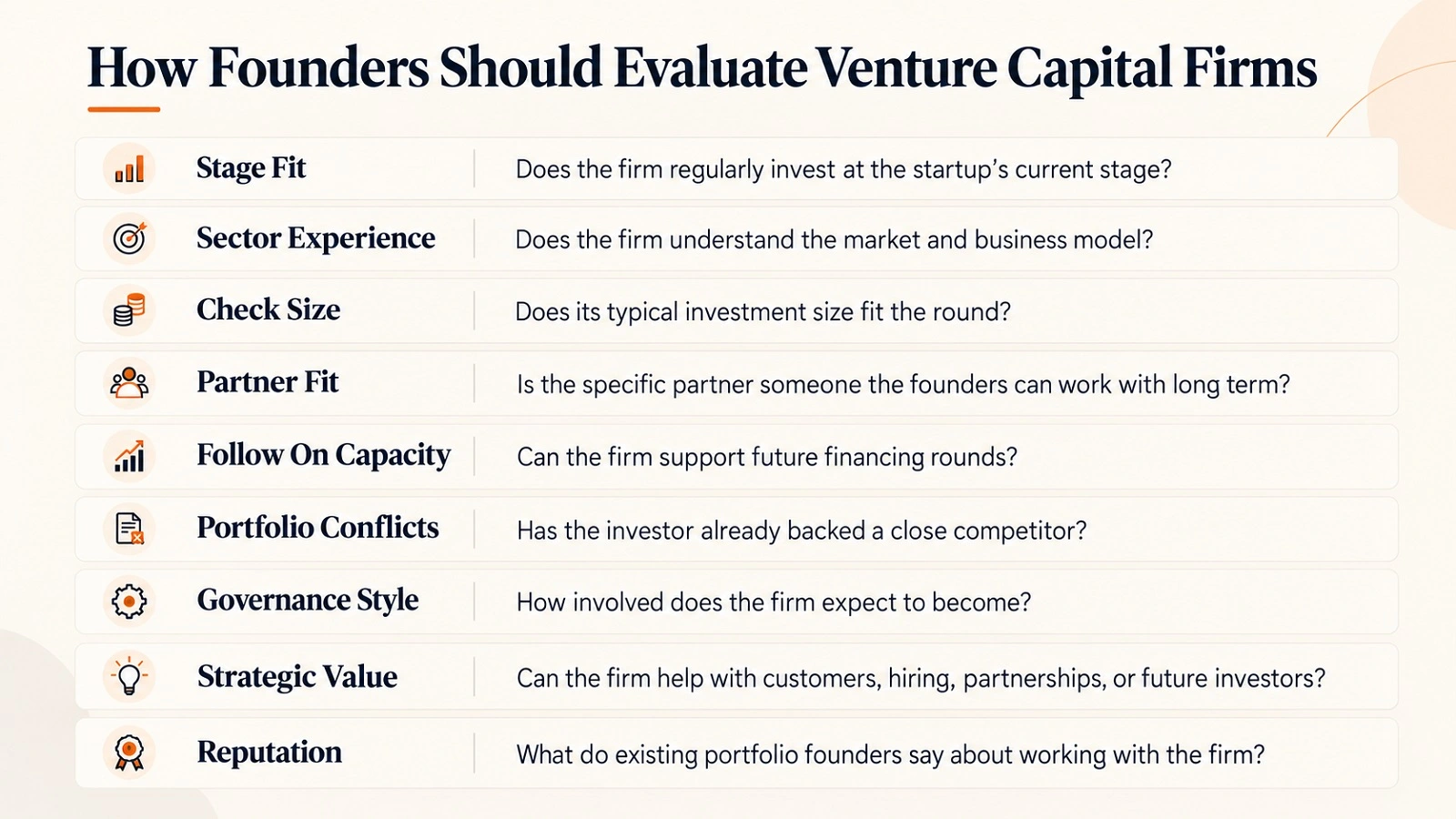
Founders should conduct diligence on investors with the same seriousness investors use when evaluating startups. The relationship may last for many years and influence financing, recruiting, governance, strategy, and major corporate decisions.
Important questions include whether the firm regularly invests at the company’s stage, understands the market, writes checks compatible with the round, has useful networks, can support future financing, and works in a way that fits the founders’ expectations.
The best investor is not necessarily the one offering the largest amount of money. Capital is only one component of a long term financial and strategic relationship.
Speaking With Portfolio Founders
Existing portfolio founders can provide information that is difficult to obtain from the VC firm itself. They can explain how responsive the investor is after the financing closes, whether promised introductions actually happen, how useful strategic support has been, and how the investor behaves when company performance becomes difficult.
Founders should ideally speak with companies experiencing different outcomes rather than only the investor’s most successful portfolio businesses. Most investors appear supportive when growth is strong. Difficult periods reveal much more about communication, governance, patience, and alignment.
These conversations are particularly valuable when the prospective investor may receive a board seat or become one of the largest shareholders in the company.
Famous VC Firm vs Best Fit
A highly recognized venture firm can provide real advantages. Its brand may help with recruiting, customer credibility, future fundraising, and media attention. Those benefits should not be dismissed.
At the same time, prestige does not guarantee that the startup will receive meaningful attention or strategic value. A smaller specialist firm where the company becomes an important portfolio investment may sometimes provide more useful support than a famous fund managing a large number of companies.
Founders should evaluate the specific partner, fund strategy, ownership expectations, level of engagement, and relevance of the investor’s network rather than treating brand recognition as the primary selection criterion.
Large VC Firms vs Small VC Firms
Large firms and small firms often operate under different economics and create different founder experiences. Large VC organizations may have greater capital reserves, extensive networks, specialized platform teams, and the ability to participate across multiple future rounds.
Their large fund sizes can also mean that investments need to become very significant before they materially influence overall returns. Smaller firms may be more flexible, provide more direct partner attention, and consider opportunities that would be too small for major funds.
The right choice depends on what the startup needs. A company expecting multiple large future rounds may value deep capital reserves, while a younger startup may benefit more from a focused early stage investor.
Generalist vs Specialist Venture Firms
Generalist firms invest across several industries, while specialist funds concentrate much more heavily on particular markets or technologies. Generalists can bring broad experience across different business models and potentially wider networks, while specialists can provide deeper industry knowledge and more targeted relationships.
Sector expertise can be particularly valuable in markets involving complex regulation, specialized customer groups, technical infrastructure, difficult distribution, or unusually long sales cycles. The specialist investor may already understand problems that another VC would need months to learn.
The tradeoff is that specialization can increase the chance of portfolio conflicts, so founders should examine existing investments carefully before sharing sensitive information.
Portfolio Conflicts
Portfolio conflicts occur when a VC already owns a company that competes with the startup or operates close enough to create concerns around confidential information.
Not every similar company creates a genuine conflict. Two startups can exist in the same broad industry while serving different customers, products, geographies, or use cases. Still, the relationship deserves investigation before founders share highly sensitive information.
Reviewing a firm’s portfolio is therefore one of the simplest and most useful steps in investor research. It helps founders understand both potential conflicts and the areas where the firm already has meaningful experience.
Corporate Venture Capital Firms
Corporate venture firms invest capital connected to established companies rather than independent investment partnerships. Their motivation can include financial returns, access to new technology, strategic partnerships, future acquisition opportunities, customer relationships, or insight into emerging markets.
For startups, this can create value that an independent fund cannot easily reproduce. A corporate investor may provide distribution, infrastructure, technical support, industry credibility, manufacturing capacity, or access to customers.
The tradeoff is strategic complexity. Corporate priorities can change if leadership or company strategy changes, and a close relationship with one established company can sometimes influence how its competitors view the startup.
Founders should therefore understand why the corporation wants to invest and whether that motivation supports the startup’s long term strategy.
Founder Friendly Venture Capital Firms
A founder friendly VC is not an investor who agrees with every decision. Strong investors should be willing to challenge assumptions when they believe the company is making a mistake.
What matters is how those disagreements are handled. Useful investors communicate clearly, respect management responsibilities, provide relevant context, and remain constructive when performance falls below expectations.
The strongest founder investor relationships combine trust with honest disagreement. A passive investor may add little value, while an overly controlling investor can create unnecessary conflict.
Warning Signs When Evaluating a VC Firm
Investor behavior during fundraising can reveal useful information about the relationship that may follow. Frequent changes in expectations, unclear decision making authority, inconsistent communication, unexplained delays, aggressive pressure around terms, or promises that cannot be confirmed through portfolio references may deserve closer examination.
Strategic misalignment is another significant warning sign. If the investor expects the startup to pursue aggressive international expansion while the founders want controlled profitable growth, that difference is unlikely to disappear after capital is transferred.
Funding often amplifies existing incentives. Founders should therefore investigate these differences while they still have the ability to choose whether to enter the relationship.
How Founders Should Research VC Firms
Investor research should go beyond reading a firm’s homepage. The portfolio shows what the VC has actually invested in, recent deals can reveal current stage and sector activity, and partner biographies can help identify the people most relevant to the startup.
Founders should also understand typical check sizes, whether the firm usually leads rounds, whether it frequently participates in future financings, and whether direct competitors already exist in the portfolio.
Public interviews, investment announcements, founder references, professional networks, and portfolio pages can all provide useful context. The objective is to understand actual investor behavior rather than relying solely on positioning statements.
Building a VC Target List
A strong target list prioritizes relevance rather than fame. Founders can organize potential investors according to stage, sector, geography, check size, lead capacity, portfolio conflicts, follow on capacity, and strategic value.
The specific partner inside the firm also matters because different investors within the same organization may have very different interests. Targeting the correct person can therefore be as important as selecting the correct firm.
Fundraising becomes much more efficient when founders know exactly why each investor belongs on the list before the first message is sent.
How Many VC Firms Should Founders Contact?
There is no universal number of investors that every startup should approach because the answer depends on stage, sector, geography, round size, investor demand, and the strength of the company.
The more useful principle is to focus on relevant investors. Contacting a large number of funds that do not invest in the company’s category or stage creates more work without materially improving the probability of completing a round.
A focused pipeline also produces better feedback because the investors evaluating the company actually understand the opportunity and operate in the relevant financing market.
How Existing VC Firms Affect Future Rounds
The investors already on the capitalization table can influence how future investors evaluate the startup. New VCs may examine who backed the company previously, whether those investors intend to participate again, how ownership is structured, and whether the relationship between founders and existing shareholders appears healthy.
A respected VC brand can provide credibility, but continued support can matter even more. If existing investors do not participate in a future financing round, new investors may want to understand whether the decision reflects portfolio strategy or concerns about the company.
The investor selected today therefore becomes part of the startup’s future financing infrastructure.
When a VC Firm Passes
Rejection is normal in venture fundraising and can happen for many reasons. A company may be outside the firm’s thesis, the startup may be at the wrong stage, the potential market may appear too limited, the valuation may be difficult to justify, or the investor may already have exposure to a competing company.
Founders should look for patterns across relevant investors rather than treating every rejection as equally meaningful. If several well matched VCs independently raise the same concern about retention, customer acquisition, market size, or team composition, that pattern may deserve investigation.
If the reasons differ significantly, the responses may simply reflect differences between fund strategies. One VC decision is not a definitive judgment about whether the startup can succeed.
The Real Role of Venture Capital Firms
Venture capital firms sit between institutional capital and private companies capable of significant growth. They raise funds, identify opportunities, evaluate startups, negotiate ownership, support portfolio businesses, participate in future financing, and eventually seek returns from successful outcomes.
For founders, the most important lesson is that VC firms are not interchangeable. Fund size, stage focus, sector expertise, check size, ownership goals, internal decision making, partner quality, governance style, and follow on capacity can all shape the financing relationship.
The best venture capital firm is therefore not automatically the largest, most famous, or highest paying investor available. It is the firm whose economics, expertise, expectations, and working style align with the startup’s current stage and the company the founders ultimately want to build.
FAQ
What is a venture capital firm?
A venture capital firm is an investment organization that manages capital and invests it into privately held companies with significant growth potential, usually in exchange for equity or equity linked ownership.
Where do venture capital firms get their money?
Most firms raise funds from limited partners such as pension funds, endowments, family offices, foundations, corporations, insurance companies, and other institutional or wealthy investors.
What is the difference between a VC firm and a VC fund?
The firm is the organization responsible for raising, investing, and managing capital. The fund is a specific pool of money managed by that organization for investment into portfolio companies.
Do all venture capital firms invest at the same stage?
No. Some specialize in pre seed and seed companies, while others focus on Series A, growth rounds, later stage businesses, or several stages through different funds.
How do venture capital firms select startups?
VC firms typically evaluate the founders, market opportunity, customer problem, product value, traction, retention, growth potential, business economics, competitive position, and how additional capital could increase company value.
What does a lead venture investor do?
A lead investor usually takes a larger role in diligence, negotiates major financing terms, commits a meaningful share of the round, and may help attract other investors.
Do venture capital firms help startups after investing?
Many do. Support can include strategy, recruiting, customer introductions, partnerships, governance, future fundraising, and other operating needs depending on the firm.
Should founders choose the VC offering the highest valuation?
Not necessarily. Valuation matters, but founders should also evaluate governance terms, partner quality, reputation, market expertise, follow on capacity, strategic alignment, and how the investor behaves during difficult periods.
How can founders evaluate a venture capital firm?
Founders can examine the firm’s portfolio, investment thesis, stage focus, check size, specific partner, governance style, future investment strategy, and references from founders already working with the investor.
Is a famous VC firm always better?
No. A famous investor may provide brand and network advantages, but a smaller or more specialized fund can sometimes provide stronger market knowledge, partner attention, strategic support, and better alignment with a particular startup.

Mobina Khanki
Venture & Funding Writer at PinerookMobina Khanki covers venture capital, startup funding, fundraising, and startup finance for Pinerook, focusing on founders and investors.
 Seen first.