Venture capital can look simple from the outside. A startup needs money, an investor provides capital, and the investor receives equity in return. In practice, the system is much more structured. Venture firms usually invest money raised from outside investors, build portfolios across many startups, reserve capital for future rounds, and depend on a relatively small number of successful companies to generate meaningful returns.
Understanding how venture capital works matters because founders are not simply negotiating with someone who likes their idea. They are entering a financial system with its own incentives, timelines, ownership expectations, and return requirements. Those incentives influence which startups receive capital, why market size matters so much, why investors care about growth, and what happens after a financing round closes.
For founders, understanding Venture Capital means understanding both sides of the transaction. The startup wants capital to build and grow, while the VC needs the investment to create enough future value to justify the risk. When those incentives align, venture financing can accelerate a company dramatically. When they do not, capital can create pressure without improving the underlying business.
What Is Venture Capital?
Venture capital is a form of private investment designed primarily for companies with the potential to grow significantly in value. Instead of lending money that must be repaid through scheduled payments, venture investors usually provide capital in exchange for ownership in the startup.
The investor is therefore making a bet on the future value of the company rather than on predictable short term cash flow. If the startup grows substantially, the investor's equity can become much more valuable. If the company fails, part or all of the investment can be lost.
That risk profile explains why venture capital usually concentrates on startups capable of producing large outcomes. A small profitable company can be an excellent business and still be a poor fit for venture investment if its market or growth potential is too limited.
Where Venture Capital Money Comes From
Most venture capital firms do not invest only their own money. They typically raise a fund from outside investors and then manage that capital on their behalf.
Those outside investors are known as limited partners. They may include pension funds, university endowments, family offices, foundations, insurance companies, corporations, sovereign institutions, and wealthy individuals. The venture firm acts as the general partner and is responsible for deciding which startups receive the fund's capital.
This creates two layers of investing. Limited partners invest in the venture fund, and the venture fund invests in startups. That structure matters because venture investors are accountable not only to founders but also to the institutions and individuals that supplied the capital.
The VC therefore needs to evaluate whether each potential investment has enough upside to contribute meaningfully to the performance of the entire fund.
The Venture Capital Structure at a Glance
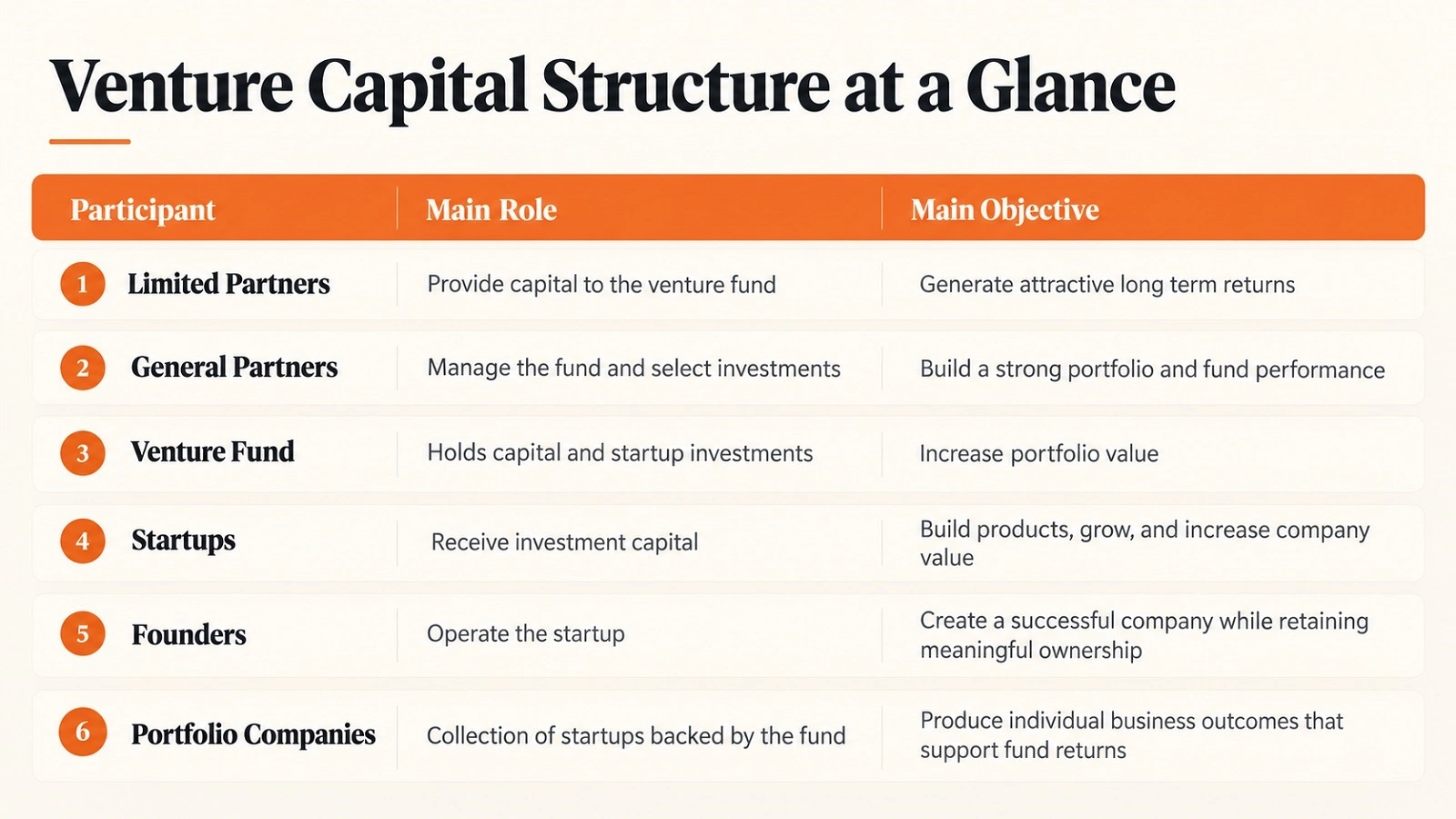
A founder raising from a venture firm is therefore participating in a larger capital system. The deal needs to make sense not only for the company but also for the economics of the fund.
How a Venture Capital Fund Is Created
A venture firm usually begins by defining an investment strategy. The partners decide which company stages they want to target, which sectors they understand, which geographies they will cover, and what size of investments they expect to make.
The firm then raises commitments from limited partners. Once enough capital has been committed, the fund can begin investing according to its mandate. Venture firms may manage multiple funds at the same time, and those funds can have different strategies.
One fund may focus on early startups, while another may support later stage companies or provide additional capital to existing portfolio businesses. Because each fund has its own size and return expectations, founders should understand which specific fund is making the investment.
That can influence check size, ownership expectations, follow on capacity, and how large an outcome the investor needs from the company.
Why Venture Funds Build Portfolios
Venture investing involves significant uncertainty. Even experienced investors cannot know which startup will become the largest winner.
For that reason, venture funds usually spread capital across multiple companies rather than concentrating most of their money in one business. Some investments may fail, some may produce modest returns, and a smaller number may create very large outcomes.
This portfolio model has an important consequence for founders. A startup that can become a good business but only create a modest financial outcome may still be unattractive to a traditional venture fund.
The investor needs to believe that there is at least a credible path toward a result large enough to matter to the entire portfolio. The company does not need to guarantee that outcome, but the potential upside needs to justify the risk.
How Venture Capital Moves From Investors to Startups
The movement of capital follows a clear sequence. The venture firm first raises a fund, then finds startup opportunities, evaluates them, invests in selected companies, supports those companies over time, and eventually seeks liquidity from successful investments.
The startup sits in the middle of that system. It receives capital today, but the venture firm ultimately needs its ownership to become more valuable and eventually liquid.
This is why investors care about market size, growth, future financing, ownership, and possible exit opportunities from the beginning.
How Venture Firms Find Startups
Venture firms discover startups through founder referrals, other investors, accelerators, portfolio companies, industry networks, events, direct outreach, research, and inbound pitches.
Some firms receive a large number of opportunities, which means filtering starts quickly. Investors may first look at company stage, sector, geography, check size, ownership needs, and whether the startup fits the fund's thesis.
A startup can be strong and still receive a rejection simply because it does not fit the investor's mandate. Founders therefore benefit from targeting relevant firms rather than treating every venture investor as a realistic prospect.
A smaller list of well matched investors is often more useful than a large list of firms with little strategic fit.
What Happens After a VC Finds a Startup?
The first stage is usually an initial conversation. The objective is not to complete a full investment analysis immediately but to decide whether the opportunity deserves deeper attention.
Investors may ask about the problem, customer, product, market size, founders, traction, competition, business model, and fundraising plans. At this stage, they are trying to determine whether the startup fits the fund and whether there is enough potential to justify more time.
If interest continues, the process becomes more detailed. Additional partners may join meetings, operating data may be requested, customer references may be checked, financial assumptions may be tested, and legal or ownership information may be reviewed.
The startup is gradually moving from an interesting opportunity to a potential investment that the venture firm must be able to defend internally.
How Venture Capital Firms Evaluate a Startup
The exact evaluation framework depends on the stage of the business. Early stage investors may have little financial history to examine, while later stage investors can analyze revenue, retention, margins, acquisition efficiency, and operating performance in much greater detail.
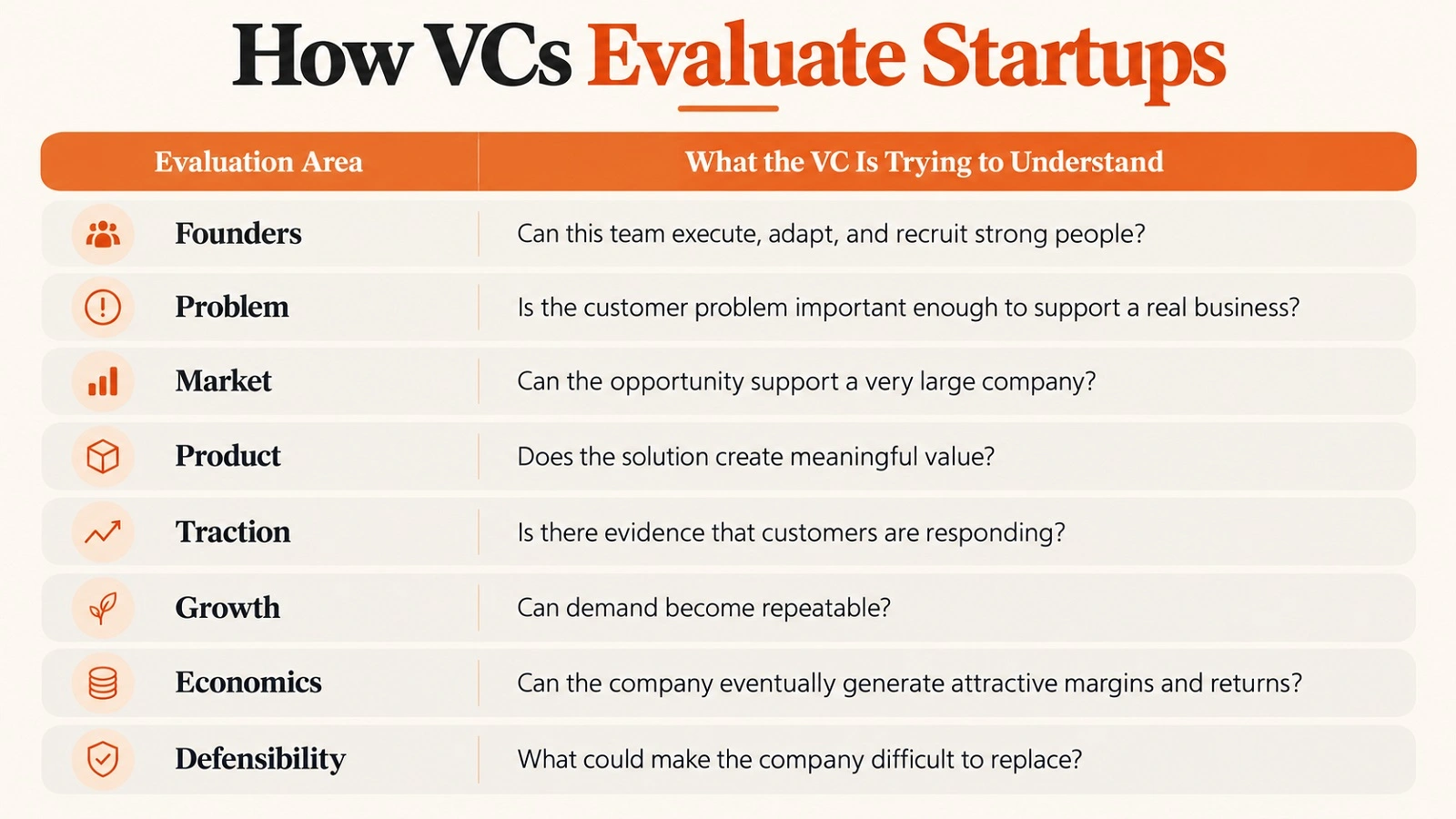
Investors are not only asking whether the startup looks good today. They are trying to estimate what the company could become if the next several years go well and additional capital is deployed effectively.
Why Market Size Matters So Much
Market size is unusually important in venture capital because the fund needs some investments to become very valuable.
A startup can execute well and still have limited venture potential if the total opportunity is too small. The company may become profitable and successful without ever becoming large enough to produce a meaningful venture return.
Investors therefore examine the number of potential customers, how much those customers may spend, how rapidly the market can grow, and whether the startup has a realistic path toward capturing a meaningful position.
Founders sometimes present an enormous theoretical market without explaining how the company can actually enter it. A stronger market argument connects a large future opportunity to a clear starting segment and a credible expansion path.
Why Founder Quality Matters
At the earliest stages, investors have limited operating data, so much of the investment decision rests on the founders.
VCs may evaluate whether the founders understand the customer deeply, whether they have relevant technical or industry experience, how quickly they learn, how they make decisions, and whether they can attract talented employees.
This matters because startups change. The original product, pricing model, target customer, or distribution strategy may evolve substantially over time.
The investor is therefore not only backing the current version of the company. They are also backing the founders' ability to adapt when assumptions change.
Why Traction Changes the Conversation
Traction reduces uncertainty.
For an early startup, traction may mean pilot customers, active users, paid trials, strong customer interviews, early product engagement, or initial revenue. As the company matures, investors may focus more heavily on retention, recurring revenue, growth rate, acquisition efficiency, expansion revenue, and business economics.
Strong traction changes the fundraising conversation because founders no longer need to rely entirely on predictions. They can show that customers are already behaving in ways that support the investment case.
This does not eliminate risk, but it gives investors more evidence that the opportunity is moving from theory toward a functioning business.
How VC Decisions Are Made Internally
A founder may interact mostly with one partner, but the investment decision often involves several people inside the venture firm.
The partner leading the opportunity may prepare an internal investment case explaining the startup, founders, market, traction, risks, potential returns, and proposed deal structure. Other partners may challenge assumptions and ask whether the opportunity fits the fund's strategy.
Some firms use a formal investment committee, while smaller firms may make decisions through more flexible partner discussions. The exact process differs, but the startup is effectively evaluated twice: once directly through founder meetings and again through internal debate after those meetings.
This is why an enthusiastic partner does not always mean the investment will close.
What Due Diligence Looks Like
Once a VC becomes seriously interested, due diligence begins.
The investor may review financial statements, legal documents, capitalization tables, customer contracts, intellectual property, employment agreements, product data, market information, security practices, and company forecasts.
Investors may also speak with customers, industry experts, former colleagues, or other references. The depth of diligence depends on the company stage and investment size.
A very early round may involve relatively limited documentation, while a larger later stage deal can require extensive analysis. Founders benefit from keeping company records organized before fundraising begins because poor documentation can slow an otherwise attractive process.
How the Term Sheet Works
If the investor decides to move forward, the VC may offer a term sheet describing the major commercial terms of the financing.
The term sheet can cover valuation, investment amount, ownership, board representation, voting rights, liquidation preferences, option pools, investor protections, and future participation rights.
Founders often focus heavily on valuation because it affects dilution, but the rest of the agreement can be equally important. Two investors can offer the same valuation while creating very different long term outcomes through governance and ownership terms.
The correct comparison is therefore between complete deals, not just headline valuation numbers.
How Venture Capital Affects Ownership
Venture capital generally involves issuing equity to investors. This reduces the percentage ownership of existing shareholders.
Suppose founders own most of the company before the financing. Once new shares are issued to investors, the founders may own a smaller percentage even though the company now has more capital.
That is not automatically a negative outcome. If the investment helps the business become much more valuable, a smaller percentage of a larger company can be economically better than a larger percentage of a company that lacks enough resources to grow.
The important question is whether the capital has a credible chance of creating enough value to justify the ownership exchanged.
How Valuation Determines Investor Ownership
Valuation establishes the price at which the investor is buying equity.
A higher valuation generally means the investor receives a smaller percentage for the same amount of capital. A lower valuation creates more immediate dilution.
However, founders should not automatically pursue the highest valuation possible. An aggressive valuation can create pressure for the company to grow enough to justify an even higher value at the next financing round.
If the business does not progress quickly enough, later fundraising can become more difficult. A strong round therefore balances sufficient capital, reasonable dilution, and a valuation that leaves room for future value creation.
What Happens When the Deal Closes
Once the investment documents are finalized and financing conditions are satisfied, capital is transferred to the startup.
At that point, the VC becomes a shareholder. The relationship changes from evaluation to ownership.
Depending on the deal, the investor may participate through board meetings, strategic advice, recruiting introductions, customer relationships, future financing support, and help with partnerships or acquisitions.
The quality of this relationship matters because a venture investor can remain connected to the company for many years.
What VCs Do After Investing
Investor involvement varies significantly.
Some VCs work closely with founders and participate actively in strategy, hiring, future fundraising, and major decisions. Others maintain a lighter relationship and become involved mainly through board meetings and investor updates.
Neither approach is automatically better. The right level of involvement depends on the startup, founder preferences, investor expertise, and stage of the company.
This is another reason investor fit matters before the financing closes. Capital is important, but the founder is also choosing a long term shareholder and potentially a board member.
Why Venture Capital Comes in Rounds
Startups rarely raise all the capital they may ever need at one time. Instead, venture financing usually happens in stages because each round is expected to help the company reach a stronger position.
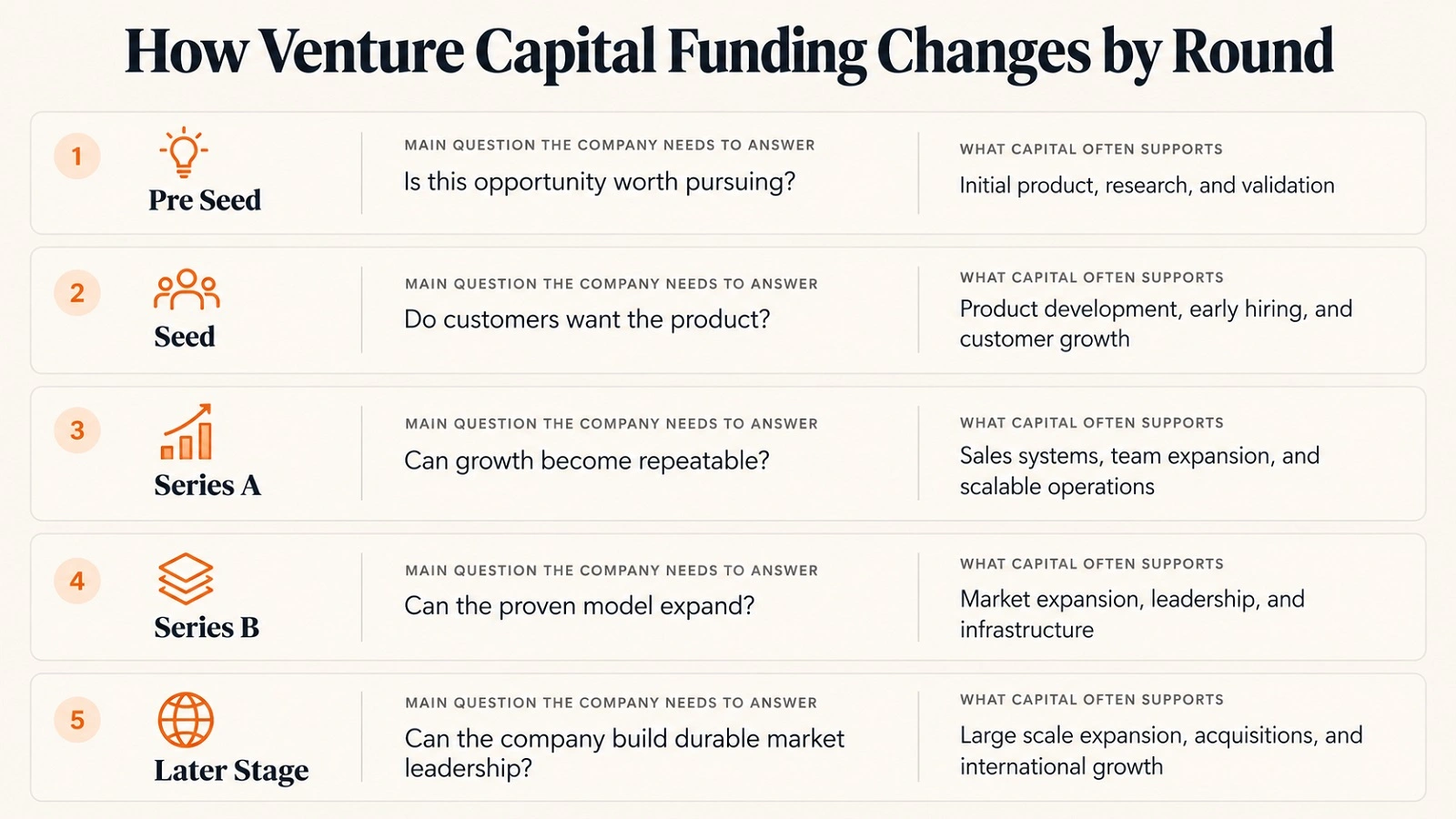
This staged structure reduces investor risk while allowing founders to raise larger amounts as the business becomes more valuable and more predictable.
The best use of one funding round is therefore to create the evidence required for the next stage.
Why Venture Firms Reserve Capital for Future Rounds
VC funds often avoid investing all available capital in their initial investments.
Part of the fund may be reserved for future investments in portfolio companies that continue performing well. This allows the firm to maintain or increase ownership in companies that appear increasingly promising.
For founders, follow on capacity can matter when choosing investors. A firm capable of supporting future rounds may provide useful continuity.
However, founders should never assume an existing investor will automatically participate again. Future investment still depends on company performance, fund strategy, ownership targets, and conditions in the next round.
How Venture Capital Investors Make Money
VC investors make money when the value of their ownership becomes greater than the amount originally invested and those shares eventually become liquid.
Liquidity can happen through an acquisition, public offering, secondary share sale, or another transaction that allows investors to sell ownership.
Before that happens, increases in company valuation generally represent unrealized value rather than cash returns.
This creates a long time horizon. A successful startup may take many years before generating actual proceeds for investors.
That is why venture investors care both about company growth and about whether there is ultimately a credible path to liquidity.
Why Large Winners Matter So Much
The economics of a venture portfolio are unusual because returns can be highly concentrated.
A fund may invest in many startups. Several may fail, several may produce modest returns, and one or two may become extremely valuable.
Those large winners can compensate for losses elsewhere in the portfolio.
This explains why venture investors often focus on startups that have the potential to become very large companies. A business that looks likely to produce only a modest outcome may not be capable of influencing the performance of the fund enough to justify the investment.
Why VCs Push for Growth
Venture funds are built around increasing company value, which naturally creates strong incentives for growth.
If a startup has discovered a repeatable customer acquisition model, new capital may be used to hire salespeople, improve the product, expand distribution, enter new markets, or build stronger infrastructure.
The expectation is that these activities make the company more valuable.
However, growth alone is not enough. A startup with weak retention, poor economics, or an unproven product can spend more money without becoming stronger.
The best venture backed companies use capital to accelerate evidence that is already becoming convincing.
Founder and VC Incentives
Founders and investors can want the same company to succeed while still having different priorities.
Founders may care about control, ownership, company culture, long term independence, and how quickly the business grows. Venture investors need enough financial upside for the investment to matter within the economics of their fund.
This difference does not automatically create conflict. Problems usually emerge when both sides enter the relationship with different assumptions about what kind of company they are trying to build.
Founder investor alignment therefore matters before the investment. Growth expectations, future financing, governance, possible exits, and the scale of the opportunity should be understood early.
When Venture Capital Makes Sense
Venture financing makes the most sense when additional capital can meaningfully expand what the startup is capable of achieving.
That may be true when product development requires significant resources, market timing is important, network effects reward rapid growth, infrastructure is expensive, or the startup already has evidence that additional investment can accelerate a functioning growth engine.
The business should also have a credible path toward becoming much larger.
If founders can build a strong profitable company primarily through customer revenue, taking venture capital may not be necessary.
The right question is whether capital creates strategic leverage, not whether venture financing is prestigious.
When Venture Capital May Not Make Sense
Venture capital may be a poor fit when the total market is relatively small, the startup requires little capital, founders strongly prioritize control, or the business can reach profitability through customer funded growth.
It can also be a poor fit when more money would not materially change the company's growth potential.
Accepting VC creates new expectations around scale, ownership, governance, and eventual liquidity. A founder primarily interested in building a durable independent business may decide that those incentives do not match the desired strategy.
Choosing not to raise venture capital can therefore be a deliberate financing decision rather than a sign of limited ambition.
What Founders Should Understand Before Raising VC
Before contacting investors, founders should know why the company needs capital, what the money should accomplish, how much runway the round should create, and what evidence should exist by the time the capital has been spent.
They should also understand the effect on ownership and governance. The best investor is not simply the firm offering the most money or highest valuation.
Founders should consider whether the investor understands the market, whether the relationship feels productive, how the firm behaves during difficult periods, whether it can support future rounds, and whether both sides share similar expectations about the company.
Fundraising is both a capital decision and a partnership decision.
How Founders Should Think About Venture Capital Returns
Founders do not need to become fund managers, but understanding the investor's return model makes fundraising conversations easier to interpret.
If a VC invests from a large fund, the company may need to become much larger before the investment can materially influence the performance of that fund. A smaller early stage investor may operate with different ownership and return expectations.
This is one reason startup investor fit matters so much.
A good company can still be a poor investment for a particular fund if the potential outcome does not match that fund's economics.
Understanding that distinction helps founders interpret rejection more accurately.
The Real Way Venture Capital Works
At its core, venture capital is a chain of aligned but different incentives.
Limited partners provide capital because they want long term returns. Venture firms manage that money by investing across a portfolio of startups. Startups accept the capital because it allows them to develop products, hire teams, reach customers, and scale faster than their own resources might permit.
The venture firm receives ownership and accepts the risk that the startup may fail. The founder accepts dilution and investor involvement in exchange for additional resources and support.
If the company succeeds, its value increases. Investor ownership becomes more valuable, and a future liquidity event may eventually return capital to the venture fund and its limited partners.
The basic mechanism is simple. The difficult part is matching the right startup with the right investor, the right amount of capital, and the right expectations at the right time.
FAQ
How does venture capital work?
Venture firms raise money from limited partners and invest that capital into startups in exchange for ownership. They build portfolios and seek returns when successful companies increase in value and eventually create liquidity.
Where do venture capital firms get their money?
VC firms typically raise investment funds from limited partners such as pension funds, endowments, family offices, foundations, corporations, insurance companies, and other institutional or wealthy investors.
Why do venture capital firms invest in startups?
They invest because startups can potentially grow significantly in value. Successful investments can generate returns large enough to compensate for portfolio companies that fail or produce smaller outcomes.
How do VCs decide which startups to invest in?
VCs commonly evaluate founders, market size, customer problem, product, traction, growth potential, economics, defensibility, and whether additional capital can help the company create significantly more value.
Does venture capital have to be repaid?
Traditional venture equity is not repaid like a conventional loan. Investors receive ownership in the company and seek returns through increases in company value and eventual liquidity.
How do venture capital investors make money?
They make money when the value of their ownership increases and those shares eventually become liquid through an acquisition, public offering, secondary transaction, or another exit.
Why do VC firms care so much about market size?
Venture portfolios often depend on a relatively small number of large winners. Investors therefore need startups to operate in markets capable of supporting substantial company values.
Why does venture capital dilute founders?
Investors receive new ownership in exchange for capital. This reduces the percentage ownership of existing shareholders, although the total value of their remaining ownership may increase if the business grows significantly.
Do VCs invest again after the first round?
They can. Many venture firms reserve capital for future investments, but participation in later rounds depends on company performance, fund strategy, ownership goals, and conditions at the time.
Is venture capital right for every startup?
No. Venture capital is generally better suited to companies with large growth potential that can use significant external capital productively. Some startups may be better served by customer revenue, founder capital, grants, debt, or other financing models.

Mobina Khanki
Venture & Funding Writer at PinerookMobina Khanki covers venture capital, startup funding, fundraising, and startup finance for Pinerook, focusing on founders and investors.
 Seen first.