Technology innovation begins when a new or significantly improved technology moves beyond an idea and changes a real product, process, service, or business capability. The technology itself is only the starting point. What matters is whether people adopt it and whether that adoption creates measurable value.
When I evaluate technology innovation, I do not start with how advanced the technology sounds. I look at the path from technical capability to practical use. That distinction matters because an impressive invention can remain in a laboratory for years, while an existing technology can create major innovation when a company applies it in a better way.
Technology Innovation Explained
Technology innovation is the development and practical application of new or significantly improved technology in a product or business process.
The OECD's Oslo Manual defines innovation around two conditions: the product or process must differ significantly from what existed before, and it must actually be introduced to users or brought into use. An unfinished prototype or research project does not meet that standard.
IEEE describes technological innovation in a similar way, emphasizing both technical development and successful introduction into organizations, markets, or society.
That gives me a straightforward test:
New capability + practical adoption + meaningful value = technology innovation
This is also where technology innovation connects with emerging technologies. A technology can emerge from research, but innovation starts when someone converts that capability into something people or organizations can actually use.
Technology Innovation vs Invention
This distinction is central to the topic.
An invention creates something new. Innovation turns new or existing technical capability into practical value.
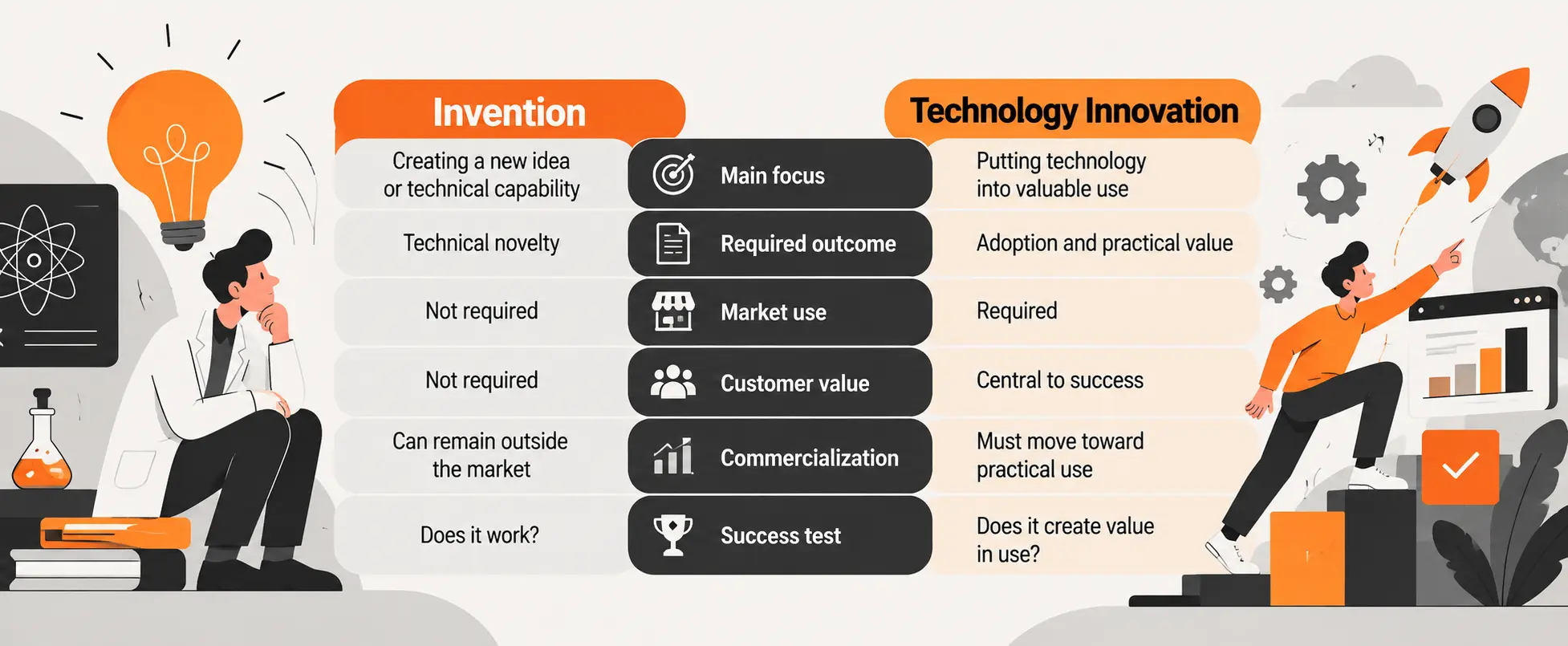
The difference explains why being first to invent something does not guarantee commercial success.
Research into commercialization shows that emerging technologies face both technical and market uncertainty. Moving from development to successful market application requires far more than proving that the technology works.
When I assess an innovation, I therefore ask two separate questions:
Can the technology perform?
Does that performance solve a problem worth paying for or adopting?
Both need a clear answer.
Main Types of Technology Innovation
For a practical business discussion, I divide technology innovation into four useful types.
Product Innovation
Product innovation changes what customers can buy or use.
This includes completely new products and significant improvements to existing ones.
Examples include a medical device with a new diagnostic capability, a battery with substantially different storage performance, or software that delivers a capability unavailable in the previous product.
The important point is that the technology changes the value delivered to the user.
Process Innovation
Process innovation changes how a company creates, delivers, manages, or supports value.
Examples include automated manufacturing, AI-assisted quality control, robotic warehousing, new payment infrastructure, or software that removes manual steps from an operational process.
The customer does not need to see the technology directly.
Its value appears through lower cost, higher speed, stronger quality, greater capacity, or a different operating model.
The OECD's current framework recognizes product innovation and business process innovation as the two broad categories of business innovation.
Incremental Technology Innovation
Incremental innovation improves an existing technical capability without replacing the entire system around it.
A faster semiconductor, more efficient manufacturing process, improved sensor, or better battery chemistry can create substantial business value through repeated improvements.
I do not dismiss incremental innovation because it looks less dramatic.
A 10 percent improvement in a technical metric can transform an industry when that metric controls cost, capacity, reliability, or profitability at scale.
Radical Technology Innovation
Radical innovation introduces a capability that changes what products, processes, or markets can exist.
Quantum computing, commercial fusion, programmable biology, autonomous machines, and new computing architectures fit this category when technical progress reaches practical deployment.
These innovations require more than product development. They can force customers, suppliers, regulators, infrastructure providers, and entire industries to adapt around the technology.
Technology Innovation Examples
The best examples show the difference between adopting technology and actually innovating with it.
Artificial Intelligence
Installing an AI chatbot does not automatically create technology innovation.
Innovation appears when AI changes the economics or capability of a product or process.
For example, AI can reduce the time required to analyze complex scientific data, automate parts of software development, interpret unstructured documents, or enable machines to respond to environments that fixed automation cannot handle.
The technology becomes valuable when the workflow itself changes.
Electric Vehicles
Electric propulsion existed long before today's EV market.
The innovation became commercially meaningful when advances in batteries, power electronics, software, charging infrastructure, manufacturing, and vehicle design combined into products buyers could use at scale.
This is why I rarely look at technologies in isolation.
Commercial innovation often appears when several technical improvements reach maturity together.
Cloud Computing
Cloud technology changed more than where companies stored data.
It changed how businesses acquired computing infrastructure.
Instead of purchasing and maintaining physical servers for every new workload, companies gained on-demand access to scalable computing resources.
That change supported new software business models, faster product development, and different cost structures.
The innovation was not just the server technology. It was the new operating model created around it.
Industrial Automation
Industrial automation turns sensors, control systems, robotics, machine vision, and software into improvements in production.
The innovation becomes measurable through output, quality, downtime, safety, or production flexibility.
The relevant question is not whether a factory owns robots.
It is whether automation changes how effectively the factory can produce.
The Technology Innovation Process
Technology innovation is not a straight path from idea to launch.
I use a seven-stage sequence to evaluate where an innovation actually stands.
Problem
Start with a meaningful problem or constraint.
Technology searching for a problem creates weak innovation. A clearly defined operational, customer, scientific, or market problem gives technical development a target.
Technical Opportunity
Identify the capability that changes what is possible.
This could come from internal R&D, university research, an external supplier, an acquisition, an open-source project, or a technology already used in another industry.
The company does not need to invent the underlying technology itself.
The OECD explicitly notes that innovation also includes the diffusion and adoption of existing technologies and practices.
Prototype
Build enough of the solution to test the central assumption.
The prototype should answer a specific technical or user question rather than imitate a finished product.
Validation
Test the technology against measurable requirements.
For a business process, that can mean cost, speed, accuracy, or capacity.
For a physical technology, it can include performance, reliability, efficiency, lifetime, safety, or manufacturing yield.
Pilot
Move from controlled testing into a real operating environment.
A pilot reveals integration problems, user behavior, operational requirements, support needs, and costs that prototypes cannot expose.
Adoption
The technology becomes part of a real workflow, product, or customer experience.
The U.S. Department of Energy's Adoption Readiness Level framework makes an important distinction here: technical readiness alone is not enough. Commercialization also requires solving market, integration, supply-chain, regulatory, and adoption barriers.
Scale
The final test is repeatability.
The company needs to deliver the value across more customers, locations, transactions, or units without destroying performance or economics.
At this stage, innovation stops being an experiment and becomes an operating capability.
Technology Innovation in Business
For businesses, technology innovation should change an economic or strategic outcome.
I look for value in five areas:
New revenue: technology enables a product, service, or market that did not exist before.
Lower cost: processes require less labor, energy, infrastructure, or waste.
Higher capacity: the company handles more customers, transactions, production, or data.
Better performance: products or operations become faster, safer, more accurate, or more reliable.
Strategic differentiation: competitors cannot deliver the same capability at the same cost, speed, or quality.
This is where I separate innovation projects from technology projects.
A cloud migration can be a technology project.
If the migration enables a company to release products weekly instead of quarterly, scale infrastructure with demand, and launch a new subscription model, it becomes part of a broader innovation.
The technology matters because of what changes around it.
Building Technology Innovation Inside a Company
Companies do not need a separate innovation lab to innovate.
They need a disciplined way to identify technical opportunities and move the strongest ones toward adoption.
I start with business problems instead of technology categories.
An operations team might need to reduce inspection time.
A product team might need to create a capability competitors cannot match.
A logistics team might need real-time visibility.
A scientific team might need to test more candidates with the same resources.
Once the problem is specific, the technology search becomes much more useful.
The next step is to define the result before choosing the tool.
If the goal is to cut inspection time from 20 minutes to 2 minutes without reducing accuracy, the team has a measurable innovation target.
Now technologies can be compared against an outcome instead of against each other.
This prevents innovation from becoming a collection of demonstrations with no clear business purpose.
R&D and Technology Innovation
Research and development is one source of innovation, not a requirement for every innovation.
A company can develop proprietary technology internally.
It can also license technology, partner with a university, work with a startup, acquire another company, or apply an existing technology in a new operating context.
This distinction matters because many businesses assume technological innovation requires a large research laboratory.
It does not.
The relevant capability is the organization's ability to recognize technical opportunity, evaluate it, adapt it, deploy it, and create value from it.
Research produces knowledge.
Innovation turns knowledge into use.
Commercialization of Technology Innovation
Commercialization begins when technical performance has to survive contact with customers, pricing, distribution, integration, procurement, regulation, and operating costs.
This is where technically strong ideas fail.
A technology can outperform an existing solution and still lose if it costs too much to install, requires an unrealistic workflow change, lacks necessary infrastructure, or creates more integration work than value.
Research into emerging technology commercialization highlights exactly this difficulty: technological promise creates attention, but successful commercialization requires complementary resources, market structures, and adoption mechanisms.
I therefore evaluate commercialization alongside technical development rather than after it.
The team needs to know:
Who adopts the technology
Who pays
Who integrates it
Who approves it
What existing behavior must change
Which economic result justifies that change
These questions turn technology development into business development.
Adoption as the Real Innovation Test
A product launch does not prove adoption.
Customers need to use the new capability in a way that creates value.
I watch three levels.
Access: the technology is available.
Usage: people or organizations actually use it.
Value: the usage produces a measurable improvement.
This distinction is critical for digital technology because launching features has become cheap.
A company can release twenty AI tools and still create less innovation than a competitor that deploys one automation system that cuts operating cost by 30 percent.
Innovation should be measured by changed outcomes, not feature count.
Measuring Technology Innovation
I do not measure innovation with a single metric.
The measurement needs to match the stage.
During development, useful metrics include technical performance, test completion, prototype reliability, and development speed.
During adoption, I look at usage, deployment rate, implementation time, user retention, and workflow change.
At the business level, I focus on revenue, cost, margin, productivity, capacity, quality, customer outcomes, or competitive advantage.
Patent counts and R&D spending can show innovation activity, but they do not prove commercial impact.
The OECD makes the same distinction between innovation activities and actual innovations: a company can spend resources trying to innovate without producing an innovation during the measurement period.
That is why I measure the result separately from the effort.
Technology Innovation and Competitive Advantage
Technology creates competitive advantage when competitors cannot easily reproduce the outcome.
The protection can come from patents, proprietary data, engineering knowledge, manufacturing capability, network effects, infrastructure, integration, customer relationships, or speed of execution.
The technology itself does not need to be secret.
Cloud computing is available to every company.
AI models are available to millions of businesses.
The advantage appears in how those technologies are combined with data, processes, product design, distribution, and organizational capability.
That is the difference between access to technology and technology innovation capability.
One can be purchased.
The other has to be built.
Technology Innovation Outlook
Technology innovation is moving toward tighter combinations of digital and physical systems.
AI is combining with robotics.
Computing is combining with biology.
Advanced materials are changing energy systems.
Software is becoming embedded in vehicles, factories, infrastructure, healthcare, and scientific research.
What matters to me is not the number of new technologies entering the market.
It is the shrinking distance between technical discovery and practical application.
New tools for simulation, AI-assisted research, cloud infrastructure, advanced manufacturing, and digital experimentation make it easier to test technical ideas and move successful ones toward deployment.
That does not eliminate commercialization risk.
It increases the number of technologies capable of reaching the commercialization stage.
For companies, the advantage will not come from identifying every new technology first.
It will come from recognizing which technical capability changes an important problem, validating it quickly, and turning it into measurable value before the opportunity becomes obvious to everyone else.
FAQ
Does an internal tool count as technology innovation if customers never see it?
Yes. An internal product or process qualifies as business innovation when it differs significantly from the organization's previous process, is brought into actual use, and creates a meaningful operational capability.
Can a failed pilot still be useful innovation work?
Yes. A failed pilot can produce valuable technical, market, integration, or adoption evidence. It counts as innovation activity even when it does not result in a successfully implemented innovation.
Do we need a patent before calling something a technology innovation?
No. Patent ownership is not a requirement for technology innovation. Innovation is defined by significant improvement and implementation, while patents protect qualifying intellectual property under separate legal criteria.
Can two competitors create the same innovation independently?
Yes. Innovation is measured relative to the products and processes of the organization implementing it. Two firms can independently introduce similar innovations without either copying the other.
Does replacing old software with a newer version count as innovation?
Only when the replacement introduces a significant improvement to the organization's product or business process. A routine upgrade that preserves the same capability does not meet that threshold.
Can regulation turn a technology into a bigger innovation opportunity?
Yes. New regulations can create demand, set technical standards, reduce uncertainty, or force industries to adopt new operating models. Regulation can therefore change the commercial value and adoption speed of a technology.
Should innovation teams own the technology after launch?
Ownership should transfer to the team responsible for operating and improving the capability at scale. Innovation teams can support the transition, but business-critical technology needs permanent operational ownership.
Can open-source technology still create a defensible innovation?
Yes. Defensibility can come from implementation, proprietary data, integration, workflow design, customer relationships, infrastructure, or complementary intellectual property even when the underlying technology is open source.
Does a technology need mass adoption before it counts as an innovation?
No. The technology needs to be implemented or made available for actual use. Mass-market diffusion is a later stage and is not required for the initial innovation to exist.
Can a company innovate with technology developed by another company?
Yes. Innovation does not require the company to invent the underlying technology. A firm can create innovation by applying external technology in a significantly improved product or business process that it successfully introduces into use.

Fatemeh Jahangard
Technology & AI Writer at PinerookFatemeh Jahangard covers AI, emerging technologies, and digital innovation for Pinerook, focusing on how technology shapes startups and industries.
 Seen first.