Emerging technologies are technologies moving from research, experimentation, or limited adoption toward real-world use with the potential to reshape products, industries, infrastructure, and the way businesses operate. They are not defined simply by being new. What matters is the combination of technical progress, growing practical use, and the scale of change they could create.
When I look at emerging technology, I focus less on which idea sounds futuristic and more on where research is turning into usable capability. That distinction matters because some technologies attract attention for years without creating practical value, while others move from a technical breakthrough to a serious business opportunity in a short period.
What Counts as an Emerging Technology
The clearest way to identify an emerging technology is to look at its position between invention and mature adoption.
The OECD describes emerging technologies as areas characterized by rapid development and uncertainty around their future trajectory and impact. The World Economic Forum uses three core factors when selecting emerging technologies: novelty, progress in development, and potential impact.
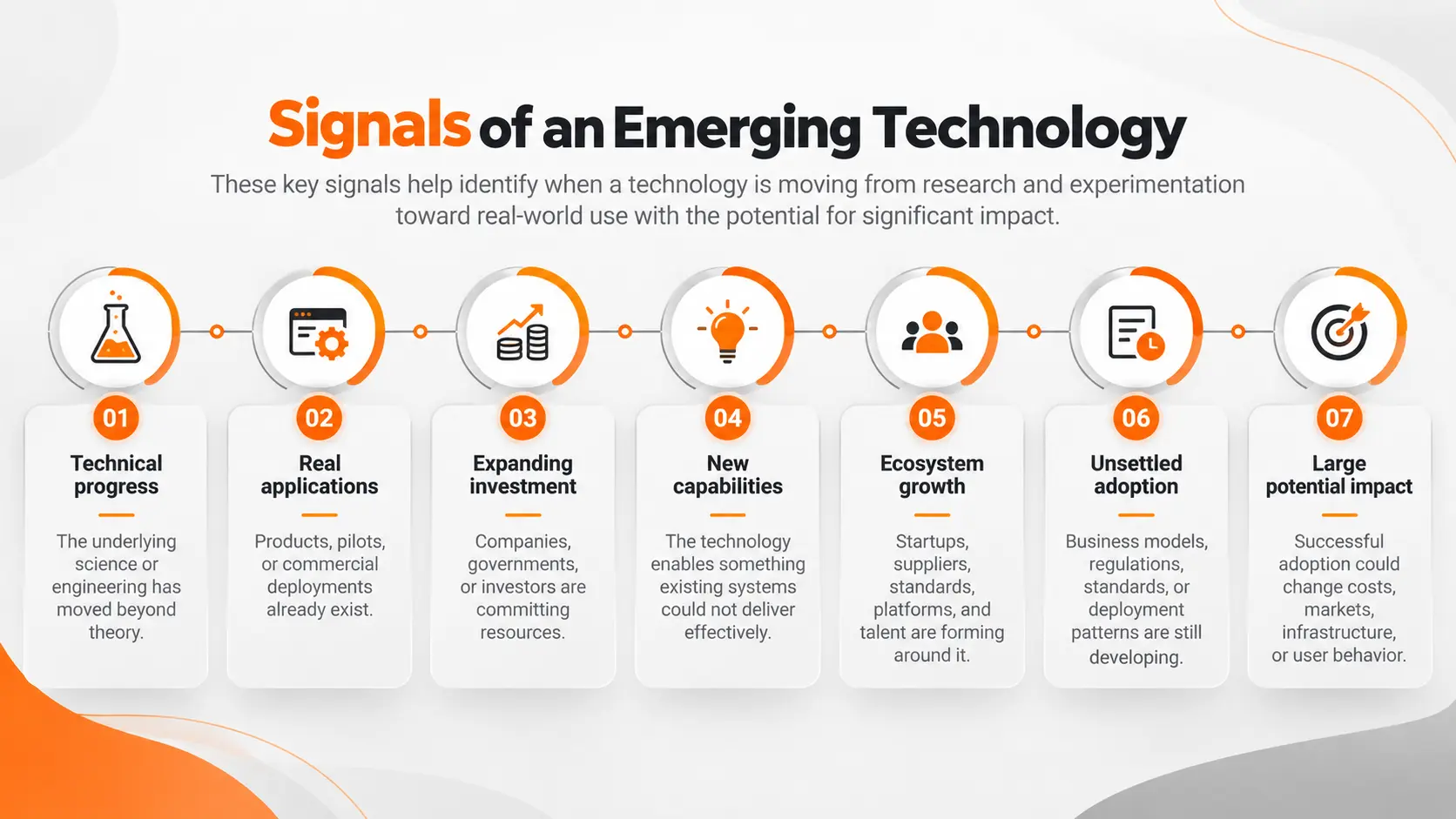
I use those ideas as a practical filter. A technology belongs in the emerging category when several of these signals appear together:
A new app feature does not become an emerging technology because it launched this year. A breakthrough in computing, biology, materials, energy, robotics, or digital infrastructure can qualify when it begins opening an entirely new set of capabilities.
That is the distinction I keep in mind when following Future Technology Trends. The useful signal is not novelty on its own. It is movement toward practical impact.
Emerging Technology Examples Shaping the Current Landscape
The emerging technology landscape extends far beyond artificial intelligence.
The World Economic Forum's 2026 research highlights technologies across energy, materials, health, cryptography, computing, and biotechnology. Its current list includes everything-to-grid energy, direct lithium extraction, passive radiative cooling materials, PFAS destruction, precision fermentation, exosome drug delivery, personalized mRNA cancer vaccines, quantum simulation for drug discovery, world models, and lattice-based cryptography.
For a broader business view, I group the most important areas into these technology families:
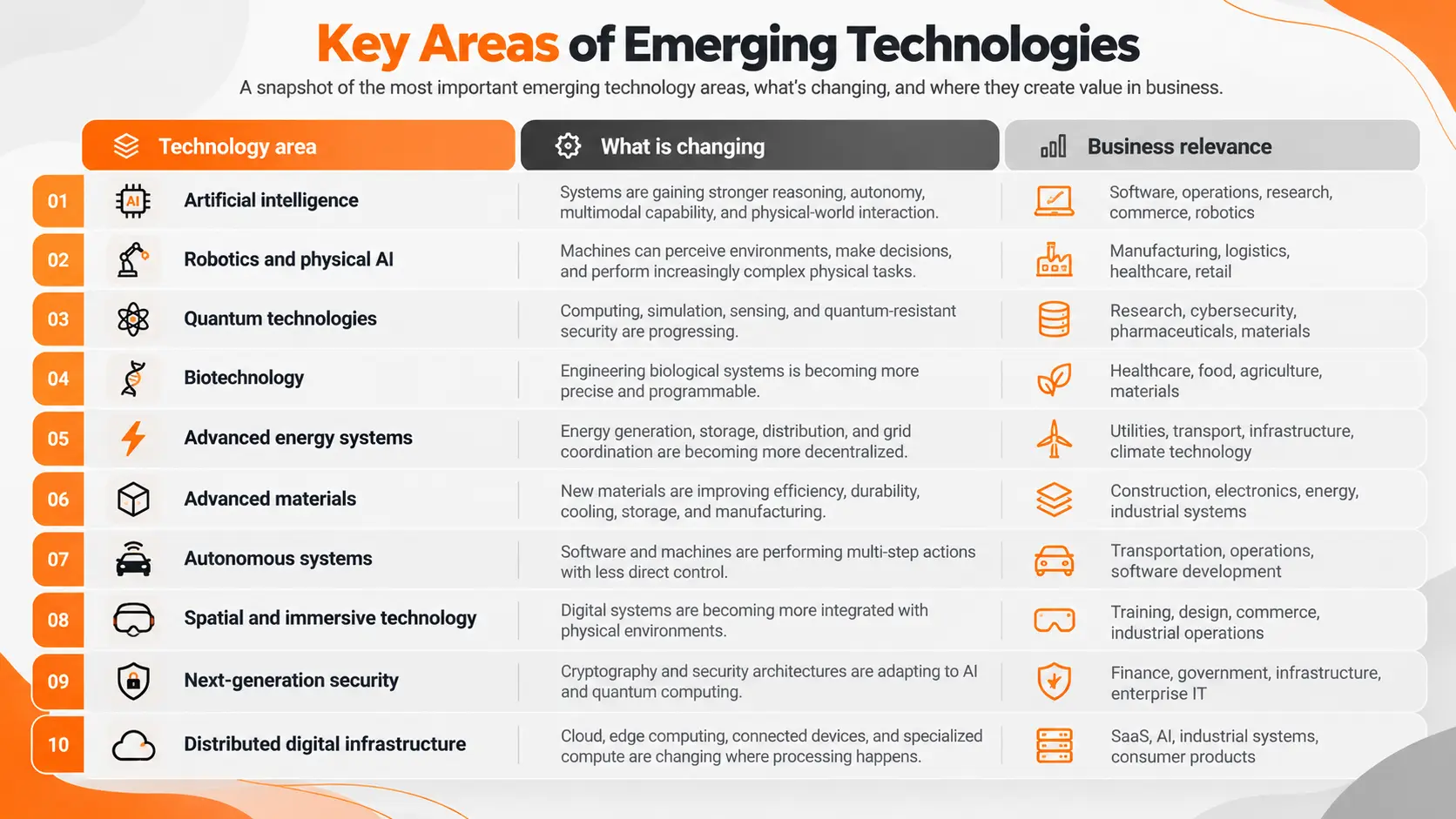
This broader view is important. Emerging technology is not one industry. It is a layer of technical change that cuts across many industries at once.
Artificial Intelligence Beyond the Chatbot Era
AI remains one of the most important forces shaping the emerging technology landscape, but the direction has changed.
The first wave of mainstream generative AI centered on creating text, images, code, and other digital content. The next phase is moving toward systems that plan, execute actions, coordinate with other agents, interact with physical environments, and participate directly in business processes.
Forrester's 2026 emerging technology research reflects this shift. Its list includes agentic commerce, frontier AI models, multiagent systems, agentic software development, physical AI and robotics, AI supercomputing, and autonomous transportation technologies.
For me, that shift changes the business question. The useful question is no longer whether a company should “use AI.” The useful question is which workflows, products, decisions, or physical processes improve when intelligence becomes embedded directly into them.
That is also why AI now connects closely with robotics, cybersecurity, scientific discovery, cloud infrastructure, chips, energy systems, and automation rather than remaining a separate software category.
Robotics and Physical AI
Robotics becomes much more important when intelligence leaves the screen.
Traditional industrial robots excel at structured and repetitive tasks. Physical AI combines sensing, machine learning, computer vision, planning, and robotics so machines can interpret an environment and respond to changing conditions.
The business impact reaches beyond factories. Warehousing, transport, agriculture, healthcare, construction, retail, and field operations all contain physical workflows where software alone cannot complete the job.
McKinsey's 2026 technology outlook describes this broader movement as technology shifting from the screen into the physical world, with intelligent robots, AI infrastructure, advanced energy systems, and scientific discovery becoming closely connected.
I see this convergence as more important than any individual robot product. Once intelligence, sensors, compute, and machines work as one system, industries built around physical work start gaining the same kind of software leverage that transformed digital businesses.
Quantum Computing and Post-Quantum Security
Quantum technology deserves attention for two separate reasons.
The first is computing. Quantum systems are being developed to solve specific classes of problems that are difficult for classical computing, including molecular simulation, materials research, optimization, and scientific discovery.
The second is security. A sufficiently capable quantum computer would change the assumptions behind widely used public-key cryptography. This is why post-quantum cryptography has already moved from research into infrastructure planning.
NIST finalized its first post-quantum cryptography standards in 2024, and the World Economic Forum lists lattice-based cryptography among its top emerging technologies for 2026.
This is a useful lesson in emerging technology: commercial relevance can begin before the headline technology itself reaches full maturity. Organizations holding sensitive information for long periods already have a reason to consider the security implications of future quantum capability.
Biotechnology and Programmable Biology
One of the most important shifts outside computing is the increasing ability to design and engineer biological processes.
Precision fermentation uses microorganisms to produce specific proteins, fats, and molecules. Personalized mRNA cancer vaccines use information from an individual patient's tumor to help train an immune response. Exosome-based systems are being developed to transport therapeutic material through the body.
These are very different applications, but the underlying pattern is similar: biology is becoming more measurable, model-driven, and engineerable.
The OECD includes synthetic biology and neurotechnology among the emerging areas it monitors, while the World Economic Forum's 2026 list gives substantial space to biotechnology and personalized medicine.
This category also shows why Deep Tech Startups Explained matters in the wider technology landscape. Many of the companies building in biotechnology, advanced materials, quantum systems, and energy technology operate on longer research cycles and require technical validation before they reach the scaling patterns associated with software startups.
Energy, Climate, and Advanced Materials
Some of the most consequential emerging technologies are almost invisible to end users.
Everything-to-grid systems turn electric vehicles, batteries, buildings, and connected devices into active parts of the electricity network. Direct lithium extraction changes how an essential battery material can be recovered. Passive radiative cooling materials can reduce heat without consuming electricity.
These technologies matter because digital growth now depends heavily on physical infrastructure. AI requires compute. Compute requires chips, data centers, cooling, electricity, and reliable grids.
McKinsey reported that energy technologies attracted close to $200 billion in investment during 2025, while spending on AI infrastructure doubled in one year.
The connection between software and energy is no longer indirect. The next phase of computing depends on improvements in the physical systems underneath it.
Cloud, Edge, and the New Computing Infrastructure
Cloud computing itself is no longer an emerging technology, but what is being built on top of and around cloud infrastructure continues to change quickly.
AI workloads demand specialized accelerators, enormous data movement, high-performance networking, distributed inference, and closer coordination between cloud and edge systems. Products that depend on real-time physical interaction also need computing closer to users, machines, or sensors.
That creates a different environment for Cloud Technology Startups. The opportunity is shifting from simply moving software to the cloud toward building infrastructure for AI workloads, distributed systems, data pipelines, security, developer tooling, and specialized compute.
This distinction matters because mature technology can become the foundation for a new emerging layer without becoming “emerging” again itself.
Blockchain Beyond Speculation
Blockchain is another technology where separating the infrastructure from the hype produces a clearer picture.
Public attention focused heavily on crypto assets, but distributed ledgers also created a set of technical building blocks for programmable ownership, digital settlement, asset tokenization, decentralized coordination, and verifiable records.
The strongest Blockchain Business Applications depend on whether a distributed system solves a real coordination or trust problem better than a conventional database. If one organization already controls the data, users, permissions, and rules, blockchain adds complexity without creating a new capability.
That makes business fit more important than the technology label.
Automation Moving From Rules to Intelligence
Automation has existed for decades. The emerging layer is the movement from predefined rules toward systems capable of interpreting information, making bounded decisions, and completing more complex sequences of work.
Traditional automation follows a specified path. Intelligent automation can work with unstructured inputs, route work based on context, interact with software, and adapt the next action to the information it receives.
This shift is visible across Automation Technology Trends because AI agents, computer vision, robotics, workflow software, and enterprise systems are becoming part of the same automation stack.
For businesses, the most valuable automation opportunities sit inside repeatable processes with clear outcomes. Technology becomes useful when it removes a real operational constraint rather than adding another system for teams to manage.
Emerging Technology vs New, Frontier, and Disruptive Technology
These terms appear together, but they do not mean the same thing.
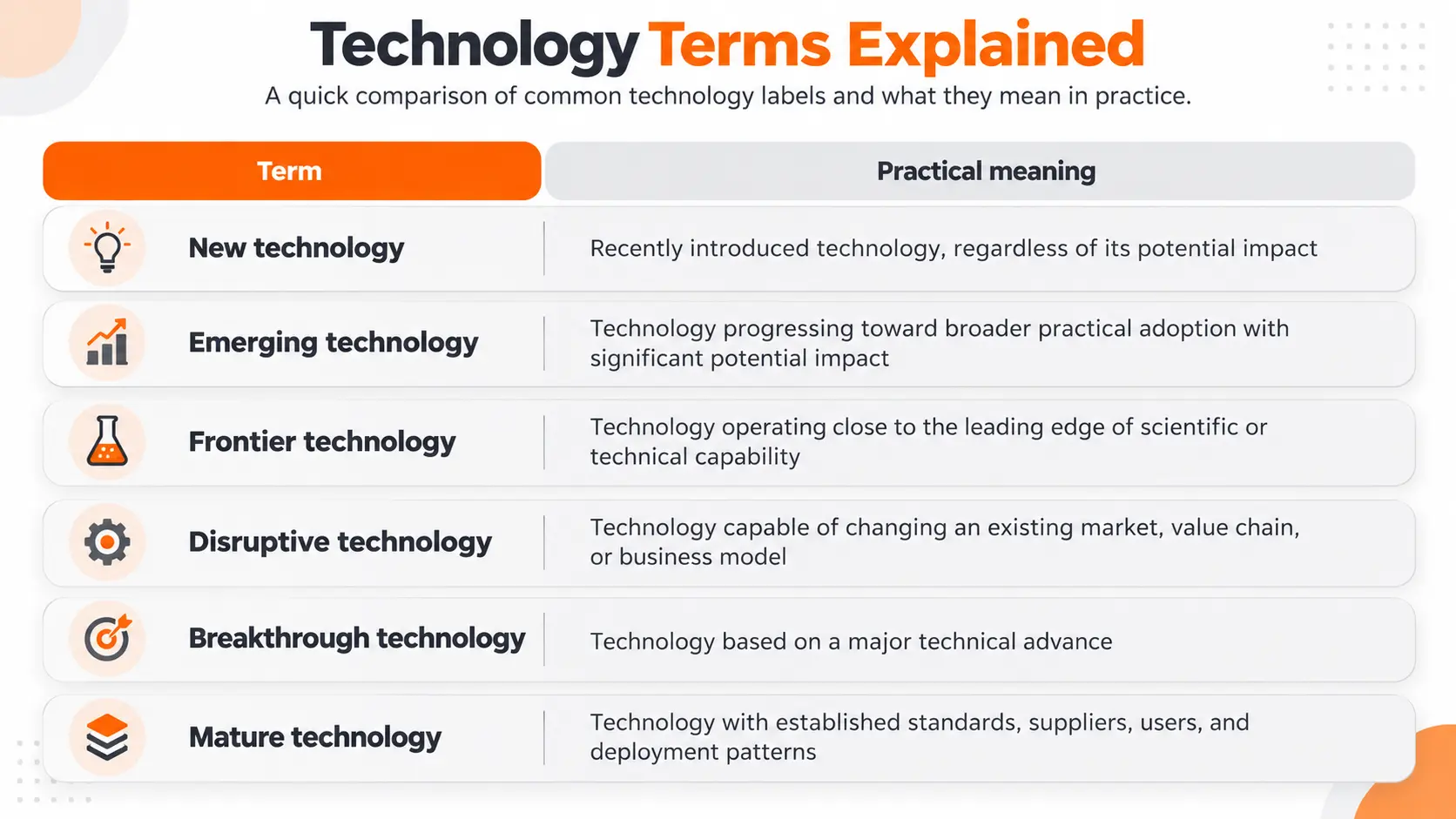
An emerging technology can become disruptive, but disruption is an outcome rather than a requirement.
A frontier technology can remain inside laboratories for years before reaching the point where businesses can use it.
This is why I avoid treating every technology buzzword as interchangeable. The stage of development tells us much more than the label.
How Emerging Technologies Move Into the Mainstream
Technologies do not move directly from invention to mass adoption.
The path looks more like this:
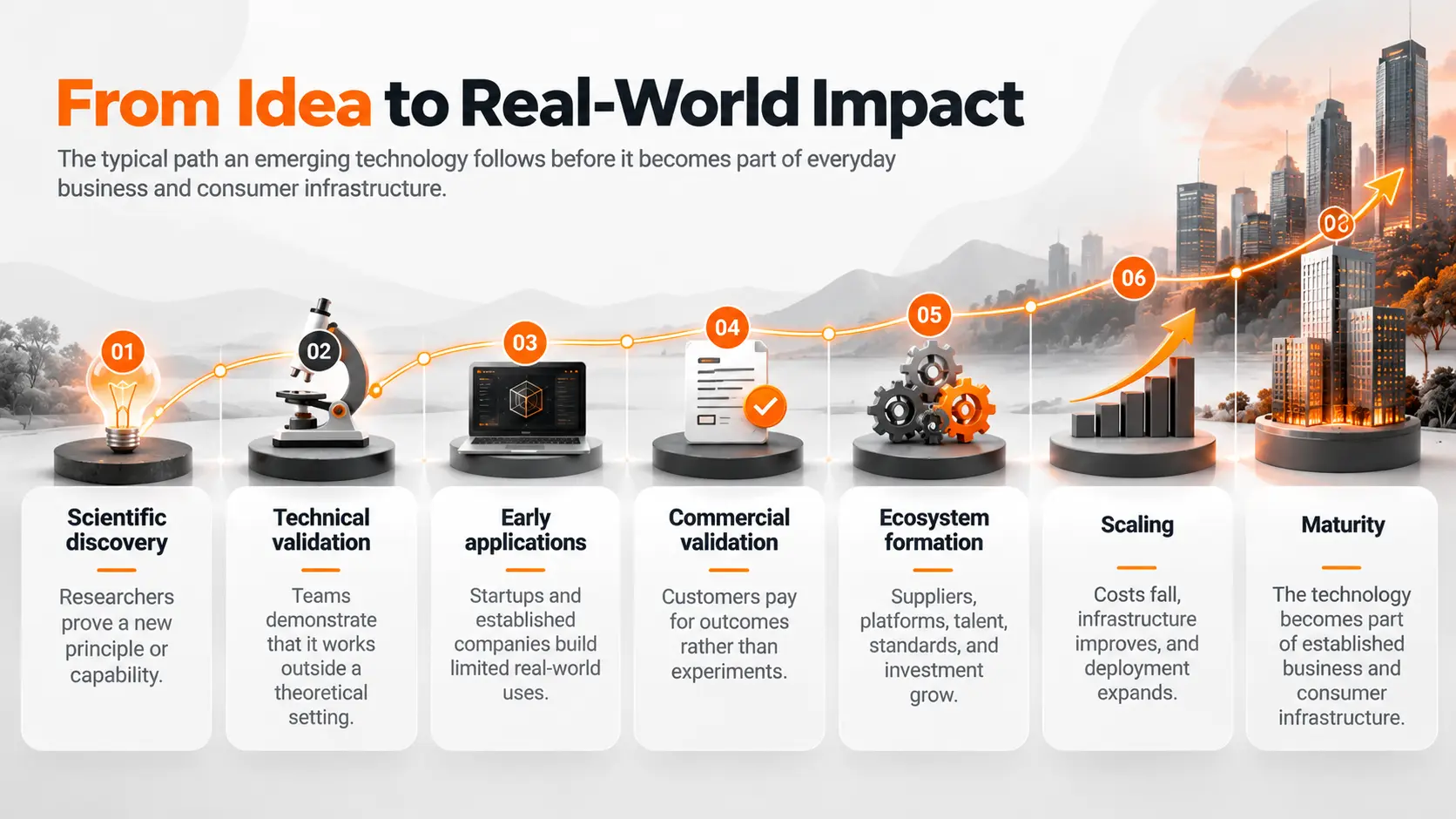
The technology becomes part of established business and consumer infrastructure
The interesting point is the middle of this path.
Too early, and the technology lacks practical infrastructure. Too late, and the strategic advantage from early understanding has already narrowed.
This is where following Technology Innovation Trends becomes useful. The goal is not to predict which invention will dominate the future. It is to identify evidence that a technology is moving from technical possibility toward repeatable economic value.
Emerging Technologies and Business Value
Businesses do not benefit from emerging technology by collecting more tools.
They benefit when a new capability changes the economics of a real activity.
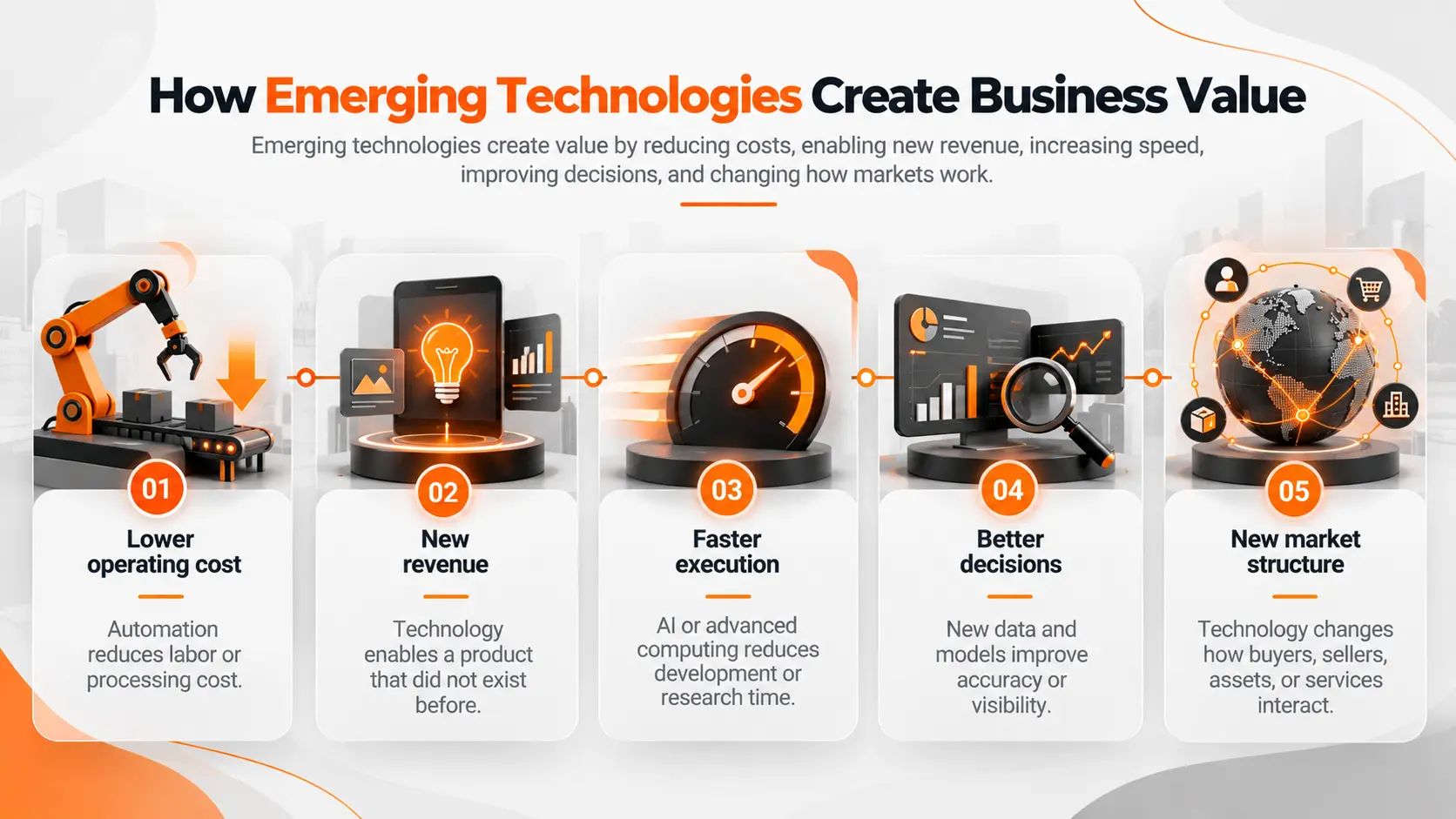
When I review Technology Trends for Businesses, I look at five forms of value first:
Lower operating costs
New revenue opportunities
Faster execution
Better decision making
Changes to existing market structures
New market structure
Technology changes how buyers, sellers, assets, or services interact
This is also where technology evaluation becomes much more disciplined.
A fascinating technology with no relevant business problem is not a strategic priority. A less exciting technology that removes an expensive constraint deserves far more attention.
Evaluating an Emerging Technology Before Adoption
I use a business-first evaluation rather than starting with technical features.
Problem fit
Define the exact problem before looking at vendors or platforms. If the problem is vague, the technology decision will be vague as well.
Capability advantage
Identify what the technology makes possible that the existing approach cannot deliver at an acceptable cost, speed, quality, or scale.
Technical maturity
Check whether the capability exists in working deployments rather than demonstrations alone.
Economic maturity
A technology can work technically and still fail economically. Infrastructure costs, integration, specialist talent, maintenance, and vendor dependence all matter.
Integration
The new system has to work with the company's existing data, processes, security requirements, and technology architecture.
Skills
The organization needs people who can implement, operate, evaluate, and govern the technology.
Risk
Security, privacy, regulation, safety, vendor dependence, intellectual property, and operational resilience belong in the decision from the beginning.
Measurable value
Define the result before deployment. Cost saved, cycle time reduced, conversion increased, defects removed, revenue created, or another measurable outcome should determine whether the project continues.
This is also the point where a Digital Transformation Guide becomes more useful than a list of technology predictions. Adoption succeeds when technology, workflows, people, data, and business goals change together.
Forrester takes a similar business-centered view, arguing that organizations should evaluate emerging technology according to business value, maturity, organizational readiness, skills, architecture, and risk instead of chasing technology for its own sake.
Separating Real Technology Shifts From Hype
Hype is not evidence of adoption.
The signals I trust are harder to manufacture:
Working deployments: Real organizations use the technology outside a controlled demonstration.
Paying customers: Buyers spend money because the capability solves a defined problem.
Improving economics: Cost, speed, reliability, or performance moves toward practical deployment.
Growing infrastructure: Developers, suppliers, standards, platforms, and skilled workers form around the technology.
Repeatable use cases: The same capability creates value across more than one isolated experiment.
Institutional commitment: Companies, research institutions, regulators, and governments start planning around the technology.
Technical convergence: Other technologies make the capability stronger or easier to deploy.
That last signal has become especially important.
The World Economic Forum has highlighted technology convergence as a major source of new business value. AI now combines with materials science, biotechnology, robotics, energy systems, sensors, and other technologies instead of advancing in isolation.
The next major technology company may not come from one breakthrough. It may come from combining several technologies that have reached useful levels of maturity at the same time.
Emerging Technologies for Startups
Startups have an advantage when a technology creates a new market before established operating models have solidified.
A startup does not need to invent the underlying science. It can build the product layer, infrastructure, workflow, distribution, data system, or specialized application that turns a technical capability into something customers can use.
The strongest opportunities appear where three elements meet:
A technical capability has improved enough to work.
An expensive or unresolved customer problem already exists.
Incumbent products were designed around the limitations of older technology.
This is why I pay more attention to market timing than technical novelty.
A startup arriving before infrastructure exists burns capital educating the market. A startup arriving after the category matures competes against established platforms. The attractive window opens when technology is usable but the market structure is still being formed.
Risks Behind Emerging Technologies
Emerging technology creates new capability and new exposure at the same time.
The OECD identifies privacy, security, equity, human rights, and governance among the issues that need to be considered as emerging technologies develop. It also argues for anticipating risk while technologies are being shaped rather than responding only after deployment.
For a business, the risk picture is broader:
Investment arrives before commercial value is proven
Responsible adoption does not mean avoiding emerging technology. It means matching the level of commitment to the strength of the evidence.
Tracking Emerging Technologies Without Chasing Every Trend
I would not build a technology strategy around a yearly “top ten” list.
Lists are useful for discovery. Decisions need stronger evidence.
I track four layers instead:
Research: Watch where scientific capability is advancing.
Commercial activity: Follow startups, enterprise deployments, partnerships, and customer adoption.
Infrastructure: Look for platforms, standards, talent, compute, supply chains, and supporting services.
Economics: Track whether the cost of using the technology is moving toward sustainable business value.
This approach also makes Technology Innovation Trends more useful because it turns a stream of announcements into evidence about maturity.
The same principle applies to the Future of Technology. The important story is not which gadget appears next. It is which capabilities become cheap, reliable, accessible, and integrated enough to change how people and companies operate.
Where Emerging Technology Is Heading
The strongest pattern I see is convergence.
AI is combining with robotics. AI and quantum computing are entering scientific research. Advanced materials connect with energy systems. Biotechnology increasingly depends on computation. Cloud infrastructure connects with specialized chips, edge systems, and physical devices.
McKinsey's 2026 outlook divides major technology shifts into AI, compute and connectivity, and cutting-edge engineering, while noting that the boundaries between them are increasingly blurred.
This makes the next wave of emerging technology harder to understand through isolated categories.
A company does not need to predict every breakthrough. It needs to understand which new capabilities could change the economics of its market, which ones are becoming commercially usable, and which ones deserve investment now.
That is the practical value of studying emerging technologies: not predicting the future, but recognizing meaningful change before it becomes ordinary.
FAQ
How long does a technology stay “emerging”?
There is no fixed number of years. The label becomes less useful once deployment patterns, standards, suppliers, economics, and customer expectations are established enough for the technology to function as a mature market.
Does an emerging technology have to be brand new?
No. A technology can exist in research for years before technical or economic changes make broader deployment possible. The relevant point is the transition toward meaningful application, not the date of invention.
Can an old technology become important again because of AI?
Yes. AI can materially change the capability or economics of an established technology. The original technology does not become new, but the combined system can create a new technology category or market.
Is Web3 still an emerging technology?
Web3 is too broad to classify as one technology. Individual components such as decentralized identity, tokenization infrastructure, smart-contract platforms, or specific cryptographic systems need to be evaluated separately according to adoption, maturity, and commercial use.
Do small companies need a dedicated emerging-tech team?
No. A smaller company can assign technology scanning to product, engineering, strategy, or leadership. The important requirement is clear ownership of evaluation and a process for turning useful findings into controlled experiments.
How do I check whether a vendor's “emerging technology” claim is real?
Ask for deployed customer references, measurable outcomes, technical limitations, total implementation cost, security documentation, integration requirements, and evidence of performance under real operating conditions.
Is being an early adopter always an advantage?
No. Early adoption creates an advantage only when the value gained exceeds the technical, financial, operational, and market risks created by immature technology.
Should a startup build its core product on technology controlled by one provider?
It should do so only after evaluating switching costs, pricing power, data portability, contractual protections, technical alternatives, and the impact of a provider changing access to the underlying capability.
Can regulation actually help an emerging technology grow?
Yes. Clear standards, certification processes, liability rules, and market requirements can reduce uncertainty and give businesses a more stable environment for investment and adoption.
What's the best way to know when an emerging technology is ready for my company?
Set measurable technical and business requirements before testing it. Run a limited deployment against those requirements and expand only when the results justify the additional cost, integration, and operational exposure.

Fatemeh Jahangard
Technology & AI Writer at PinerookFatemeh Jahangard covers AI, emerging technologies, and digital innovation for Pinerook, focusing on how technology shapes startups and industries.
 Seen first.