Blockchain has a clear business role when several parties need to share, verify, and act on the same records without giving one participant complete control over those records. That is where I find it useful: supply chains, payments, asset ownership, contract execution, identity, settlement, and other multi-party processes.
I do not treat blockchain as a replacement for every database. I treat it as one part of the broader emerging technologies landscape and judge it by a stricter standard: does a shared ledger solve a real coordination, verification, or ownership problem better than the existing system?
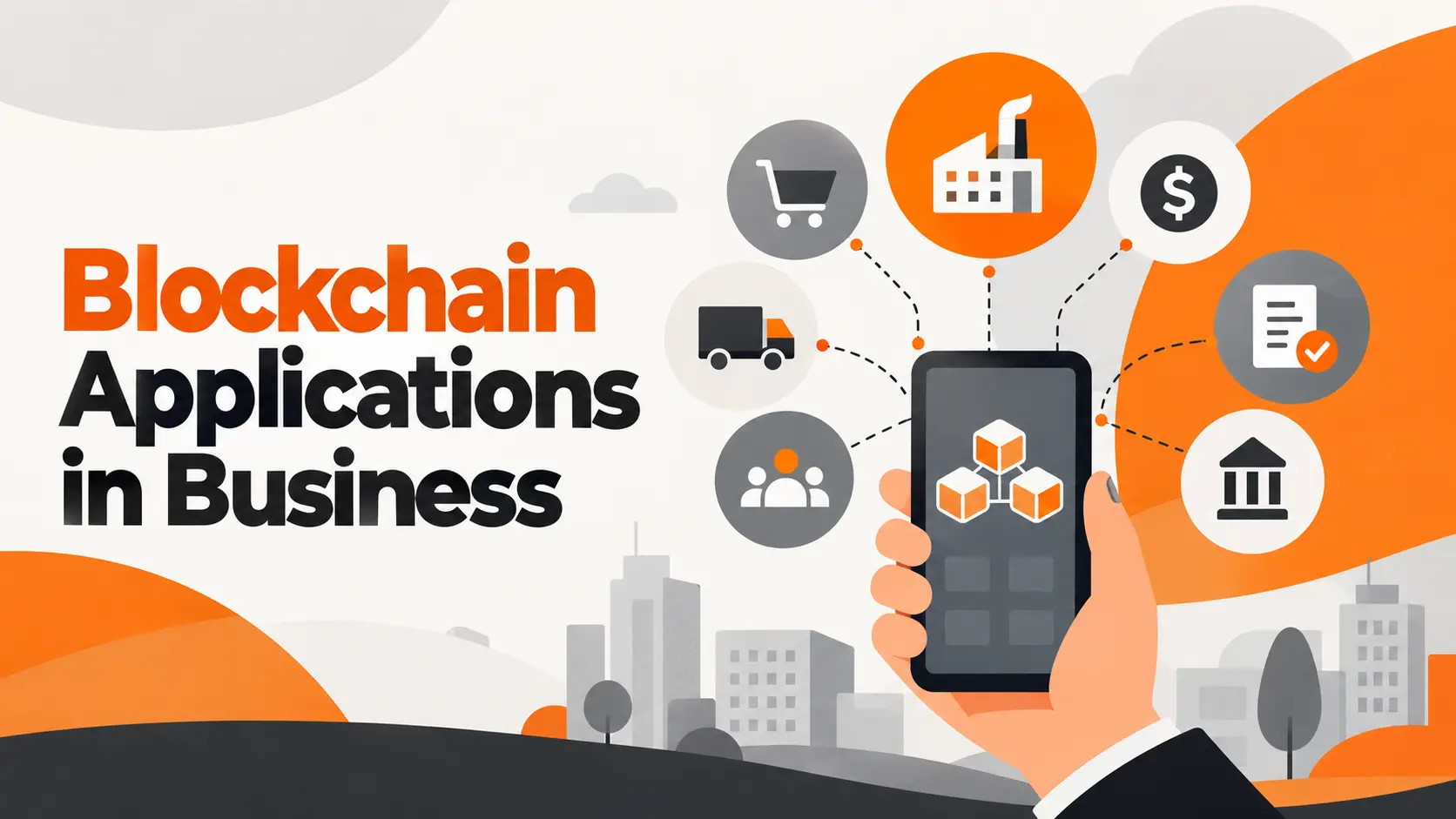
Blockchain Applications in Business
These are the applications I see creating the clearest business value.
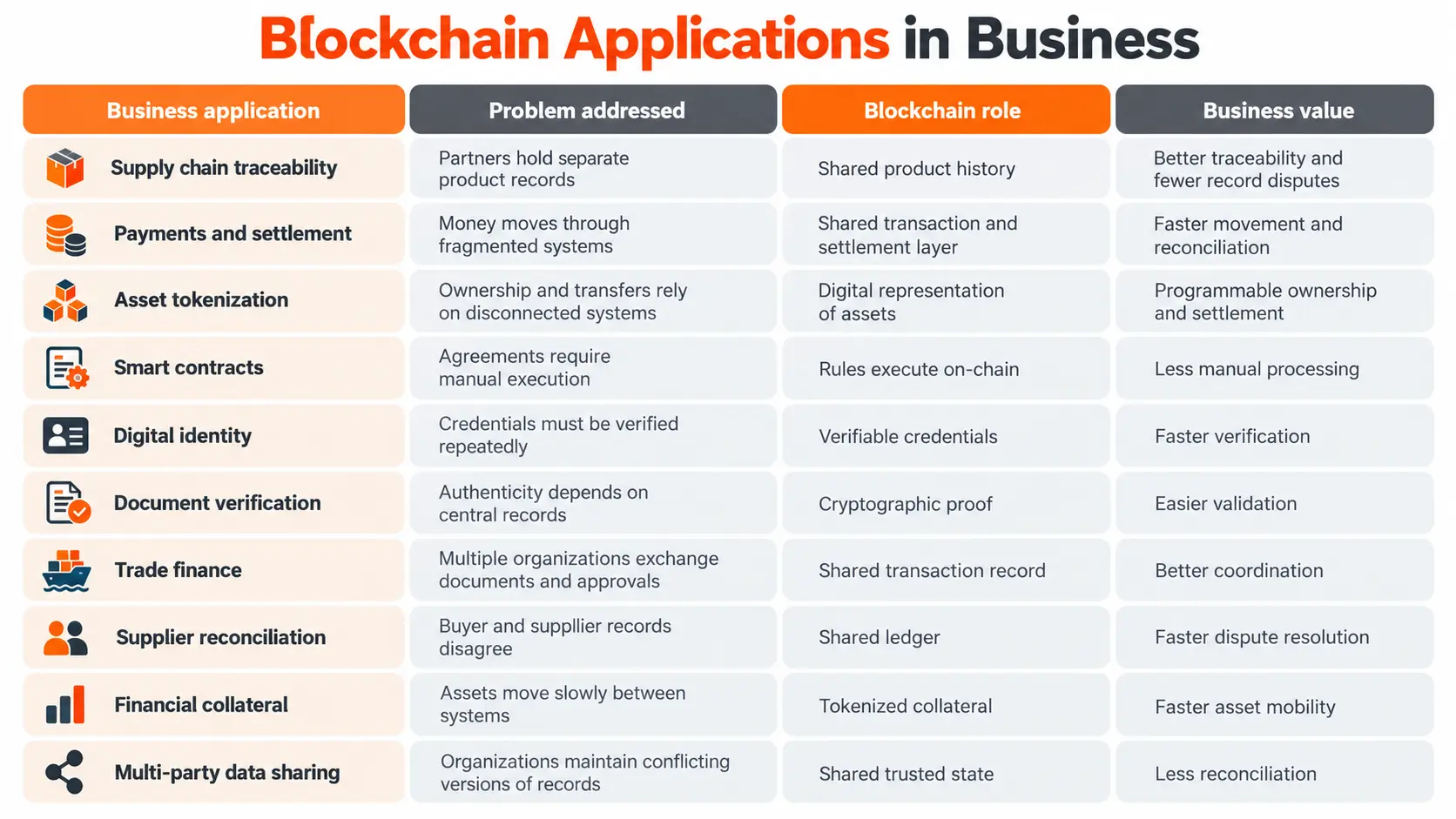
The common thread is not cryptocurrency. It is coordination between parties that maintain separate systems.
IBM describes enterprise blockchain in similar terms: permissioned participants share access to the same ledger, while consensus, replication, immutability, and controlled access create a common transaction record.
Supply Chain Traceability
Supply chains are one of the clearest places where blockchain solves a structural problem.
A manufacturer, supplier, freight company, warehouse, retailer, and regulator can all hold information about the same product. When those records sit in separate systems, confirming what happened requires reconciliation between organizations.
Blockchain gives authorized participants a shared transaction history.
For me, the value is not simply “transparency.” The practical value appears in specific tasks:
proving where a product originated
recording ownership changes
confirming shipment events
tracking certifications
verifying product conditions
resolving supplier disputes
identifying discrepancies between shipped and received goods
EY's OpsChain Traceability platform reflects this model. It uses blockchain and digital representations of physical goods to track information such as location, ownership, and storage conditions across supply-chain networks.
IBM also documents The Home Depot's use of blockchain to give the retailer and participating suppliers visibility into shipment and receiving records. The purpose was straightforward: both parties could work from the same transaction data when resolving discrepancies.
That is a strong blockchain use case because the problem exists between companies, not inside one company's database.
Payments and Settlement
Payments become more complicated when money moves across institutions, currencies, markets, and operating hours.
Blockchain changes the structure by allowing value and transaction instructions to exist on shared programmable infrastructure.
The strongest business applications include:
cross border fund movements
institutional settlement
treasury transfers
delivery versus payment
programmable payments
collateral transfers
tokenized deposits
transaction reconciliation
This is no longer limited to proof of concept work.
Kinexys by J.P. Morgan reported in August 2026 that its blockchain business had processed more than $4 trillion in transactions since inception and averaged $7 billion per day. Its infrastructure supports areas including payments, tokenization, settlement, and collateral management.
I consider this one of the clearest signs that enterprise blockchain has moved beyond the original crypto narrative. The value here is operational: assets and money move through shared digital infrastructure instead of relying entirely on sequences of disconnected records.
Asset Tokenization
Tokenization is one of the business applications I would watch most closely.
A token represents rights to an asset on a blockchain. The underlying asset could be a fund interest, security, cash instrument, collateral position, or another financial asset.
The useful part is not turning everything into a token. The useful part is making ownership programmable and transferable on the same infrastructure used for settlement.
That creates applications such as:
tokenized investment funds
digital securities
on-chain collateral
tokenized deposits
programmable ownership
automated asset servicing
faster transfer of financial assets
J.P. Morgan's current tokenization infrastructure supports issuance, transfer, management, settlement, and on-chain use of assets. The company also launched infrastructure supporting tokenized money market funds in 2026.
Its 2026 payments outlook identifies tokenized cash, deposits, securities, money market funds, and collateral as active business use cases for blockchain-based assets.
From a business perspective, this matters because ownership, settlement, and automation start becoming parts of the same digital process.
Smart Contracts and Process Automation
A smart contract is code that executes predefined rules on a blockchain.
I find smart contracts useful when the business process already has clearly defined conditions.
For example:
Condition: goods are confirmed as received.
Action: update the settlement state.
Or:
Condition: ownership transfers.
Action: record the new owner and trigger the related transaction.
This reduces manual coordination between systems.
Smart contracts fit processes such as:
settlement instructions
escrow
asset transfers
capital events
supplier agreements
fund operations
insurance workflows
compliance conditions
J.P. Morgan's Fund Flow provides a current example. The blockchain-based system handles fund lifecycle processes on a shared ledger and automates areas such as capital calls, transaction records, and investor data that otherwise require reconciliation across separate systems.
The limitation is just as important: automating a weak business process does not make the process better. The rules, responsibilities, data, and exceptions need to be defined before they are encoded.
Supplier Reconciliation and Dispute Resolution
Reconciliation rarely receives the same attention as tokenization, but from an operational perspective it is one of blockchain's most practical applications.
Imagine a retailer records:
950 units received.
The supplier records:
1,000 units shipped.
Both companies now investigate their own systems, emails, invoices, warehouse records, and shipping information.
A shared ledger changes the workflow because both parties work from synchronized transaction events.
The Home Depot case documented by IBM is useful here. Blockchain was introduced to improve real-time visibility between the retailer and vendors and help identify where transaction discrepancies originated.
This is the kind of application I consider stronger than vague claims about decentralization. The problem is concrete, the participants are clear, and the operational outcome can be measured.
Trade Finance
Trade finance involves exporters, importers, banks, insurers, logistics providers, customs authorities, and documents moving between them.
That makes it a natural multi-party environment.
Blockchain supports this workflow by giving participating organizations access to a common transaction state instead of requiring each one to reconstruct that state independently.
Applications include:
document verification
transaction status
financing records
ownership records
automated conditions
settlement coordination
The value comes from reducing the gap between what one organization believes happened and what another organization's system records.
For me, that is the central enterprise blockchain problem.
Digital Identity and Credentials
Businesses verify the same types of information repeatedly:
employment credentials, professional qualifications, customer identity, supplier status, certifications, licenses, and authorization.
Blockchain-based identity systems separate the credential from the database of the organization requesting it.
A credential issuer signs the credential. The holder presents it. The receiving organization verifies its authenticity cryptographically.
This model supports:
employee credentials
academic qualifications
professional certifications
business identity
customer verification
supplier credentials
The World Economic Forum has documented decentralized digital identity systems where credentials remain with the user while blockchain infrastructure supports verification of the credential issuer and its cryptographic proof.
The business value is not putting personal information on a public blockchain. The value is verifying a claim without rebuilding the entire trust process each time.
Document and Record Verification
Some records matter because businesses need to prove they have not been altered.
Examples include:
certificates
compliance records
transaction proofs
ownership records
audit events
intellectual property records
product certifications
Blockchain creates a timestamped record that lets another party verify whether the information presented matches the registered state.
I would not place large confidential documents directly on-chain. A stronger architecture stores sensitive information in the appropriate private system and uses blockchain to anchor the proof, identifier, ownership state, or transaction record.
This keeps the blockchain focused on verification rather than turning it into an expensive document store.
Blockchain vs Traditional Databases
This is the decision I would make before starting any blockchain project.
A traditional database is not the weaker option. In many business systems, it is the correct option.
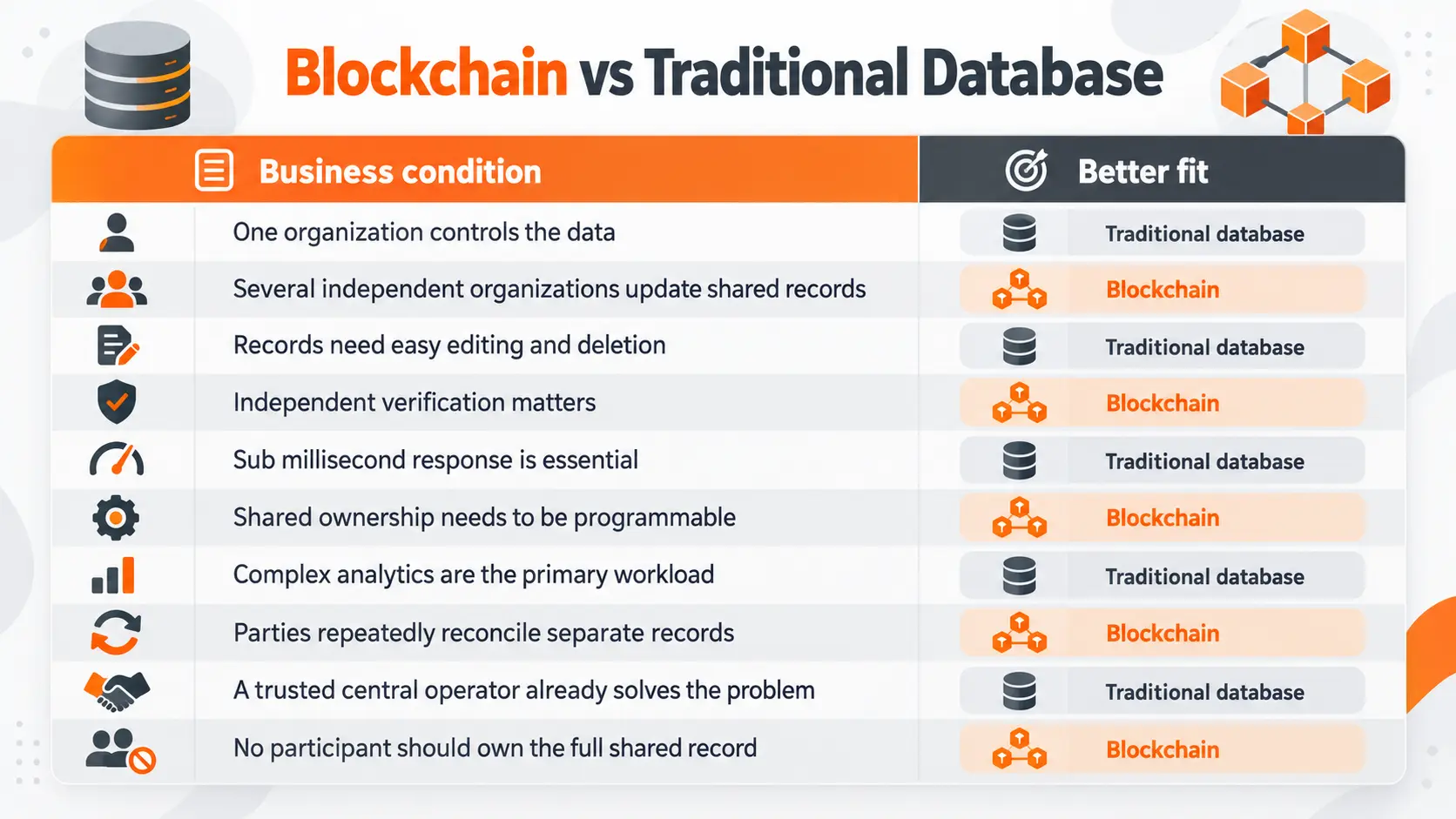
If one trusted organization can maintain the record efficiently, I start with a conventional database.
Blockchain earns its complexity when multiple parties need the same trusted state and central ownership creates friction, dependency, or reconciliation work.
A 2026 comparison of blockchain and conventional database architectures reaches the same core distinction: centralized databases fit single-owner and high-throughput systems, while blockchain becomes relevant when independent organizations require a shared verifiable record.
Enterprise Blockchain Architecture
Business blockchain does not mean every company needs to publish its operations on a public network.
Enterprise systems use several architectures.
Public Blockchain
Anyone can verify activity according to the network's rules.
This model fits applications that benefit from open digital assets, public settlement infrastructure, or broad interoperability.
Permissioned Blockchain
Participation and access are restricted to approved organizations.
This suits industries where businesses need shared infrastructure while controlling identity, privacy, and access.
Hybrid Architecture
The blockchain records the parts of the process that require shared verification while conventional databases handle private data, search, analytics, customer interfaces, and high-volume internal operations.
This is the architecture I find most practical for enterprise systems.
Blockchain does not need to contain everything. It needs to contain the shared state that participants need to trust.
Business Value From Blockchain
When I evaluate a blockchain application, I look for measurable changes in the operating model.
Less Reconciliation
A shared record reduces the need to compare different versions of the same transaction.
Faster Verification
Participants verify records against the shared system instead of requesting confirmation from another party.
Programmable Transactions
Smart contracts connect agreed rules directly to transaction execution.
Better Traceability
Assets, products, or transaction states retain a verifiable history across organizations.
New Ownership Models
Tokenization gives businesses a way to represent and transfer ownership digitally.
Stronger Auditability
Transaction histories provide a consistent record for authorized participants.
Research into real business blockchain projects has found an important gap between theoretical use cases and applications that companies actually adopt. That is why I focus on demonstrated operational value rather than lists of possible blockchain uses.
Blockchain Fit by Business Problem
This is the filter I would apply before approving a project.
Blockchain has a strong fit when:
several independent parties participate
each party needs access to the same transaction state
reconciliation creates measurable cost or delay
no single participant should control the complete record
ownership or transaction history needs independent verification
programmable transfers create operational value
Blockchain has a weak fit when:
one company owns the entire process
participants already trust one central database
records require frequent deletion or rewriting
maximum database performance matters more than shared verification
there is no measurable cost caused by trust, reconciliation, or ownership friction
The distinction matters because blockchain adoption creates its own requirements: integration, governance, skills, compliance, security, and operating responsibility.
A 2026 Delphi study on blockchain adoption in business organizations identified automation, efficiency, regulatory support, supply-chain traceability, and trust as important adoption enablers, while integration problems, skills shortages, compliance requirements, supply-chain fragmentation, and key management create barriers. Springer
Implementation Requirements
Once the business case passes the first test, I would resolve six issues before choosing a platform.
Network Participants
Identify every organization that needs to read, write, verify, or approve transactions.
Governance
Define who sets network rules, approves participants, changes smart contracts, resolves disputes, and responds to failures.
On-Chain Data
Decide exactly what belongs on the ledger.
Sensitive commercial and personal information requires a deliberate privacy model.
Integration
The blockchain needs to connect with existing ERP, payment, identity, supply-chain, accounting, or customer systems.
Compliance
Data protection, financial regulation, record retention, identity requirements, and sector rules belong in the design phase.
Success Metric
Define what the deployment is expected to improve.
Examples include:
reconciliation time
settlement time
dispute volume
transaction cost
fraud losses
verification time
manual processing
asset utilization
Without a measurable outcome, there is no reliable way to determine whether blockchain improved the business.
Blockchain Business Applications by Industry
The same underlying technology creates different value across industries.
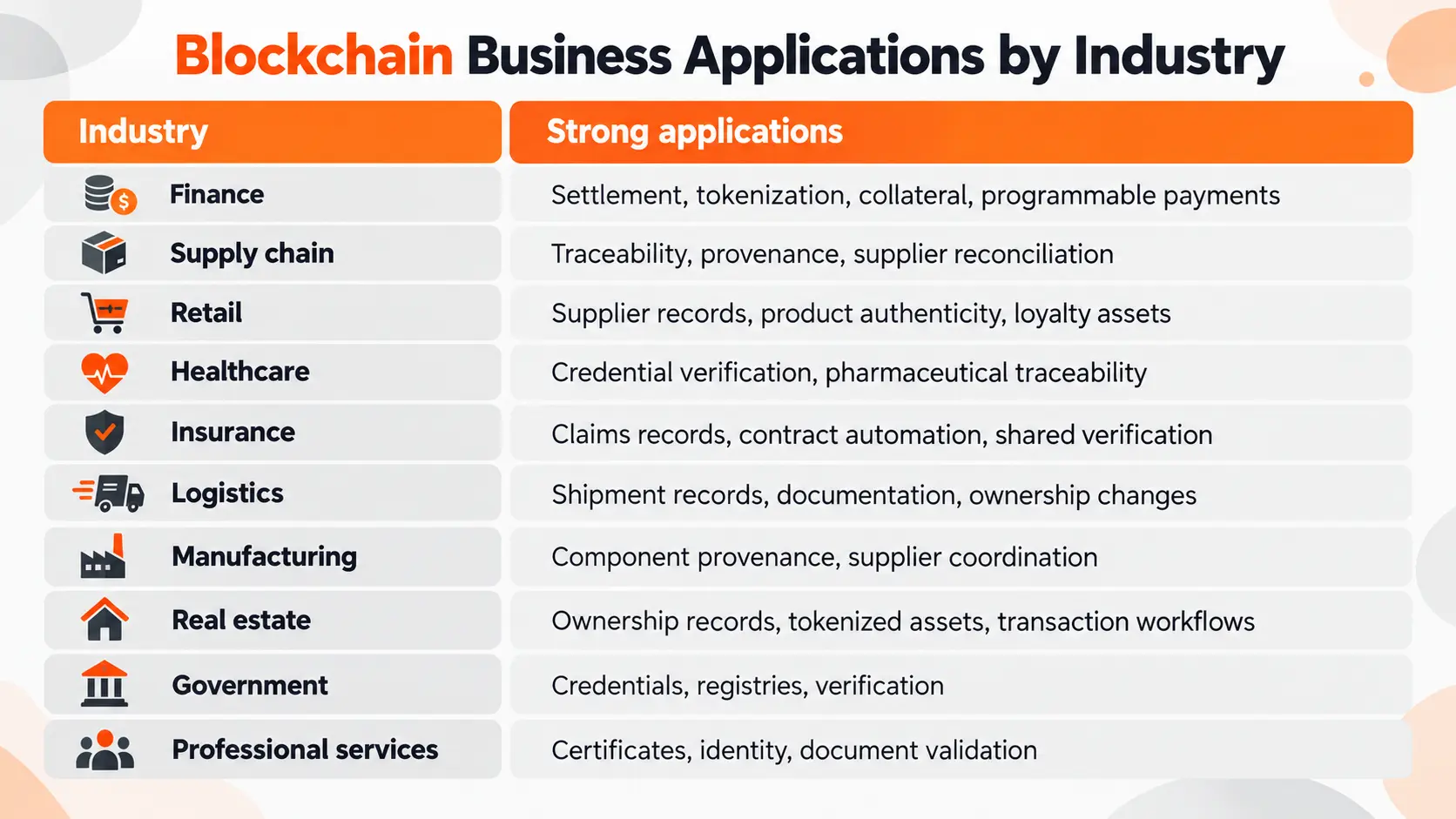
Credentials, registries, verification Professional services
Certificates, identity, document validation
I would not choose blockchain because an industry appears on this table. I would choose it only when the business process contains the multi-party trust problem described earlier.
The Business Case for Blockchain
The most useful change in blockchain over the past few years is that business conversations have become less focused on the word “blockchain” itself.
The strongest projects now start with:
reconciliation, settlement, ownership, traceability, verification, or coordination.
The technology sits underneath.
J.P. Morgan's production blockchain infrastructure illustrates that transition clearly. Its current products are marketed around moving money, mobilizing collateral, tokenizing assets, managing funds, and reducing fragmented processes rather than around blockchain as a novelty.
That is also how I would evaluate the technology inside a startup or established company.
Start with the business problem. Identify the parties involved. Find the trust or coordination gap. Then decide whether blockchain provides a better operating model.
If the answer is yes, blockchain has a business case.
If the answer is no, adding a blockchain only adds architecture.
FAQ
Do I need crypto to use blockchain in my business?
No. Enterprise blockchain applications can operate without exposing the business to cryptocurrencies. Permissioned blockchain networks, tokenized records, credentials, and shared ledgers can function as business infrastructure without requiring speculative crypto assets.
Can customers see everything we put on a blockchain?
No. Visibility depends on the architecture and permissions of the network. Enterprise systems can restrict access to approved participants and keep sensitive information off-chain while recording only the information required for verification.
What happens if we put the wrong data on the blockchain?
Blockchain does not guarantee that input data is accurate. Businesses need validation rules, trusted data sources, correction procedures, and governance for inaccurate submissions. Immutability protects the transaction history; it does not make false information true.
Who pays for running a private blockchain?
The network participants need an agreed operating model. Costs can be carried by one operator, divided between members, included in transaction fees, or funded through another commercial structure defined by the consortium.
Can competitors actually share the same blockchain?
Yes. A permissioned network can give competing companies access to shared transaction information while restricting confidential commercial data. Governance and privacy controls determine what each participant can read or write.

Fatemeh Jahangard
Technology & AI Writer at PinerookFatemeh Jahangard covers AI, emerging technologies, and digital innovation for Pinerook, focusing on how technology shapes startups and industries.
 Seen first.