Automation technology uses hardware, software, control systems, and increasingly AI to complete tasks with little or no continuous human input. It covers far more than factory robots: the same principle runs production lines, processes invoices, monitors IT systems, controls buildings, and coordinates digital workflows.
What interests me most is the shift in what automation can handle. Traditional systems execute predefined rules. Newer systems can interpret information, adapt decisions, and coordinate more complex work. That puts automation at an important intersection of software, machines, and emerging technologies.
Automation Technology Explained
I think of automation technology as the system behind an automated outcome, rather than one specific product.
ISA defines automation as the creation and application of technology used to monitor and control the production and delivery of products and services. AWS takes a broader digital view, describing automation as the use of tools and systems to perform work with minimal human intervention. Together, those definitions capture the modern landscape: automation now spans both physical operations and digital processes.
An automation system needs three basic capabilities:
Observe: receive information about what is happening.
Decide: determine what action should follow.
Act: execute that action.
A fourth capability closes the loop:
Feedback: check the result and use it to control the next action.
The technologies behind those steps depend on the environment.
In a factory, they can include sensors, PLCs, industrial controllers, actuators, robots, and machine-vision systems.
In software, they can include APIs, workflow engines, business rules, RPA bots, AI models, and event triggers.
The architecture changes. The automation principle does not.
How Automation Technology Works
A practical automation flow looks like this:
Input → Decision → Action → Feedback
Consider a production line.
A sensor detects that a part has reached a specific position. The controller receives that information and checks programmed logic. An actuator moves the part to the next station. Sensors then confirm whether the action completed correctly.
Industrial systems connect sensors and actuators to higher-level control systems for exactly this reason. Siemens, for example, describes industrial field systems as connecting sensors and actuators with controllers so physical processes can be monitored and controlled.
The same model works in software.
A customer submits an invoice. Software detects the new document, extracts its data, checks predetermined conditions, routes it for approval, updates the accounting system, and records the outcome.
The automation may happen entirely in software, but the structure remains:
Event → logic → action → result
The biggest change arrives when AI is inserted into the decision layer. Instead of only checking predefined conditions, an automated system can interpret unstructured information, classify it, make predictions, or select an action based on context.
Types of Automation Technology
Automation is easier to understand when the different categories are separated by what they automate.
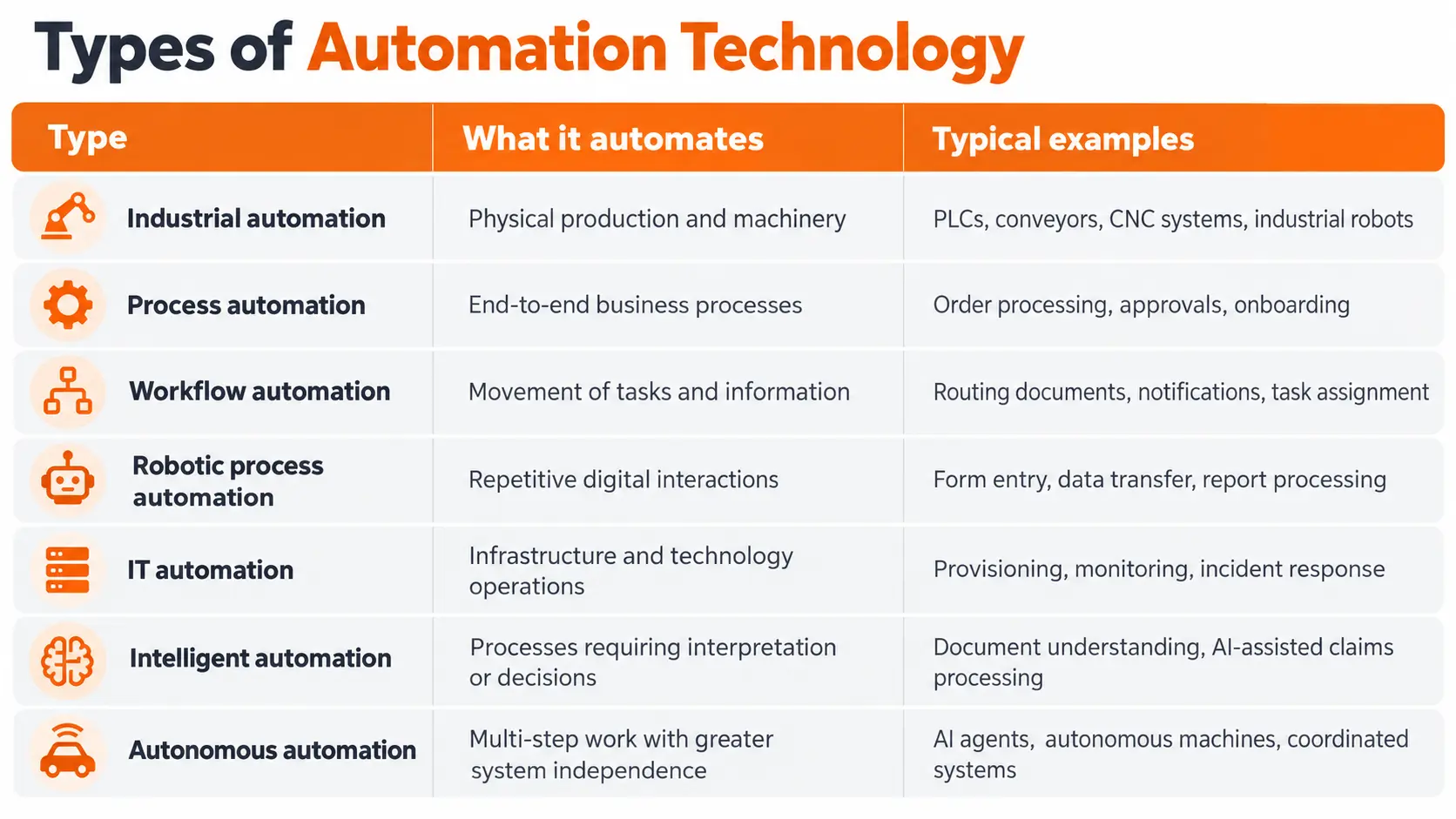
These categories overlap.
A manufacturing system can use industrial automation, AI, workflow software, and predictive analytics at the same time. A financial company can combine RPA with business process automation and AI.
IBM describes intelligent automation specifically as the combination of AI, business process management, and RPA to automate and scale more complex decision-making.
Industrial Automation Technology
Industrial automation controls physical equipment and production processes.
This is the branch most people associate with automation: machines, production lines, robots, sensors, and controllers.
The main components include:
sensors
programmable logic controllers
industrial computers
actuators
drives and motors
machine vision
robotic systems
human-machine interfaces
industrial networks
Rockwell Automation separates manufacturing automation into fixed, programmable, and flexible systems. Fixed automation performs highly repetitive processes with little variation. Programmable automation can be reconfigured for different batches. Flexible automation makes those changes faster and supports greater product variation.
I find that classification more useful than simply calling every automated factory a “smart factory.”
The degree of flexibility matters.
A high-volume production line that makes the same product every day has different automation requirements from a plant producing hundreds of product variations.
Business and Software Automation
Digital automation removes manual work from processes that happen inside software systems.
The strongest candidates are processes that involve:
repeated data entry
predictable routing
document handling
status updates
approvals
system-to-system data transfer
scheduled actions
recurring checks
Business process automation works at the process level rather than simply automating one click.
For example, employee onboarding can involve creating an account, assigning permissions, requesting equipment, sending documents, creating payroll records, and notifying managers.
Automating only the account creation saves one step.
Automating the entire onboarding workflow changes the process.
AWS distinguishes business process automation from RPA in a similar way: RPA completes individual rule-based digital tasks, while BPA coordinates broader workflows across enterprise applications.
That distinction matters because automating isolated tasks does not always improve the full process.
Robotic Process Automation
RPA uses software bots to perform repetitive actions inside digital systems.
A bot can:
copy information between applications
complete forms
extract records
download files
generate reports
trigger predefined actions
Despite the word “robotic,” there is no physical robot involved.
RPA became useful because many enterprise systems were never designed to communicate cleanly with each other. Software bots can interact with their user interfaces in ways similar to a human employee.
I see RPA as a bridge technology.
It solves real integration problems, but it is strongest when the underlying task follows clear rules. Once exceptions become too frequent or information becomes highly unstructured, rule-based automation needs another layer.
That is where intelligent automation starts.
Intelligent Automation
Intelligent automation combines automation with technologies that can interpret information rather than simply follow a fixed sequence.
IBM describes AI as the decision engine inside intelligent automation, while BPM manages workflows and RPA executes digital tasks.
That combination supports tasks such as:
reading documents
classifying incoming requests
detecting anomalies
predicting equipment failures
extracting information from text
selecting workflow routes
assisting customer support
recognizing images
AWS also includes technologies such as natural language processing, generative AI, and optical character recognition in intelligent automation systems.
This moves automation beyond:
If X happens, do Y.
toward:
Understand what happened, decide which action fits, then execute it.
The difference sounds small, but it expands the number of processes that can be automated.
Automation Technology Examples
Real automation becomes easier to understand through specific applications.
Manufacturing
Sensors monitor production conditions while controllers adjust machines. Robots handle welding, assembly, painting, cutting, and material movement.
Logistics
Automated systems route packages, manage warehouse inventory, move goods, schedule shipments, and coordinate fulfillment.
Banking and Finance
Software automates transaction processing, document checks, reconciliations, reporting, and internal approvals.
Healthcare
Automation supports scheduling, laboratory workflows, claims processing, records management, and medical-device operations.
Retail
Retail systems automate inventory updates, checkout processes, pricing workflows, warehouse operations, and order fulfillment.
IT Operations
Automated systems provision infrastructure, monitor services, detect incidents, deploy software, and respond to predefined system events.
Customer Service
Workflows classify requests, retrieve account data, route cases, produce responses, and escalate situations that need human judgment.
These examples show why I would not define automation as “replacing people with machines.”
Automation is better understood as moving execution from continuous manual control into a system.
Automation vs AI vs Robotics
These terms are closely connected, but they describe different capabilities.
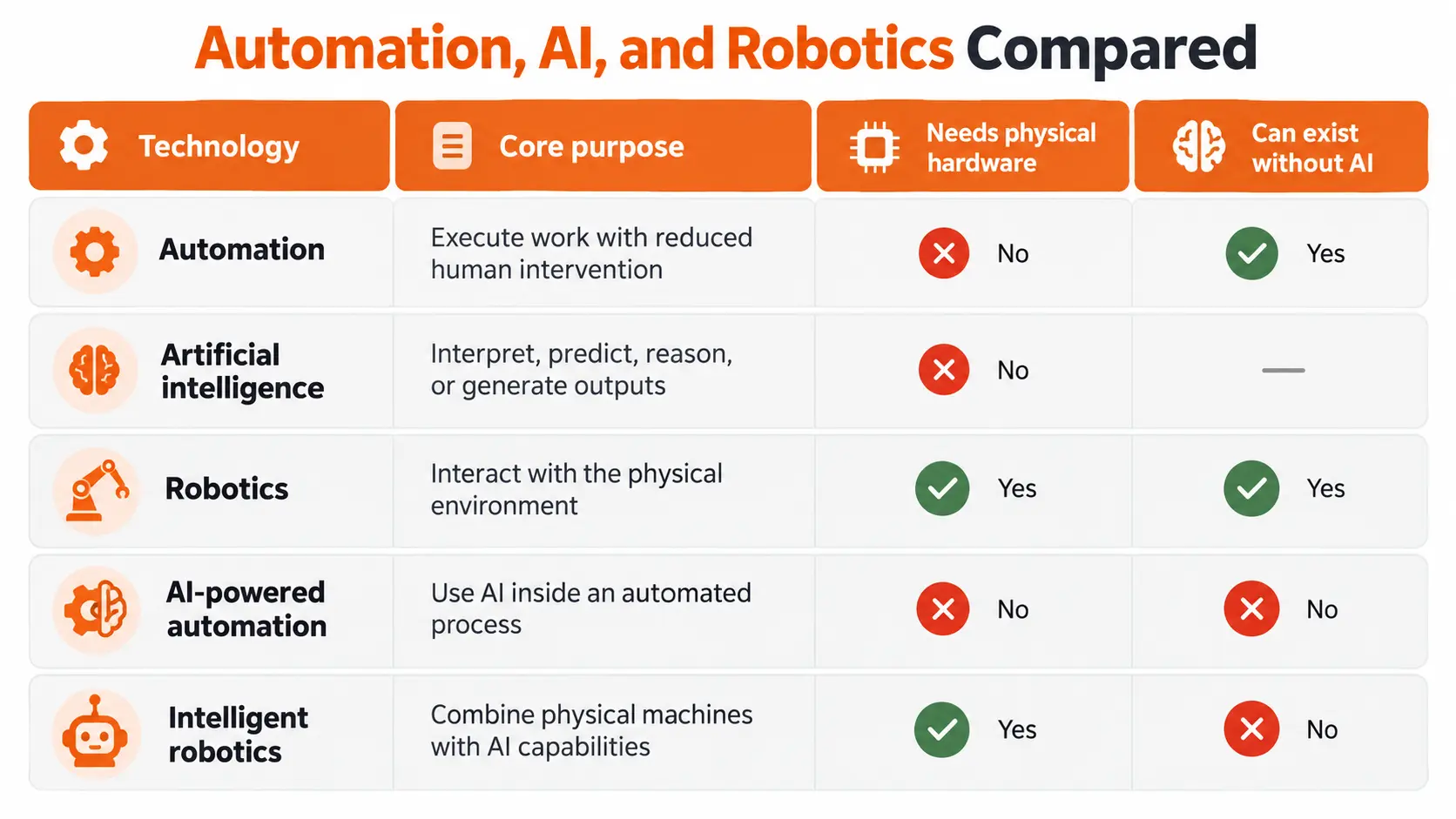
A conveyor belt controlled by fixed logic is automation without AI.
An AI model analyzing customer sentiment is AI without process automation.
An industrial robot welding the same location repeatedly is robotics and automation without AI.
A robot using computer vision to identify objects and adapt its movements combines all three.
IBM's 2026 definition of industrial AI reflects this convergence, combining AI with robotics, sensors, IIoT, edge computing, digital twins, and operational data in physical industrial environments.
Keeping these concepts separate makes technology decisions much clearer.
Business Value of Automation Technology
I evaluate automation through measurable changes to the process rather than through the number of tools deployed.
The strongest value appears in six areas.
Speed: repetitive work is completed faster.
Consistency: the same process executes according to the same rules.
Capacity: an automated system can process more work without adding the same amount of manual effort.
Accuracy: structured tasks become less exposed to manual entry errors.
Visibility: automated workflows generate timestamps, events, and process data.
Availability: systems can perform certain processes outside human working hours.
AWS connects automation with higher productivity, reduced time, greater consistency, and cost efficiency. IBM also identifies productivity, customer service, compliance, operational efficiency, and reduced errors as common automation outcomes.
But I would never automate a process based on those benefits alone.
The economics need to work at the individual process level.
Choosing Processes for Automation
The best automation candidate has a clear trigger, repeatable steps, identifiable inputs, measurable output, and enough volume to justify the implementation effort.
I start by mapping the current process without technology.
Who starts it?
What information enters?
Which decisions are made?
Which systems are touched?
Where do exceptions appear?
What outcome marks completion?
This reveals an important distinction.
Some processes are repetitive but poorly designed.
Automating them only executes a bad workflow faster.
I would fix unnecessary approvals, duplicated data entry, unclear ownership, and broken handoffs before deciding how much technology to add.
Then I look at the execution itself.
Rule-based work can use conventional automation.
Work involving unstructured information can require AI.
Physical tasks can require industrial equipment or robotics.
Processes spanning multiple systems require orchestration and integration.
The right automation architecture follows the process instead of forcing every process into the same tool.
Human Control in Automated Systems
Automation reduces human involvement in execution. It does not eliminate the need for human responsibility.
I separate decisions into three groups.
Fully automated: the rules and consequences are controlled enough for the system to execute independently.
Human supervised: automation performs the work while a person reviews defined events or exceptions.
Human approved: the system prepares or recommends an action, but a person makes the final decision.
AWS uses a similar distinction between attended and unattended automation. Attended systems operate with human participation, while unattended automation runs after predefined triggers without continuous manual control.
The right level depends on risk.
Resetting a password and approving a large financial transaction do not deserve the same autonomy.
The more significant the consequence of a wrong action, the stronger the controls need to be.
Limits of Automation Technology
Automation works best when the process is understandable.
Problems appear when organizations try to automate work that has no stable logic, poor-quality data, unresolved ownership, or too many hidden exceptions.
The technical system also introduces dependencies.
An automated workflow can fail because an API changes.
A factory system can fail because a sensor produces bad data.
An AI-powered workflow can return the wrong classification.
A bot can execute the wrong action perfectly if its instructions are wrong.
That is why I look beyond whether an automation can run.
I want to know:
how failures are detected
how exceptions are handled
who can override the system
what is logged
how permissions are controlled
what happens when an external system becomes unavailable
Automation should reduce operational friction without making the process impossible to understand.
Automation and the Future of Work
Automation changes jobs by changing the composition of work.
A role consists of many individual tasks. Some can be automated completely, some can be accelerated, and others still depend on judgment, accountability, negotiation, creativity, or physical interaction.
This distinction is becoming more important as AI expands automation beyond structured tasks.
Gartner's 2026 research argues that workforce amplification can create more value than treating automation purely as employee replacement. Its September 2026 outlook predicts that some organizations that remove roles too aggressively through AI will later need to rebuild human capability.
From a business perspective, I would design automation around the work first.
Remove low-value execution where technology performs it reliably.
Keep judgment where the business still needs human context and accountability.
Then redesign the role around the remaining work.
The Next Stage of Automation
The direction of automation is moving from executing predefined steps toward coordinating outcomes.
Traditional automation waits for a defined trigger and follows a defined path.
Intelligent automation can interpret more complex inputs.
Agentic automation goes further by allowing AI systems to plan and execute multi-step work across tools and systems.
Gartner describes agentic automation as one of the major changes affecting process automation in 2026, while its current enterprise automation research increasingly combines orchestration with agentic capabilities.
IBM describes the same shift as moving from automating individual actions toward systems that reason and act across an end-to-end workflow.
I would still treat this as an extension of automation rather than a completely new concept.
The core model remains:
understand the state → decide → act → evaluate the result
What is changing is how much of that cycle the system can handle without predefined instructions for every individual step.
Automation Technology in Practice
The useful question is no longer whether a business “uses automation.”
Every modern organization already depends on automated technology somewhere.
The more useful question is:
Which decisions and actions should the system control, and which should remain with people?
Fixed automation works when the environment is predictable.
Flexible systems work when inputs vary.
AI extends automation into information that cannot be handled with simple rules.
Agentic systems extend it further into multi-step workflows.
The technology should become more sophisticated only when the process requires that sophistication.
That is the principle I use when evaluating automation: start with the work, define the outcome, then choose the lowest-complexity technology capable of delivering it reliably.
FAQ
Can I automate a process that's still changing every week?
Automating an unstable process creates high maintenance costs because every workflow change can require updates to rules, integrations, tests, and controls. Stabilize the core steps first and isolate the parts that continue to change before automating the process extensively.
Is custom automation better than buying an existing platform?
Custom development is justified when the workflow creates strategic differentiation or existing platforms cannot meet critical requirements. Established platforms are more efficient when the process is standardized and the company does not gain competitive value from owning the automation technology.
How much process volume do I need before automation pays off?
There is no universal transaction threshold. Calculate the current labor and error cost, expected implementation and maintenance cost, transaction volume, process duration, and expected useful life of the automation. The project becomes economically justified when the expected savings and business value exceed its total ownership cost.
Can automation work across old legacy systems?
Yes. APIs, middleware, RPA, integration platforms, database connections, and interface automation can connect legacy systems. The appropriate method depends on the system's available interfaces, security requirements, stability, and expected remaining lifespan.
Who should own automation projects inside a company?
Business teams should own the process outcome, while technology teams should own architecture, integration, security, and technical reliability. Automation fails as a governance model when either side makes decisions without the other.
How do I measure whether an automation is actually working?
Define operational metrics before deployment. Useful measures include processing time, error rate, cost per transaction, exception rate, completion rate, downtime, manual interventions, and the percentage of work completed without escalation.
Can an automated system keep running if one connected app goes down?
Only if the architecture was designed for that failure. Reliable systems use retries, queues, timeouts, fallback paths, alerts, and recovery procedures so an external outage does not silently corrupt the workflow.
Should employees be able to override an automated decision?
Yes, when the process includes decisions with significant customer, financial, legal, safety, or operational consequences. Override permissions should be controlled, logged, and connected to a defined escalation process.
How do I stop different teams from building duplicate automations?
Maintain a shared inventory of automated processes, reusable integrations, owners, dependencies, and platforms. Central governance does not require one team to build everything, but the organization needs visibility into what has already been automated.
What happens to an automation when the employee who built it leaves?
The automation should remain maintainable through documented logic, centralized credentials, version control, named business and technical owners, monitoring, and support procedures. Business-critical automation should never depend on knowledge stored only with one employee.

Fatemeh Jahangard
Technology & AI Writer at PinerookFatemeh Jahangard covers AI, emerging technologies, and digital innovation for Pinerook, focusing on how technology shapes startups and industries.
 Seen first.