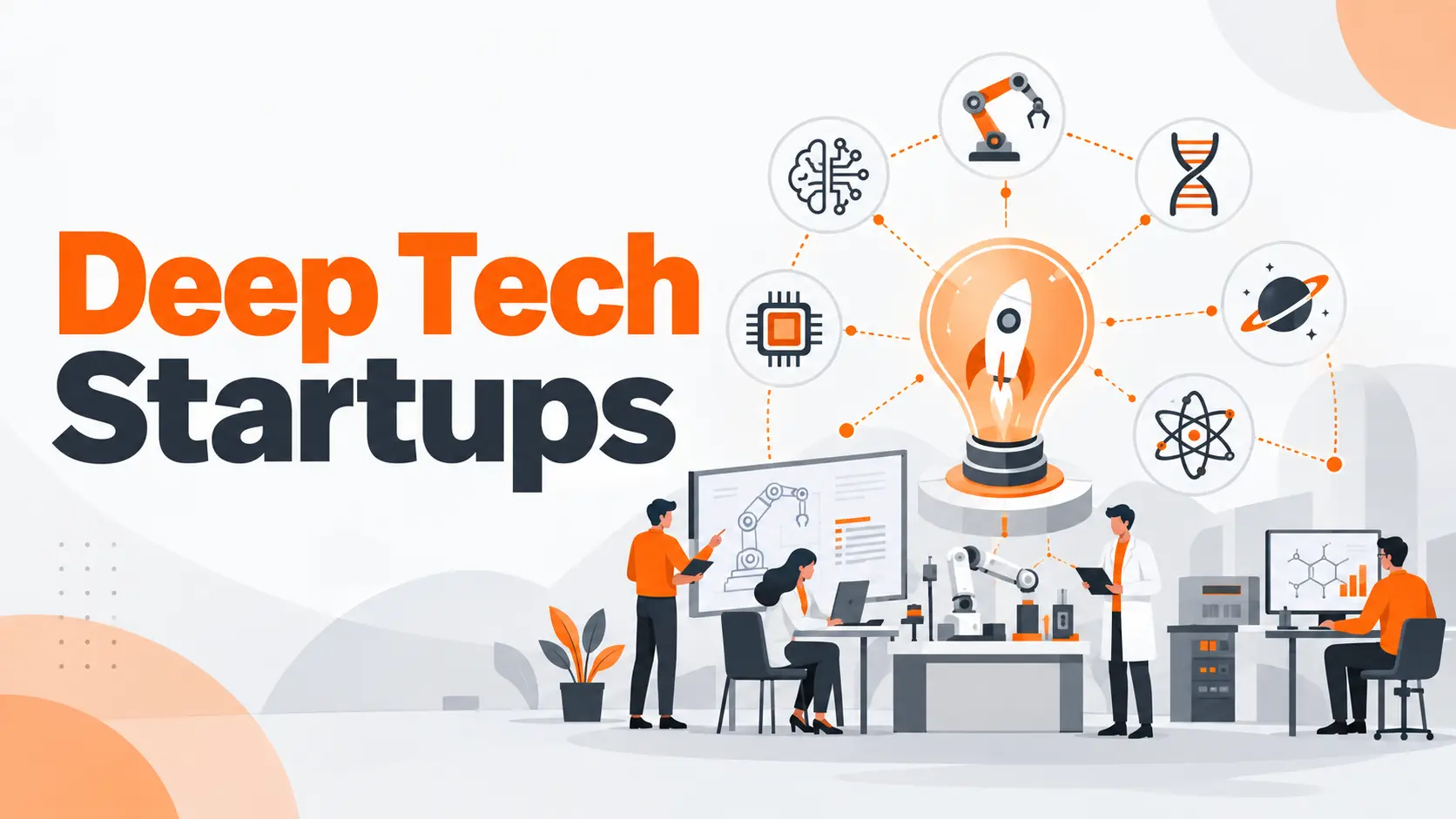
Deep tech startups build businesses around scientific discoveries or engineering breakthroughs that are difficult to reproduce. Unlike a conventional software startup, the company must prove the technology itself before it can prove the business at scale.
When I evaluate a deep tech startup, I start with one distinction: is the company creating a new technical capability, or simply using technology that already exists? That difference shapes everything that follows, from funding and product development to customer discovery, intellectual property and manufacturing.
What Makes a Startup Deep Tech
A deep tech startup has scientific or engineering innovation at the core of its competitive advantage. Its product depends on technical capability that required original research, substantial engineering or both.
WIPO describes deep science ventures as companies built from significant scientific discoveries in fields such as physics, chemistry, biology and mathematics, with extensive validation required before those discoveries become scalable businesses.
I look for six signals.
Scientific or engineering breakthrough: The product depends on an original technical capability.
Significant R&D: Research and engineering remain central before commercial scale.
Technical validation: The company has to prove repeatable performance, not just demonstrate an idea.
Defensible knowledge: Patents, trade secrets, processes or technical know-how protect the advantage.
Long development path: Prototypes, testing and pilots come before scaled deployment.
High capital requirements: Labs, hardware, manufacturing, testing or specialist teams require serious investment.
Using AI, robotics, biotechnology or quantum technology does not automatically make a startup deep tech. A company building an HR product on an existing AI model is a software startup. A company developing a new semiconductor architecture or photonic computing platform is much closer to deep tech.
That is why I see deep tech as one part of the wider emerging technologies landscape rather than a standalone industry.
Deep Tech Startups vs Traditional Tech Startups
The difference becomes clearer when both models are compared side by side.
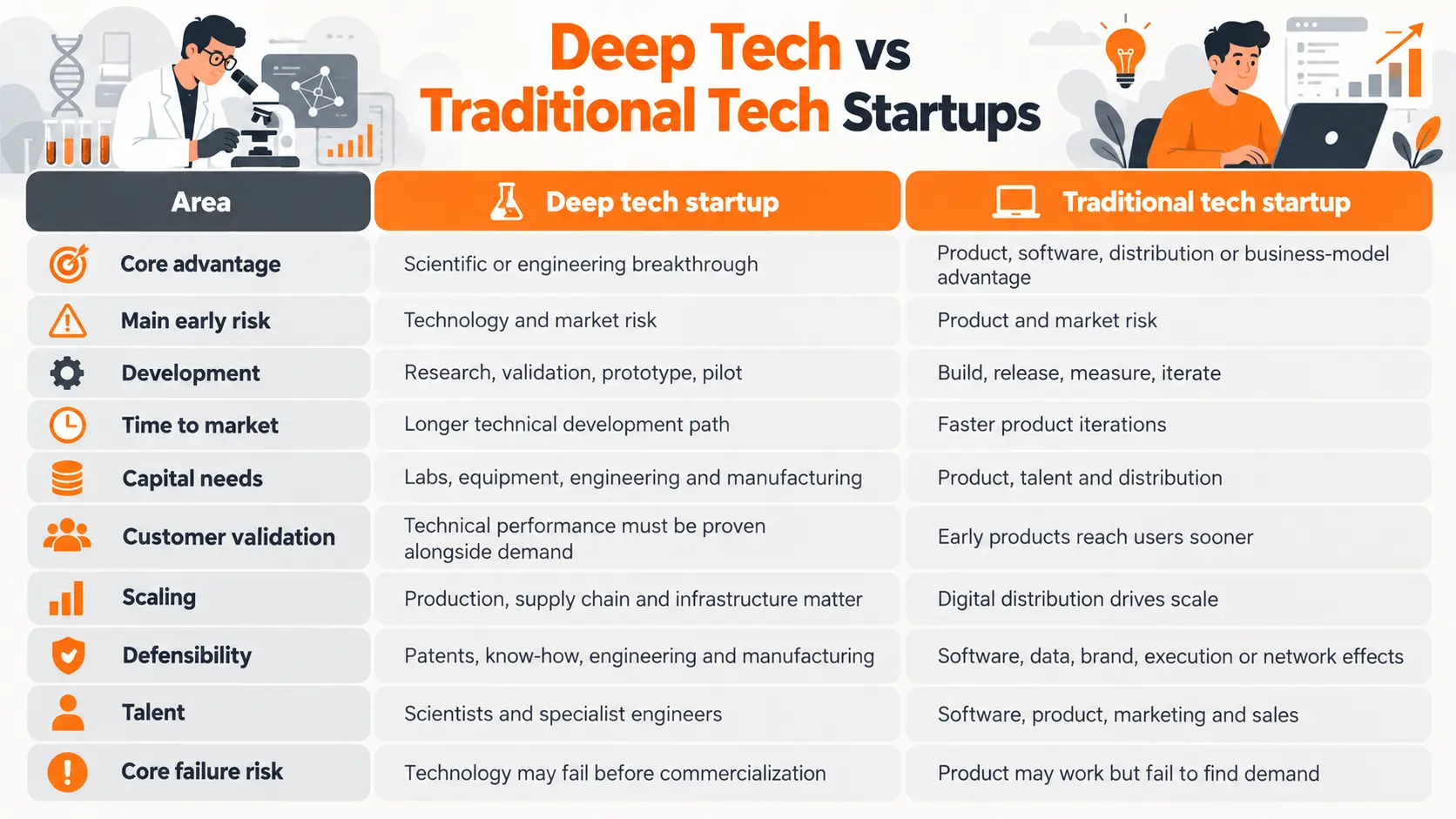
MIT highlights the same structural difference: science-based startups need more time, specialized talent, validation and capital, and they can also require entirely new manufacturing processes before reaching commercial scale.
This changes how I apply the standard startup idea of rapid iteration.
A software team can change a feature and release another version the same week. A materials company has to reformulate the material, manufacture another sample, test it and confirm that its properties remain stable.
Deep tech still requires iteration. The iteration cycle is simply more expensive and technically constrained.
Core Deep Tech Sectors
Deep tech cuts across industries because the category describes the underlying innovation, not the market where the company sells.
The strongest areas include semiconductors and advanced computing, quantum technology, robotics and autonomous systems, biotechnology and synthetic biology, advanced materials, energy and storage, fusion, space technology, photonics, advanced manufacturing and scientific instrumentation.
Dealroom's current deep tech taxonomy reflects this breadth, tracking companies across semiconductors, robotics, space, advanced materials, synthetic biology, AI compute, photonics and quantum computing.
The important distinction is that a startup can operate inside one of these sectors without being deep tech.
A marketplace for laboratory equipment is not deep tech because its customers are scientists. A startup inventing a new type of scientific instrument could be.
I classify the business by the source of its technical advantage.
Real Deep Tech Startup Examples
Real companies make this distinction easier to understand.
Commonwealth Fusion Systems
Commonwealth Fusion Systems grew out of MIT research and is developing commercial fusion systems built around high-temperature superconducting magnet technology. The company spun out of MIT in 2018 and has raised $4 billion to move from fusion research toward commercial power plants.
What makes CFS a useful deep tech example is the chain between science and business.
The company does not sell software to the energy industry. Its business exists because an engineering breakthrough changes what type of fusion system can be built.
PsiQuantum
PsiQuantum is developing fault-tolerant quantum computers based on photonic qubits. Its strategy combines quantum physics with silicon photonics and established semiconductor manufacturing infrastructure.
I find this example especially useful because it shows that deep tech does not mean inventing every part of the stack.
PsiQuantum is trying to combine new quantum architecture with manufacturing processes already capable of producing semiconductor devices at scale.
That is a commercialization decision as much as a scientific one.
Deep Tech Beyond Computing
The category extends far beyond quantum and fusion.
WIPO's 2026 work on science-driven entrepreneurship covers life sciences, semiconductors, robotics, space, energy and advanced materials. More than 30,000 deep science startups created since 2000 were included in its global mapping.
The common feature across these businesses is not the sector.
It is the attempt to turn difficult science or engineering into a repeatable commercial capability.
The Deep Tech Path From Lab to Market
A successful experiment is not a commercial product.
I separate the development path into stages because every stage answers a different question.
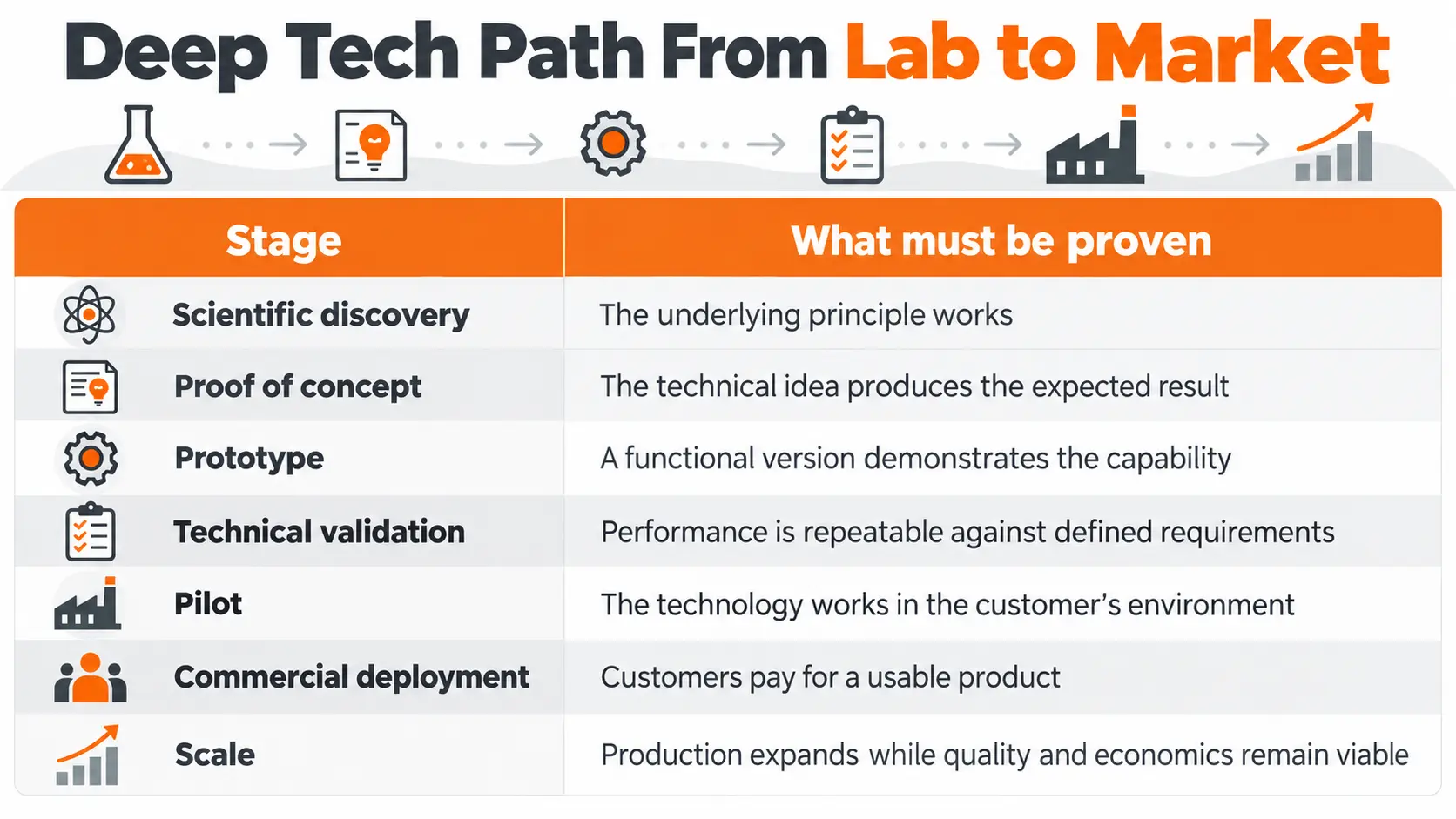
This distinction matters when evaluating progress.
A laboratory result proves the science.
A prototype proves that engineers can turn the science into a system.
A pilot proves the system can work outside controlled conditions.
A commercial deployment proves someone values the result enough to pay for it.
Scale is another test altogether.
WIPO emphasizes multi-stage validation, prototyping, trials, specialized infrastructure and manufacturing scale-up as core parts of the deep science journey.
That is why I never judge a deep tech company only by the quality of its research announcement. I want to know what the company has proven at the next stage.
Customer Discovery Before the Technology Is Finished
Deep tech founders cannot wait until engineering is complete to learn what customers need.
The technology and the market have to move toward each other.
A battery company, for example, does not win because its chemistry produces an impressive laboratory result. Customers care about cost, lifetime, safety, charging profile, operating temperature, availability and integration.
A technically excellent solution can fail because it optimizes a metric the market does not value enough.
I would therefore start customer discovery while technical development is still underway.
The purpose is not to ask customers whether they “like the idea.” It is to identify the performance threshold that turns the technology into an economic advantage.
That changes the founder's question from:
Can we make this work?
to:
What must this technology achieve before a customer changes how they operate?
That second question is where commercialization begins.
Commercialization as a Technical Discipline
I treat commercialization as part of engineering rather than something that begins after engineering.
Every technical decision affects the business.
A new material that performs exceptionally well but requires an extremely expensive manufacturing process has a commercialization problem. A robot that works perfectly but takes twelve hours to install at each customer site has a commercialization problem.
The founder needs to connect technical performance to economics early.
Three things must eventually align: the product has to reach the required technical specification, that specification must solve a customer problem with measurable value, and the company must be able to deliver it at a viable cost.
This is where deep tech founders have to think differently from research teams.
Research asks whether something is possible.
A business asks whether it is repeatable, manufacturable and worth paying for.
Funding Deep Tech Startups
Deep tech requires a different capital strategy because major technical risk remains long before recurring revenue appears.
MIT points out that conventional venture structures do not always align well with science-driven companies because development timelines and capital requirements are longer. Grants and other non-dilutive funding therefore play a larger role in the early stages.
NSF's America's Seed Fund is a clear example. It funds early-stage R&D in areas such as AI, energy, medical devices, robotics and semiconductors and provides up to $2 million without taking equity. NSF states that it funds roughly 400 companies each year.
I would match the funding source to the uncertainty being removed.
Research funding should prove science.
Early capital should establish technical feasibility.
Later capital should move the company toward pilots, production and repeatable sales.
That sequencing matters because raising equity before a major technical milestone can mean selling a large part of the company while its risk is still priced at its highest level.
Intellectual Property and Deep Tech Defensibility
Intellectual property matters more in deep tech because the company can spend years creating capability before reaching commercial revenue.
WIPO reports that about half of deep science startups hold patents, compared with 15.4% of non-deep-science startups. It also notes that patents become increasingly important as companies mature, although trade secrets and engineering know-how remain critical in sectors where execution and manufacturing carry more of the advantage.
I would not reduce defensibility to patents alone.
A strong technical moat can exist in manufacturing processes, tacit engineering knowledge, specialized equipment, testing data, supply relationships and system integration.
The right question is:
How difficult would it be for a well-funded competitor to reproduce this capability?
If the answer is “they could copy it in six months,” the company does not yet have the type of technical moat I expect from strong deep tech.
Manufacturing as Part of the Product
Manufacturing is where many deep tech ideas meet their hardest commercial test.
A process that produces one perfect sample in a laboratory has not proved that it can produce thousands of identical units.
For hardware, materials, chips, batteries, robotics and other physical technologies, the manufacturing process directly affects product performance.
MIT specifically notes that science-based startups can require manufacturing processes that do not yet exist at commercial scale, forcing some companies to build new production capabilities themselves.
This means decisions about manufacturing belong inside product development.
A founder needs to understand which steps create the technical advantage, which steps can be outsourced, which equipment requires custom development and how yield changes as volume grows.
Scaling a deep tech company is not just selling more units.
It is proving that more units can actually be built.
Deep Tech Business Models
The underlying technology does not determine one fixed business model.
A company inventing a new material could manufacture and sell the material itself. It could license the underlying process. It could use the material internally to produce a higher-value end product.
A quantum company could sell access to computing infrastructure rather than hardware. A robotics company could sell machines, lease them or charge for completed work. A biotechnology platform could license discoveries to larger pharmaceutical companies.
I decide between these models by asking where the company has the strongest defensibility and where taking control creates enough additional value to justify the additional capital.
Owning more of the value chain increases potential upside.
It also increases operational responsibility.
The best model is the one that captures the value of the breakthrough without forcing the startup to build unnecessary parts of the business around it.
Deep Tech Scaling
A software company reaches a large market by adding computing capacity and acquiring more customers.
Deep tech has more physical constraints.
Technology performance has to survive scale. Manufacturing output has to rise. Suppliers must deliver critical inputs. Products need to pass certifications. Specialist teams have to grow. Pilots need to become repeatable commercial deployments.
This creates a financing problem between successful technical development and mature commercial economics.
WIPO's 2026 research focuses heavily on this transition from pilots into scalable companies because many science-driven businesses reach technical milestones before traditional commercial financing becomes a natural fit.
This is why I want a deep tech roadmap to show more than product milestones.
I want to see technical, manufacturing, customer and financing milestones moving together.
Market Timing in Deep Tech
A scientific breakthrough can arrive years before the market is ready for it.
That makes timing unusually important.
I look at four conditions together: the technology must reach commercial performance, customers must have an urgent enough problem, supporting infrastructure must exist, and deployment economics must work.
Quantum computing illustrates this well. The science has existed for decades, but commercial opportunities change as manufacturing, error correction, infrastructure, government investment and customer demand advance.
PsiQuantum's strategy of using mature semiconductor manufacturing shows how advances outside the core invention can change the path to commercialization.
The same principle applies across fusion, synthetic biology, robotics, advanced materials and energy storage.
A breakthrough creates the possibility.
The ecosystem determines when that possibility becomes a company.
Deep Tech Market Direction
Deep tech is no longer a narrow category limited to university laboratories.
Dealroom tracks more than 26,000 VC-backed deep tech companies founded since 1990, with large concentrations in semiconductors, robotics, space and advanced materials.
WIPO's narrower deep-science dataset counted more than 30,000 science-based startups created since 2000 and valued them collectively at $7.6 trillion in 2026.
For me, the interesting part is not the size of those numbers.
It is the direction of the market.
Science-intensive startups increasingly sit behind the infrastructure for computing, energy, mobility, manufacturing, medicine and automation.
That makes the ability to commercialize science increasingly important to founders, investors and entire economies.
Deep Tech Outlook
A strong scientific paper does not make a strong deep tech startup.
The company still has to turn the breakthrough into something customers can buy and depend on.
When I evaluate one of these companies, I want to see a clear chain:
Scientific advantage → technical validation → customer value → commercial deployment → scalable production
Each step needs evidence.
If the science is strong but customers do not care, there is no business.
If demand is strong but the technology cannot be manufactured reliably, there is no scalable product.
If both work but funding runs out between pilot and production, the company still fails.
The strongest deep tech startups solve all three problems at once: science, commercialization and scale.
FAQ
Do I need a PhD cofounder for a deep tech startup?
A PhD is not a formal requirement. The founding team does need enough domain expertise to evaluate the core science independently, direct technical work and defend technical decisions during investor, customer and partner diligence.
How technical should the CEO of a deep tech startup be?
The CEO must understand the technology well enough to connect technical milestones with financing, customers and strategy. The CEO does not need to be the strongest scientist on the team when a highly capable technical founder or CTO owns that responsibility.
How do I choose the first market when the technology works in several industries?
Choose the market where the technology delivers the greatest economic advantage with the shortest path to validation. Market size matters, but the first market should also provide accessible customers, achievable technical requirements and a realistic deployment path.
Should a university spinout license the IP or try to buy it outright?
The correct structure depends on the university's technology-transfer policy, patent ownership, field-of-use rights, royalty terms and future financing requirements. Founders should resolve these rights before raising institutional capital because investors need clarity over the company's control of its core technology.
How should I price the first paid pilot?
The pilot price should reflect the customer's economic value and the work required to deliver the deployment. It should not disguise custom research as scalable revenue. The agreement should also define success metrics and the path from pilot to commercial contract.

Fatemeh Jahangard
Technology & AI Writer at PinerookFatemeh Jahangard covers AI, emerging technologies, and digital innovation for Pinerook, focusing on how technology shapes startups and industries.
 Seen first.