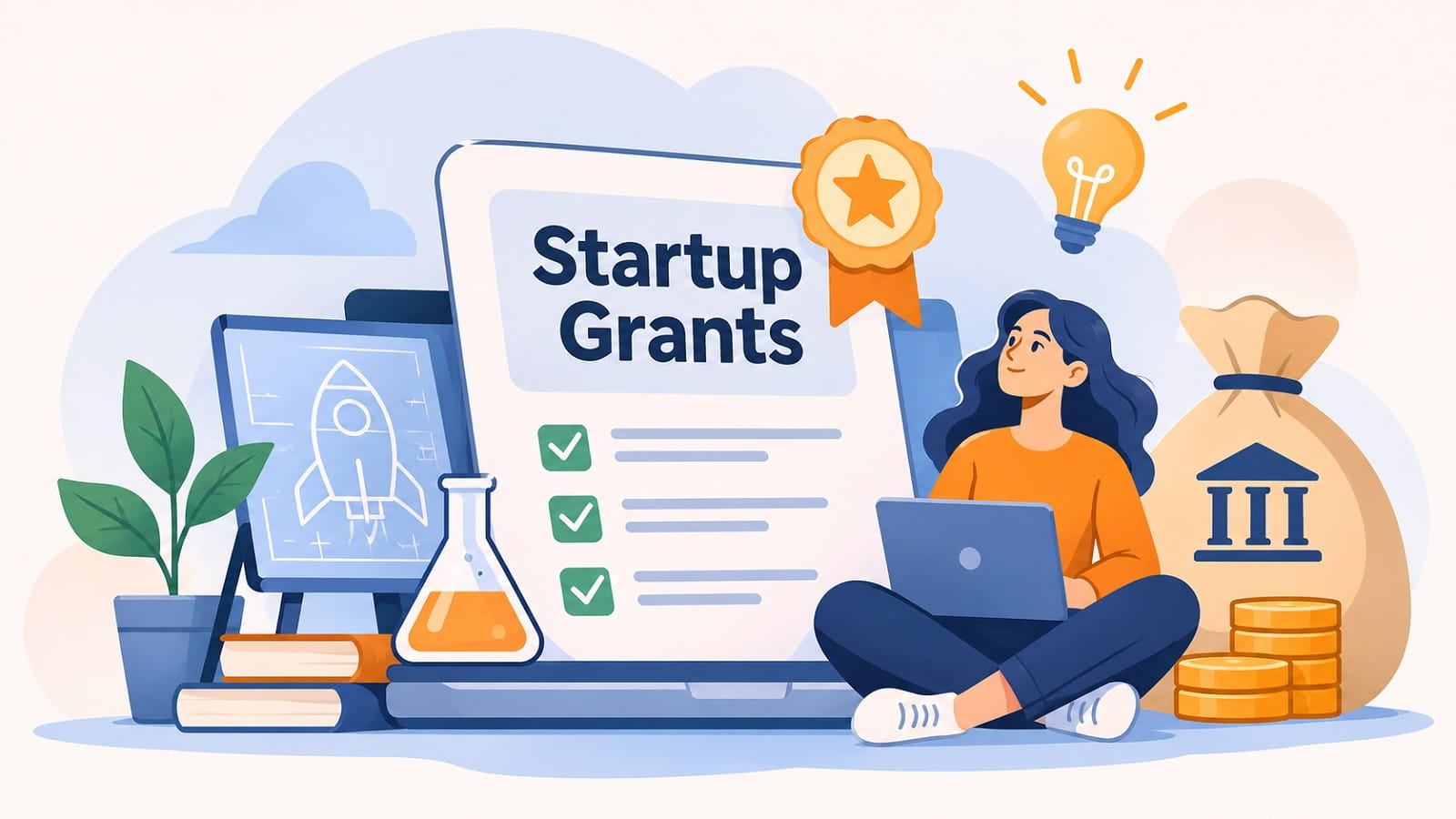
Startup grants provide eligible businesses with funding for specific projects, research activities, technological development, or other objectives supported by a grant provider. Unlike conventional loans, qualifying grants generally do not require scheduled repayment when the recipient meets the award conditions. They also typically avoid the immediate ownership dilution associated with selling equity, making them attractive to founders who need capital without introducing new shareholders or additional debt service.
Within Startup Debt and Alternative Funding, grants occupy a distinct position because receiving capital is tied to eligibility, approved expenditure, and demonstrated project outcomes. A startup may qualify for substantial support but still need its own cash to cover excluded expenses, matching contributions, or costs incurred before reimbursement. Founders must therefore evaluate a grant not only by its advertised value but also by the financial resources and operational commitments required to complete the funded project.
This guide explains where startups can find grant opportunities, how eligibility and application assessments work, and what successful applicants must do after receiving an award. It also provides a practical project budget example showing how grant percentages, eligible costs, and payment timing affect the company's actual funding requirements.
What Are Startup Grants?
Startup grants are financial awards provided by government agencies, public institutions, foundations, or other organizations to support activities that meet specified objectives. Unlike ordinary commercial borrowing, a grant generally does not establish a conventional principal and interest repayment schedule.
However, the absence of ordinary loan repayments does not make grant funding unrestricted. Providers typically define which organizations may apply, what activities can be supported, which expenses qualify, and how recipients must demonstrate compliance.
A grant may support laboratory research, product development, sustainability initiatives, regional economic growth, or other activities aligned with the funding organization's priorities. Some programs support individual businesses, while others require cooperation between companies, universities, or research institutions.
The funding agreement establishes what the recipient is allowed to do with the award. Spending outside the permitted scope, failing to satisfy contractual requirements, or providing inaccurate information may result in adjustments, repayment claims, or other consequences.
For founders, the central question is whether the startup has a qualifying project that the provider wants to support, not merely whether the business needs additional capital.
How Startup Grant Funding Works
Grant funding normally begins with an official opportunity announcement describing the program's objectives, eligible applicants, project requirements, available support, and application procedure.
A company reviews the conditions and submits a proposal demonstrating how its planned activities satisfy the program's purpose. Applications may be assessed for technical quality, commercial potential, public benefit, implementation feasibility, and financial credibility.
Successful applicants generally receive an award agreement specifying the approved activities, budget, reporting requirements, and payment conditions.
Funding Awards and Eligible Expenditure
A grant may cover all or only a proportion of qualifying project costs. The provider usually defines which categories of expenditure can be included in the approved budget.
Eligible costs might include directly attributable research personnel, specified equipment use, materials, approved subcontracting, or other necessary project activities. The precise treatment of these categories depends on the funding scheme.
A company should not assume that general marketing, existing business debts, unrelated salaries, or ordinary overhead expenses are automatically covered.
Costs outside the agreement may remain entirely the responsibility of the startup, even when they contribute indirectly to business growth.
Matching Contributions
Some programs require the recipient to contribute a defined share of eligible project costs.
For example, a grant covering 60% of a qualifying $200,000 project would provide a maximum contribution of $120,000 under the simplified assumptions. The company would need to finance the remaining $80,000.
Other funding schemes may establish different contribution percentages or require additional partners to provide resources.
Founders must confirm that the necessary contribution is available before committing to the project. A grant can become financially difficult to use when the business lacks the money required to satisfy its own share.
Payment Schedules and Reimbursement
Not every grant is paid entirely in advance. Some programs distribute funding after recipients submit qualifying expenditure claims, financial reports, or evidence of completed milestones.
Reimbursement arrangements create an important cash management issue. A startup may need to pay project suppliers and employees before receiving the associated grant funds.
Other schemes use advances, milestone payments, or lump sum arrangements. The actual payment mechanism must be established from the award terms.
Founders should prepare a cash forecast that reflects the dates money must leave the company and the dates grant receipts are expected.
Types of Startup Grants
Grant programs vary by purpose, eligibility, jurisdiction, and financing structure. Founders should classify opportunities according to what they support rather than assume that every grant is available for general business expenditure.
Research and Development Grants
Research and development grants support eligible projects intended to investigate technical problems, develop new knowledge, or advance innovative products and processes.
These programs often require a clearly defined technical challenge, a credible methodology, and measurable project outcomes.
The United States Small Business Innovation Research and Small Business Technology Transfer programs are examples of public funding frameworks supporting eligible small business research and development.
A project does not necessarily qualify simply because the startup describes its product as innovative. The proposed activity must satisfy the specific agency requirements and topic scope.
Innovation and Commercialization Grants
Some grants support businesses moving promising technologies toward commercial application. Depending on the program, activities may include prototype validation, demonstration, testing, or preparation for market entry.
The European Innovation Council provides several funding pathways for companies and research organizations developing advanced innovations.
For example, the EIC Accelerator supports qualifying startups and smaller businesses pursuing innovations with substantial market potential. Depending on the selected funding structure, assistance can include grant funding, investment, or a combination of both.
Founders should distinguish the grant component from any investment component because accepting equity investment may have ownership consequences.
Regional and Economic Development Grants
Regional grant programs may encourage business formation, employment, investment, or innovation within specified geographic areas.
Eligibility can depend on where the company is registered, where the project takes place, and whether proposed activities contribute to the region's policy objectives.
A startup expanding operations in an eligible region may find opportunities that would not be available for the same project in another location.
Founders should examine requirements concerning project location, eligible spending, employment commitments, and the period during which operations must remain in the designated area.
Sustainability and Sector Specific Grants
Some funding opportunities are directed toward clean technology, energy efficiency, healthcare innovation, advanced manufacturing, agriculture, or other designated sectors.
These grants can provide valuable support when the startup's commercial activities align closely with the program's objectives.
However, a general connection to a priority sector may be insufficient. The proposal must meet the specific technical and policy criteria, and the company must demonstrate that the requested funding supports eligible activities.
Where to Find Legitimate Startup Grants
Founders should prioritize official funding portals and program administrators rather than relying on third party advertisements promising easy access to business grants.
In the United States, Grants.gov provides a centralized search system for federal funding opportunities. Companies can search for relevant announcements and examine the eligibility and application requirements published by the responsible agency.
The SBIR/STTR website provides additional information about participating federal agencies and their research funding topics. Applicants should verify current opportunities using the relevant agency's original announcement because deadlines and conditions may change.
In the United Kingdom, Innovate UK publishes funding competitions supporting eligible innovation activities. Applicants must review the requirements of the individual competition rather than assume that general business registration guarantees eligibility.
Within the European Union, the European Innovation Council and the EU Funding and Tenders Portal provide information about relevant research and innovation funding opportunities.
The official announcement should remain the authoritative source for application rules, deadlines, and required documentation.
How to Evaluate Grant Eligibility
Finding a grant that appears relevant is only the first step. The company must establish whether it can legally apply and whether the planned project satisfies all mandatory conditions.
Eligibility requirements can concern the applicant, the project, the proposed expenditure, and the financing arrangements.
Company and Applicant Requirements
Funding schemes may restrict eligibility according to business size, registration jurisdiction, ownership, trading history, industry classification, or organizational structure.
Some programs accept individual startups, while others require a consortium with research institutions or commercial partners.
A company incorporated outside the permitted jurisdiction may be ineligible even if its technology closely matches the program's objectives.
Project Scope and Technical Requirements
Grant providers typically publish specific goals that proposed projects must address.
A strong application establishes a direct connection between those goals and the activities the company intends to undertake.
Founders should explain the problem being addressed, the work required, the expected outputs, and how success will be measured.
Applications that describe an attractive commercial business without demonstrating alignment with the funding objectives may fail even when the startup itself is financially promising.
Financial Capacity and Funding Restrictions
Some grant programs assess whether applicants can cover their own contribution and maintain sufficient resources throughout the project.
Providers may also restrict duplicate funding for the same expenditure or require applicants to disclose other financial support.
The startup should confirm that the proposed budget is eligible, that any required matching funds are available, and that other financing arrangements do not conflict with the grant conditions.
Comparing Startup Grant Opportunities
Founders need a consistent way to evaluate opportunities before investing significant time in preparing applications. A grant with a large advertised award may be less suitable than a smaller program that directly supports the company's planned expenditure.
The following table summarizes common grant categories and the main factors that should influence the decision to apply.
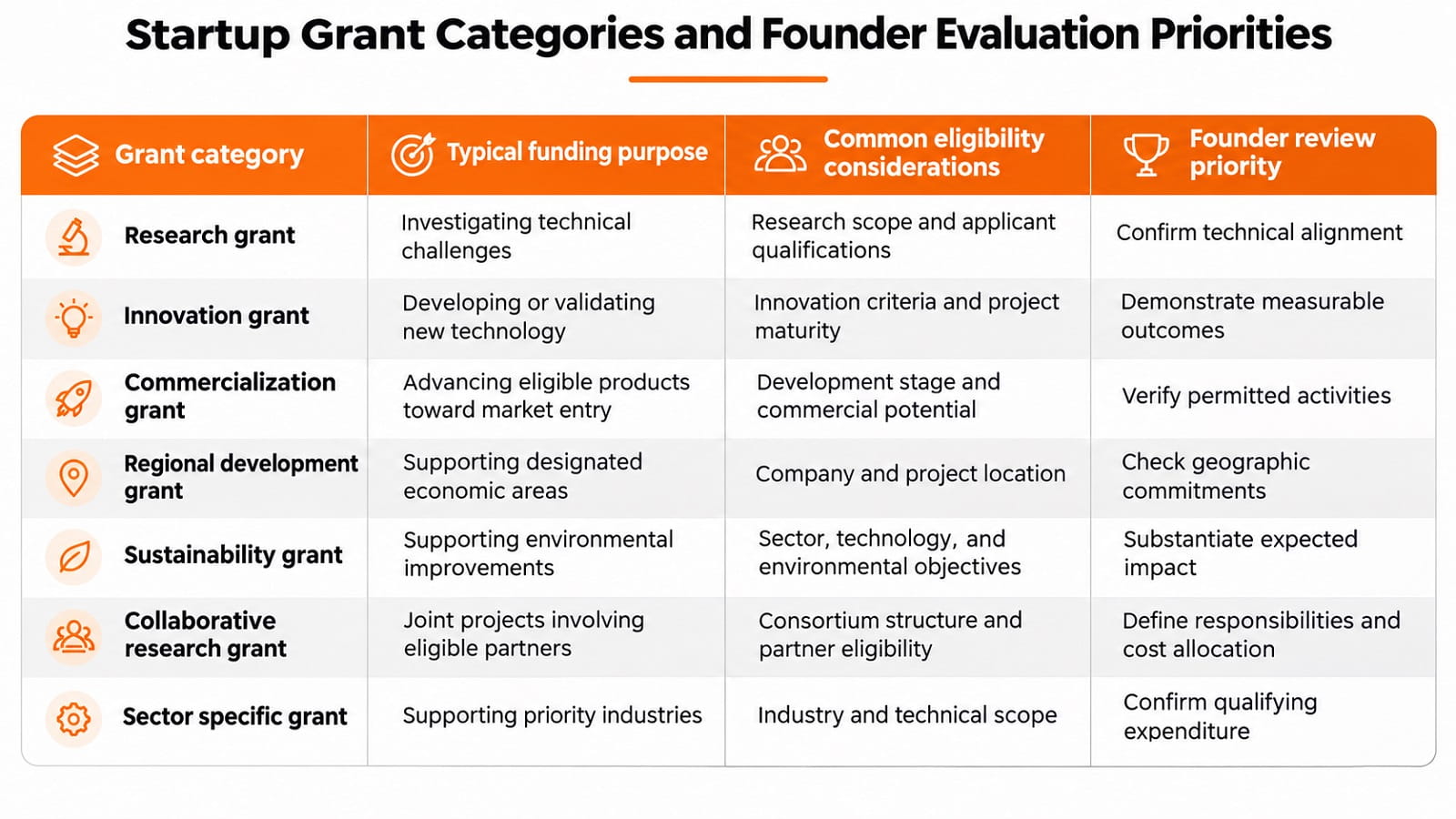
The most suitable opportunity is one where the company can satisfy the eligibility rules and complete the proposed activities without placing its operations under excessive financial pressure. A grant should support a project that already makes commercial or strategic sense, rather than encourage founders to pursue unrelated work solely because funding is available. Matching the project's objectives with the provider's priorities can improve application relevance while reducing the risk of committing resources to unsuitable opportunities.
How to Apply for Startup Grants
A successful application requires more than a persuasive description of the business. Reviewers need evidence that the proposed project fits the program, can be delivered within the specified period, and has a credible financial plan.
Identify the Right Funding Opportunity
Start by defining the project that requires support. The company should establish what it intends to achieve, why the work is necessary, and which resources will be required.
Once the project is clear, compare its objectives with the eligibility and evaluation criteria of relevant funding programs.
Founders should avoid submitting the same general business proposal to unrelated grant schemes without adapting it to the specific opportunity. Each application must respond directly to the published requirements.
Prepare the Technical Proposal
The proposal should describe the problem, the proposed solution, the activities required, and the evidence that the project is feasible.
Technical claims should be supported by credible information. Where a proposal involves research, the applicant should explain the uncertainties being investigated and the methods used to evaluate progress.
Reviewers may also expect measurable milestones, identifiable deliverables, and realistic project scheduling.
The proposal should show what the company can accomplish with the award rather than simply describe the long term potential of its industry.
Build an Eligible Project Budget
The budget should connect each expenditure to a specific project activity. Staffing, equipment, subcontractors, materials, and other proposed costs should be classified according to the applicable funding rules.
Founders need to distinguish eligible expenses from excluded costs and identify any required company contribution.
A financial forecast should also account for payment timing. Where the award is reimbursed after expenditure, the startup needs enough cash to finance activities before grant receipts arrive.
Submit and Manage the Application
Application portals may require organizational registration, identity verification, financial information, and submission through designated systems.
For United States federal applications submitted through Grants.gov, organizational applicants generally need registration through SAM.gov and an associated Unique Entity Identifier.
Founders should complete required registrations early, verify submission instructions, and allow sufficient time for administrative review.
After submission, the funding organization may assess eligibility, technical quality, financial credibility, and other program specific criteria. Some processes include interviews or requests for additional documentation before an award decision.
A Practical Startup Grant Budget Example
Consider Helix Materials, a fictional technology startup developing a new manufacturing process. The company identifies a hypothetical research grant that could support part of the cost of validating its prototype.
The proposed project has a total budget of $240,000. Of that amount, $200,000 qualifies under the assumed grant rules, while $40,000 consists of business expenditures excluded from funding.
The program offers to cover 60% of approved eligible costs. Helix would therefore receive a maximum contribution of $120,000 if it successfully completes and claims the qualifying expenditure.
The remaining cost must be covered through the company's own resources or other permitted financing.
Calculating the Company Contribution
The approved eligible expenditure totals $200,000. At a 60% funding rate, the grant contribution is $120,000, leaving $80,000 in eligible costs to be financed by the company.
Helix must also pay the $40,000 in excluded expenditure.
The company's total net project contribution is therefore $120,000, assuming it receives the full grant and the project costs remain unchanged.
However, this does not establish the maximum cash the business will need at any one time.
Understanding Reimbursement Timing
Assume the hypothetical grant operates through reimbursement claims rather than advance payments.
During the first project period, Helix incurs $110,000 in eligible expenditure and $20,000 in excluded costs. It must initially finance the entire $130,000 before receiving reimbursement.
If the provider accepts the eligible expenditure and pays 60%, Helix subsequently receives $66,000.
The remaining project period includes another $90,000 in eligible expenditure and $20,000 in excluded costs. A second approved claim would provide the remaining $54,000.
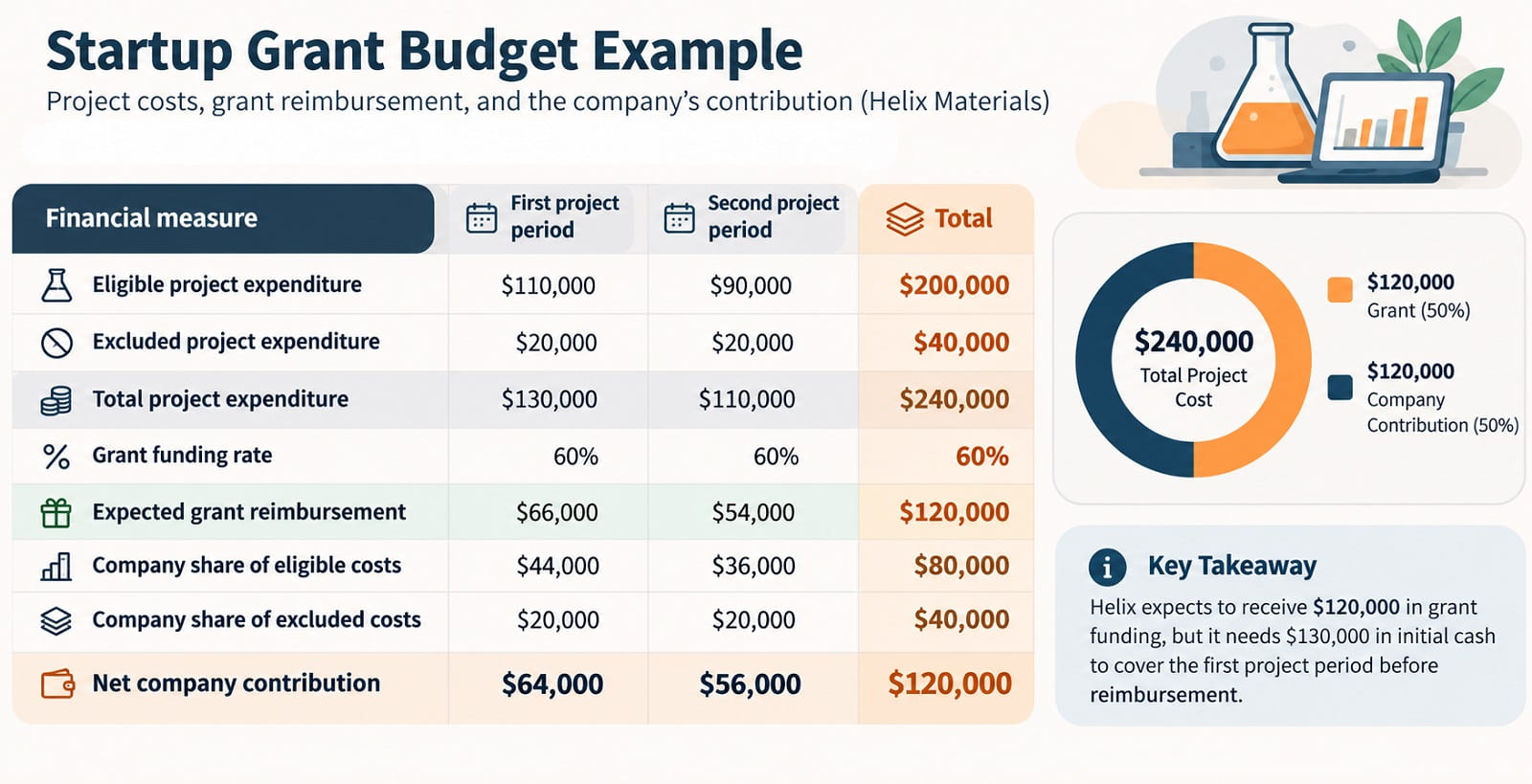
The example shows why the announced grant amount and the company's immediate cash requirements are different. Helix expects to receive $120,000 in total support, but it initially needs $130,000 to cover the first project period before reimbursement. Its net contribution falls to $120,000 over the entire project, assuming both claims are accepted and paid. The company must therefore plan for sufficient interim liquidity rather than assuming the grant will finance expenditure before it occurs.
What Happens if Costs Are Rejected?
Suppose the funding provider determines that $15,000 of the originally planned eligible expenditure does not meet the applicable requirements.
If that expenditure becomes ineligible and is not replaced by other qualifying costs, the eligible budget would fall to $185,000.
At the assumed 60% rate, the maximum grant contribution would decline to $111,000, reducing the anticipated award by $9,000.
Helix would need to finance the resulting difference itself if it still incurred the original project expenditure.
This demonstrates why accurate cost classification, supporting documentation, and adherence to the approved project scope are essential for managing grant funding.
What Happens After Winning a Startup Grant?
Receiving an award does not necessarily mean the company can immediately spend the entire approved amount. The recipient must satisfy the funding agreement and any conditions that must be completed before the project begins.
These may include financial checks, execution of formal agreements, confirmation of project partners, and acceptance of the approved budget.
Once the project starts, management should track expenditure against approved categories and maintain supporting financial records.
Monitoring Project Milestones
Grant agreements may require progress reports demonstrating whether the funded activities remain consistent with the approved proposal.
Founders should assign responsibility for technical progress, financial reporting, and communication with the funding administrator.
Material changes to project scope, timing, staffing, or spending may require approval before implementation.
An internal review process can help identify problems before they affect the company's ability to claim funding.
Maintaining Financial Records
Recipients may be required to retain invoices, payroll records, supplier agreements, timesheets, and other evidence demonstrating that claimed expenditure meets program requirements.
Financial reporting should separate grant expenditure from unrelated business activities wherever appropriate.
The required retention period and acceptable evidence depend on the funding agreement and applicable rules.
Intellectual Property and Commercialization
Some grants include conditions affecting research results, intellectual property ownership, publication, licensing, or the commercialization of funded technology.
A startup intending to attract future investors should understand whether these obligations could influence its ability to commercialize the resulting product.
The company should review relevant intellectual property provisions before accepting the award rather than assuming all research outcomes can be used without restrictions.
Common Startup Grant Application Mistakes
One common mistake is applying for funding without confirming that the company's legal structure and proposed project meet the eligibility criteria. An otherwise strong proposal may be rejected because it fails a mandatory administrative requirement.
Another problem is presenting a project budget that includes expenses the provider does not permit. Such errors can reduce the approved award or create financial difficulties after the project begins.
Founders may also underestimate the cash required to finance their own contribution and support activities before reimbursement. A grant can appear financially attractive but remain difficult to use if the company lacks sufficient liquidity.
Weak proposals frequently fail to explain how objectives will be measured. General statements about innovation and market opportunity are less useful than clearly defined activities, credible technical evidence, and achievable milestones.
A further risk involves misleading funding offers. Applicants should verify the identity of providers and use official application channels. United States federal grant applications do not require applicants to pay a government application fee, and unsolicited promises of guaranteed awards should be treated with caution.
When Startup Grants Make Financial Sense
A grant is most useful when the proposed project closely matches the program's objectives and contributes to the startup's existing strategy.
Research intensive companies may benefit when funding supports technical work that would otherwise be expensive to complete. Businesses developing innovations with substantial public or commercial benefits may also find relevant opportunities.
However, the grant's financial contribution should be compared with the resources required to apply, administer, and complete the project.
Management should consider the application effort, likelihood of eligibility, required matching funds, reimbursement timing, reporting commitments, and possible restrictions on commercial activities.
A company should not redirect its strategy toward an unrelated project simply to pursue an award. The strongest funding opportunities support work the business has a credible reason to undertake.
Final Thoughts
Startup grants can help eligible companies finance innovation, research, and other strategically important projects without the ordinary repayment commitments of a business loan or the immediate dilution associated with equity investment.
Their value, however, depends on more than the amount awarded. Eligibility, matching contributions, expenditure restrictions, payment schedules, and reporting obligations determine whether the funding is practical for the business.
Founders should begin with a credible project, identify programs whose objectives match that work, and prepare a financial plan that accounts for both the grant contribution and the company's own commitments. When the conditions are suitable, grant funding can support meaningful commercial progress while preserving flexibility for future business decisions.
FAQ
Are Startup Grants Free Money?
Grants generally do not require conventional repayment when recipients satisfy their award conditions. However, they may involve restricted expenditure, matching contributions, reporting requirements, and potential recovery of funds when obligations are breached.
Can a New Startup Apply for Government Grants?
Some programs accept newly established businesses, while others require particular operating histories, registration arrangements, partnerships, or financial capabilities. Eligibility depends on the specific opportunity.
Do Startup Grants Require Equity?
Many grants do not require ordinary equity issuance. However, programs that combine grant support with investment may include a separate equity financing component.
Can Startup Grants Cover Employee Salaries?
Certain grants allow eligible personnel expenses directly attributable to an approved project. The applicable rules determine which employees, activities, and calculation methods qualify.
Do Startups Need Matching Funds?
Some programs require applicants to contribute part of the eligible project budget, while others offer different funding percentages or conditions. Founders should verify the required contribution before applying.
Are Startup Grants Paid in Advance?
Not necessarily. Payment structures vary and can include advances, reimbursement after approved expenditure, or milestone payments. The award agreement determines the schedule.
Can a Startup Receive More Than One Grant?
Potentially, subject to the funding rules. Programs may restrict duplicate support for the same costs, require disclosure of other awards, or impose cumulative funding limits.
What Happens if a Startup Fails to Complete Its Grant Project?
The outcome depends on the funding agreement and the circumstances. The provider may revise the award, reject certain claims, terminate funding, or seek recovery where the applicable terms permit it.

Mobina Khanki
Venture & Funding Writer at PinerookMobina Khanki covers venture capital, startup funding, fundraising, and startup finance for Pinerook, focusing on founders and investors.
 Seen first.