Equity crowdfunding allows startups to raise capital from multiple investors through an online investment platform in exchange for shares or other qualifying equity securities. Instead of depending entirely on venture capital firms or a small group of angel investors, founders can present their business to a broader investment audience. This approach can provide growth capital and strengthen relationships with customers who believe in the company's future. However, it also requires careful consideration of ownership dilution, securities regulations, campaign expenses, and the responsibilities that arise when new investors join the business.
Within Startup Debt and Alternative Funding, equity crowdfunding is a financing method that raises capital through ownership participation rather than conventional borrowing. Although the company generally avoids scheduled principal and interest payments, existing shareholders give up a portion of their ownership when new shares are issued. Founders must also consider how the investment is structured, whether investors receive voting rights, and how the resulting capitalization table may affect future fundraising. Understanding these consequences before launching a campaign helps prevent short term financing decisions from creating unnecessary complications later.
This guide examines the practical and financial considerations involved in equity crowdfunding, from selecting an investment platform and preparing an offering to calculating dilution and managing shareholders after closing. It also uses a realistic financing example to demonstrate how the advertised fundraising amount differs from the cash a startup actually receives after campaign expenses.
What Is Equity Crowdfunding?
Equity crowdfunding is a method of raising capital by offering securities to multiple investors through an arrangement permitted under applicable securities laws. Investors provide money in exchange for shares or other securities that give them rights connected to the company's financial performance. Unlike supporters of a product crowdfunding campaign, equity investors participate in the potential financial value of the business, although their rights depend on the securities issued and the contractual terms of the offering.
For a startup, this approach creates access to investors who may not otherwise participate in private company financing. A company with a recognizable product, an established customer community, or a clear commercial opportunity may attract individuals interested in supporting its development through an investment. However, investor interest should not be confused with guaranteed capital. Prospective shareholders still need convincing financial information, realistic growth expectations, and a clear explanation of the risks associated with investing in an early stage business.
Investor returns are also uncertain. Shares in privately held startups are often difficult to sell, and there may be no established secondary market providing liquidity. Investors may receive proceeds if the company is acquired, completes another liquidity transaction, or distributes dividends where permitted, but none of these outcomes is guaranteed. If the business fails, investors may lose their entire investment. These risks make accurate disclosure and responsible communication essential throughout the fundraising process.
How Equity Crowdfunding Works for Startups
An equity crowdfunding campaign begins with a financing decision. The founders determine how much capital the company needs, what it intends to achieve with that money, and how much ownership it is prepared to issue. Management must then assess whether equity crowdfunding is appropriate for its business stage, financial condition, and regulatory circumstances. A company seeking capital to expand a proven commercial operation may be in a different position from a startup that has not yet established reliable customer demand.
The next step involves selecting an investment platform or intermediary that can legally support the proposed transaction. The company typically provides information about its business model, financial position, ownership structure, management team, and intended use of funds. Depending on the jurisdiction and platform, this process may involve eligibility checks, financial disclosures, legal documentation, and a review of proposed investment communications. Approval by a platform does not guarantee that investors will participate or that the campaign will reach its target.
Once the offering is available to eligible investors, the company presents its investment proposition and accepts commitments through the permitted process. Prospective investors can review the offering documents, assess the company's risks, and decide whether the proposed securities meet their investment objectives. Funding may be conditional on reaching a minimum target, while investor cancellation rights and other procedures can affect whether commitments become final. Founders should avoid treating indicative interest or incomplete commitments as money already available to spend.
When the applicable closing requirements are satisfied, the company completes the securities issuance and receives the investment proceeds according to the intermediary's procedures. Its capitalization records must reflect the newly issued securities, and any required regulatory filings or investor notifications must be completed. The relationship with investors does not end at closing. Depending on the offering structure, the company may have continuing reporting, communication, governance, and shareholder administration responsibilities.
Which Startups Are Suitable for Equity Crowdfunding?
Equity crowdfunding can be particularly relevant to startups that have established a credible commercial proposition and can explain their investment case to a broad audience. Consumer brands with engaged customers may be able to communicate their financing objectives more effectively because potential investors already understand their products or services. Nevertheless, an enthusiastic audience is not a substitute for financial performance, and customer loyalty does not automatically establish the investment merits of a company.
Businesses with demonstrated commercial progress may be better positioned to explain how new capital will support further development. Relevant evidence can include recurring revenue, customer retention, improving gross margins, completed technical milestones, or successful product launches. The importance of each indicator depends on the company's industry and development stage. A research intensive startup may need to demonstrate technical validation and a credible commercialization plan, while a subscription business may place greater emphasis on customer economics and revenue quality.
Founders must also consider whether they are prepared to manage a wider investment community. A successful campaign may create relationships with dozens or hundreds of investors, depending on the arrangement used. These investors may expect updates on financial performance, business milestones, and potential liquidity opportunities. Companies without appropriate shareholder records, internal communication procedures, or legal support can find these responsibilities more demanding than initially anticipated.
The strongest candidates are therefore not necessarily the companies with the largest audiences. They are businesses that can communicate a credible investment opportunity, satisfy the applicable legal requirements, and manage the resulting ownership structure throughout future financing rounds.
Equity Crowdfunding Ownership Structures and Investor Rights
One of the most consequential decisions in an equity crowdfunding transaction is how participating investors will hold their securities. The ownership structure affects shareholder administration, voting procedures, future financing documents, and the practical relationship between investors and the company. Although these arrangements can appear similar from a fundraising perspective, they may produce materially different legal and operational outcomes.
Under direct shareholding, investors hold securities individually and are recorded according to the company's applicable shareholder registration requirements. This creates a direct ownership relationship, but it can increase administrative complexity when numerous shareholders need to receive notices, participate in corporate actions, or sign financing documents. The significance of these responsibilities depends on the securities issued and the company's governing documents.
A nominee arrangement instead allows a designated holder to hold legal title to securities for the benefit of underlying investors. Depending on the agreement, this may simplify elements of shareholder administration and coordination. However, the arrangement must clearly establish how beneficial ownership, voting, distributions, communications, and transfer rights operate. Founders should not assume that using a nominee automatically resolves every issue associated with having a large number of investors.
Some jurisdictions also permit qualifying investment vehicles that aggregate investors through a separate legal entity. Other offerings may issue different classes of shares or equity linked securities with specific conversion or governance provisions. These structures require careful legal review because their permissibility and consequences vary between regulatory frameworks.
The following table compares common ownership arrangements and identifies the matters founders should consider before selecting a structure.
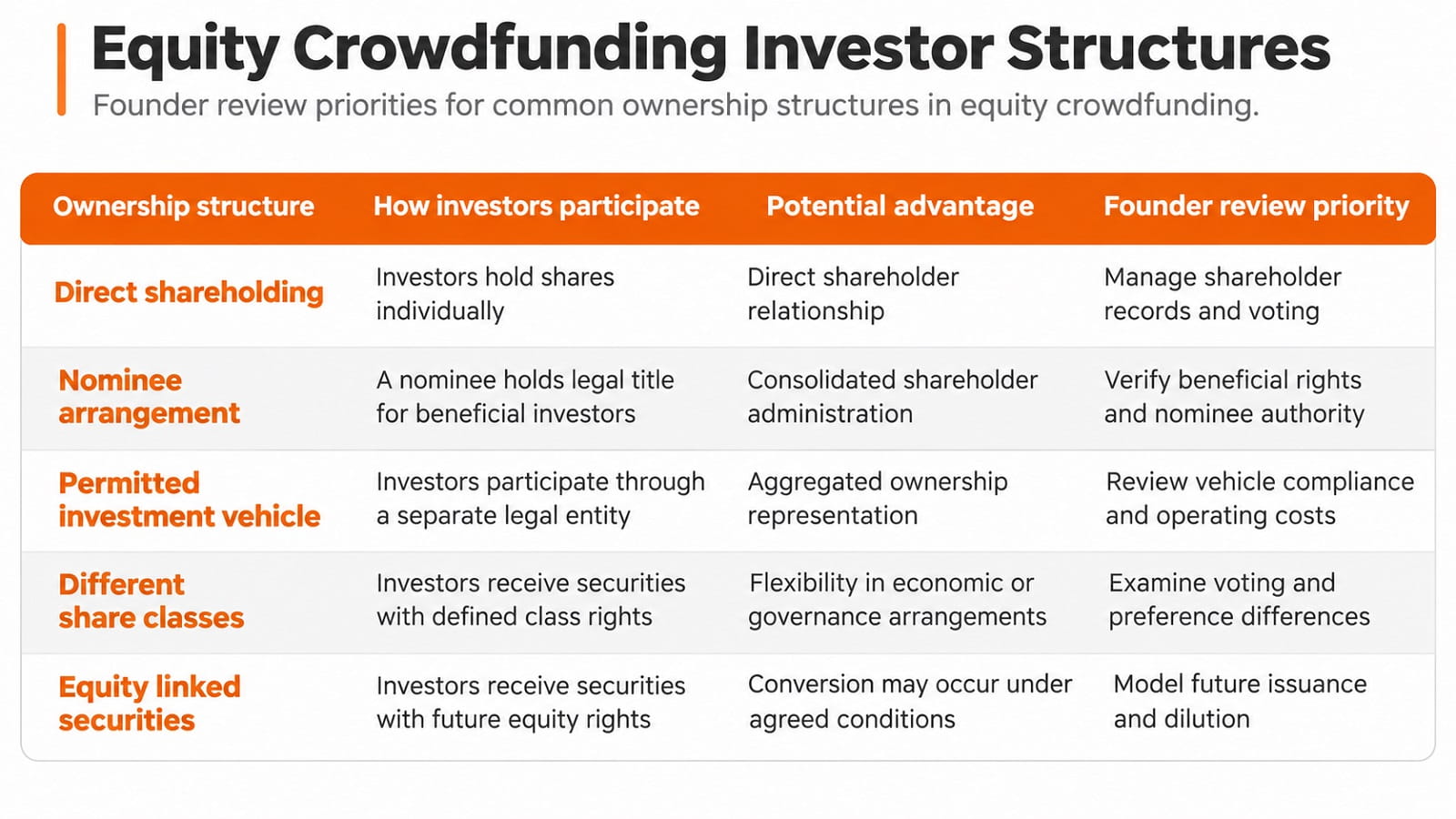
The most suitable arrangement is not necessarily the one that produces the smallest number of names on the capitalization table. Founders should also evaluate whether the structure protects investor rights appropriately, supports efficient corporate decision making, and remains acceptable to prospective institutional investors. A nominee or investment vehicle may simplify certain processes but introduce additional administration costs and contractual obligations. These factors should be considered alongside the company's existing shareholder agreements and future financing plans.
Equity Crowdfunding Regulations in the United States and United Kingdom
Equity crowdfunding involves securities offerings, making regulatory compliance an essential part of the fundraising process. The rules applicable to an offering depend on the company's jurisdiction, the investors being approached, and the legal framework used to distribute the securities. Founders should not assume that a campaign permitted in one country can automatically be advertised to investors in another. Cross border promotion may introduce additional registration, disclosure, or marketing restrictions.
United States: Regulation Crowdfunding
In the United States, Regulation Crowdfunding provides an exemption from conventional securities registration for eligible issuers that satisfy its requirements. Under the SEC framework, qualifying companies can raise up to $5 million through Regulation Crowdfunding over a rolling 12 month period. Offerings must be conducted through an appropriately registered intermediary, such as a broker dealer or funding portal, and issuers must comply with the applicable disclosure and offering rules.
Companies generally provide information through Form C, including details about the business, management, securities offered, financial condition, and investment risks. Financial statement requirements vary according to the offering circumstances and relevant regulatory thresholds. Investor limits, restrictions on resale, and ongoing reporting obligations may also apply. Founders should review the current SEC requirements before launching because compliance obligations depend on the specific transaction rather than simply the amount the company hopes to raise.
United Kingdom: FCA Requirements
In the United Kingdom, relevant investment crowdfunding activities fall within the regulatory framework overseen by the Financial Conduct Authority. Applicable requirements can concern platform authorization, financial promotions, investment distribution, and investor protection. The specific responsibilities depend on the regulated activities involved and the securities being offered, so founders must establish which rules apply to their planned campaign.
The FCA also emphasizes the significant risks associated with investing in private businesses through crowdfunding. Shares may be difficult to sell, company valuations can be uncertain, and investors may lose all their capital. Startups must therefore avoid presenting an investment opportunity as equivalent to a savings product or suggesting that business growth will necessarily produce financial returns. Clear risk disclosures and accurate investment communications are fundamental to a responsible offering.
How to Choose an Equity Crowdfunding Platform
Selecting the right platform requires evaluating regulatory suitability, investor access, financing costs, and post financing support. A platform with a substantial audience may appear attractive, but its investor base must be relevant to the company's business and financing objectives. Founders should establish whether the provider supports the intended securities, accepts issuers in the company's jurisdiction, and can facilitate the proposed investment amount.
Regulatory status should be verified through the appropriate official register where applicable. The intermediary should explain how it evaluates issuers, processes commitments, manages investor funds, and coordinates the closing of an offering. Founders also need to understand whether the platform requires particular ownership structures or investment terms that could affect the company's future financing flexibility.
Commercial terms deserve the same scrutiny. Platform commissions may be calculated as a percentage of successfully raised capital, while legal documentation, financial reviews, marketing production, payment processing, and investor administration can generate further expenses. Some charges may become payable even when the offering does not succeed. Management should obtain a detailed breakdown of costs before deciding how much capital the campaign needs to raise.
The relationship with the platform after closing is another important consideration. Certain providers support investor communications or nominee administration, while others have more limited ongoing responsibilities. The company should establish who maintains shareholder information, coordinates voting, manages distributions where relevant, and facilitates corporate actions. These responsibilities can become particularly significant during a later investment round or acquisition.
Equity Crowdfunding Costs and Founder Dilution
One of the main financial consequences of equity crowdfunding is the reduction in existing shareholders' percentage ownership. When a company issues new shares to investors, the total number of outstanding shares generally increases, reducing the proportion held by existing shareholders unless other arrangements change the outcome. The amount of dilution depends on the financing valuation, the investment received, and any adjustments involving outstanding securities or employee options.
Founders should distinguish the company's valuation before investment from its valuation after receiving new capital. In a simplified priced equity round, the post money valuation equals the pre money valuation plus the new equity investment. The new investors' ownership percentage can then be estimated by dividing the investment amount by the post money valuation. This calculation is useful for understanding dilution, but real transactions may require adjustments for convertible securities, option pools, and different share classes.
Campaign costs introduce another distinction. Investors acquire securities based on the offering terms, while the company may receive less cash than the gross amount raised because fees and transaction expenses reduce the net proceeds. A company should therefore evaluate the percentage of ownership issued in relation to the capital actually available for its business objectives.
A Practical Equity Crowdfunding Example
Consider Alder Robotics, a fictional technology startup developing automation solutions for small manufacturing businesses. After completing an initial commercial pilot, the company plans to raise $600,000 to expand production capacity and support customer acquisition. Its proposed pre money valuation is $4 million, and its existing ownership consists of 80% held by the founders and 20% held by angel investors.
Assume Alder successfully raises the full $600,000 through newly issued ordinary shares. For simplicity, the company has no outstanding convertible instruments, no employee option pool adjustments, and no additional securities issued during the transaction. Adding the investment to the pre money valuation produces a post money valuation of $4.6 million, giving the new crowdfunding investors approximately 13.04% ownership.
The existing shareholders collectively retain approximately 86.96% after the financing. The founders' ownership falls from 80% to approximately 69.57%, while the angel investors' stake declines from 20% to approximately 17.39%. Although neither existing shareholder group has sold its shares, its percentage ownership decreases because the company has issued new securities.
Alder must also account for transaction expenses. Assume the platform charges a hypothetical success fee equal to 6% of the capital raised, producing a $36,000 charge. Additional legal and compliance expenses amount to $14,000, while campaign preparation costs total $10,000. Combined expenses therefore equal $60,000, leaving the company with $540,000 in net proceeds.
The following table shows how the financing affects ownership and the capital available after assumed campaign expenses.
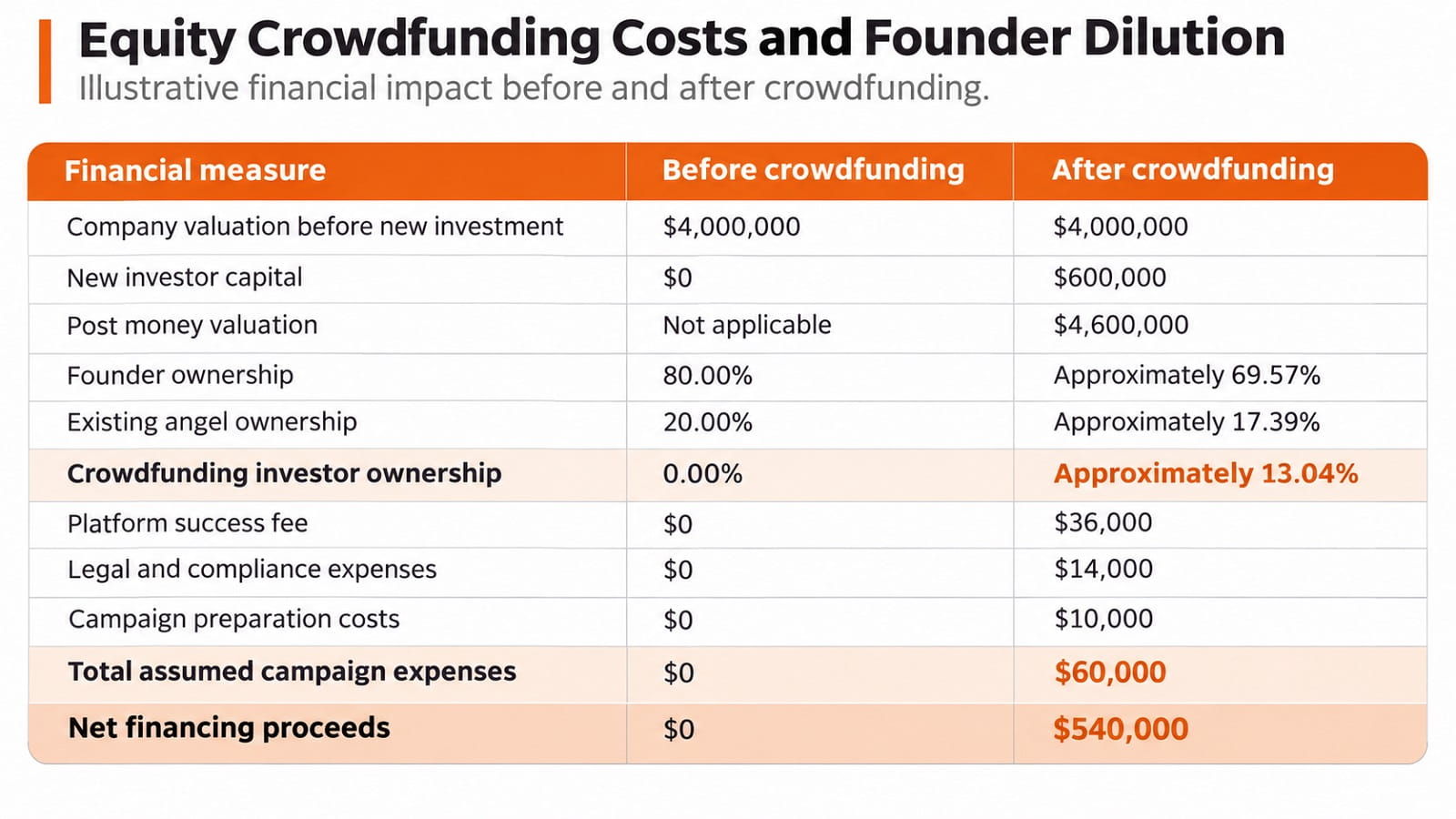
The example highlights the difference between raising capital and receiving usable cash. Alder sells approximately 13.04% of its equity to crowdfunding investors in exchange for $600,000, yet only $540,000 remains after the assumed transaction expenses. The founders' collective ownership decreases by approximately 10.43 percentage points, while the amount available for operations is 10% lower than the gross fundraising total. These calculations also show why valuation decisions and campaign budgeting should be evaluated together rather than as separate exercises.
Planning for the Next Investment Round
Suppose Alder needs the entire $600,000 for its planned expansion rather than $540,000. Under the example's assumptions, management would need to reduce the project budget, arrange additional financing, or consider a larger offering if the regulatory framework and investor demand permit it. Simply reaching the announced fundraising target would not satisfy the company's actual funding requirement.
Future financing introduces further ownership considerations. If Alder subsequently raises capital from venture capital investors, another issuance of shares may dilute the founders, existing angels, and crowdfunding investors. Institutional investors may also examine the company's shareholder records, voting arrangements, nominee agreements, and existing contractual protections before investing. Founders should therefore model more than the immediate offering and consider how the ownership structure might evolve over multiple financing rounds.
Advantages and Risks of Equity Crowdfunding
Equity crowdfunding can broaden access to investment capital and allow startups to engage potential investors outside traditional institutional financing networks. For companies with an established customer community, an offering may also create a deeper relationship between the business and individuals who believe in its products or long term strategy. Public investment interest can improve awareness of the company, although marketing exposure should not be confused with evidence that the business will become commercially successful.
Another advantage is the absence of ordinary scheduled debt service associated with a conventional loan. Equity financing generally allows a company to use investment capital without committing to fixed principal and interest payments. This can be useful for startups investing in product development or expansion where the timing of future revenue remains uncertain. Nevertheless, the financial flexibility comes at the cost of issuing ownership interests, and the rights attached to those interests may affect future corporate decisions.
The main disadvantages include dilution, fundraising expenses, securities compliance, and shareholder administration. A campaign may require substantial preparation before it becomes clear whether investors will commit sufficient capital. If the offering fails, the company may still be responsible for certain legal, marketing, or administrative costs. Public disclosure also requires management to communicate financial and operational information accurately without making unsupported forecasts.
Founders should consider the risks to participating investors as well. Startup investments are inherently uncertain, and shareholders may not have a practical opportunity to sell their securities for an extended period. The company must communicate these limitations appropriately and avoid suggesting that an eventual acquisition, public offering, or financial return is assured.
Preparing an Equity Crowdfunding Campaign
Preparation should begin with a clear financing objective. Founders need to define what the business will accomplish with the investment, how much capital the plan requires, and what milestones the company expects to reach. The financial forecast should reflect realistic operating expenses and include the costs associated with conducting the offering. A fundraising target that covers only project expenditure but ignores transaction fees may leave the company underfunded immediately after closing.
The company should then review its financial records and capitalization structure. Management must understand existing shareholdings, option arrangements, convertible securities, investor agreements, and any restrictions that could affect the proposed issuance. This review helps establish the financing valuation and identify matters that may require shareholder approval or contractual consent. A clear capitalization model also allows founders to explain the proposed dilution accurately.
Investment materials should present a consistent account of the company's business, financial performance, principal risks, and intended use of funds. Claims about commercial progress should be supported by reliable records, while forward looking statements should be appropriately qualified. Founders must also ensure that promotional activity follows the relevant securities rules rather than assuming conventional marketing practices are suitable for an investment offering.
Finally, the company should establish how it will communicate with investors after the transaction closes. Responsibilities for shareholder records, reporting, corporate actions, and investor questions need to be clearly assigned. Preparing these processes before launch reduces the risk of administrative complications when the startup later seeks additional financing or undertakes a significant corporate transaction.
Final Thoughts
Equity crowdfunding can help startups finance commercial development by providing access to a broader investment audience. Unlike conventional borrowing, it generally raises capital through securities issuance rather than scheduled loan repayments. This can create financial flexibility, particularly when a business requires capital for growth activities whose results may take time to materialize.
However, the amount successfully raised is only one measure of a campaign's financial outcome. Founders must also understand how much ownership they are issuing, what remains after platform and transaction costs, and how new investor rights may affect future corporate decisions. A financing round that appears attractive from a fundraising perspective can still introduce unnecessary complexity if its ownership structure is not carefully planned.
The most effective approach combines a realistic valuation, a clear use of funds, accurate financial disclosure, and an investor structure compatible with future growth. Equity crowdfunding should be evaluated as part of the startup's broader capital strategy, with equal attention given to the immediate financing requirement and the responsibilities that continue after the campaign closes.
FAQ
What Is Equity Crowdfunding for Startups?
Equity crowdfunding allows eligible startups to raise capital from multiple investors in exchange for shares or other qualifying securities through legally permitted investment arrangements. The investors participate in the potential financial value of the company but also accept the risk of losing their investment. The specific rights they receive depend on the securities offered and the applicable contractual terms.
Does Equity Crowdfunding Dilute Founder Ownership?
Yes. When a company issues new shares to crowdfunding investors, existing shareholders generally own a smaller percentage of the business. The amount of dilution depends on the financing valuation, capital raised, and capitalization adjustments. Founders should calculate the expected ownership consequences before committing to an offering.
How Much Can a Startup Raise Through Equity Crowdfunding?
The maximum amount depends on the jurisdiction and applicable offering framework. In the United States, eligible companies using Regulation Crowdfunding can raise up to $5 million over a rolling 12 month period under the SEC framework. Other jurisdictions impose different requirements, and a platform may establish its own offering conditions.
Do Crowdfunding Investors Receive Voting Rights?
Voting rights depend on the securities issued, the company's governing documents, and any nominee or investment vehicle arrangements. Some investors may hold shares with voting rights, while others participate through structures that provide different governance arrangements. Founders and investors should review these rights before the offering closes.
What Happens if an Equity Crowdfunding Campaign Fails?
If the required minimum funding threshold is not achieved, the offering may be cancelled and investor commitments handled according to the applicable rules. However, the startup may remain responsible for certain preparation or professional expenses. Management should establish these costs before launching the campaign.
Can Investors Sell Their Crowdfunding Shares?
Investors may have limited opportunities to sell their shares because privately held startup securities generally lack a liquid public market. Securities laws, contractual restrictions, and shareholder agreements may further limit transfers. Investors should not assume that they can immediately recover their capital by selling their holdings.
Can a Startup Raise Venture Capital After Crowdfunding?
Yes. A startup can pursue institutional investment after completing an equity crowdfunding campaign, provided the subsequent financing satisfies applicable requirements. However, prospective investors may review the shareholder structure, voting arrangements, existing rights, and capitalization records before committing capital.

Mobina Khanki
Venture & Funding Writer at PinerookMobina Khanki covers venture capital, startup funding, fundraising, and startup finance for Pinerook, focusing on founders and investors.
 Seen first.