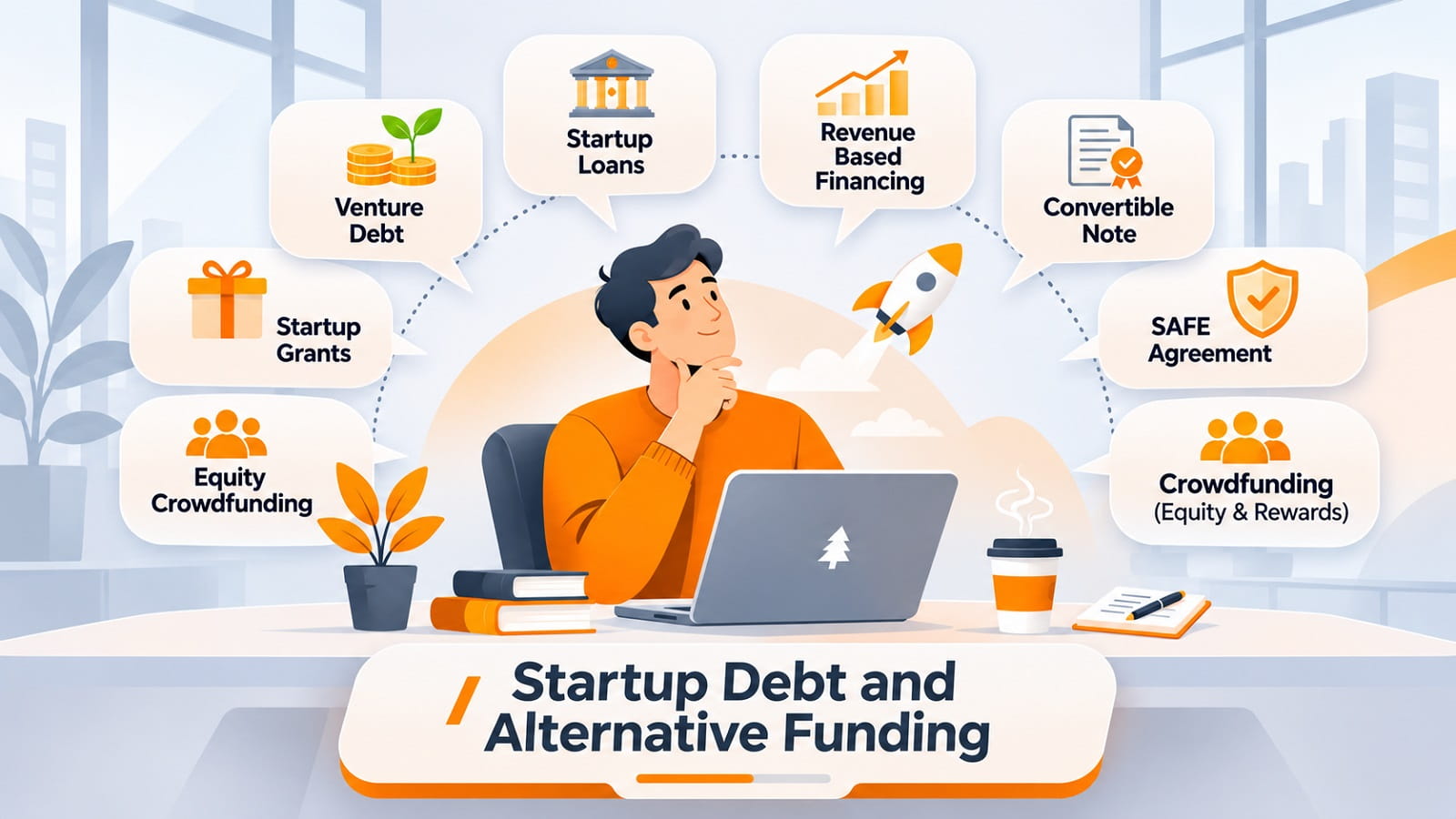
Startup debt and alternative funding give founders access to capital beyond traditional venture capital investment. These financing options include commercial lending, specialized venture financing, arrangements linked to business revenue, convertible investment instruments, government grants, and crowdfunding. Each method carries different financial obligations, ownership consequences, and eligibility requirements. Understanding these differences allows founders to select funding that supports their business model rather than creating financial commitments the company cannot sustain.
For an early stage startup, securing capital is only part of the challenge. The company must also determine whether it can afford repayment obligations, how financing will affect ownership, and whether the chosen structure provides enough flexibility to reach its next milestone. A loan may preserve equity but introduce regular payments, while a convertible investment can postpone an immediate valuation decision and create dilution later. Grants may provide support without conventional repayment obligations, although eligibility and spending restrictions can limit their usefulness.
This guide examines the main sources of startup debt and alternative capital, explains their financial and contractual consequences, and provides a practical framework for comparing funding options. It also follows a fictional software company through different financing scenarios to demonstrate how repayment terms, future dilution, and operating cash flow affect the funding decision.
What Is Startup Debt and Alternative Funding?
Startup debt refers to financing arrangements in which a company borrows money and accepts a contractual obligation to repay it. Repayment generally includes principal, interest, and any applicable fees, although the specific structure varies between lenders and financing products.
Unlike a conventional equity investment, borrowing does not necessarily require founders to issue new ownership interests. However, the absence of immediate equity dilution does not mean debt is free from financial risk. Lenders may require collateral, financial covenants, repayment guarantees, or restrictions on additional financing.
Alternative funding describes a broader collection of capital sources that extend beyond traditional venture capital equity rounds. Some involve borrowing, while others provide capital through investor participation, revenue sharing, public support programs, or customer contributions.
The distinction matters because alternative funding is not synonymous with non dilutive financing. Certain instruments eventually convert into equity, while crowdfunding arrangements may involve selling securities directly to investors.
A startup can also use several funding methods together. For example, a company might combine an equity investment with equipment financing and a grant supporting an eligible research project. The suitability of that combination depends on the compatibility of the contractual obligations and the timing of the company's financial needs.
Why Startups Consider Alternative Financing
Traditional venture capital is not appropriate or accessible for every startup. Institutional investors generally seek opportunities that match their investment strategies, growth expectations, and potential returns. A business can have a commercially viable model without meeting those requirements.
Some founders also prefer to preserve ownership or avoid introducing additional investor governance rights. Others need capital for a specific operating purpose rather than an extended period of speculative growth.
Alternative financing can address these circumstances when the company's financial characteristics support the chosen arrangement.
Preserving Ownership
Conventional debt generally allows founders to raise capital without immediately issuing additional shares. This may be particularly attractive when the business has predictable revenue and can support repayment from operating cash flow.
However, founders should compare the value of preserved ownership with the cost and risk of borrowing. Maintaining a larger equity percentage provides limited benefit if debt obligations place the company's operations under severe financial pressure.
Financing Specific Business Needs
A startup may need capital to purchase equipment, fulfill customer orders, develop technology, or expand its sales capacity. These activities have different timelines and financial outcomes.
Financing inventory backed by confirmed customer demand may justify a different structure from funding several years of research without commercial revenue.
Matching the financing arrangement to the intended expenditure can help reduce unnecessary financial pressure.
Diversifying Capital Sources
Dependence on a single financing source creates uncertainty if that source becomes unavailable. Combining suitable capital arrangements may allow founders to allocate different forms of financing to different business requirements.
However, diversification introduces additional contractual complexity. Existing lenders or investors may have approval rights that affect subsequent financing decisions, and some grants restrict how awarded funds can be used.
The goal should be a coherent capital structure rather than collecting as many funding sources as possible.
Debt Financing Compared With Equity Financing
Debt and equity distribute financial risk differently. Debt normally requires repayment under contractual terms regardless of whether the startup achieves its growth forecast. Equity investors generally accept the possibility of losing their investment in exchange for ownership and participation in potential future value.
Debt can be attractive when the company generates sufficient cash to support payments. It may also be appropriate for financing assets or operating needs with relatively predictable economic benefits.
Equity is often better suited to uncertain development activities that may require substantial investment before generating commercial returns. Although founders accept dilution, the business does not ordinarily face the same scheduled repayment obligations associated with a conventional loan.
The decision should therefore consider more than the immediate cost of obtaining capital. Founders need to evaluate repayment capacity, available collateral, ownership consequences, and the company's ability to tolerate weaker than expected results.
The Main Types of Startup Debt and Alternative Funding
Different financing arrangements serve different business needs. Some are designed for startups with established investor backing, while others are accessible to companies with operating revenue, qualifying projects, or supportive customer communities.
Understanding the basic mechanics of each option helps founders eliminate unsuitable funding sources before beginning detailed negotiations.
Specialized Lending for Venture Backed Companies
Specialized lending arrangements known as venture debt provide capital to qualifying growth companies, often those that have already raised institutional equity financing. Lenders may consider investor backing, available liquidity, revenue development, company assets, and the likelihood of future financing when assessing a loan application.
This financing can support growth initiatives, equipment purchases, or additional operating flexibility between equity rounds. It may allow founders to obtain capital without completing another immediate equity financing.
However, repayment remains an important obligation. Venture lenders may charge interest and fees, require security over company assets, impose financial covenants, or receive warrants that create some potential ownership dilution.
Founders should examine the repayment schedule and determine whether the company could continue servicing the loan if its next funding round is delayed. Borrowing based solely on the expectation that another investor will provide capital later can create substantial refinancing risk.
Loans for New and Growing Businesses
Access to startup loans depends on the company's location, financial history, ownership structure, creditworthiness, and lender eligibility requirements. Some lending programs focus on businesses with established operating revenue, while others consider founder guarantees, collateral, or projected financial performance.
Government supported lending programs may improve access to financing for eligible companies. However, such programs generally retain underwriting requirements and should not be interpreted as guaranteed funding for every new business.
When evaluating business loans for startups, founders should distinguish between term loans, revolving credit facilities, and financing secured against equipment or other business assets. These arrangements serve different purposes and may have different payment schedules.
A term loan may be suitable for a defined capital expenditure, while a revolving credit facility can help manage temporary changes in working capital. Equipment financing may connect repayment to an asset that supports operations over several years.
The financing amount should remain consistent with the company's repayment capacity. Founders should also review whether personal guarantees expose their own assets to risks beyond the company.
Financing Based on Company Revenue
Under revenue based financing, a business receives capital in exchange for payments determined by a defined percentage of revenue or cash receipts. Depending on the agreement, payments may continue until a specified repayment amount has been collected.
This arrangement can be attractive to companies with recurring revenue because payments may adjust as business activity changes. A month with lower eligible revenue can produce a smaller payment than a month with stronger collections, provided the contract does not impose overriding minimum payment requirements.
However, revenue is not the same as profit or free cash flow. A startup may generate substantial sales while facing high infrastructure, fulfillment, or customer acquisition expenses.
Founders should examine the percentage of receipts allocated to the financing provider, total repayment amount, fees, minimum payments, and treatment of refunds or revenue disruptions.
The cost should also be evaluated over time. A repayment multiple that appears straightforward can represent a substantially different effective financing cost depending on how quickly the company repays the capital.
Debt That Can Convert Into Equity
A convertible note is a debt instrument that can convert into company equity when specified contractual conditions occur. It is frequently used during early financing stages when the company and investors prefer to postpone establishing a definitive share price.
Convertible notes commonly include interest, maturity, and conversion provisions. The conversion price may depend on a valuation cap, discount, or another negotiated mechanism.
The maturity date deserves particular attention. If the company has not completed the anticipated financing before maturity, the agreement may provide for repayment, extension, or another contractual outcome.
Founders should also consider how accumulated interest affects conversion and the number of shares issued to investors.
Agreements for Future Equity
A safe agreement gives investors contractual rights to receive equity upon specified future events. Standard Y Combinator SAFEs are not loans and do not include ordinary interest or debt maturity provisions.
This structure can reduce some of the immediate repayment concerns associated with convertible debt. However, it does not eliminate the economic cost of financing because shares issued upon conversion can dilute existing shareholders.
Valuation caps, discounts where applicable, and conversion definitions influence the eventual ownership outcome. Founders should model these effects before accepting several instruments with different terms.
The distinction in safe vs convertible note becomes particularly important when evaluating financial risk. A convertible note creates a debt obligation until conversion or another settlement, whereas a standard SAFE does not impose conventional loan repayment requirements.
Both instruments may be useful during early fundraising, but their legal structure, conversion mechanics, and potential ownership consequences require separate assessment.
Grants and Public Support Programs
Eligible startups may receive startup grants from government agencies, research institutions, foundations, and other organizations supporting specific commercial or technological activities.
Grants can be attractive because qualifying awards generally do not require the company to issue ordinary equity shares or make conventional loan repayments.
However, funding may be restricted to specified expenses, eligible activities, or project milestones. Some programs require matching contributions, detailed financial reporting, or reimbursement requests after expenditure has already occurred.
Founders should verify the eligibility criteria, funding conditions, application deadlines, and reporting obligations before including a grant in the company's financial forecast.
An expected grant should not be treated as available cash until the relevant award and payment conditions have been satisfied.
Investment Through Crowdfunding
Through equity crowdfunding, eligible businesses can raise capital by issuing securities to investors through an applicable regulated fundraising framework.
This approach may allow startups to attract investment from a broader community, particularly when their products have a recognizable audience or established customer base.
However, securities offerings involve legal requirements that vary by jurisdiction. Issuer eligibility, disclosure obligations, investment limits, intermediary requirements, and shareholder administration may all affect the feasibility of a campaign.
The broader category of crowdfunding for startups also includes reward and donation campaigns. A reward campaign may allow founders to finance development or production through customer commitments without issuing equity.
These campaigns still create obligations. Businesses must consider production costs, fulfillment delays, refunds, and the possibility that collected funds will not be sufficient to deliver the promised products.
Founders should distinguish financing through securities from arrangements involving customer purchases, rewards, or donations because the legal and financial consequences are substantially different.
Comparing Startup Debt and Alternative Funding Options
The suitability of a financing method depends on the company's stage, revenue predictability, and intended use of capital. Founders should also consider whether the arrangement creates scheduled payments, introduces ownership dilution, or restricts future business decisions.
The following comparison summarizes the principal financial characteristics of the funding methods discussed above. It is intended as an initial decision framework rather than a substitute for reviewing actual financing offers and contractual conditions.
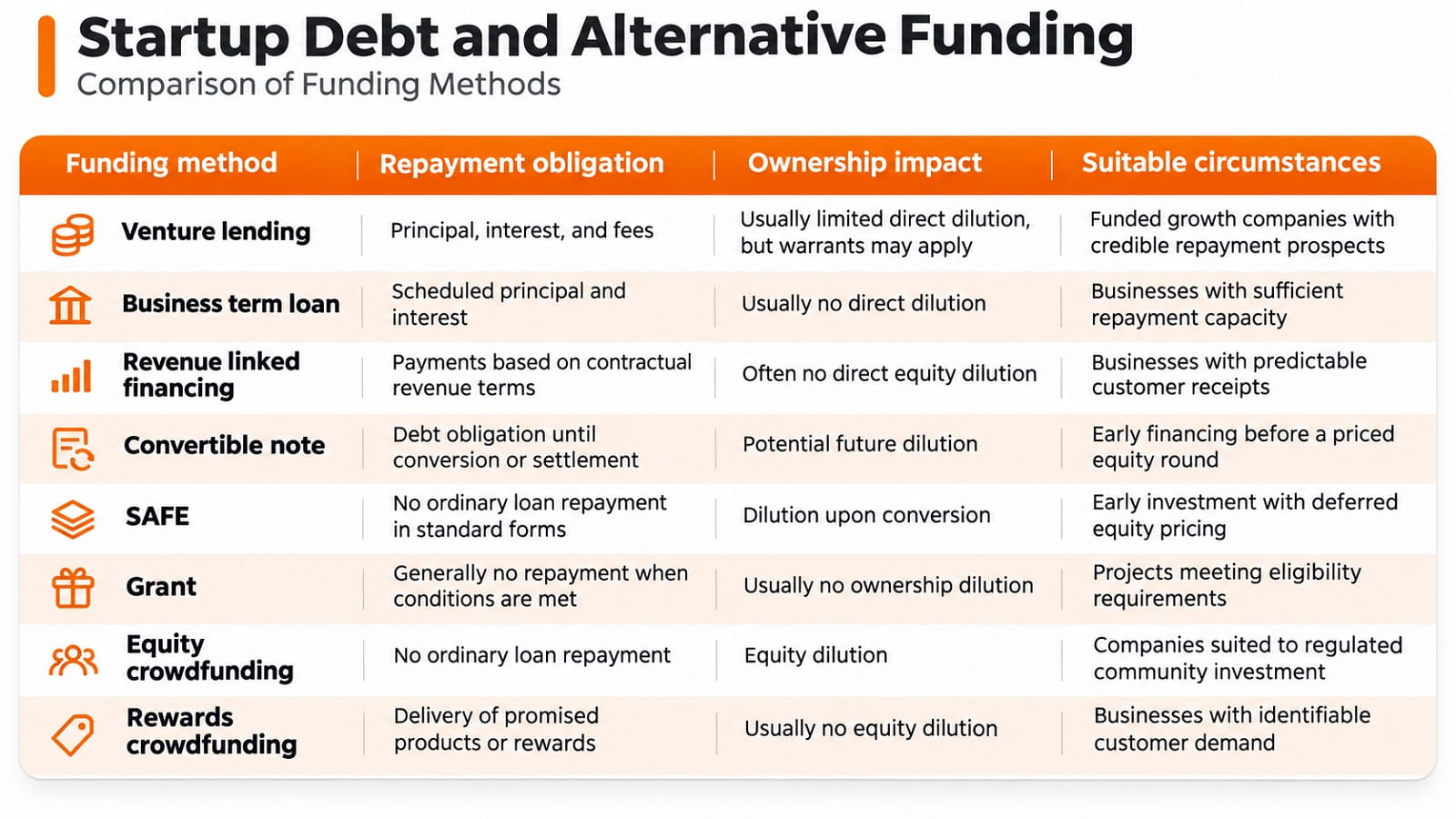
The comparison demonstrates that preserving ownership and preserving cash are different objectives. Conventional borrowing can avoid immediate dilution but creates repayment commitments, while convertible instruments may reduce current cash obligations at the cost of future ownership. Grants may avoid both conventional debt and equity dilution, but eligibility requirements can limit their usefulness. Founders should therefore assess the full financial consequences rather than selecting an option based on a single attractive feature.
How to Choose the Right Financing Method
Choosing financing begins with understanding what the company needs to accomplish. A startup financing a predictable inventory cycle has different requirements from a company developing technology without an established commercial market.
The decision should connect the use of funds with repayment capacity, total capital cost, ownership consequences, and the flexibility needed for future financing.
Match Financing to the Business Milestone
Founders should define the operational milestone the financing is expected to support. Examples include completing product development, expanding manufacturing capacity, launching a sales channel, or fulfilling confirmed customer orders.
The capital structure should reflect how long the company expects to take before the funded activity generates meaningful economic benefits.
Financing with near term repayment obligations may be inappropriate for a project whose commercial outcome remains uncertain for several years. Conversely, issuing equity for a relatively predictable working capital requirement may create unnecessary ownership dilution.
The objective is to choose financing whose obligations remain manageable throughout the period required to reach the intended milestone.
Calculate Realistic Repayment Capacity
Before borrowing, founders should estimate how much cash remains available after essential operating expenses, taxes, existing financing obligations, and necessary business investments.
Revenue forecasts alone are insufficient. Customers may pay later than expected, and higher sales can increase inventory, infrastructure, staffing, or fulfillment costs before the corresponding cash is collected.
A company considering debt should prepare a cash forecast that includes scheduled principal, interest, and relevant fees. The forecast should cover both expected performance and a reasonable downside scenario.
If modest underperformance would make the obligations unaffordable, the proposed financing may be too large or structured with insufficient flexibility.
Evaluate the Total Cost of Capital
The cost of financing extends beyond headline interest rates or repayment multiples.
Conventional loans may include origination charges, commitment fees, legal expenses, and security requirements. Specialized lending may also involve warrants, which can create future equity dilution.
Revenue linked financing should be assessed according to the total expected repayment and the timing of payments. The same repayment amount can represent different financing costs depending on how quickly the company pays it.
Convertible instruments require a separate ownership analysis. Valuation caps, discounts, interest on notes, and conversion events can influence the number of shares issued to investors.
Founders should compare cash costs and ownership effects separately before deciding which financing arrangement is economically attractive.
Consider the Effect on Future Fundraising
Existing financing obligations can influence the company's ability to obtain additional capital.
Lenders may restrict further borrowing or require approval for specified corporate transactions. Convertible instruments may affect the capitalization table and the number of shares available to new investors.
Grants can impose conditions on intellectual property, eligible expenditure, or project reporting. Regulated crowdfunding may introduce disclosure and investor administration responsibilities.
The best financing arrangement should address the immediate capital requirement without unnecessarily limiting the company's next stage of development.
A Practical Startup Financing Example
Consider Atlas Systems, a fictional software company with an established subscription product and growing customer demand. Management wants to raise $500,000 to expand sales operations, improve its technology, and finance additional working capital.
Atlas currently has $350,000 in unrestricted cash. It collects approximately $120,000 from customers each month and pays $150,000 in operating cash expenses. Its current monthly operating cash shortfall is therefore $30,000.
The company is considering three financing structures. Each would provide $500,000, but the repayment obligations and ownership consequences would differ significantly.
Comparing Three Financing Structures
Under the first option, Atlas receives a $500,000 term loan with an illustrative fixed annual interest rate of 12%, repaid through 36 equal monthly installments. Using a standard monthly amortization calculation, its payment would be approximately $16,607, excluding fees.
The second option involves a financing provider advancing $500,000 in exchange for payments equal to 8% of eligible customer receipts until a total contractual repayment amount of $650,000 is reached.
The third option involves a $500,000 investment through a standard style SAFE with an illustrative $5 million post money valuation cap. This arrangement would not require ordinary scheduled loan payments, but it would create future equity dilution under the applicable conversion terms.
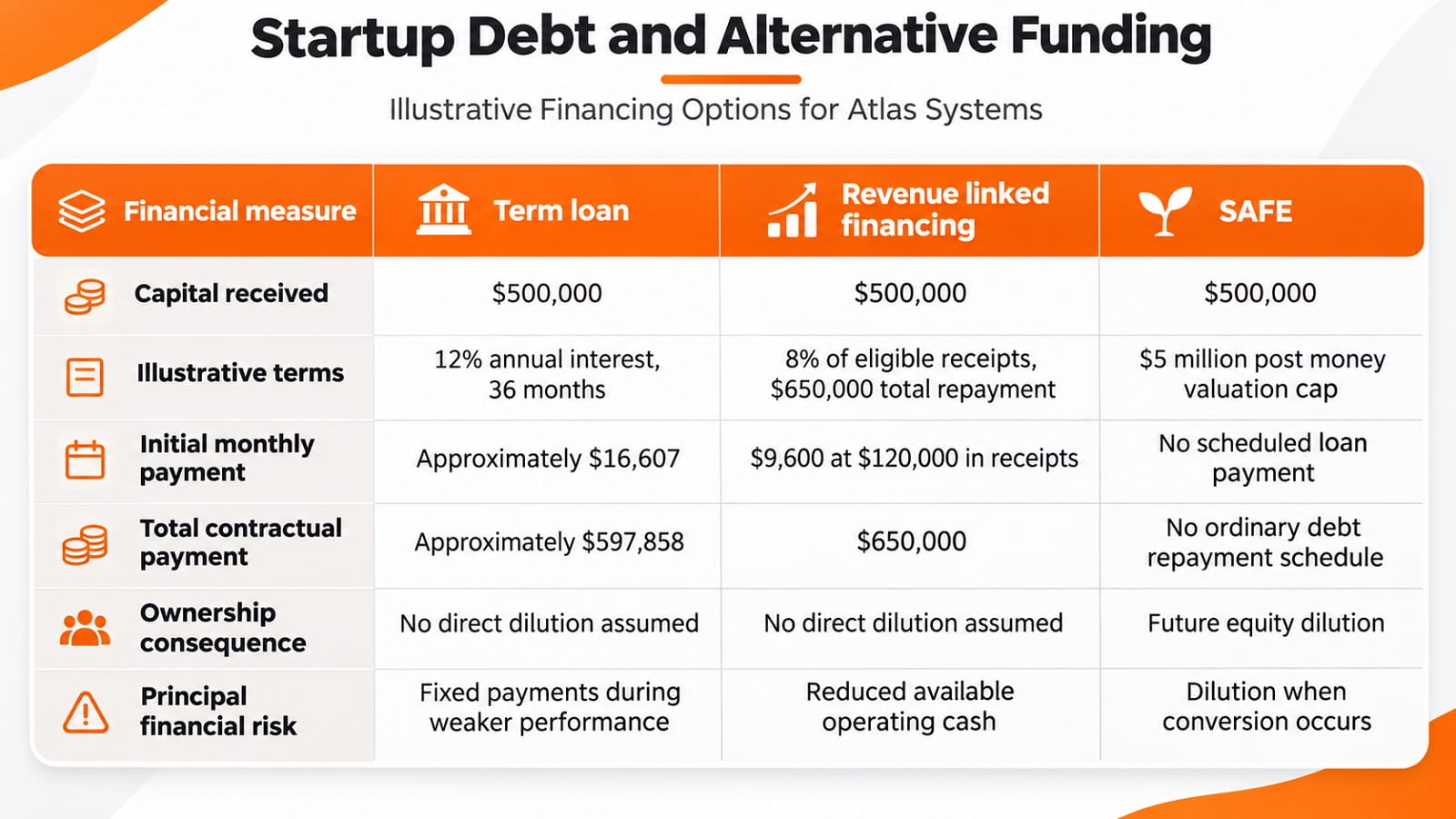
These figures illustrate financing mechanics rather than actual market offers. The calculation excludes additional loan fees, warrants, taxes, and unexpected operating changes. For the revenue linked option, the monthly payment varies with eligible receipts, and the eventual repayment duration depends on actual performance and contractual conditions. The SAFE illustration also requires a capitalization analysis before its ownership consequences can be determined precisely.
How the Options Affect Cash Flow
Before financing, Atlas has a monthly operating cash shortfall of $30,000. If customer collections and expenses remain unchanged, the term loan would increase total monthly cash consumption to approximately $46,607 while scheduled repayments continue.
The revenue linked arrangement would produce an initial payment of $9,600 at the current collection level, increasing the monthly cash shortfall to $39,600. If eligible receipts declined, the payment could decrease under the assumed percentage structure, although the company's operating shortfall might become larger.
The SAFE would not introduce an ordinary debt installment. Atlas could therefore preserve more cash during the initial period, but the financing would affect the ownership interests of existing shareholders when conversion occurs.
These differences demonstrate why an identical funding amount can produce substantially different financial results.
Understanding the Effect on Financial Runway
After receiving $500,000, Atlas would have an illustrative cash balance of $850,000 before transaction costs.
At its existing monthly operating cash shortfall of $30,000, this would represent approximately 28.3 months of simple runway if conditions remained unchanged.
Under the term loan, monthly cash consumption would increase to approximately $46,607, reducing the corresponding estimate to about 18.2 months.
For the revenue linked arrangement, the runway would depend on changes in collections, operating expenses, and the repayment schedule. Under the SAFE, no ordinary debt installment would be added, although future financing and ownership consequences would remain relevant.
These estimates are simplified and should not replace a monthly cash forecast. They assume no additional growth expenditure, changes in revenue, or unexpected obligations.
Selecting the Appropriate Structure
The term loan may be suitable if Atlas expects reliable cash generation and can support fixed installments. However, its existing operating cash shortfall means management should examine whether additional debt service is prudent before accepting the financing.
Revenue linked payments may provide greater flexibility when receipts fluctuate, but they still reduce the money available for operations. The company should evaluate the financing cost and whether payment obligations remain affordable under slower growth.
The SAFE avoids conventional monthly debt service, making it potentially attractive when preserving operating cash is a priority. Its future dilution, however, must be evaluated alongside the company's capitalization and anticipated financing plans.
The correct choice depends on the company's forecast, tolerance for risk, and long term capital strategy rather than a universal preference for debt or equity.
Combining Multiple Sources of Startup Capital
A startup may benefit from using different forms of capital for different business requirements. For example, a technology company could finance eligible research through a grant, use a commercial loan to purchase equipment, and rely on equity investment for broader product development.
This approach can match financing obligations more closely with the economic characteristics of each activity. However, combining capital sources also creates additional complexity.
Loan agreements may restrict new indebtedness, investors may hold approval rights, and grant programs may limit how money can be spent. Founders should review these restrictions before committing to multiple arrangements.
A consolidated financial forecast should show when each funding source becomes available, which expenses it supports, and when any repayment obligations arise.
Combining financing methods should strengthen the company's financial resilience rather than create a collection of incompatible commitments.
Preparing a Startup for Alternative Financing
Funding providers evaluate companies using different criteria, but reliable financial information remains important across most financing methods.
Lenders may examine historical cash flow, existing debts, customer concentration, collateral, and repayment capacity. Revenue linked providers may focus on recurring receipts, payment records, and the stability of commercial activity.
Grant programs evaluate eligibility and the intended use of funds, while equity investors typically consider commercial potential, company valuation, and ownership arrangements.
Founders should prepare current financial statements, a realistic operating forecast, and a clear explanation of how the requested funding will be used.
The forecast should include a downside scenario, especially when repayment obligations depend on continued sales growth or timely customer collections.
Accurate capitalization records and an understanding of existing contractual restrictions are also important. A financing arrangement may require consent from current investors, lenders, or other parties before it can be completed.
Risks of Startup Debt and Alternative Financing
Every financing method introduces risks that should be considered before accepting capital. The most important concerns involve financial commitments, ownership changes, contractual restrictions, and uncertainty about future business performance.
Repayment and Default Risk
Debt creates obligations that remain relevant even when customer demand weakens. Founders should examine scheduled payments, default definitions, acceleration provisions, collateral requirements, and financial covenants.
Personal guarantees require particular attention because they may expose the founder to liabilities beyond the company.
Ownership Dilution
Convertible investments can postpone immediate equity issuance without eliminating future dilution. Multiple outstanding instruments may produce ownership outcomes that differ substantially from the founder's initial expectations.
The company should maintain a capitalization model that includes relevant conversion scenarios before issuing additional instruments.
Regulatory and Contractual Compliance
Grants and securities crowdfunding arrangements may require specific disclosures, reporting, and permitted uses of funds. Failure to satisfy these requirements can create financial or legal consequences.
Founders should verify the applicable rules in their jurisdiction and obtain professional advice where necessary.
Excessive Dependence on Future Funding
Borrowing based on an assumed future investment round can create serious liquidity risk if the financing is delayed or unavailable.
Expected investments, grants, or refinancing arrangements should be distinguished from confirmed funds in the company's cash forecast.
A financing strategy should remain viable under reasonable downside conditions rather than depending entirely on the next capital provider.
A Practical Funding Decision Framework for Founders
Founders can evaluate financing alternatives through a structured process that connects capital requirements to business milestones.
The first step is defining the required amount and its intended use. Rather than requesting the largest available sum, the company should estimate how much capital is necessary to complete a specific initiative and maintain sufficient operating flexibility.
The second step is evaluating financial capacity. This involves reviewing cash balances, expected collections, existing commitments, and the potential consequences of weaker business performance.
Next, founders should compare financing options using their complete contractual terms. The assessment should include repayment obligations, fees, equity dilution, collateral, eligibility requirements, and restrictions on future financing.
Finally, the preferred arrangement should be tested against the company's broader capital strategy. A funding source that supports an immediate milestone but creates substantial obstacles for the next financing round may not be the best long term choice.
A financial and legal review before signing can help identify obligations that are easy to overlook when attention is focused primarily on receiving capital.
Final Thoughts
Startup debt and alternative funding provide founders with financing choices beyond conventional venture capital investment. Each arrangement offers a different balance of repayment obligations, ownership consequences, eligibility requirements, and financial flexibility.
The most suitable financing method is not necessarily the one that provides the largest amount of money or avoids immediate dilution. It is the arrangement that matches the startup's financial capacity, supports a clearly defined milestone, and allows the company to continue operating under realistic conditions.
Founders who compare funding methods through cash flow forecasts, contractual analysis, and ownership scenarios are better positioned to make sustainable financing decisions. A well structured capital strategy should help the company reach its next stage of development without creating obligations that threaten its ability to grow.
FAQ
What Is Alternative Funding for Startups?
Alternative funding includes financing methods beyond traditional venture capital equity investment. These can involve commercial borrowing, specialized lending, revenue linked arrangements, convertible instruments, public support programs, and community fundraising.
Can Startups Raise Money Without Giving Up Equity?
Yes. Conventional loans, grants, and certain revenue linked or reward based arrangements may provide financing without directly issuing ownership interests. However, founders should consider repayment obligations, fees, guarantees, and other contractual restrictions.
Is Debt Financing Better Than Equity Financing?
Neither approach is universally preferable. Debt may preserve ownership but introduce repayment obligations, while equity can reduce immediate cash pressure at the cost of dilution. The appropriate choice depends on the company's financial position and business objectives.
Can a Startup Without Revenue Obtain Financing?
Some companies without revenue may qualify for funding through eligible grant programs, convertible investments, equity financing, or lending supported by suitable guarantees or collateral. Availability depends on the provider and the startup's circumstances.
Is a SAFE Considered a Loan?
A standard Y Combinator SAFE is not a loan and does not include ordinary interest or debt maturity provisions. It establishes contractual rights related to future equity issuance when specified events occur.
How Does Revenue Linked Financing Affect Cash Flow?
Payments are calculated according to contractual revenue or receipts definitions. This can make payments responsive to commercial performance, although the amount collected by the financing provider still reduces cash available for business operations.
Are Government Grants Free Money?
Grants generally do not require conventional repayment when their conditions are fulfilled. However, they may impose eligibility restrictions, permitted expenditure requirements, reporting obligations, and other commitments.
Can a Startup Use Debt and Equity Together?
Yes. A company may combine loans, equity investments, and other financing methods when the contractual arrangements permit it. Founders should assess the combined effect on cash flow, ownership, and future fundraising flexibility.

Mobina Khanki
Venture & Funding Writer at PinerookMobina Khanki covers venture capital, startup funding, fundraising, and startup finance for Pinerook, focusing on founders and investors.
 Seen first.


