Building a startup is a journey of turning uncertainty into evidence. In the early days, founders are not only trying to build a product; they are trying to prove that a real problem exists, that customers care about solving it, and that the team behind the idea can execute.
As the company grows, the questions become different. A startup that is still validating its idea does not need the same resources or investor expectations as a company that already has customers, revenue, and a clear growth model. This is why understanding Startup Funding is not just about knowing where money comes from. It is about understanding when capital can create meaningful progress and what a company needs to achieve before moving to the next stage.
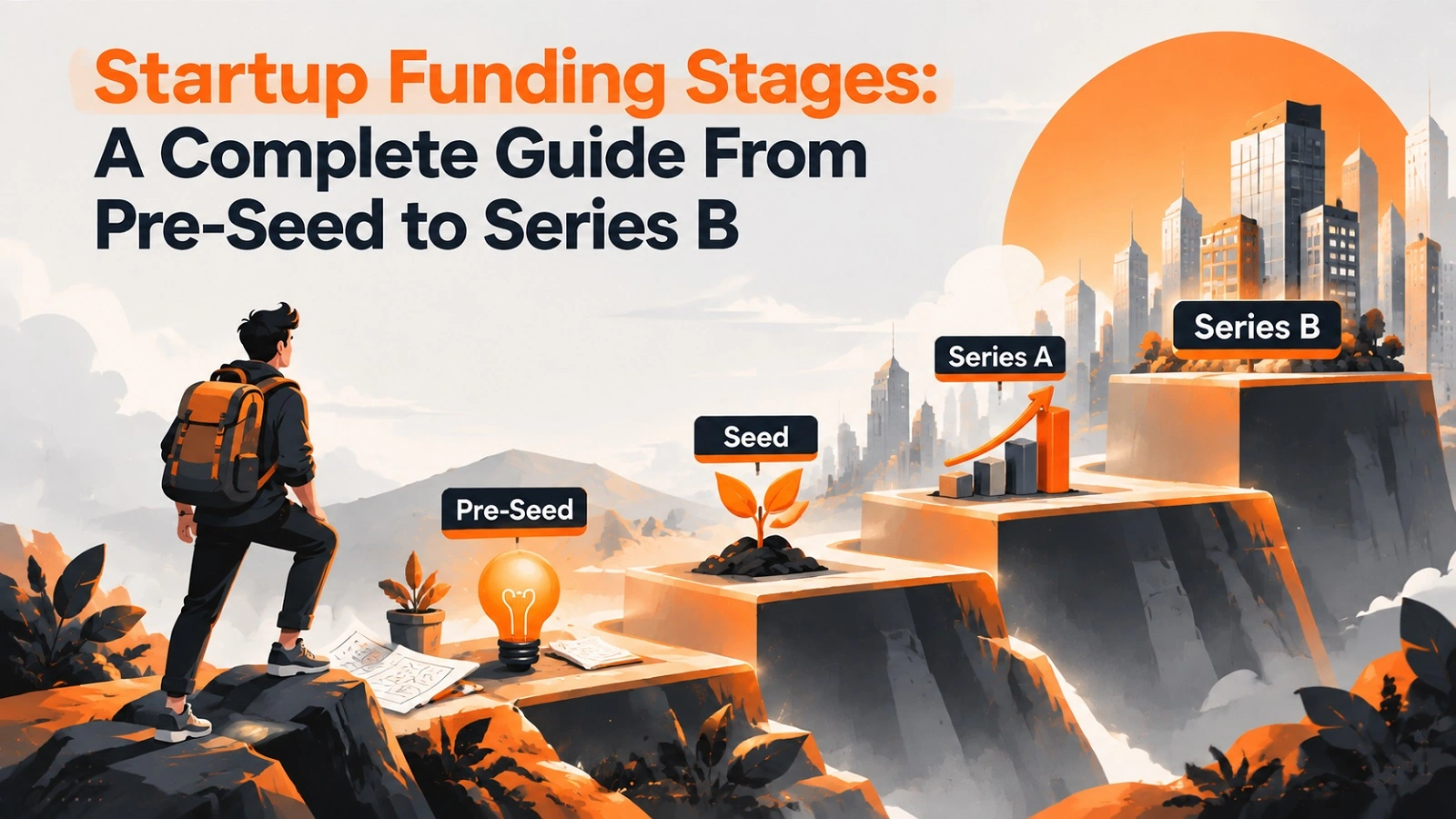
The journey through startup funding stages helps founders understand how investors evaluate opportunities, why different rounds exist, and what milestones usually define the transition from an early idea into a scalable company.
Why Startup Funding Stages Matter
Not every startup follows the same path. Some companies can grow through customer revenue from the beginning, while others need external capital because they are building technology, entering competitive markets, or trying to move quickly before competitors.
Funding stages create a shared framework between founders and investors. They explain where a company currently stands, what risks have already been reduced, and what challenges remain. A founder raising capital for an early prototype is having a completely different conversation from a founder preparing to expand a proven business model.
Many founders make the mistake of viewing funding rounds as achievements on their own. However, a successful funding round is not simply about collecting money. The real purpose of capital is to help the company reach a specific milestone that would be difficult or impossible to achieve without additional resources.
For example, early funding may help validate customer demand, while later funding may help scale a system that is already working. The value of each round depends on whether the capital creates measurable progress.
Startup Funding Stages at a Glance
Before exploring each stage in detail, it is useful to understand how funding rounds differ. Each stage represents a different level of company maturity, uncertainty, and investor expectation.
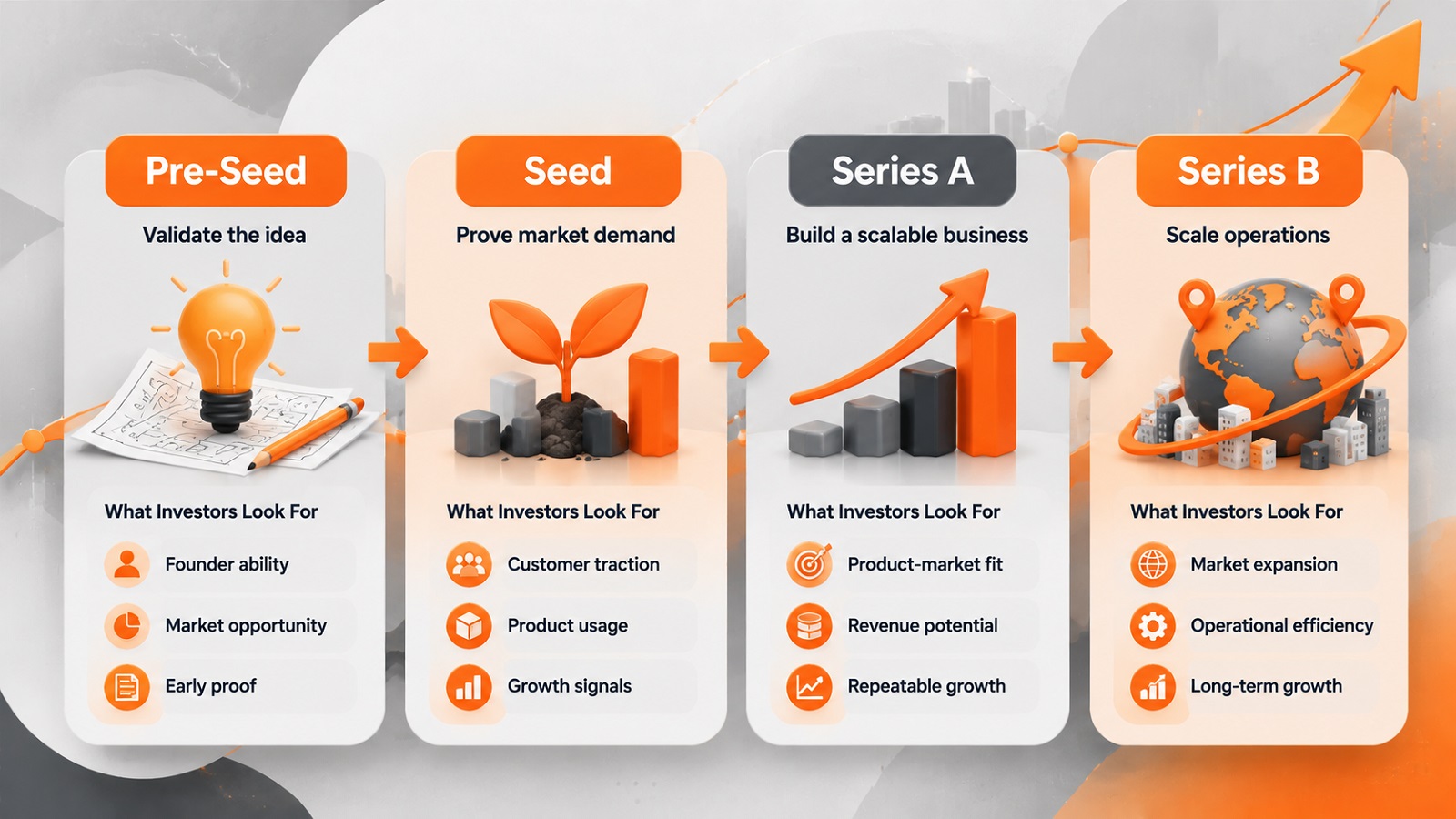
These stages are not simply based on how old a company is. They represent different questions investors are trying to answer.
At the earliest stages, investors are often asking whether the problem is important, whether the founding team understands the market, and whether there is enough evidence to justify building the product.
As companies move forward, the focus changes. Investors begin looking for stronger proof that customers are responding, growth can be repeated, and the business model can support expansion.
Pre Seed Funding: Turning an Idea Into Early Proof
Pre seed is usually the first stage where founders look for external capital to move an idea beyond the concept phase. At this point, the company may only have a prototype, an early product version, or even a strong understanding of the problem it wants to solve.
The main challenge at this stage is not scaling. It is learning.
Founders use pre seed capital to answer fundamental questions:
Is this problem important enough for customers to care about?
Is the proposed solution actually useful?
Can the founding team build something people want?
Pre seed funding is commonly used for product development, customer interviews, market research, and building the first version of the company. Since uncertainty is still high, investors at this stage often focus heavily on the founders themselves.
They want to understand:
Why does this team understand the problem?
Why is this market opportunity worth pursuing?
Does the company have the ability to adapt based on feedback?
A startup does not need to have a complete business model at the pre seed stage. However, it needs a clear direction and a convincing reason why this idea has the potential to become valuable.
The purpose of pre seed capital is not to prove that everything is already working. It is to create enough evidence that the company deserves the next opportunity.
Seed Funding: Finding Product Market Signals
After a startup has moved beyond the initial idea stage, the focus shifts toward proving that the market is responding. This is where seed funding becomes important.
At the seed stage, founders usually have more than an idea. They may have an MVP, early customers, user feedback, or initial revenue signals. The goal is to understand whether these early signs can become a repeatable business model.
Seed capital is often used to improve the product, hire important team members, develop customer acquisition channels, and create systems that support growth.
Investors at this stage are looking for evidence such as:
Customers actively using the product
Signs of retention
Early revenue
Strong user feedback
A clear understanding of the target market
The difference between pre seed and seed is not only the amount of money raised. It is the amount of uncertainty removed.
Pre seed asks:
“Is this idea worth exploring?”
Seed asks:
“Is there evidence that customers actually want this?”
A strong seed round gives the startup the resources needed to move from experimentation toward a more predictable business.
Series A Funding: Building a Scalable Company
Series A represents a significant change in how investors evaluate a startup. At this stage, the company is expected to show more than potential. It needs evidence that it can build a repeatable and scalable business.
The focus moves from proving that the product works to proving that the company can grow efficiently.
Companies raising Series A funding usually focus on:
Expanding the team
Improving operations
Growing customer acquisition
Strengthening the product
Building repeatable growth systems
Investors typically evaluate:
Product market fit
Market size
Revenue potential
Customer growth
Team capability
The central question at this stage becomes:
“Can this company turn early success into sustainable growth?”
Many startups fail to make this transition because they confuse early interest with scalability. Having users or early customers is valuable, but investors want to understand whether that success can continue as the company becomes larger.
A successful Series A round helps transform a promising startup into a structured business.
Series B Funding: Scaling What Already Works
Series B is the stage where the conversation shifts from proving the business model to expanding it. By this point, the startup has usually moved beyond experimentation and has stronger evidence that customers want the product and that the company can generate repeatable growth.
At this stage, investors are not only asking whether the business can work. They are looking at how efficiently it can become much larger.
Companies typically use Series B capital to:
Enter new markets
Expand sales and marketing teams
Improve internal systems
Increase operational capacity
Develop additional products or services
The evaluation process also becomes more focused on measurable performance. Investors pay closer attention to:
Revenue growth
Customer retention
Operational efficiency
Market position
Long term scalability
A startup raising Series B should have a clear explanation of why additional capital will create significant growth rather than simply increase spending.
The main question at this stage is:
How can this successful model become a much larger company?
How Investor Expectations Change Across Funding Stages
One of the most important things founders need to understand is that investors are not looking for the same evidence at every stage.
At the pre seed stage, investors understand that uncertainty is high. They are often evaluating the founders, the market opportunity, and whether there is a strong reason to believe the idea could become valuable.
During seed funding, the focus moves toward early market signals. Investors want to see that customers are responding, the product is solving a real problem, and the company has learned enough from the market to improve its direction.
By Series A, expectations become more focused on repeatability. Investors want evidence that the startup has moved beyond early experiments and has the foundation needed to grow efficiently.
At Series B and later stages, investors are usually looking for operational strength. The company needs to show that it can manage growth, expand responsibly, and create long term value.
This progression explains why founders should not approach every fundraising conversation in the same way. A pitch that works for an early stage investor may not answer the questions of a later stage investor.
Choosing the Right Stage Before Raising Capital
The timing of fundraising can have a major impact on a startup’s future. Raising too early may force founders to give away ownership before the company has enough evidence to negotiate effectively. Raising too late may limit the company’s ability to take advantage of market opportunities.
Instead of asking, “How soon can we raise money?”, founders should ask:
“Will this capital help us reach a meaningful milestone?”
A startup may be ready to raise when it has:
A clear understanding of the customer problem
Evidence that users want the product
A strong explanation of how the market opportunity works
A realistic plan for using the capital
Specific milestones that the funding will help achieve
The strongest fundraising processes usually begin when a company has momentum, not when it is running out of options.
What Milestones Should Each Funding Stage Achieve?
Each funding round should have a clear purpose. The goal is not simply moving from one round name to another. The goal is reducing uncertainty and building a stronger company.
At the pre seed stage, the priority is learning. Founders are trying to understand the problem, validate assumptions, and build something that customers may want.
At the seed stage, the focus shifts toward traction. The company needs stronger evidence that its product is gaining interest and that there is a market willing to support it.
At Series A, the company should focus on scalability. The goal is proving that growth can happen through repeatable processes rather than isolated successes.
At Series B, the priority becomes expansion. The startup needs to show that its existing model can work across larger markets and a bigger customer base.
Thinking about funding through milestones helps founders avoid using capital without a clear direction.
Common Mistakes Across Funding Stages
Many fundraising mistakes happen because founders misunderstand what each stage requires.
Treating Every Round the Same
A common mistake is using the same fundraising story for every investor.
A pre seed investor understands that the company is still searching for validation. A Series B investor expects stronger evidence, clearer metrics, and a more mature operating model.
The more advanced the stage, the more investors expect proof.
Raising Without Clear Milestones
Capital should always be connected to progress.
Before raising, founders should be able to explain:
What will this money help build?
Which milestones will be achieved?
How will the company be stronger after this round?
Without clear answers, funding can become a temporary solution rather than a growth strategy.
Focusing Only on Valuation
Many founders focus heavily on valuation because it directly affects ownership. However, the highest valuation is not always the best outcome.
The right investor relationship matters because investors may influence important decisions, provide strategic support, and participate in future funding rounds.
Founders should consider:
Investor experience
Industry knowledge
Network value
Long term alignment
Scaling Before Validation
Growing too quickly before the business model is ready can create unnecessary complexity.
Hiring large teams, expanding markets, or increasing spending before understanding customer demand can make problems more expensive.
Growth should follow evidence, not replace it.
How Founders Can Prepare for the Next Funding Stage
Successful founders think about the next stage before they reach it.
A company preparing for seed funding should focus on proving that the problem is real and customers are interested.
A company preparing for Series A should focus on demonstrating product market fit and showing that growth can become repeatable.
A company preparing for Series B should strengthen operations, improve efficiency, and prove that the business model can scale.
Preparation is not only about improving metrics. It is also about building the systems, team, and strategy required for the next phase.
Final Thoughts on Startup Funding Stages
Understanding funding stages helps founders make better decisions about timing, investors, and growth strategy.
From validating an idea in pre seed to expanding a proven business in Series B, each stage represents a different challenge and requires a different approach.
The goal of fundraising is not simply to collect more capital. The goal is to use the right resources at the right time to build a stronger company.
When founders understand where their startup stands, what investors expect, and which milestones matter, they can approach fundraising with more clarity and create better opportunities for long term growth.
FAQ
What are the main startup funding stages?
The main stages are pre seed, seed, Series A, and Series B. Each stage represents a different level of startup maturity, risk, and investor expectation.
What is the difference between pre seed and seed funding?
Pre seed focuses on validating the idea and building early proof. Seed funding focuses on gaining traction, improving the product, and proving market demand.
When should a startup raise funding?
A startup should consider raising when capital can help achieve specific milestones and accelerate meaningful growth.
What do investors look for at different funding stages?
Early stage investors usually focus on the team, market opportunity, and early validation. Later stage investors expect stronger evidence such as traction, scalability, revenue growth, and operational strength.
Do all startups need venture funding?
No. Some startups grow through revenue, bootstrapping, grants, or other financing methods without raising venture capital. The right approach depends on the company’s business model and growth strategy.

Mobina Khanki
Venture & Funding Writer at PinerookMobina Khanki covers venture capital, startup funding, fundraising, and startup finance for Pinerook, focusing on founders and investors.
 Seen first.