The right funding at the right stage can help a startup move faster, hire the right people, build stronger products, and capture market opportunities before competitors do. But raising money too early, choosing the wrong investors, or scaling before the business is ready can create pressure that slows the company down.
That is why startup funding is not simply about getting money. It is about understanding when capital creates leverage and when it creates unnecessary complexity.
For founders, funding is connected to bigger decisions: How much ownership should they keep? Which investors can provide value beyond capital? What milestones should each round achieve? And when is the company actually ready to raise?
This guide explains the complete journey of startup capital, including startup funding stages, different funding options, investor expectations, fundraising strategies, and the mistakes founders should avoid.
What Is Startup Funding?
Startup funding is the capital a startup uses to build, validate, and grow its business.
Unlike traditional businesses that mainly grow through revenue, many startups use external capital to move faster in markets where speed and scale matter.
Startups usually use funding for:
Building products and technology
Hiring key employees
Testing customer demand
Improving distribution channels
Expanding into new markets
Developing operational systems
However, funding itself does not create a successful company.
Capital only amplifies what already exists. If a startup has strong customer demand and a clear growth path, funding can accelerate progress. If the fundamentals are weak, more money often increases the speed of problems.
The most important question before raising capital is:
What specific progress will this funding allow the company to achieve?
A strong fundraising strategy connects every dollar raised to measurable milestones.
Understanding Startup Funding Stages
The journey of startup capital is usually divided into different stages. Each stage represents a different level of uncertainty, business maturity, and investor expectation.
The main startup funding stages include pre-seed, seed, Series A, and Series B.
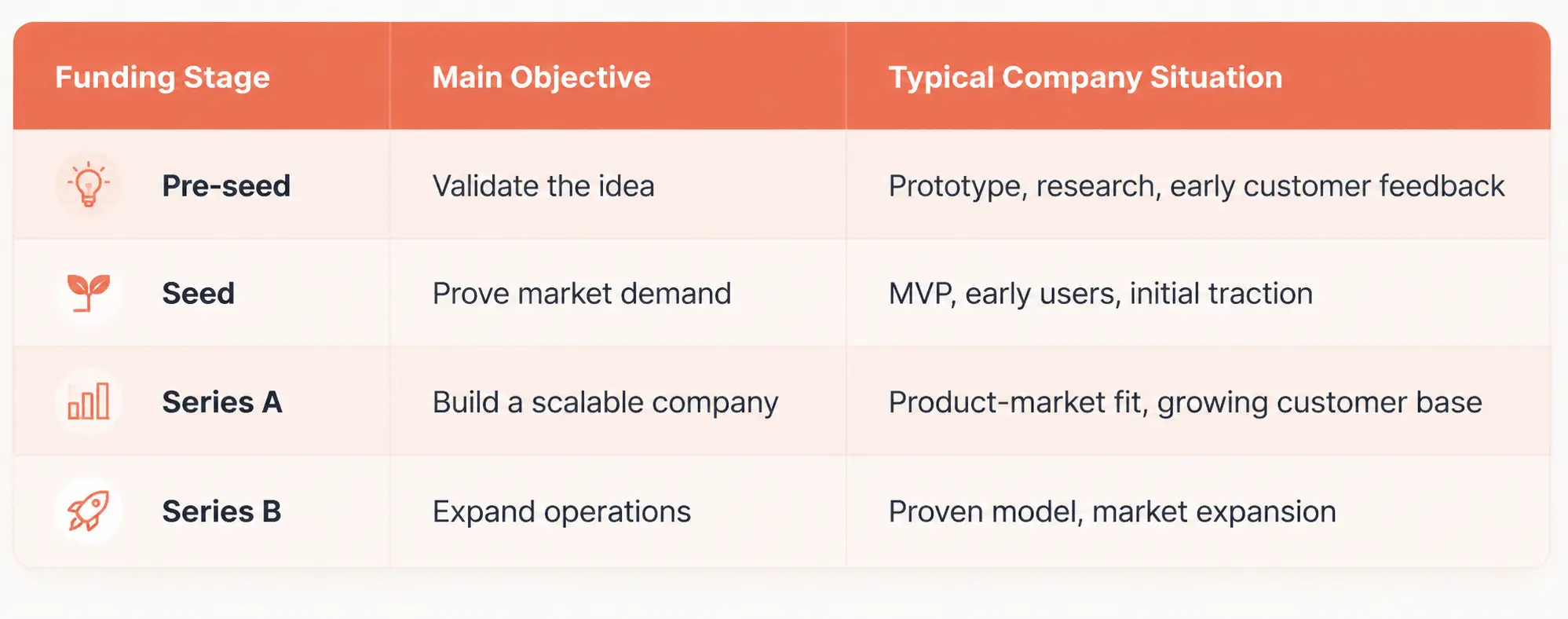
Funding StageMain ObjectiveTypical Company SituationPre-seedValidate the ideaPrototype, research, early customer feedbackSeedProve market demandMVP, early users, initial tractionSeries ABuild a scalable companyProduct-market fit, growing customer baseSeries BExpand operationsProven model, market expansion
These stages are not simply labels based on company age.
They represent different questions investors are trying to answer.
At early stages, investors usually ask:
Is this a meaningful problem?
Can this team solve it?
Is there evidence customers care?
At later stages, the questions become:
Can this company scale?
Is growth repeatable?
Can this business become a major market player?
Understanding this difference helps founders approach investors with the right expectations.
Pre Seed Funding: Turning an Idea Into Early Proof
Pre seed funding is usually the first external capital a startup raises.
At this stage, founders are still proving whether their idea can become a valuable business. The company may not have significant revenue yet, but it should have a clear understanding of the problem, target users, and potential solution.
Pre-seed capital is often used for:
Creating an MVP
Conducting customer research
Testing assumptions
Building the first version of the product
Developing early market understanding
Common sources include:
Founder savings
Friends and family
Angel investors
Accelerators
Early-stage funds
Investors at this stage understand that uncertainty is high. They usually evaluate:
Founder capability
Market opportunity
Speed of execution
Quality of insight behind the idea
A startup does not need to have everything figured out before pre-seed funding. But founders should be able to explain why this problem matters and why their approach has potential.
The purpose of pre-seed capital is not simply survival. It should help the company learn faster and reach stronger validation.
Seed Funding: Proving Market Demand
After early validation, startups often move toward seed funding.
Seed funding represents the transition from testing an idea to building a repeatable business.
At this stage, investors usually want evidence that the startup has some form of traction.
This can include:
Active users
Early revenue
Customer retention
Pilot customers
Product engagement
Market feedback
Seed capital is commonly used for:
Improving the product
Hiring the first major team members
Developing sales channels
Increasing customer acquisition
Finding repeatable growth methods
The difference between pre-seed and seed is the level of proof.
Pre-seed answers:
“Is this idea worth exploring?”
Seed answers:
“Is there evidence that this can become a real business?”
A successful seed round gives founders the resources to transform early signals into a stronger operating model.
Series A Funding: Building a Scalable Company
Series A funding is where investors start looking beyond potential and focus more on execution.
At this stage, startups are expected to demonstrate that they are not only building something people want, but that they can create a repeatable growth engine.
Investors usually evaluate:
Product-market fit
Customer growth
Market size
Revenue potential
Team capability
Business model strength
Series A capital is often used for:
Expanding the team
Improving infrastructure
Scaling customer acquisition
Strengthening operations
Building predictable growth systems
The main question changes from:
“Does this product work?”
to:
“Can this company grow efficiently?”
Many startups reach Series A with strong ideas but struggle because they cannot prove that early success can be repeated at a larger scale.
Series B Funding: Scaling What Works
Series B funding focuses on expansion.
By this stage, investors are usually not funding an experiment. They are investing in a company that has already shown meaningful traction and now needs resources to grow.
Series B funding may support:
Entering new markets
Growing sales teams
Expanding operations
Building new products
Increasing market share
At this stage, investors pay close attention to:
Revenue growth
Customer retention
Operational efficiency
Market position
Long-term scalability
The challenge at Series B is not proving that the company can work. It is proving that the company can become significantly larger.
Startup Funding Options Beyond Venture Capital
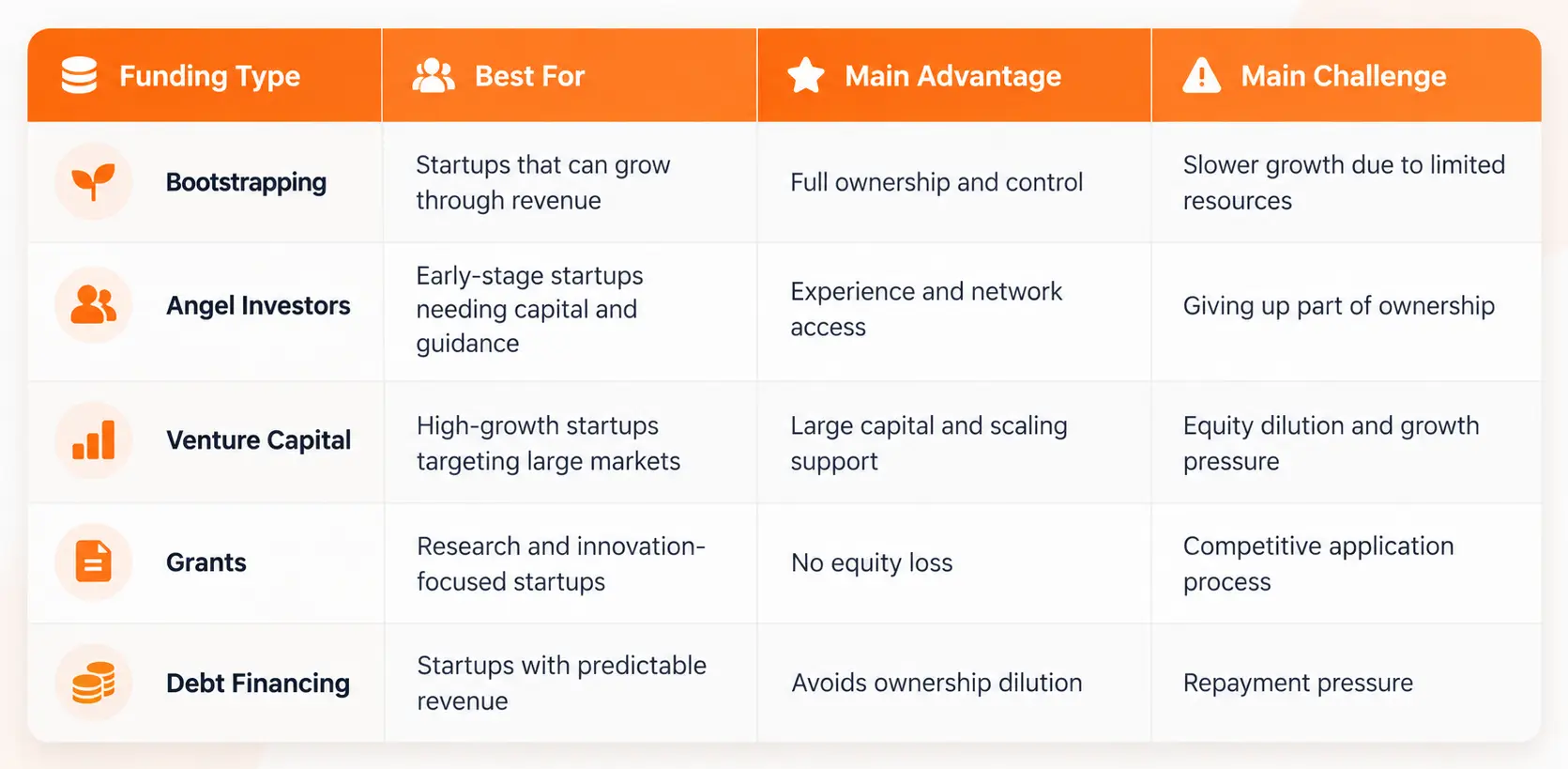
Many founders think startup funding automatically means venture capital. In reality, there are multiple ways to finance a startup.
Understanding different startup funding options helps founders choose capital that matches their business model.
Bootstrapping
Bootstrapping means building a company using personal resources or revenue generated by the business.
This approach allows founders to maintain full control but often requires slower growth.
Bootstrapping works well when:
The business can generate revenue early
Initial costs are manageable
Speed is less important than ownership
Angel Investors
Angel investors are individuals who invest their own capital into early-stage startups.
Beyond money, they may provide:
Industry experience
Strategic advice
Network access
Founder mentorship
Angel investment is common during pre-seed and seed stages.
Venture Capital
Venture capital firms invest in startups that have the potential for significant growth.
VC funding is usually suitable for companies that:
Target large markets
Can scale quickly
Need significant resources to compete
In exchange, investors usually receive equity in the company.
Grants
Grants provide capital without requiring founders to give up ownership.
They are often used in areas such as:
Research
Technology
Healthcare
Climate innovation
Debt Financing
Debt financing allows startups to borrow money and repay it over time.
It can reduce ownership dilution, but repayment obligations can create pressure for early-stage companies.
Bootstrapping vs Funding: Choosing the Right Strategy
The discussion around bootstrapping vs funding is often presented as a competition, but the right choice depends on the company.
Bootstrapping may be the right path when:
The startup can grow through customer revenue
The business does not require large upfront investment
The founder values ownership control
External funding may make sense when:
Market timing is important
The product requires significant investment
Competitors are moving quickly
Additional capital creates a clear advantage
The goal is not to raise money because other startups are raising money.
The goal is to choose the capital structure that gives the company the strongest chance of success.
What Investors Look For Before Funding
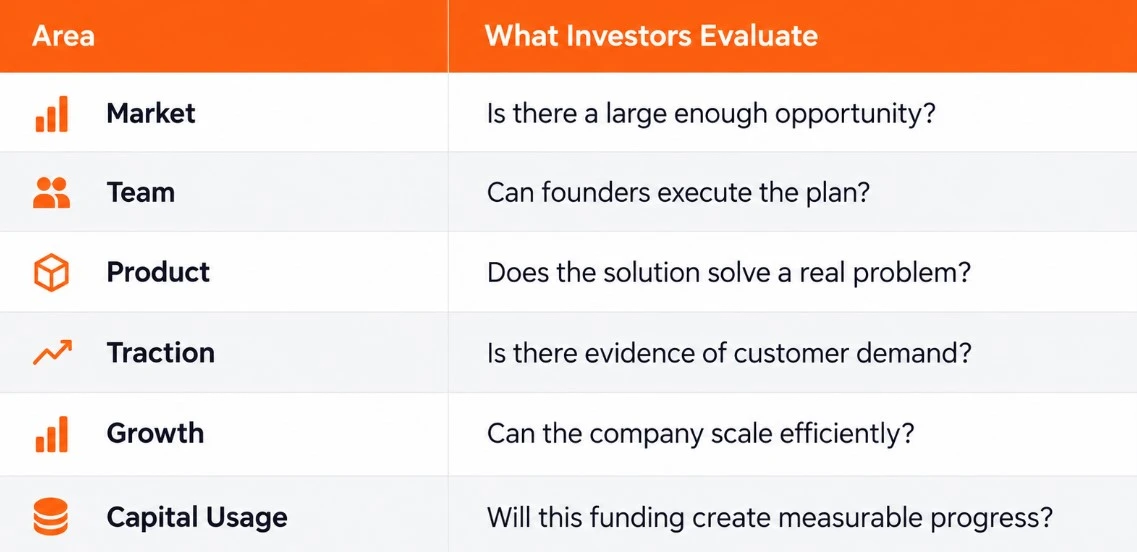
Before investing, most investors evaluate more than the idea itself.
They want to understand whether the startup has the foundation needed for growth.
Market Opportunity
Investors look for markets that are large enough to support significant growth.
A great product in a very small market may have limited upside.
Founding Team
Early-stage investors often place significant importance on founders.
They evaluate:
Industry understanding
Execution ability
Commitment
Ability to adapt
Traction
Traction can appear in different forms:
Revenue
Customer growth
User engagement
Partnerships
Retention
Traction shows that the market is responding.
Scalability
Investors want to understand whether growth can happen efficiently.
A startup that requires equal increases in cost for every new customer may struggle to scale.
Clear Use of Capital
A strong founder can explain exactly what the funding will achieve.
Investors want to know:
What milestones will this round unlock?
How long will the capital last?
What changes after this investment?
How Startups Raise Money
Understanding how startups raise money requires looking at fundraising as a structured process.
Define the Reason for Raising
Before contacting investors, founders should know:
How much capital they need
Why they need it now
What milestones they will achieve
What success looks like after the round
Prepare Fundraising Materials
Most startups prepare:
Pitch deck
Financial projections
Market analysis
Product information
Growth metrics
Company roadmap
These materials help investors understand the opportunity.
Find the Right Investors
The biggest mistake founders make is contacting every investor they can find.
A better approach is targeting investors based on:
Startup stage
Industry focus
Investment size
Previous portfolio
Strategic value
The right investor is not always the most famous investor.
It is the investor who understands the company’s journey.
Build Relationships Before Raising
Fundraising often works better when investor relationships start before a company urgently needs money.
Strong relationships create better conversations and more trust during the investment process.
Manage the Process Professionally
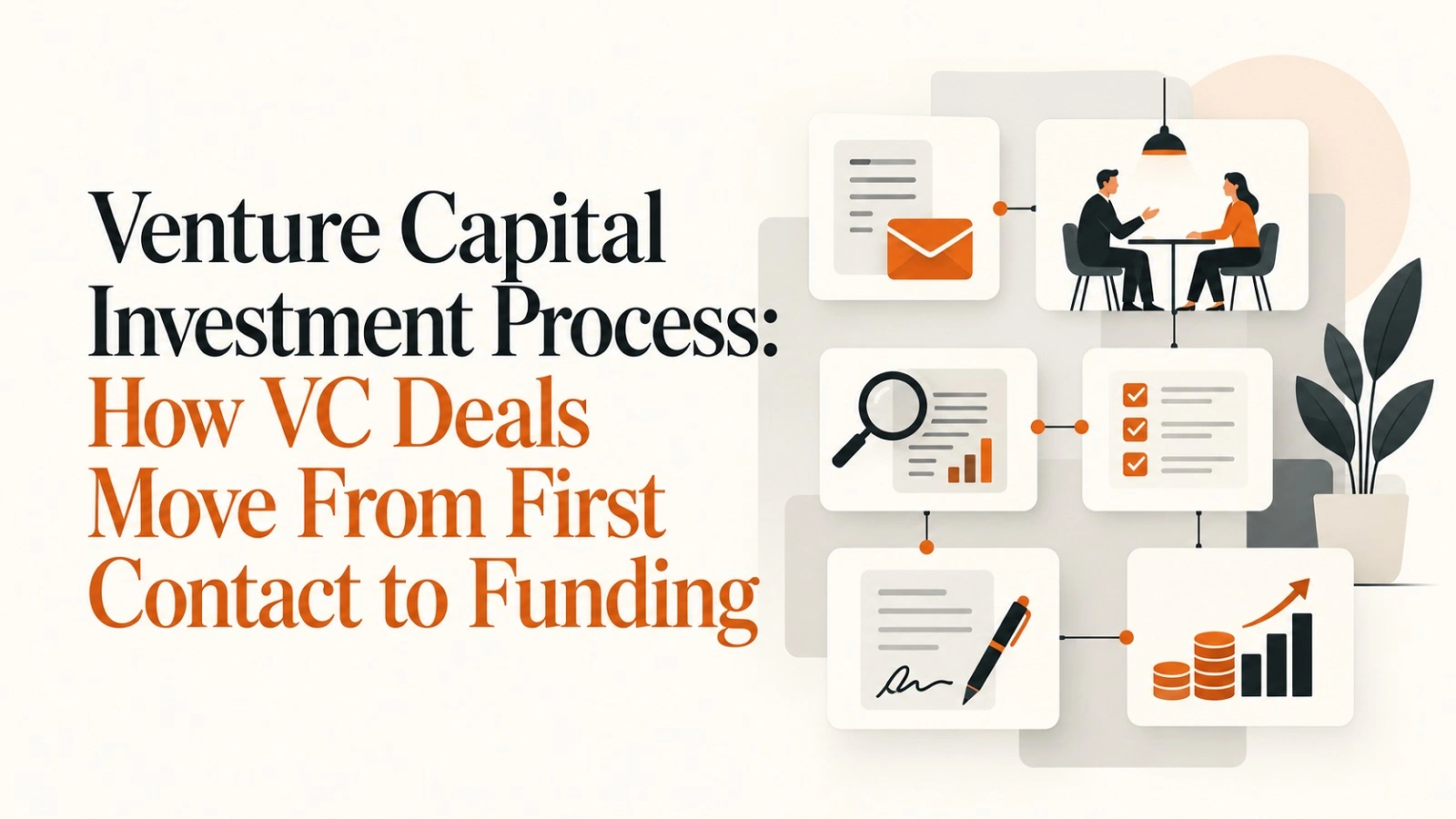
A fundraising process usually includes:
Investor research
Introductory conversations
Pitch meetings
Due diligence
Negotiation
Closing
Founders should remember that fundraising is part of building the company, not a replacement for building the company.
Startup Funding Mistakes Founders Should Avoid
Many fundraising challenges come from avoidable mistakes.
Raising Too Early
Some founders raise because they feel pressure rather than because the company is ready.
Capital cannot replace customer understanding.
Choosing Investors Only Because of Their Name
A famous investor is not automatically the right partner.
The relationship matters because investors may influence important company decisions.
Ignoring Ownership Changes
Every investment affects ownership.
Founders should understand:
Equity dilution
Investor rights
Ownership structure
Future fundraising impact
Raising Without Clear Milestones
Funding should have a purpose.
A startup should know what progress the capital will create.
Focusing More on Fundraising Than Building
The ultimate goal is not completing a funding round.
The goal is creating a valuable company.
Preparing Your Startup for Funding
Before beginning fundraising, founders should ask:
Do we understand our customer clearly?
Have we validated the problem?
Do we know why now is the right time?
Can we explain how capital creates growth?
Are we approaching suitable investors?
Is the founding team aligned?
Strong fundraising usually starts with strong fundamentals.
FAQ
What is startup funding?
Startup funding is the capital used by startups to build products, hire teams, acquire customers, and grow operations.
What are the main startup funding stages?
The main stages are pre-seed, seed, Series A, and Series B. Each stage represents a different level of company maturity and investor expectation.
What is the difference between pre seed funding and seed funding?
Pre seed funding focuses on validating an idea and building early proof. Seed funding focuses on gaining traction and developing a repeatable business model.
Should every startup raise venture capital?
No. Venture capital is only one funding option. Some startups grow through revenue, bootstrapping, grants, or other financing methods.
How do startups raise money?
Startups raise money by identifying the right funding strategy, preparing investor materials, building relationships, pitching investors, completing due diligence, and negotiating investment terms.

Mobina Khanki
Venture & Funding Writer at PinerookMobina Khanki covers venture capital, startup funding, fundraising, and startup finance for Pinerook, focusing on founders and investors.
 Seen first.