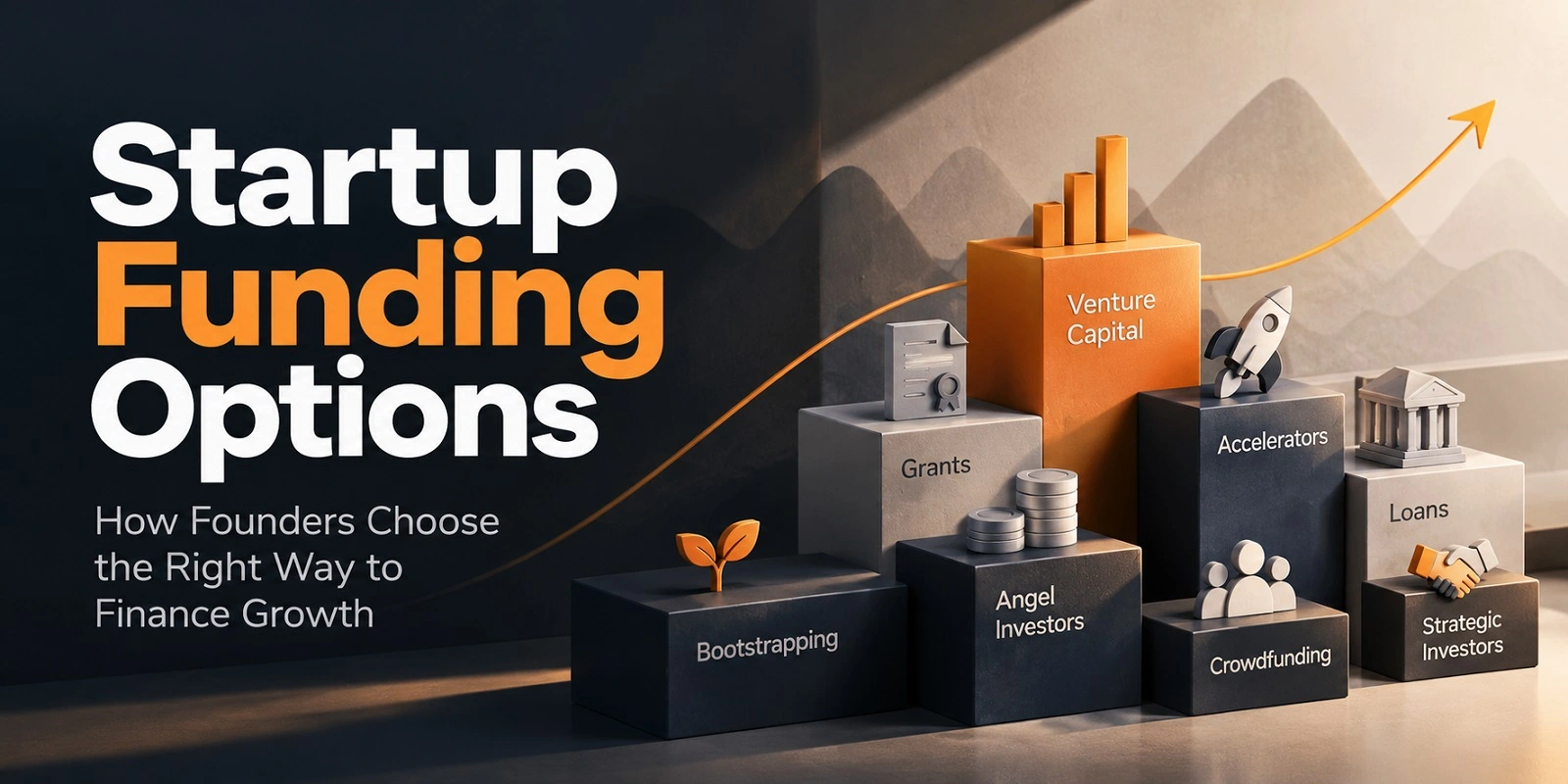
Startups do not all need the same type of capital. A software company may be able to launch with relatively little money, while a hardware, biotech, marketplace, or infrastructure startup may need significant funding long before revenue becomes predictable.
That is why Startup Funding should not be treated as a single path. Founders can finance a company through their own money, customer revenue, angel investors, venture capital, accelerators, crowdfunding, loans, grants, strategic investors, or a combination of several sources over time.
Understanding startup funding options is therefore less about finding the largest available check and more about choosing capital that fits the company’s stage, business model, risk profile, ownership goals, and next milestone.
What Are Startup Funding Options?
Startup funding options are the different sources of capital founders can use to build, operate, and grow a company.
Some options involve selling part of the business to investors. Others allow founders to retain ownership while creating repayment obligations. Certain funding sources are suitable when the company is still validating an idea, while others become practical only after revenue, customers, or predictable cash flow exist.
The right choice also changes over time. A founder may begin with personal savings, use customer revenue to validate demand, raise angel capital to accelerate product development, and later use venture capital to scale into a larger market.
The important question is not simply where money can come from. It is what type of capital makes sense for the problem the startup needs to solve next.
Startup Funding Options at a Glance
Different funding sources affect ownership, repayment obligations, control, and growth expectations in different ways.
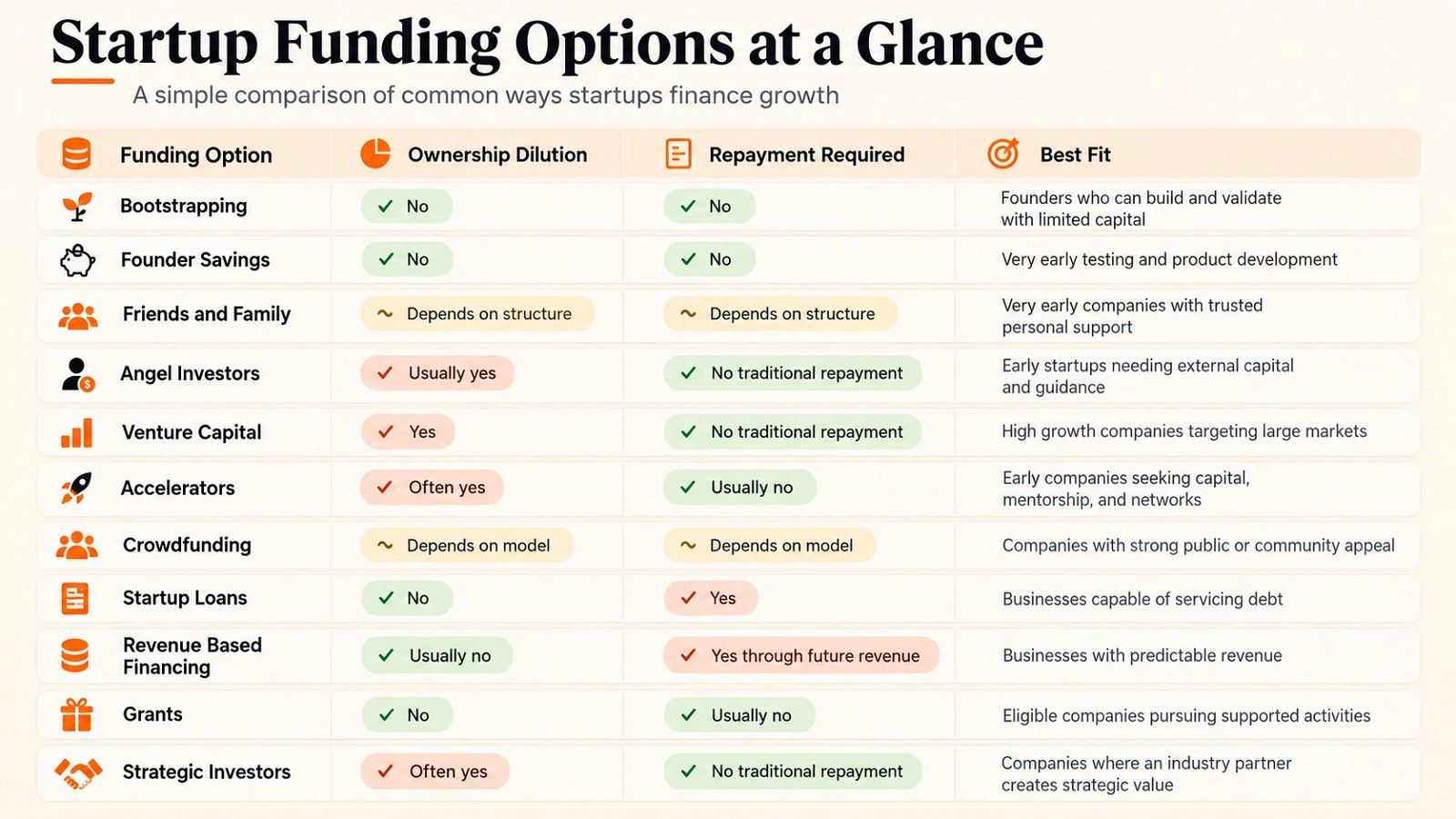
There is no universal winner. Each source solves a different financing problem and creates different consequences for ownership, control, cash flow, and future fundraising.
Bootstrapping
Bootstrapping means building the company using founder resources and operating revenue rather than raising outside equity capital.
For some startups, this is the most attractive starting point because founders maintain greater ownership and control. It can also force the business to focus early on customers, pricing, revenue, and disciplined spending.
Bootstrapping works particularly well when the product is relatively inexpensive to build, the company can reach customers quickly, and revenue can begin before large infrastructure or hiring costs appear.
The limitation is available capital. A company competing in a market where speed matters may struggle if competitors can invest aggressively while it depends entirely on internally generated cash.
Bootstrapping is therefore not automatically better than raising money. It is most effective when the economics of the business allow founders to create meaningful progress without substantial outside capital.
Founder Savings
Founder savings are often the first money invested in a startup.
The capital may pay for product development, software, legal setup, prototypes, market research, customer interviews, or the initial tools required to test the opportunity.
Using personal money can help founders create enough evidence to reach investors from a stronger position later. It also gives the team more freedom to experiment before external investors become involved.
The main risk is personal exposure. A startup is uncertain by nature, so founders should not confuse commitment with taking financial risk they cannot reasonably absorb.
Founder savings are most useful when they buy specific learning or progress rather than simply extending an unclear project.
Friends and Family Funding
Friends and family can become another source of early capital when a startup is too early for professional investors.
People close to the founders may be willing to invest based partly on personal trust rather than business performance. This can give the company enough time to build a first product, test demand, or reach an early commercial milestone.
The funding can be structured in several ways depending on the agreement, including equity or debt.
The biggest risk is not only financial. Personal relationships can become difficult when expectations are unclear or the company fails.
Founders should communicate the risks clearly and treat this capital with the same seriousness as professional investment. The possibility of losing the entire investment should be understood before money changes hands.
Angel Investors
Angel investors are individuals who invest their own capital into private companies, often during the early stages of development.
They can be valuable when the startup needs more capital than founders can provide but is not yet ready for a large institutional round.
Experienced angels may also contribute industry knowledge, customer introductions, recruiting support, strategic advice, and access to future investors.
Because angel investment usually involves equity, founders need to understand the ownership impact. The value of an angel also depends on more than the size of the check.
An investor with relevant experience and a useful network may provide substantially more value than someone whose involvement ends after the investment is completed.
Venture Capital
Venture capital firms invest money from managed funds into startups they believe can become significantly larger.
VC is generally most relevant for companies pursuing large markets where substantial capital can accelerate product development, hiring, customer acquisition, international expansion, or infrastructure.
The advantage is access to significant resources and professional investment networks.
The tradeoff is ownership and expectations. Venture investors typically receive equity and may gain governance rights. They also invest with the expectation that the company will pursue substantial growth.
A founder trying to build a smaller, profitable business may find that venture capital creates pressure that does not match the company’s desired direction.
Angel Investors vs Venture Capital
Angel investors and venture capital firms both provide equity capital, but they usually enter at different stages and operate differently.
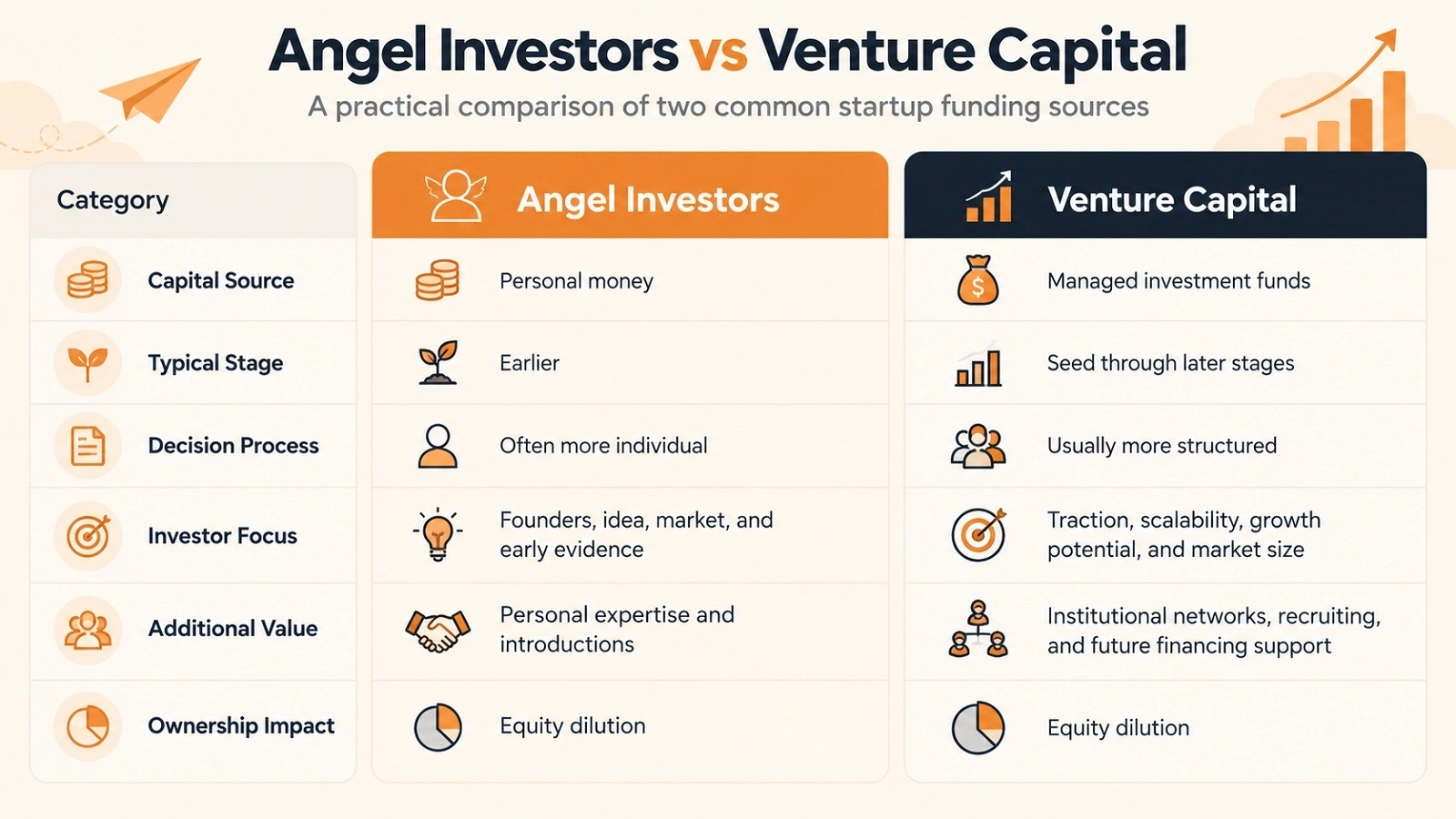
The distinction matters because founders should approach investors whose capital model matches the current stage and future direction of the company.
Startup Accelerators
Accelerators support early startups through structured programs that may combine capital, mentorship, investor introductions, founder communities, and business education.
A company accepted into an accelerator may receive an initial investment in exchange for equity and then spend several weeks or months improving its product, positioning, business model, and fundraising readiness.
Accelerators can be particularly useful to founders who need access to experienced operators, investor networks, and other startup founders.
Not every accelerator provides the same value. Founders should evaluate the quality of mentors, alumni outcomes, investment terms, investor access, program requirements, and how much ownership the company gives up.
The name of the program matters less than whether participation materially improves the startup’s position.
Crowdfunding
Crowdfunding allows startups to raise money from a larger group of people rather than relying only on traditional investors.
There are several different models.
Reward based crowdfunding gives supporters a product, early access, or another benefit in exchange for their contribution. Equity crowdfunding allows eligible participants to invest in the company. Other platforms may support lending or alternative structures.
Crowdfunding can work especially well for consumer products, hardware, creative businesses, and brands with strong communities.
It can also provide useful demand validation. If customers are willing to commit money before a product is fully available, the campaign can demonstrate that the market has real interest.
The challenge is execution. Strong campaigns often require substantial preparation, marketing, storytelling, community building, and fulfillment planning.
Raising the money is only one part of the process. Delivering what customers were promised can become the more difficult part.
Startup Loans
Loans allow companies to borrow capital without selling ownership.
This can appeal to founders who want to avoid dilution. The company receives capital and agrees to repay it according to specified terms.
The challenge is that debt must generally be serviced even if growth slows.
That makes traditional borrowing difficult for startups with little revenue, limited assets, and uncertain cash flow.
Loans become more practical as revenue becomes predictable and the company can reasonably estimate its ability to make payments.
Debt is therefore often better suited to financing a defined business need than financing open ended experimentation.
Venture Debt
Venture debt is financing designed for certain venture backed companies and is often used alongside equity capital.
It may help extend runway, fund equipment, support working capital, or give the company additional flexibility between equity rounds.
Venture debt can reduce the need for immediate additional equity dilution, but it introduces repayment obligations and financing costs.
The terms may also include conditions that affect the company’s future financial flexibility.
This type of financing is most useful when the startup has enough visibility into its future cash position to understand how the debt will be serviced.
Using debt simply to delay unresolved business problems can make those problems more serious.
Revenue Based Financing
Revenue based financing provides capital in exchange for a portion of future revenue until an agreed repayment threshold is reached.
This model can appeal to founders who want capital without issuing additional equity.
It is generally more suitable for businesses with established and predictable revenue because the financing provider needs reasonable confidence that repayments can occur.
Subscription companies and other businesses with measurable recurring income may find this structure more practical than companies with highly uncertain sales.
The important consideration is cash flow. Revenue sharing reduces the money available to reinvest in operations and growth.
Founders should therefore model the impact carefully before accepting this form of financing.
Grants
Grants can provide capital without requiring founders to sell equity or take on a traditional loan.
Government organizations, universities, nonprofit institutions, research programs, and industry initiatives may offer funding for specific types of companies or activities.
Grants can be especially relevant for scientific research, climate technology, health innovation, advanced engineering, regional development, and other projects that align with a funding program’s objectives.
The main limitation is eligibility and restrictions.
Applications may require detailed documentation, technical milestones, approved spending categories, and ongoing reporting.
Grant funding is most valuable when it supports work the startup already needs to do. Designing the company around the hope of winning grants can create dependence on a source that may not be predictable.
Strategic Investors
Strategic investors are companies that invest because the startup has value beyond financial returns alone.
A large technology company may invest in a startup that strengthens its platform ecosystem. An established industry company may invest in technology that improves its supply chain, products, or customer experience.
Strategic capital can provide distribution, infrastructure, customers, technical knowledge, manufacturing relationships, credibility, and access to industry expertise.
However, strategic relationships also create complications.
A partnership with one major company may make competitors less comfortable working with the startup. The investor’s strategic priorities may also change over time.
Founders should therefore evaluate both the capital and the long term commercial consequences of accepting the investment.
Customer Funded Growth
Customers can become one of the strongest sources of startup financing.
A company that generates revenue early can reinvest that money into product development, hiring, marketing, and expansion.
Some businesses also use annual contracts, advance orders, deposits, paid pilots, or prepayments to improve cash flow.
Customer funded growth has an important advantage because the money arrives together with evidence of demand.
Instead of convincing investors that people might pay for the product, the startup is financing growth with customers who already have.
The limitation is speed. Customer revenue may not arrive quickly enough to support an aggressive growth strategy.
Still, even companies that later raise substantial investment benefit from improving the amount of growth supported by their customers.
Incubators and Startup Studios
Incubators and startup studios can provide support before or around the earliest stage of company formation.
An incubator may provide workspace, mentorship, networks, technical resources, education, or access to funding.
A startup studio often takes a more active role and may help create companies by supplying ideas, team members, technology, shared infrastructure, or operational support.
The structure varies significantly between organizations.
Some programs receive equity, some charge fees, and others are supported by universities, corporations, governments, or investors.
Founders should understand how much ownership, control, and independence they exchange for the support provided.
Convertible Financing
Early investors sometimes provide money through financing instruments that are designed to convert into equity later.
This can allow a startup to raise capital without setting a final company valuation immediately.
Such structures can be useful when the company is still early and both founders and investors expect a more formal equity round later.
However, delayed valuation does not mean dilution disappears.
The economic outcome depends on the specific terms and the way conversion happens during a later financing event.
Founders should understand those terms before accepting the capital and should use qualified legal support when issuing securities or entering financing agreements.
Equity Funding vs Debt Funding
One of the most important decisions founders face is whether to exchange ownership for capital or accept a repayment obligation.
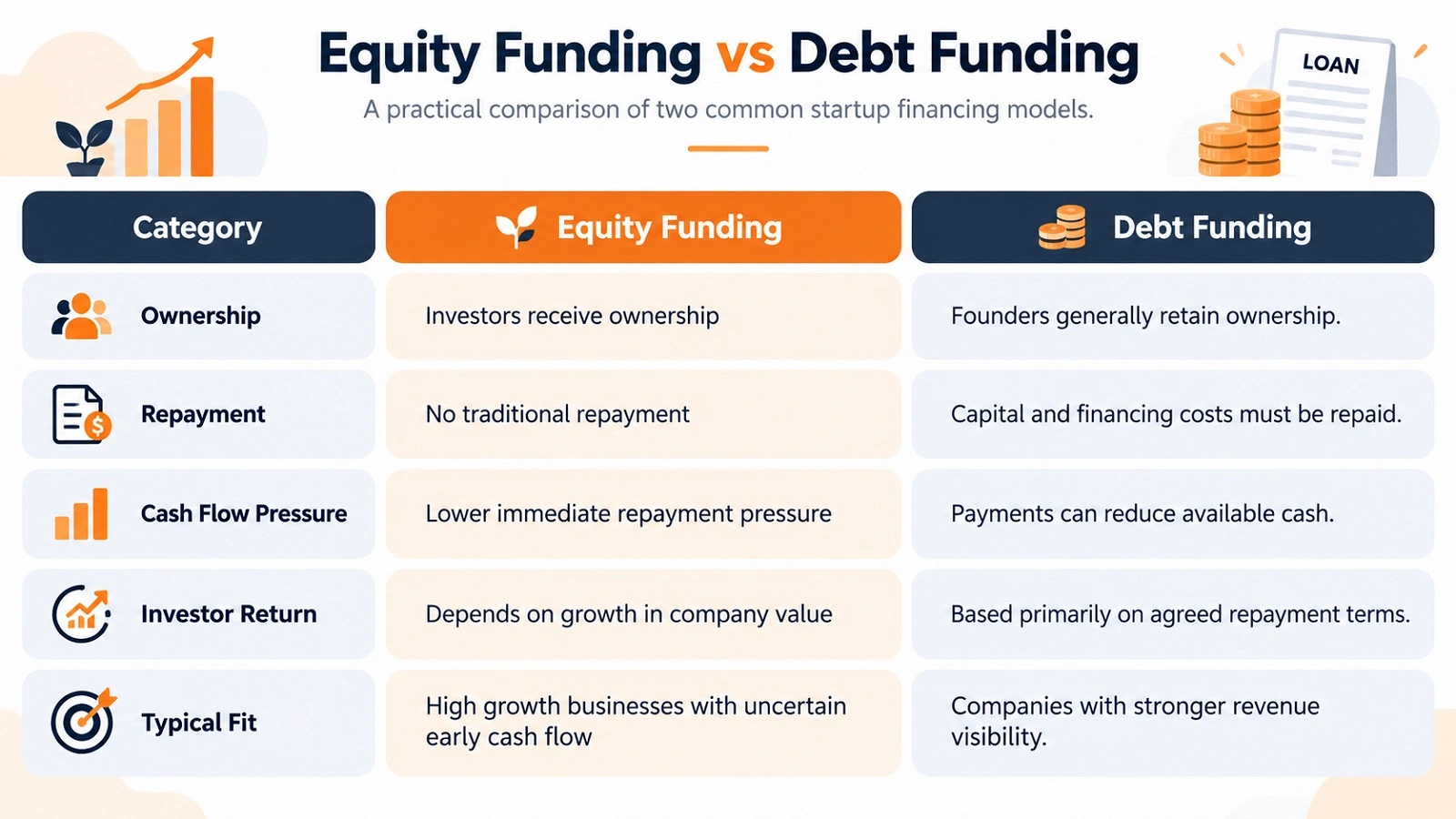
Equity can provide more flexibility while the company is uncertain, but it permanently changes ownership.
Debt allows founders to preserve equity but creates financial obligations.
The appropriate choice depends on which type of risk the business is better positioned to manage.
Dilutive vs Non Dilutive Funding
Funding can also be understood through the effect it has on ownership.
Dilutive funding reduces the ownership percentage of existing shareholders because new investors receive equity. Angel investment and venture capital are common examples.
Non dilutive funding allows the company to access capital without issuing new ownership. Revenue, grants, and many forms of debt belong in this category.
Non dilutive does not mean free.
Debt creates repayment obligations. Grants may restrict how money is used. Customer financed growth can be slower than investor funded expansion.
The real question is whether the value created by the capital is greater than the ownership or financial cost required to obtain it.
How to Choose the Right Startup Funding Option
Choosing a funding source should begin with the reason the startup needs money.
A company that needs a relatively small amount to validate demand may not need institutional investors. Founder savings, customer revenue, grants, or angel capital may be enough.
A company that has already found strong demand and needs to expand quickly may have a stronger case for venture capital.
Cash flow also matters. Debt becomes more dangerous when revenue is unpredictable because repayments continue even when sales slow.
Ownership goals should also be considered. Some founders are comfortable exchanging part of the company for faster growth and investor support. Others prefer to keep greater ownership and grow more gradually.
The correct financing method should fit the startup rather than forcing the startup to reshape itself simply to qualify for a particular source of capital.
Matching Funding Options to Startup Stage
The company’s stage can help founders narrow the range of financing options worth considering.
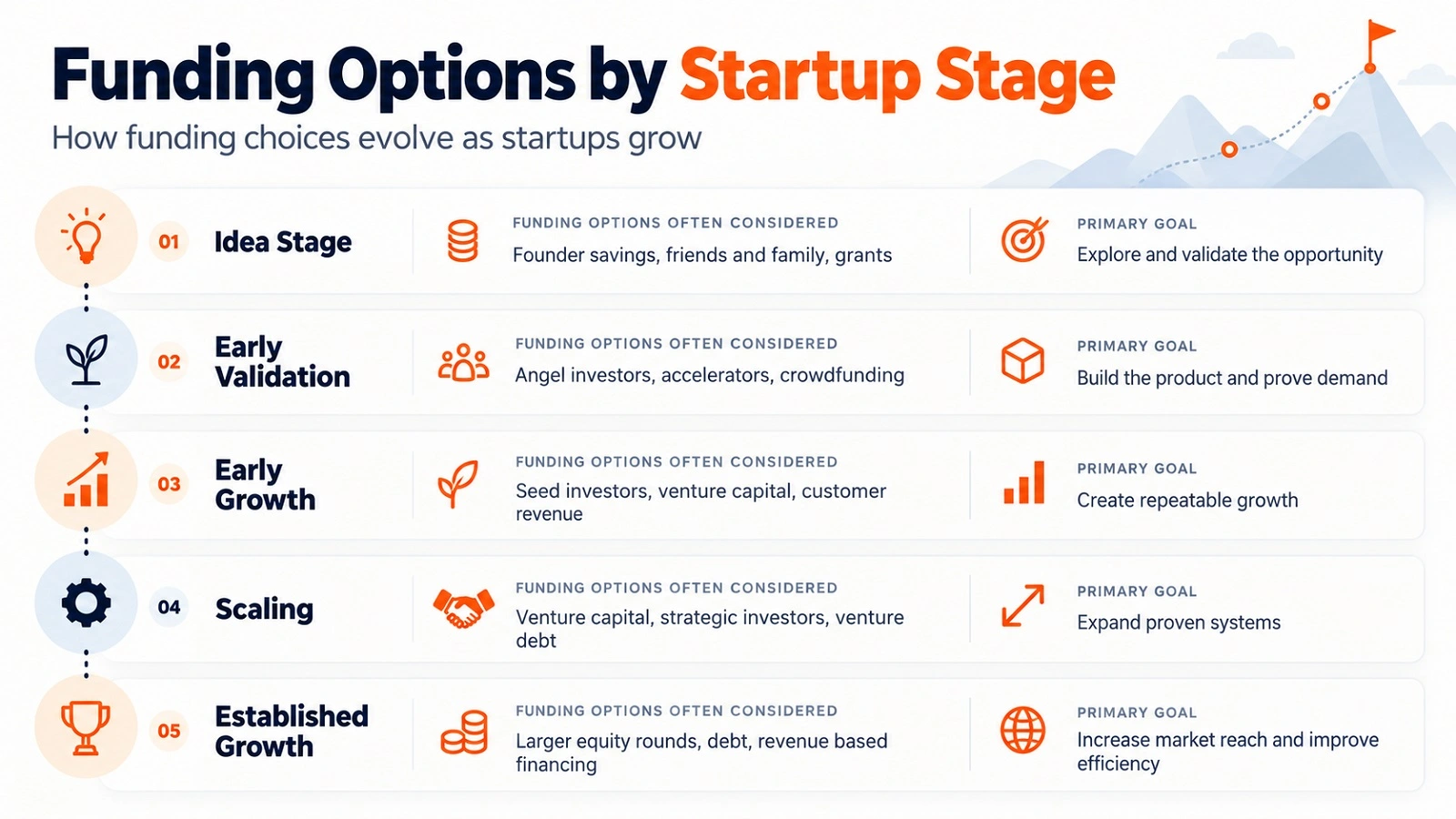
These categories are not strict rules.
A company may combine multiple funding sources at the same stage, while another may skip several options entirely.
The broader principle is that the type of capital should evolve as the evidence and economics of the company change.
How Much Funding Does a Startup Actually Need?
Before choosing a financing source, founders need to understand how much capital is actually required.
The starting point should be the next meaningful milestone.
A startup might need enough capital to build an MVP, reach a specific level of customer validation, hire a core team, enter a new market, or build enough revenue to reach the next financing stage.
The funding amount should therefore be connected to an outcome rather than an arbitrary number.
Raising too little can force the company back into fundraising before it has enough new evidence to improve its position.
Raising too much can create unnecessary dilution, encourage inefficient spending, or increase investor expectations before the business is ready to support them.
Good capital planning links the amount raised to a clear period of execution and measurable progress.
Cost of Capital Matters
Founders often compare funding options by looking only at the amount of money available.
The more important question is what that money costs.
Equity capital does not require monthly repayments, but founders give up part of the future value of the company.
Debt preserves ownership but creates repayment and interest obligations.
Revenue based financing reduces future cash flow.
Accelerators may take equity in exchange for a relatively small amount of capital plus networks and mentorship.
Strategic investors may provide commercial advantages but also create constraints around partnerships.
Understanding cost therefore requires looking beyond cash. Control, ownership, flexibility, future fundraising, repayment obligations, and strategic consequences all belong in the calculation.
Control and Governance
Capital can also change how decisions are made inside the company.
Equity investors may receive voting rights, information rights, board representation, or influence over major business decisions.
For some founders, this is valuable because experienced investors can improve strategic decision making and help the company avoid expensive mistakes.
For others, giving external investors influence may conflict with how they want to build the business.
The issue is not whether investor involvement is good or bad. The important question is whether the governance structure matches the needs and goals of the company.
Founders should understand the control implications before signing investment agreements rather than discovering them after the financing is complete.
Can Startups Combine Multiple Funding Options?
Yes. Many companies use a combination of financing sources throughout their development.
A founder may bootstrap the first product, receive a grant for technical research, raise angel capital for initial hiring, use customer revenue to support operations, and later raise venture capital to accelerate expansion.
Using several sources can reduce dependence on a single financing method and help founders choose the right type of capital for each milestone.
However, previous financing decisions affect future options.
Existing debt, shareholder rights, convertible instruments, ownership arrangements, and strategic agreements can all influence later fundraising.
Founders should therefore treat financing as a long term capital strategy rather than a series of isolated events.
When Outside Funding May Not Be Necessary
Fundraising receives significant attention in startup culture, but raising outside money is not itself a measure of success.
If a startup can reach profitability and grow through customer revenue, external capital may not create enough additional value to justify dilution or repayment obligations.
Founders should ask what outside funding would allow the company to achieve that it cannot reasonably achieve with its existing resources.
The answer may be speed, product development, geographic expansion, key hires, infrastructure, or competitive positioning.
If the only answer is that more money would allow the company to spend more, the funding case may not be strong.
Capital is most useful when it removes an important constraint or accelerates an opportunity that has already shown credible evidence.
When Equity Funding Makes More Sense
Equity capital can be particularly useful when the company faces significant uncertainty but has a potentially large opportunity.
A startup may need several years of product development before revenue becomes substantial. Another may need to hire quickly to take advantage of a rapidly developing market.
Because equity financing does not create traditional monthly repayments, it can give companies more flexibility during periods when cash flow remains uncertain.
The tradeoff is ownership.
Founders should therefore consider equity when the additional capital has the potential to increase the value of the company significantly enough to justify the ownership exchanged.
When Debt Funding Makes More Sense
Debt becomes more practical when the company has clearer revenue visibility and a specific reason for borrowing.
A profitable business may use debt to finance inventory, equipment, working capital, or expansion without selling additional ownership.
The advantage is that founders can retain more equity.
The risk is that debt must still be serviced if business conditions deteriorate.
A company with highly volatile revenue may therefore be taking more risk with debt than a business that can forecast its cash flow with greater confidence.
Debt should solve a financing problem the company understands rather than create additional runway for a business model that remains uncertain.
Common Mistakes When Choosing Startup Funding
One common mistake is choosing capital simply because it is available. A funding source can be easy to access and still be poorly suited to the company.
Another mistake is focusing only on valuation. A high valuation may look attractive, but investor rights, governance, ownership dilution, future financing expectations, and strategic compatibility can matter just as much.
Some companies raise more capital than they know how to deploy efficiently. Others raise too little and return to investors before reaching meaningful milestones.
Founders can also take on debt too early because they underestimate how difficult repayment becomes when revenue slows.
Another mistake is ignoring the future. A financing agreement that appears attractive today may make later rounds more complicated.
The strongest decisions consider how the funding affects not only the company’s current bank balance but also its future flexibility.
Building a Startup Funding Strategy
A funding strategy should connect capital directly to business milestones.
Founders should understand what needs to be achieved next, how much that progress will cost, what kind of financing matches the risk involved, and how the decision affects future ownership and flexibility.
A company validating its first product requires a different financing strategy from one entering several international markets.
The strategy should therefore change as uncertainty decreases and the company becomes more established.
Funding works best when each financing decision moves the company into a stronger position for whatever comes next.
The Real Purpose of Startup Funding Options
Different funding sources exist because startups face different financial problems.
A company trying to validate an idea does not need the same capital structure as a company expanding internationally. A profitable software company has different options from a research business that may spend years developing technology before meaningful revenue appears.
The purpose of understanding startup funding options is therefore not to identify one method as universally superior.
It is to match capital with the company’s current stage, economics, risk, ownership goals, and growth opportunity.
Good financing gives founders enough resources to reach the next meaningful milestone without creating obligations that the business is poorly prepared to manage.
FAQ
What are the main startup funding options?
Common startup funding options include bootstrapping, founder savings, friends and family funding, angel investment, venture capital, accelerators, crowdfunding, loans, venture debt, revenue based financing, grants, strategic investment, and customer funded growth.
What is the best funding option for a new startup?
There is no universal best option. The right choice depends on the company’s stage, capital needs, business model, revenue visibility, growth goals, and founder ownership preferences.
Can a startup raise money without giving away equity?
Yes. Customer revenue, grants, loans, venture debt, and revenue based financing can provide capital without immediately issuing additional equity.
When should a startup consider venture capital?
Venture capital becomes more relevant when the company is targeting a large market, has significant growth potential, and can use substantial external capital to expand faster.
Is bootstrapping better than raising investment?
Neither approach is always better. Bootstrapping preserves ownership and can encourage financial discipline, while outside investment can accelerate growth when additional capital creates a meaningful advantage.
Can startups use more than one type of funding?
Yes. Many startups combine different sources of capital over time, including founder money, customer revenue, grants, angel investment, venture capital, and debt.
What is the difference between equity and debt funding?
Equity financing provides capital in exchange for ownership in the company. Debt financing generally preserves ownership but requires the borrowed money and associated financing costs to be repaid.
What is non dilutive startup funding?
Non dilutive funding provides capital without issuing additional ownership. Examples can include grants, customer revenue, loans, and some revenue based financing structures.
How should founders decide how much money to raise?
Founders should work backward from the next meaningful business milestone and calculate the resources required to reach it while maintaining enough financial flexibility for unexpected delays or costs.
Does every startup need external funding?
No. Some companies can grow through founder resources and customer revenue. External capital is most useful when it removes an important constraint or accelerates an opportunity that the startup could not reasonably pursue with its existing resources.

Mobina Khanki
Venture & Funding Writer at PinerookMobina Khanki covers venture capital, startup funding, fundraising, and startup finance for Pinerook, focusing on founders and investors.
 Seen first.