Fundraising can accelerate a startup, but it can also create problems that become difficult to reverse. A company can raise a large round, attract respected investors, and still weaken its position if the timing, terms, or use of capital are wrong. The quality of a funding decision therefore matters as much as the amount of money raised.
Within Startup Funding, founders are not simply deciding whether to take capital. They are deciding when to raise, how much ownership to exchange, which investors to bring into the company, what milestones the money needs to create, and how the round will affect future financing. Each of those decisions can strengthen the startup or create pressure that only becomes visible months or years later.
Understanding startup funding mistakes helps founders avoid treating fundraising as a success metric on its own. A strong round should improve the company’s ability to build, learn, grow, and reach the next meaningful milestone. If it does not, the startup may have raised money without improving the underlying business.
Why Startup Funding Mistakes Matter
Funding decisions affect much more than cash in the bank. They influence ownership, governance, hiring, growth expectations, future valuations, and the company’s ability to raise again. Some mistakes are visible immediately, while others take much longer to appear.
A startup may raise too little and run out of runway before reaching the next milestone, or it may raise too much and build an organization that is far larger than the business actually needs. It may choose an investor who creates strategic conflict, accept a valuation that becomes difficult to justify later, or increase spending before customer demand has been properly validated.
The challenge is that fundraising often creates positive momentum around the company. New capital can make weak decisions feel less urgent because the startup suddenly has more resources. That is exactly why discipline becomes more important after a round closes.
Startup Funding Mistakes at a Glance
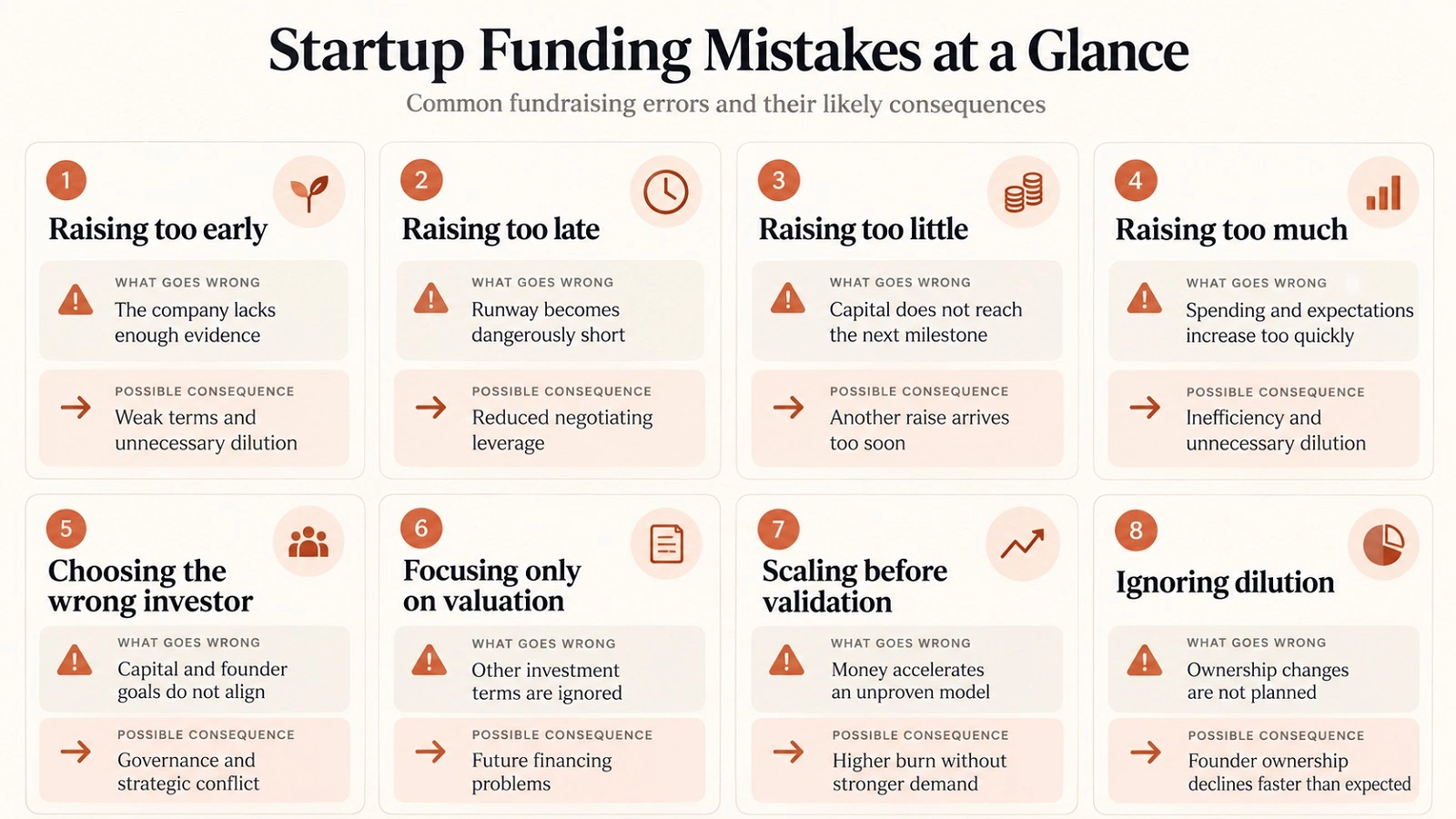
The common thread is that most funding mistakes happen when capital becomes disconnected from the evidence the company needs to create next.
Mistake One: Raising Money Too Early
Raising before the company has enough evidence can make fundraising harder than it needs to be. Early investors understand that startups are uncertain, but even very young companies usually need some reason for investors to believe the opportunity deserves capital.
A founder with only an idea may still raise successfully, especially with a strong track record or deep market expertise, but most teams improve their position by creating some evidence first. Customer interviews, a prototype, pilot demand, technical progress, initial users, or early revenue can all make the company more credible.
Raising too early can also increase dilution because investors are taking on more uncertainty. When the company has very little proof, the valuation may be lower and the terms may be less founder friendly. A few months of meaningful validation can sometimes improve the startup’s negotiating position significantly.
Mistake Two: Raising Money Too Late
Waiting too long can be just as dangerous as raising too early. Fundraising takes time, and there is no guarantee that investor interest will develop quickly.
If founders begin only when the company has very little runway remaining, every delay increases pressure. That pressure can weaken negotiations because the startup has less freedom to reject an investor, negotiate valuation, or walk away from unattractive terms.
A short runway can also damage operations. Founders may spend most of their time fundraising while employees become concerned about the company’s financial position. The strongest fundraising processes usually begin while the company still has enough flexibility to make choices rather than simply survive.
Mistake Three: Raising Without a Clear Milestone
A startup should know what the round is supposed to achieve before the money arrives. Raising capital for general growth is too vague because the company needs a specific target that can be measured.
A pre seed company may need to build an MVP and validate demand. A seed company may need to prove retention and early revenue. A Series A company may need to build repeatable acquisition systems and stronger operating processes.
Without a clear milestone, spending can become disconnected from progress. The startup may hire more people, launch more initiatives, and spend more on marketing without actually answering the questions that matter for the next stage. Capital should buy evidence, not simply activity.
Mistake Four: Raising Too Little
A funding round that does not provide enough runway to reach the next meaningful milestone can create a difficult cycle. The company spends much of the new capital, makes only partial progress, and then has to return to investors before its position has improved enough.
This becomes especially risky when the next raise begins before the company has created stronger traction, revenue, retention, or customer evidence. Investors may reasonably ask why the previous capital did not produce enough progress.
Founders should work backward from the next milestone and estimate the resources required to reach it, including hiring, product development, operations, and normal delays. The goal is to give the company enough time to improve its position before it needs capital again.
Mistake Five: Raising Too Much
A large funding round can look like a sign of strength, but more capital is not always better. Raising significantly more than the company needs can create unnecessary dilution, higher expectations, and pressure to spend faster than the business can learn.
Large rounds can also change internal behavior. Hiring may accelerate, office costs may rise, marketing budgets may expand, and the company may begin building an organization designed for future scale before current demand justifies that structure.
A bigger bank balance should not become permission to ignore discipline. The right amount is the amount the company can deploy intelligently toward a defined objective.
Raising Too Little vs Raising Too Much
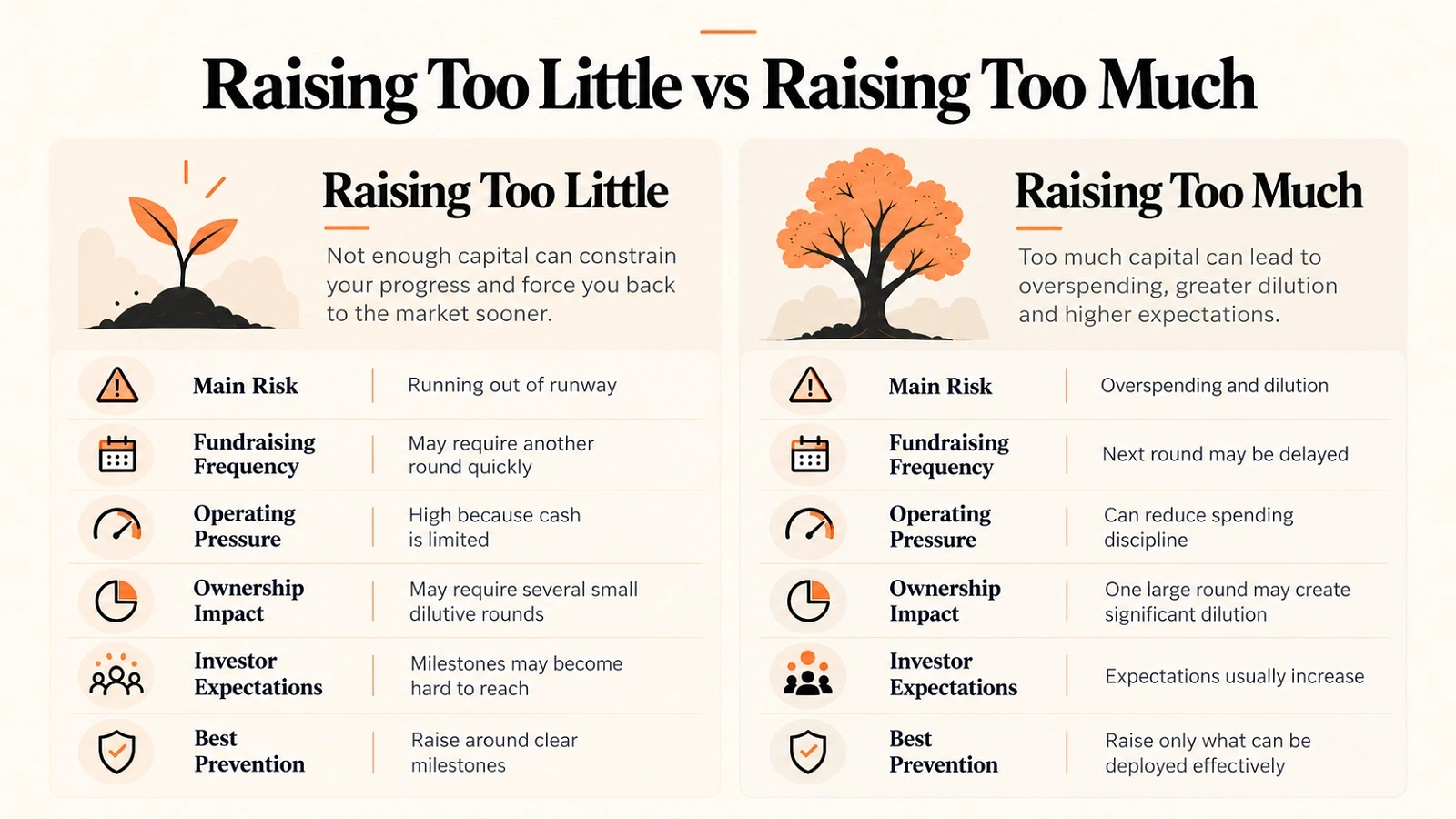
The goal is not to raise the smallest or largest possible amount. It is to raise enough capital to reach a stronger business position.
Mistake Six: Optimizing Only for Valuation
Founders naturally care about valuation because it influences dilution, but valuation is only one part of an investment agreement.
A high valuation can look attractive in the current round while creating problems later. If the company does not grow enough to justify that price, the next financing may become difficult.
Investors may also offer very different terms around board representation, voting rights, liquidation preferences, future participation, and governance. A lower valuation from the right investor with cleaner terms can sometimes create a better long term outcome than the highest possible headline number.
Funding should be evaluated as a complete agreement rather than as a valuation contest.
Mistake Seven: Choosing Investors Only for Their Money
Capital matters, but investors can influence the company for years. A founder who chooses an investor only because the investor is willing to participate may ignore questions around reputation, communication style, sector knowledge, governance expectations, and future support.
A strong investor can help with recruiting, customer introductions, strategy, later financing, and credibility. A poor investor relationship can create distractions at exactly the moment the startup needs focus.
Founders should therefore conduct their own due diligence on investors. Speaking with founders from previous portfolio companies can reveal how an investor behaves when the company performs well and when problems appear.
What Founders Should Evaluate in an Investor
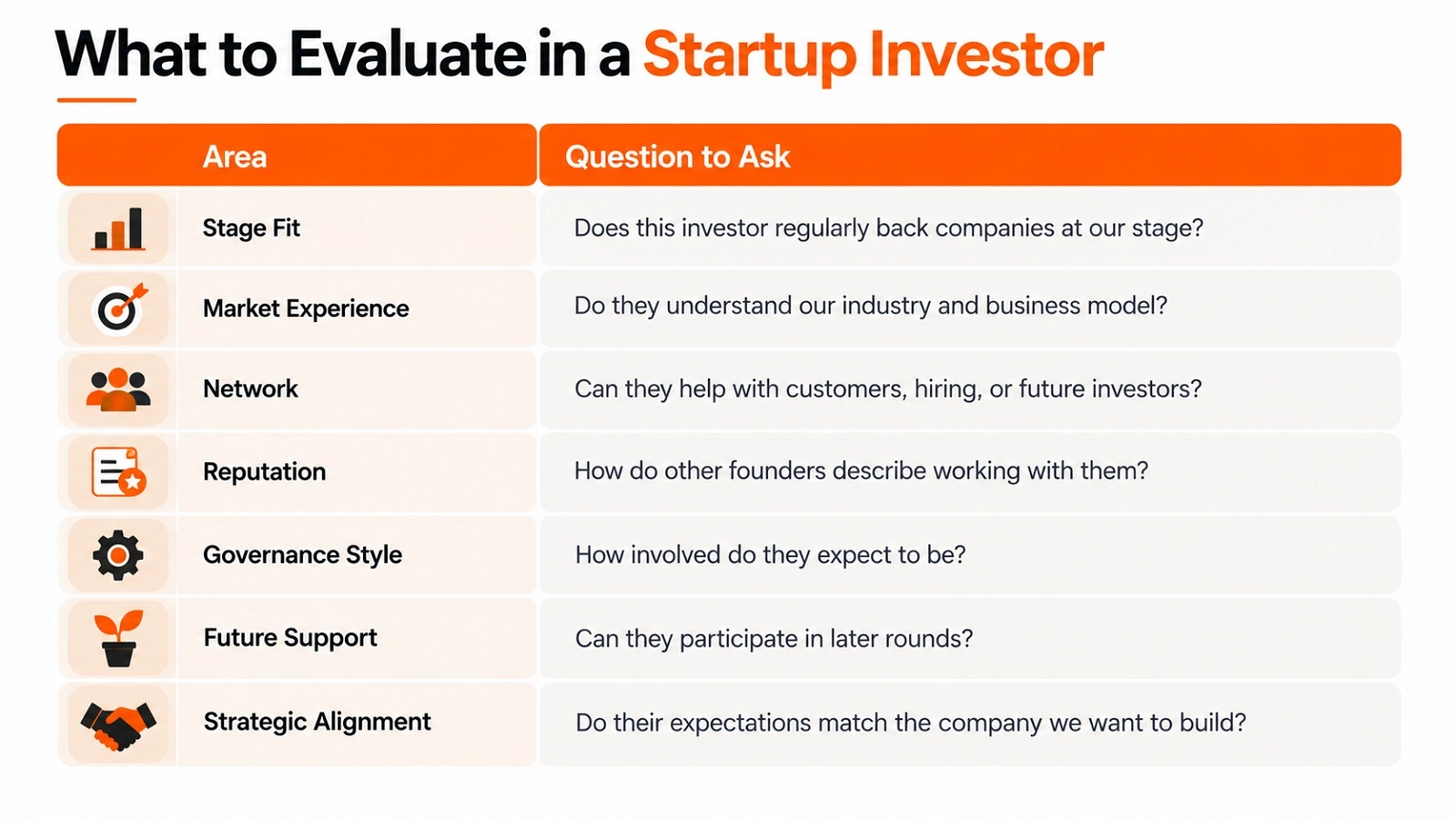
Investor selection should be treated as a partnership decision, especially when the investor may join the board or remain on the capitalization table for many years.
Mistake Eight: Scaling Before Product Market Fit
One of the most expensive funding mistakes is using capital to accelerate a business model that has not been proven.
A startup may receive investment and immediately expand sales, marketing, and hiring because growth is expected. If customer retention is weak or the product does not solve a sufficiently important problem, additional spending can make the weakness more expensive rather than fixing it.
Acquisition can temporarily hide a retention problem. The company may continue bringing in new users while existing customers leave, creating the appearance of growth without building a durable customer base.
Before scaling aggressively, founders need evidence that customers actually value the product and that increased acquisition will strengthen the business rather than simply increase churn.
Mistake Nine: Hiring Too Fast After Funding
A new round often creates pressure to build the team quickly, but hiring should solve actual constraints rather than become a symbol of progress.
Some expansion is necessary because capital is often raised specifically to increase execution capacity. The problem begins when headcount grows before roles are clearly needed or before the company has strong systems for managing a larger organization.
Rapid hiring increases burn, management complexity, and organizational friction. It also creates commitments that can be difficult to reverse without layoffs.
Founders should understand which bottlenecks new hires are expected to remove and how each role contributes to the milestones the round was designed to achieve.
Mistake Ten: Spending Before Learning
Early startups are still learning what customers want, how the product should work, and which growth channels are effective. Large spending decisions become dangerous when they are made before those questions have reasonable answers.
A company may invest heavily in paid acquisition before understanding retention, build expensive features before confirming demand, or enter a new market before testing whether the existing model translates.
The advantage of a startup is often its ability to learn quickly. Funding should increase the speed of useful learning rather than simply increase the speed of spending.
Mistake Eleven: Ignoring Burn Rate
The amount raised gets attention, but burn rate determines how quickly the money disappears. Two startups can raise the same amount and have completely different financial positions depending on how much they spend each month.
Founders need to understand the company’s cost base, hiring commitments, cash position, and how spending changes as the organization grows. Burn is not automatically bad. A startup may intentionally spend aggressively because the opportunity justifies it.
The problem appears when management cannot explain what the spending is producing. Every significant increase in burn should connect to stronger product development, customer growth, revenue, or another important milestone.
Mistake Twelve: Confusing Runway With Safety
A company with a large cash balance may still be financially vulnerable if its burn rate is rising rapidly.
Founders often think of runway as the number of months the startup can operate at its current spending level, but current spending rarely stays constant after a funding round. New hires, infrastructure, expansion, and acquisition can increase expenses quickly.
The startup should therefore model how runway changes under different scenarios rather than relying on one static number. Financial planning should reflect where the company is going, not only where spending sits today.
Mistake Thirteen: Ignoring Dilution Across Multiple Rounds
Founders may understand dilution in one round while underestimating how ownership changes across several financing events.
A round that looks manageable on its own can become much more significant when combined with earlier investments, employee option pools, convertible instruments, and future raises. Ownership planning matters because founders need enough economic incentive and governance influence to continue leading the company effectively.
This does not mean founders should avoid dilution at all costs. The objective is to exchange ownership when the capital has a credible chance of creating substantially greater company value.
Mistake Fourteen: Not Understanding the Term Sheet
Some founders focus on the amount raised and valuation while allowing lawyers or investors to handle everything else. Legal advice is essential, but founders still need to understand the business consequences of the terms they accept.
Board rights, voting provisions, liquidation preferences, option pool changes, future financing rights, and investor protections can all affect major decisions later. Terms that appear unimportant when the company is growing quickly can become much more significant during a sale, difficult financing round, or strategic disagreement.
Founders should be able to explain what they signed and how the agreement affects the company.
Mistake Fifteen: Building the Business Around the Next Fundraise
A startup may begin making decisions mainly to create metrics that look attractive to investors rather than to build a stronger business.
This can lead to aggressive acquisition spending, pricing designed to increase short term growth, or expansion into markets chosen mainly to improve the fundraising story.
Investors matter, but customers determine whether the business has lasting value. Strong revenue quality, retention, product value, efficient growth, and customer satisfaction create better fundraising leverage than cosmetic metrics.
The best preparation for the next round is usually building a healthier company.
Mistake Sixteen: Treating Fundraising as Customer Validation
A successful funding round proves that investors were willing to invest. It does not prove that customers want the product.
Investors make decisions based on future potential. Customers decide based on whether the product solves a real problem for them today.
Confusing the two can cause founders to believe that investment confirms the business model before customer evidence supports that conclusion. The company should continue testing product demand, retention, pricing, and customer behavior after the round closes.
Investor conviction is useful, but customer behavior remains the stronger market signal.
Mistake Seventeen: Ignoring Future Funding Conditions
Funding decisions should not be evaluated only in the context of the current round.
A valuation, investor right, ownership structure, or debt obligation accepted today can affect what becomes possible later. A company that raises at an aggressive valuation may need exceptional growth before the next round. A complicated ownership structure may slow due diligence. Existing debt can change how new investors evaluate the business.
Founders should ask how each financing decision changes the company’s future options. Good financing should create flexibility rather than unnecessarily reduce it.
Mistake Eighteen: Waiting Too Long to Prepare the Next Raise
The next fundraising process begins long before the first investor meeting.
Founders need to build the metrics, documentation, relationships, and business evidence that future investors will expect. Waiting until runway becomes short can leave the company trying to create months of evidence in a few weeks.
Strong fundraising preparation happens through normal execution. If the current round was supposed to prove retention, the company should track retention from the beginning. If the next stage requires stronger revenue predictability, reporting systems should be built before investors request them.
Mistake Nineteen: Failing to Keep Financial Records Clean
Weak financial records can create unnecessary problems during fundraising and due diligence.
As the company grows, founders need clear records around revenue, expenses, payroll, taxes, ownership, contracts, and cash movements. Informal tracking may be manageable when the startup is extremely small, but it becomes increasingly risky as investors and employees enter the company.
Poor records can slow diligence, reduce investor confidence, and make management decisions harder because founders do not have a reliable picture of the business.
Financial discipline is not only about compliance. It also gives founders better information when deciding how much capital the company actually needs.
Mistake Twenty: Using Debt to Hide a Business Problem
Debt can be useful when a company has predictable revenue and a clear reason for borrowing, but it becomes dangerous when it is used to delay confronting fundamental weaknesses.
A startup with declining demand, weak retention, or an unproven business model may take on debt simply to extend runway. That can provide temporary relief while adding repayment obligations to an already weak financial position.
Debt works best when it finances a known opportunity or operating need. It is much less effective when it is being used to avoid solving a product, revenue, or customer problem.
Founders should understand whether debt is buying productive capacity or merely buying time.
Mistake Twenty One: Expanding Into Too Many Markets After Funding
A new round can create enthusiasm around expansion, but pursuing too many markets at once can dilute focus.
Each new geography, customer segment, or product line requires management attention, marketing, sales capacity, operations, and product adaptation. If the company expands before understanding which opportunities are strongest, capital can become scattered across several weak initiatives.
A more disciplined approach is to test expansion in stages and look for evidence before increasing commitment.
Funding creates the option to expand. It does not mean the company should pursue every available opportunity at the same time.
Mistake Twenty Two: Ignoring Founder and Investor Alignment
Founder and investor incentives can diverge even when everyone initially agrees on the opportunity.
A founder may want to build a profitable independent company while an investor may expect aggressive expansion and a large exit. Neither objective is inherently wrong, but misalignment can create conflict later.
Founders should understand what type of outcome investors are seeking, how quickly they expect the company to grow, and how they think about future rounds, acquisitions, or exits.
These conversations are easier before the investment than after the company faces a difficult strategic decision.
How Funding Mistakes Change by Startup Stage
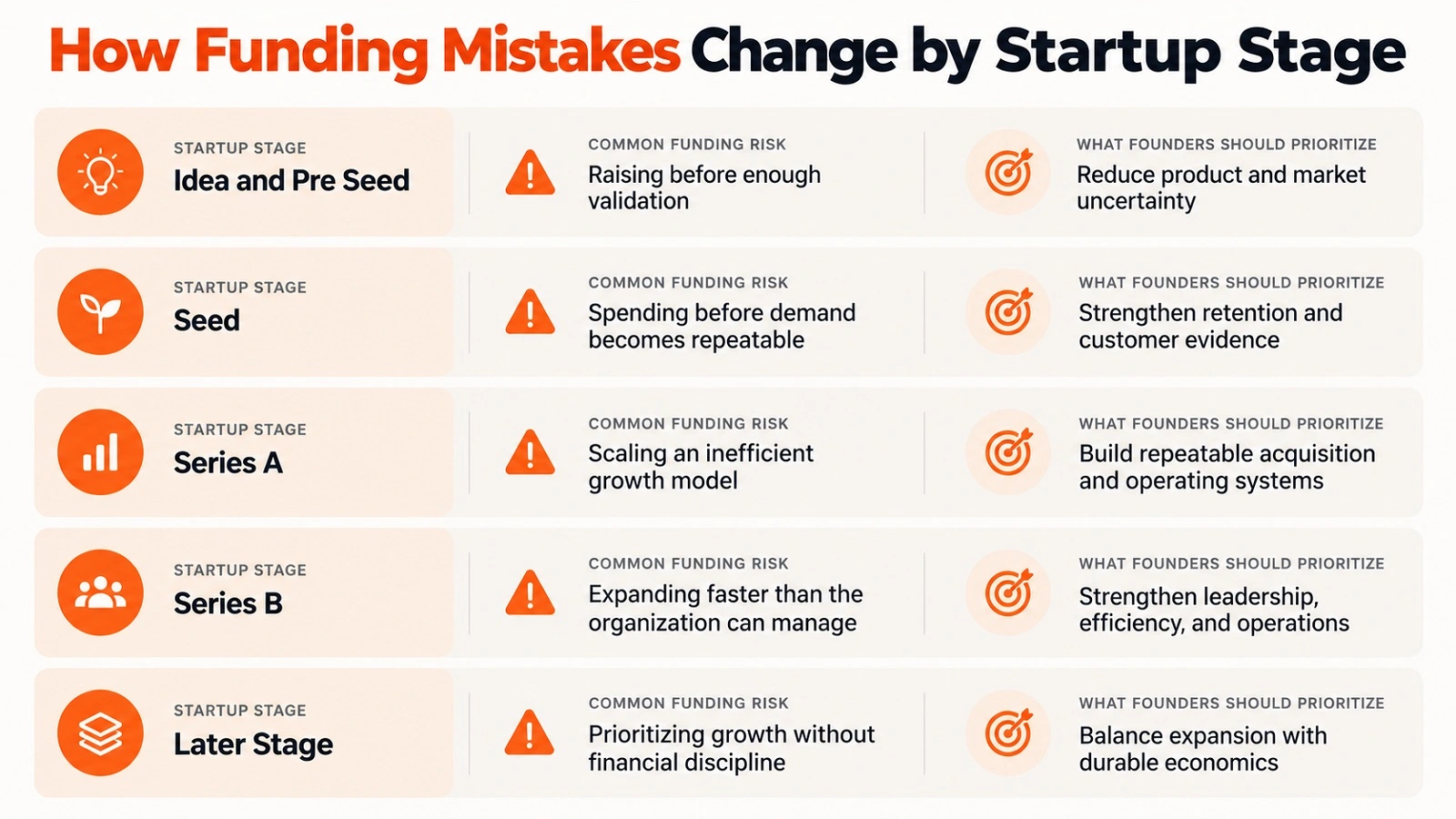
The nature of the mistake changes as the company develops. Early startups are more vulnerable to validation problems, while later companies face greater operational, governance, and efficiency risks.
How Founders Can Avoid Startup Funding Mistakes
The strongest defense against funding mistakes is connecting capital directly to evidence. Before raising, founders should understand what uncertainty the company needs to remove, what milestone the round should reach, and which financing structure matches the business.
During fundraising, founders should evaluate investors and terms as carefully as investors evaluate the company. After the round closes, spending should remain connected to the original purpose of the capital. If assumptions change, management should adapt rather than continuing to follow a plan simply because it appeared in the fundraising deck.
Financial discipline also matters. Founders should know their runway, burn, ownership structure, major financing terms, and the metrics likely to determine whether the next round becomes possible.
The goal is not to avoid every risk. Startups operate under uncertainty by definition. The goal is to make financing decisions where the potential value created justifies the ownership, financial, and strategic cost.
What Good Startup Funding Looks Like
Good funding leaves the company in a meaningfully stronger position.
The startup should have more than additional cash. It should have enough resources to answer important business questions, strengthen customer evidence, improve operations, and build toward the next stage.
A successful round may increase headcount or spending, but those changes are secondary. The real objective is stronger evidence and greater business capability.
When capital is deployed well, the company should finish the round with fewer critical uncertainties than it had when fundraising began.
The Real Cost of a Funding Mistake
The cost of a poor funding decision is not always visible on the day the deal closes.
It may appear later as excessive dilution, a difficult board relationship, a down round, weak retention hidden by expensive acquisition, an organization that became too large too early, or another fundraising process that begins before the company is ready.
That is why fundraising should be treated as part of company strategy rather than as a separate financial event.
The right capital can accelerate progress significantly. The wrong capital, terms, timing, or spending strategy can accelerate problems just as quickly.
The Real Purpose of Avoiding Startup Funding Mistakes
Avoiding funding mistakes does not mean founders should become excessively cautious or refuse capital until every uncertainty has disappeared.
The purpose is to make sure the financing strategy matches the business. A startup should raise when capital can create meaningful progress, accept dilution when the expected value justifies it, select investors who improve the company’s position, and spend in ways that strengthen the evidence required for the next stage.
Fundraising works best when money increases the quality of the business rather than simply increasing its size.
FAQ
What are the most common startup funding mistakes?
Common mistakes include raising too early or too late, raising the wrong amount, focusing only on valuation, choosing the wrong investors, scaling before product market fit, hiring too quickly, ignoring dilution, and spending without clear milestones.
Is raising too much money bad for a startup?
It can be. A larger round may create more dilution, higher investor expectations, and pressure to increase spending before the business is ready. The right amount depends on the milestones the company needs to reach.
Why is raising too little risky?
If the round does not provide enough runway to reach a stronger business milestone, founders may need to raise again before the company has created enough new evidence to improve its fundraising position.
Should founders always choose the investor offering the highest valuation?
No. Valuation is only one part of an investment. Founders should also evaluate investor fit, governance, financing terms, reputation, strategic value, and potential support in future rounds.
Is dilution always bad?
No. Dilution can be worthwhile when the capital and investor support help create significantly more company value. The important question is whether the ownership exchanged is justified by the progress the capital can create.
What is the biggest mistake after raising funding?
One of the biggest mistakes is increasing spending before understanding what already works. Capital should accelerate validated opportunities and useful learning rather than simply increase activity.
How can founders avoid running out of runway?
They should monitor burn rate, model future spending, connect hiring and expansion to milestones, and begin preparing for future financing before cash becomes dangerously low.
Does successful fundraising mean the startup has proven its business model?
No. Fundraising demonstrates investor interest, not customer validation. The startup still needs to prove that customers want the product and that the company can build a sustainable business around that demand.

Mobina Khanki
Venture & Funding Writer at PinerookMobina Khanki covers venture capital, startup funding, fundraising, and startup finance for Pinerook, focusing on founders and investors.
 Seen first.