Series B is the stage where a startup is no longer being judged mainly on whether the idea works. By this point, the company should already have meaningful traction, clearer customer demand, stronger revenue signals, and a business model that has been tested through earlier funding rounds.
This is where Startup Funding shifts from proving scalability to accelerating it. Investors want to see that the company has built systems that already work and that additional capital can help those systems reach a much larger market without weakening customer economics or operational quality.
Series B funding is therefore primarily about expansion. The company should understand who its customers are, why they stay, how they are acquired, what drives revenue, where growth is most efficient, and which opportunities are worth pursuing next.
What Is Series B Funding?
Series B funding is a later stage investment round raised by startups that have already demonstrated strong traction and a more repeatable business model.
The company is typically beyond the experimental phase that defines pre seed and seed funding. It may already have a growing customer base, established revenue, clearer retention patterns, structured sales or acquisition channels, and more mature internal teams.
The purpose of Series B capital is to expand what has already been proven. That may mean entering new geographic markets, serving larger customers, increasing sales capacity, strengthening product infrastructure, hiring experienced leaders, or extending the company into closely related products or customer segments.
Series B investors are therefore asking a different question from early stage investors. They are not mainly asking whether the business can work. They want to understand how large it can become and whether the current model can survive that growth.
Where Series B Fits in the Funding Journey
Each major funding stage represents a different level of evidence. The startup gradually moves from proving the original problem to proving that a large company can be built around the solution.
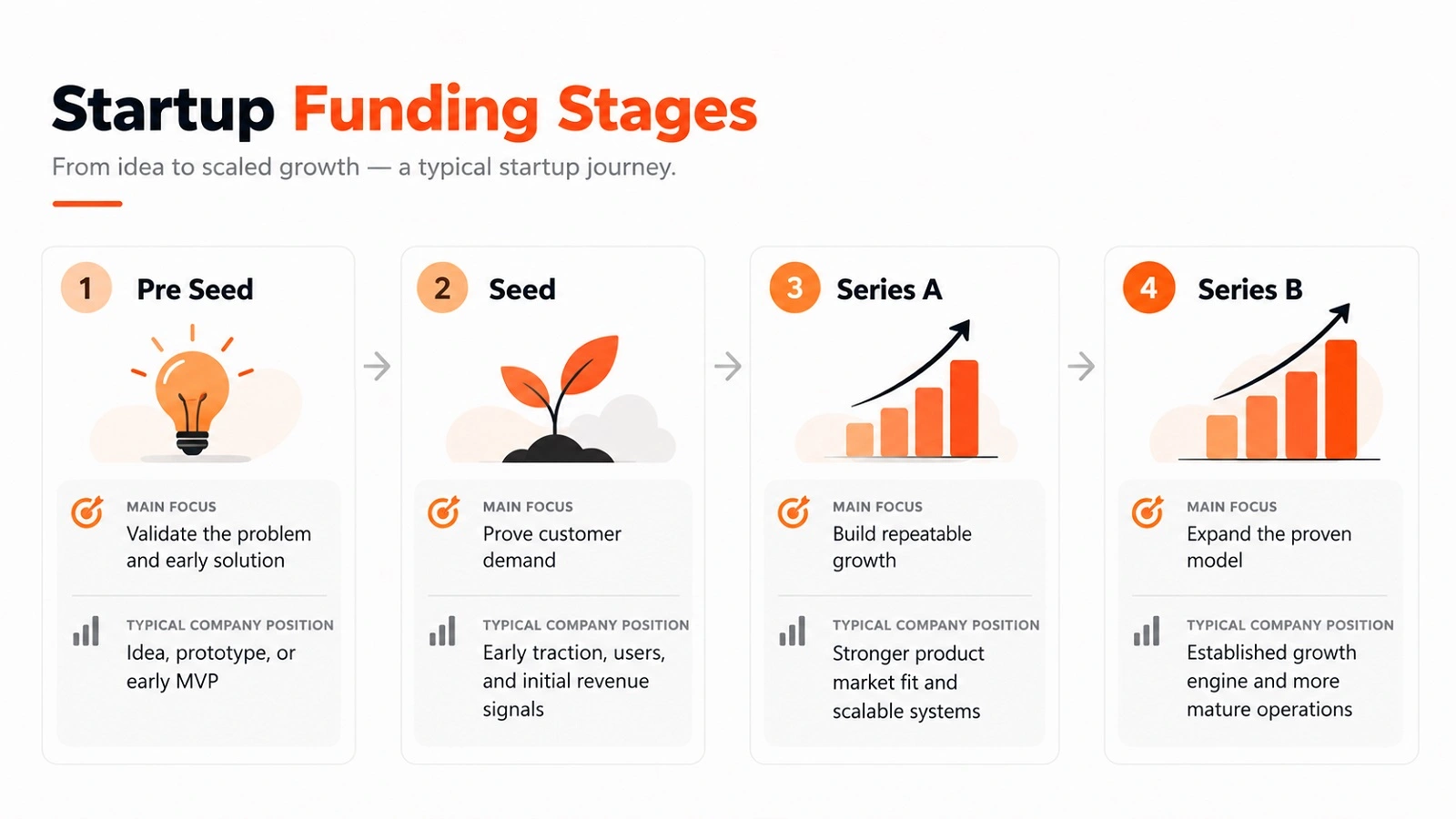
At Series B, investors expect fewer fundamental questions about whether customers want the product. The conversation moves toward market expansion, operating efficiency, leadership depth, financial performance, and the company’s ability to manage larger scale.
The business should already have a credible growth engine. Series B capital is used to make that engine larger, stronger, and more durable.
What Investors Look For in Series B Funding
Series B investors usually expect stronger proof than investors at earlier stages. The startup should already be producing measurable results and should understand what is causing those results.
The exact metrics vary between business models, but investors are generally trying to answer one central question: can this company become much larger without damaging the strengths that made it successful in the first place?
Proven Product Market Fit
Product market fit should be more established at Series B than it was during Series A.
Investors want to see that customers continue using the product, that retention remains healthy, and that the company is solving a sufficiently important problem for demand to continue as the customer base expands.
This matters because some companies look strong while serving a small group of early adopters but struggle when they move into the broader market. Series B investors want evidence that demand extends beyond the startup’s earliest supporters.
Strong retention, customer expansion, repeat purchases, recurring usage, referrals, and improving customer satisfaction can all strengthen the investment case.
Revenue Growth and Predictability
Revenue usually plays a much more important role at Series B.
Investors are interested not only in how much revenue the company produces but also in how predictable that revenue is becoming. They may examine recurring revenue, customer concentration, contract length, pricing, sales pipeline quality, expansion revenue, renewal behavior, and the consistency of historical growth.
A startup that understands exactly where revenue comes from has a stronger case than one that simply reports rapid growth.
Series B investors generally want to see that revenue is emerging from a repeatable business system rather than a small number of unusually large deals or founder relationships.
Growth Efficiency
Fast growth does not automatically mean healthy growth.
As a startup expands, investors increasingly examine how much capital the company needs to produce additional revenue and customers. Customer acquisition cost, gross margin, customer lifetime value, sales efficiency, contribution margin, and payback period can all become more important.
The company does not necessarily need perfect economics. Many Series B startups are still investing aggressively in growth. What matters is whether management understands the economics and can explain how they should develop as the company scales.
A startup that requires dramatically more spending every year to maintain the same growth rate may have a scaling problem that Series B capital alone cannot solve.
Customer Retention at Larger Scale
Retention becomes especially important because Series B often involves accelerating customer acquisition.
If customers leave quickly, increasing acquisition spending may simply increase the speed at which the company replaces lost customers. That creates the appearance of growth without building a durable customer base.
Investors therefore look closely at whether retention remains healthy as the company reaches different customer segments and larger volumes.
The appropriate measure depends on the business model. A software company may focus on customer and revenue retention, while a consumer business may look at repeat usage and engagement. A marketplace may analyze repeat transactions from both sides of the platform.
The important point is that growth should create a larger base of valuable customers rather than a constantly changing pool of temporary users.
Market Expansion Potential
Series B capital is often raised because the company sees an opportunity beyond its original market.
Expansion can mean reaching new customer segments, moving into new geographic regions, increasing the size of customers served, introducing related products, or opening new distribution channels.
Investors want evidence that the expansion path is realistic. Interest from customers in another region, successful pilot programs, inbound demand from larger companies, or strong usage of an adjacent product feature can all support the case.
Expansion becomes less convincing when it depends only on the assumption that success in one market will automatically transfer to another.
The strongest Series B companies understand both where they can expand and why their existing advantage should remain relevant there.
Operational Maturity
A business that doubles in size can become much more complex even when its product remains the same.
At Series B, investors increasingly examine whether the company has the infrastructure required to manage larger teams, more customers, greater revenue, and more complex operations.
Financial reporting, sales operations, hiring systems, customer support, product development, security, compliance, internal communication, and management processes may all need to become more structured.
Processes that worked when everyone sat in one room may no longer work when the company operates through multiple departments or countries.
Operational maturity therefore becomes part of the investment case rather than simply an internal management issue.
Leadership and Team Depth
The founders remain central to the company, but Series B investors also care about the leaders around them.
A rapidly growing company needs executives and managers who can build teams, recruit specialists, manage budgets, create processes, and make decisions without requiring constant founder involvement.
Investors may examine the strength of leadership across sales, marketing, engineering, product, finance, operations, and customer success.
This does not mean every leadership position must already be filled. What matters is that founders understand where the organizational gaps are and have a credible plan for addressing them.
A company that depends on the founders for every major operational decision may struggle to scale even when demand is strong.
What Series B Capital Is Used For
Series B capital should generally strengthen and expand business areas that have already produced evidence of success.
A startup may invest heavily in sales if demand exceeds the capacity of its current commercial team. Another company may expand engineering because product infrastructure is becoming the main constraint on growth. A business preparing for international expansion may need new leadership, compliance capabilities, localization, and regional sales teams.
The same principle applies across these examples. Series B capital should accelerate a proven direction.
The round should not primarily be used to discover what customers want or what the company’s core business should become. Those questions should already have much stronger answers by this stage.
Series A Funding vs Series B Funding
Series A and Series B both involve scaling, but they usually represent different levels of business maturity.
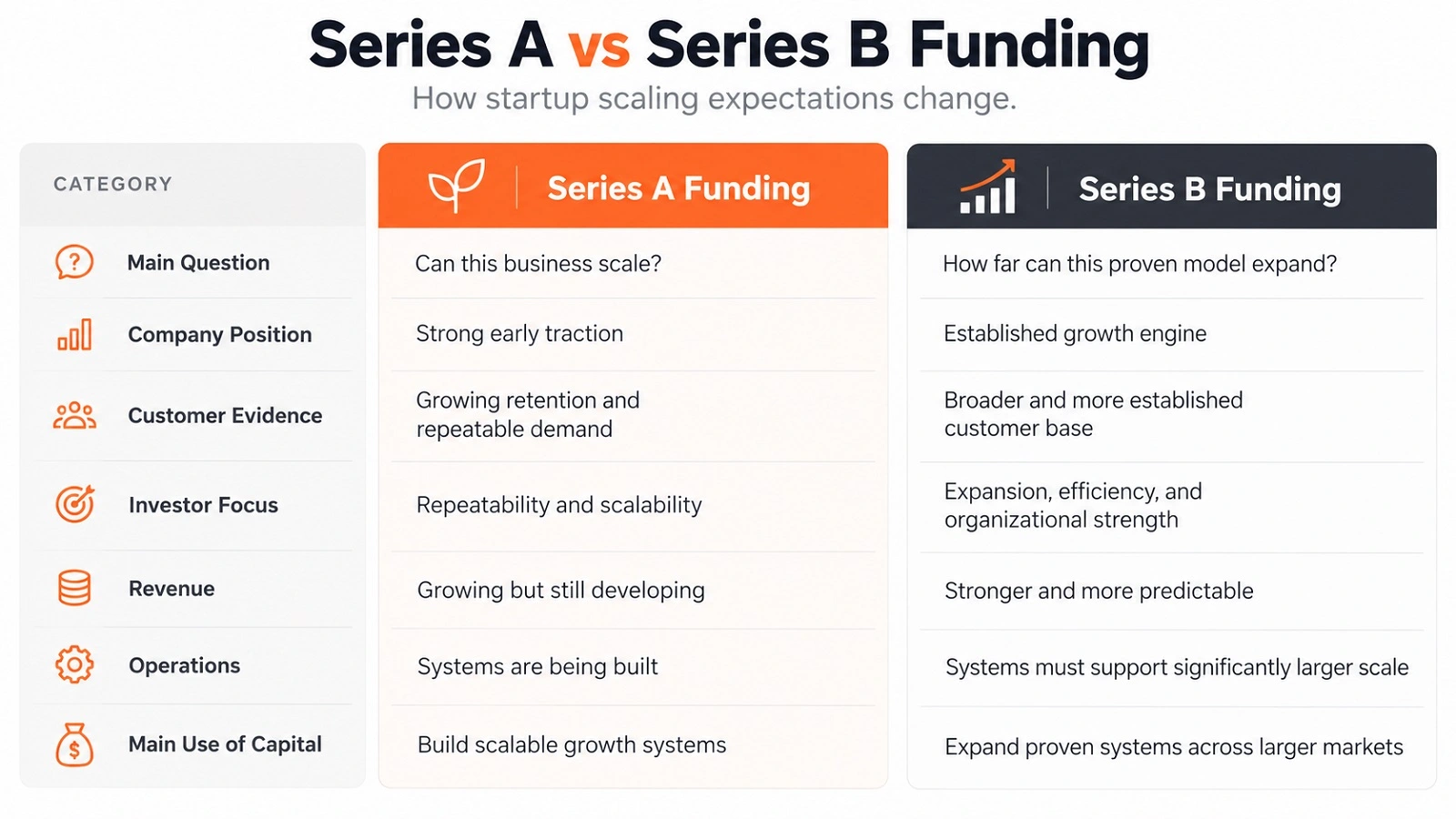
Series A is often about proving that a growth engine can become repeatable. Series B is about showing that the same engine can support a significantly larger organization.
Metrics That Matter at Series B
Series B investors generally expect more detailed operating data than investors in earlier rounds.
Revenue growth remains important, but it needs context. Investors may want to understand how much revenue comes from existing customers, how much comes from new customers, how efficiently those customers are acquired, and whether margins remain healthy as volume increases.
Retention and churn can show whether the customer base is durable. Gross margin can reveal how attractive additional revenue is. Sales productivity can show whether adding commercial capacity continues to produce acceptable results.
Different business models require different metrics. Subscription companies may emphasize recurring revenue, retention, expansion revenue, sales efficiency, and gross margin. Marketplaces may focus on transaction volume, repeat activity, liquidity, take rate, and unit economics. Consumer businesses may pay more attention to active usage, engagement, repeat behavior, monetization, and customer acquisition efficiency.
Strong management teams do not merely report these numbers. They can explain what drives them and which actions are expected to improve them.
How Much Progress Should Series B Funding Create?
Series B should move the startup from a proven growth model toward broader market scale.
A successful round may allow the company to enter new regions, increase revenue substantially, expand into larger customer segments, strengthen product infrastructure, improve margins, or develop a deeper leadership team.
The company should also become less dependent on individual people. Growth needs to be supported by systems that continue working even as the team changes and responsibilities become distributed across departments.
By the end of Series B, management should understand not only how the company grows but also how to manage that growth at a much larger scale.
This is important because later investors will expect increasingly greater predictability and organizational discipline.
How Founders Should Prepare for a Series B Raise
Series B fundraising usually requires a deeper operating story than earlier rounds.
Founders need to explain how the company has performed since Series A, where growth came from, how customers behave, how efficiently capital has been deployed, and where the largest remaining opportunities exist.
Financial and operational data should also be more reliable by this point. Investors may examine revenue trends, retention cohorts, customer acquisition, margins, sales productivity, product usage, operating costs, hiring plans, and forecasts.
The fundraising narrative should connect historical proof with future expansion.
A strong company can explain what has already been proven, what the next stage of growth requires, and why Series B capital is the correct resource for reaching that stage.
How Much Series B Funding Should a Startup Raise?
There is no universal amount that every Series B startup should raise.
The appropriate round size depends on the business model, industry, growth strategy, operating costs, hiring requirements, market expansion plan, and the milestones expected before the next financing stage.
Founders should begin with those milestones rather than choosing an impressive fundraising target and building the plan around it.
If international expansion is the next objective, the company should calculate the people, infrastructure, regulatory work, sales capacity, and runway required to test and scale that expansion properly.
Raising too little can leave the company fundraising again before meaningful progress has been created. Raising significantly more than necessary can increase dilution, encourage inefficient spending, and create higher expectations for future performance.
The size of the round should reflect the strategy rather than the desire to produce a larger funding announcement.
Ownership and Dilution at Series B
Series B does not only affect the company’s bank account. It also changes its ownership structure.
Founders and earlier investors may experience additional dilution when new shares are issued to Series B investors. The exact impact depends on the valuation, size of the round, existing capitalization, option pools, and investment terms.
Founders therefore need to evaluate more than the headline amount being raised.
A larger round at a higher valuation may appear attractive, but the terms attached to the investment can also affect governance, board composition, future financing, and economic outcomes.
This makes Series B a financial and strategic decision rather than simply a fundraising event.
What Makes a Strong Series B Story?
A strong Series B story begins with evidence rather than ambition.
The startup should be able to show that the product has established value, customers stay, revenue is growing, acquisition has become more predictable, and the organization has demonstrated an ability to execute at greater scale.
The next part of the story is expansion. Founders should explain where the company can grow next and why its existing strengths provide an advantage in that opportunity.
Finally, investors need to understand the role of capital. The round should have a clear purpose and should connect directly to measurable milestones.
When these three parts fit together, the fundraising story becomes much more credible.
When a Startup May Not Be Ready for Series B
A company can have strong growth and still be too early for Series B.
One warning sign is growth that becomes increasingly expensive as the company scales. If acquisition costs continue rising while customer value remains flat, the current growth engine may not be ready for broader expansion.
Weak retention is another concern. A company that constantly replaces departing customers may report attractive top line growth while building little long term value.
Operational dependence on founders can also signal that the company needs more time. If key sales, customer relationships, hiring decisions, or internal processes still require direct founder involvement, scaling rapidly may create organizational problems.
Expansion plans based mostly on assumptions can create another issue. Entering several new markets before testing whether the model translates can turn Series B capital into an expensive experiment.
In these situations, extending the current stage and improving the underlying business may be more valuable than raising a larger round immediately.
Common Series B Funding Mistakes
One common mistake is expanding across too many markets at the same time. A company may see several opportunities, but pursuing all of them can dilute focus and weaken the core business.
Another mistake is assuming that systems created during Series A will automatically support much greater scale. Processes often need to be redesigned as the number of employees, customers, and transactions increases.
Some startups also focus too heavily on revenue while ignoring the cost of producing that growth. Rapid expansion can hide rising acquisition costs, declining margins, weak retention, or deterioration in customer quality.
Leadership gaps can create additional problems. A company may reach Series B because of a strong founding team, but the next stage often requires experienced executives who know how to operate larger organizations.
Founders can also underestimate the expectations created by the round. More capital usually means a more ambitious growth plan and greater pressure to demonstrate measurable progress before another financing event.
Building the Organization After Series B
Series B often changes the company as much internally as it does commercially.
Teams become larger, managers gain more responsibility, departments become more specialized, and communication becomes more difficult. Informal processes that once worked efficiently can begin creating confusion.
Founders therefore need to think carefully about organizational design. Reporting structures, decision rights, hiring standards, performance measurement, and communication processes become increasingly important.
The goal is not to create unnecessary bureaucracy. It is to make sure that a larger organization can continue moving quickly without requiring every decision to pass through the founders.
A successful Series B company learns how to preserve startup speed while adding the structure required for scale.
Expanding Into New Markets After Series B
Market expansion is one of the most common reasons for raising Series B, but expansion should be approached as a disciplined process.
A company entering a new geographic market may face different customer expectations, competitors, regulations, pricing conditions, and acquisition channels. A strategy that worked in the original market may not transfer directly.
The same challenge applies when moving into a new customer segment. Enterprise customers, for example, may require longer sales cycles, different product capabilities, stronger security, and more sophisticated support than smaller customers.
Successful expansion therefore depends on understanding which parts of the existing model are transferable and which parts need to change.
Series B provides the resources to make that transition, but evidence should still guide the strategy.
Moving Beyond Series B
After Series B, some startups continue raising Series C and later rounds.
Those rounds can support additional geographic expansion, acquisitions, major product development, large infrastructure investments, or preparation for a potential public listing.
Investor expectations also continue changing. Financial performance, competitive position, organizational strength, and the path toward sustainable profitability can become increasingly important.
Not every company needs to continue raising external capital. Some startups reach a point where internal revenue can finance future growth.
The appropriate path depends on the business model, the market opportunity, capital requirements, ownership considerations, and the strategic goals of the company.
Series B Funding Is About Expanding What Works
The defining feature of Series B is that the startup should already understand what works.
The company should know who its customers are, why they value the product, how they are acquired, what encourages them to stay, how revenue is generated, and which systems drive growth.
Series B capital gives the company an opportunity to take those strengths into a much larger market.
That can mean reaching more customers, entering new regions, moving into larger customer segments, expanding the team, strengthening infrastructure, or introducing additional products around an established customer relationship.
The central challenge is maintaining business quality while significantly increasing business size.
The Real Purpose of Series B Funding
Series B is not simply the next fundraising milestone after Series A. Its purpose is to transform a proven growth engine into a larger and more durable company.
A startup entering Series B should already know which parts of its business are producing meaningful results. The round gives the company additional resources to expand those strengths while building the leadership, infrastructure, and operating systems needed for the next level of scale.
A successful Series B round therefore creates more than higher revenue. It should leave the company with broader market reach, deeper organizational capability, stronger operating systems, and greater confidence that growth can continue beyond the startup’s original market.
FAQ
What is Series B funding?
Series B funding is a later stage investment round used by startups that have already demonstrated strong traction and want to expand a proven business model.
What comes before Series B funding?
Series A typically comes before Series B. Series A focuses on proving that a startup can build scalable and repeatable growth systems, while Series B focuses on expanding those systems.
What do Series B investors look for?
Series B investors typically examine revenue growth, customer retention, acquisition economics, market expansion potential, operating efficiency, leadership depth, and the ability of the company to scale.
Does a startup need revenue before Series B?
Most Series B companies have meaningful revenue or another substantial form of measurable traction. Exact expectations depend on the industry and business model.
What is the difference between Series A and Series B funding?
Series A is focused on proving that a company can create repeatable growth. Series B is focused on expanding that proven growth model across larger markets, teams, and customer segments.
What is Series B funding used for?
Series B capital can be used for market expansion, hiring, sales growth, product development, infrastructure, customer success, operations, and building a stronger leadership team.
How much Series B funding should a startup raise?
The appropriate amount depends on the company’s growth plan, operating costs, business model, expansion strategy, capital requirements, and the milestones it needs to reach before the next stage.
What should Series B funding achieve?
A successful Series B round should help the startup increase scale while maintaining healthy customer economics, strong retention, operating discipline, and a clear path toward continued expansion.

Mobina Khanki
Venture & Funding Writer at PinerookMobina Khanki covers venture capital, startup funding, fundraising, and startup finance for Pinerook, focusing on founders and investors.
 Seen first.