Reaching Series A changes the conversation around a startup. During the earliest stages, founders are mainly trying to prove that the problem is real, that customers care about the solution, and that the product deserves to exist. By Series A, those questions have not disappeared, but investors expect much stronger evidence that the company can turn early traction into a repeatable business.
This is where Startup Funding enters a more demanding phase. The company is expected to understand its customers, show meaningful traction, explain how revenue or usage is growing, and demonstrate that additional capital can expand something that is already working.
Series A funding is therefore not simply a larger seed round. It is a transition from proving demand to proving scalability. The strongest companies at this stage can explain not only why customers want the product, but also how the business can acquire more customers, retain them, and grow without losing control of its economics.
What Is Series A Funding?
Series A funding is an institutional investment round typically raised after a startup has completed its seed stage and developed stronger evidence of market demand. The company usually has an established product, active customers, measurable traction, and a clearer understanding of how its business model works.
The purpose of Series A capital is to help a startup transform early success into a repeatable growth system. Founders may already know that people want the product, but they still need to prove that customer acquisition, retention, revenue, and operations can continue working as the company becomes larger.
This distinction matters because Series A investors are taking a different type of risk from seed investors. Seed investors often fund uncertainty around whether a business can emerge. Series A investors are increasingly evaluating whether an emerging business can become a scalable company.
Where Series A Fits in the Startup Funding Journey
Series A sits between early market validation and larger scale expansion. By this point, the startup should have reduced many of the uncertainties that dominated its pre seed and seed stages.
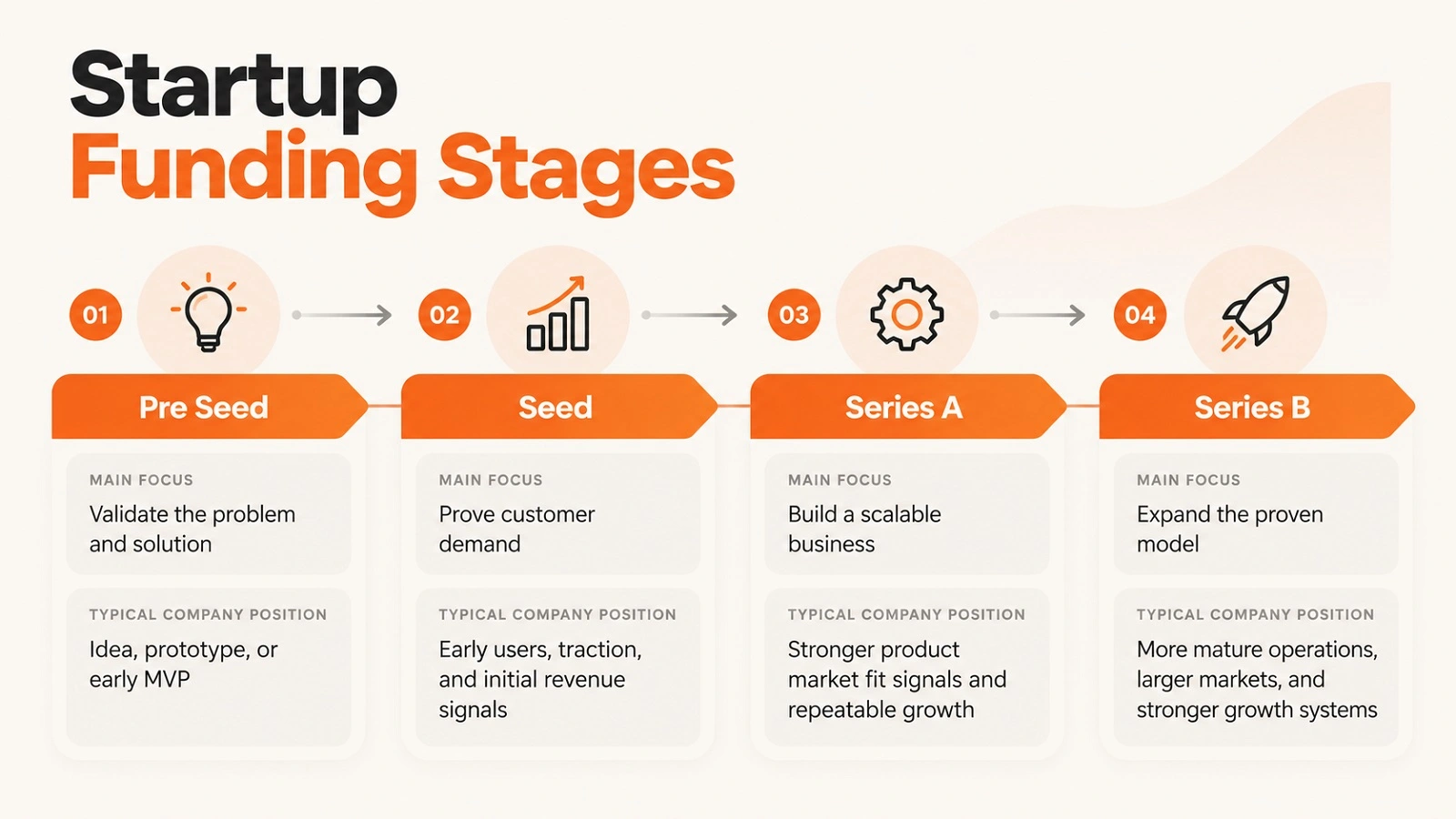
The transition into Series A is important because the company is no longer being evaluated mainly on possibility. Investors increasingly want proof that the startup understands what drives its growth and can use additional capital to expand that engine.
What Investors Look For in Series A Funding
Series A investors usually want evidence that the startup has moved beyond experimentation. The business does not need to be fully mature, but its strongest signals should be becoming more predictable.
The exact metrics vary by industry and business model, but most investors are trying to understand the same fundamental question: is there enough evidence here to justify scaling the company?
Product Market Fit
Product market fit is one of the most important concepts at Series A because growth becomes much harder to justify when customer demand is weak.
Investors want to see that customers are not simply trying the product once. They want evidence that users continue receiving value from it. Retention, repeat usage, customer satisfaction, expansion revenue, organic recommendations, and low levels of unwanted churn can all provide useful signals.
A startup may acquire customers quickly through aggressive spending, founder relationships, or promotions, but those customers are not very valuable if they leave soon afterward. That is why strong retention can matter as much as rapid acquisition.
Series A investors are effectively asking whether the company has found something customers want strongly enough to support continued growth.
Revenue and Growth Quality
Revenue often becomes more important during Series A, but investors are not interested only in the headline number. They want to understand the quality behind that revenue.
A company growing quickly because it spends heavily on acquisition may look impressive on the surface, but investors will examine whether those customers remain valuable after acquisition costs are considered. They may also look at whether revenue is recurring, how concentrated it is among customers, how predictable it has become, and whether the company understands what is driving growth.
The strongest Series A companies can explain the relationship between customer acquisition, retention, pricing, usage, and revenue. Growth becomes more compelling when founders can show why it is happening rather than simply report that it happened.
Market Size and Expansion Potential
A startup can have excellent retention and still struggle to raise Series A if the market appears too small.
Investors need to believe there is enough room for the business to become significantly larger. This means founders should understand who their customers are, how many potential customers exist, what those customers are willing to spend, and how the market could expand over time.
Market size should also connect logically with the company strategy. A huge theoretical market is less convincing when the startup has no realistic path to reaching it.
A stronger case shows how the company can move from its current customer segment into larger opportunities while maintaining a clear competitive position.
Repeatable Customer Acquisition
Early startups often win their first customers through founder relationships, personal networks, direct outreach, or highly manual sales efforts. Those methods can be useful during validation, but they may not support larger scale growth.
Series A investors want to understand whether customer acquisition can become repeatable.
That may involve product led growth, paid acquisition, sales teams, partnerships, content, community, referrals, or another channel that can expand without depending entirely on the founders.
A repeatable acquisition model does not mean every part of growth is perfectly optimized. It means the company has enough evidence to believe that spending more time or capital on a particular channel can create more customers in a reasonably predictable way.
Customer Retention
Acquiring customers is only one part of the Series A story. Keeping them is equally important.
Strong retention suggests that customers continue receiving value from the product after the initial purchase or signup. Weak retention can indicate that the company is spending money to replace customers who are constantly leaving.
For subscription businesses, this may be visible through churn and recurring revenue. For marketplaces, retention may appear through repeat transactions. Consumer products may focus more heavily on engagement, active usage, and frequency.
There is no single retention metric that works for every startup, but founders should know which behavior best demonstrates ongoing customer value.
Business Model Strength
Investors also want to understand whether the company has the foundations of a sustainable business model.
That includes pricing, margins, customer acquisition costs, customer lifetime value, sales efficiency, and the cost of delivering the product. Not every Series A startup will have optimized economics, but founders should understand how the model is developing.
The important distinction is between a company that has imperfect economics but knows what drives them and a company that is growing without understanding whether that growth can ever become financially attractive.
Team and Execution
The organizational challenge changes significantly around Series A.
Early startups can operate with a very small group of generalists making decisions quickly. As the company grows, founders need to build teams, delegate responsibilities, create clearer processes, and recruit people with deeper functional expertise.
Investors therefore evaluate whether the founding team can lead a larger organization. They may look at hiring quality, leadership gaps, decision making, and whether the company understands which roles need to be added next.
Series A is often the point where a startup begins changing from a founder driven project into an organization that can operate through teams and systems.
What Series A Capital Is Used For
Series A capital should strengthen areas of the business that have already shown evidence of working. The exact allocation depends on the startup, but the round commonly supports product development, customer acquisition, commercial teams, technology infrastructure, customer success, operations, and key leadership hires.
A company with strong product demand but limited sales capacity may invest heavily in expanding its commercial organization. A product led software business may focus more on engineering, onboarding, activation, retention, and distribution. Another company may need operational infrastructure before it can support a much larger customer base.
The principle is more important than the category. Series A capital should scale evidence rather than replace it.
Seed Funding vs Series A Funding
Seed funding and Series A are closely connected, but the investor questions are different. Seed is usually about proving that customer demand can become a real business. Series A is about proving that the emerging business can scale.
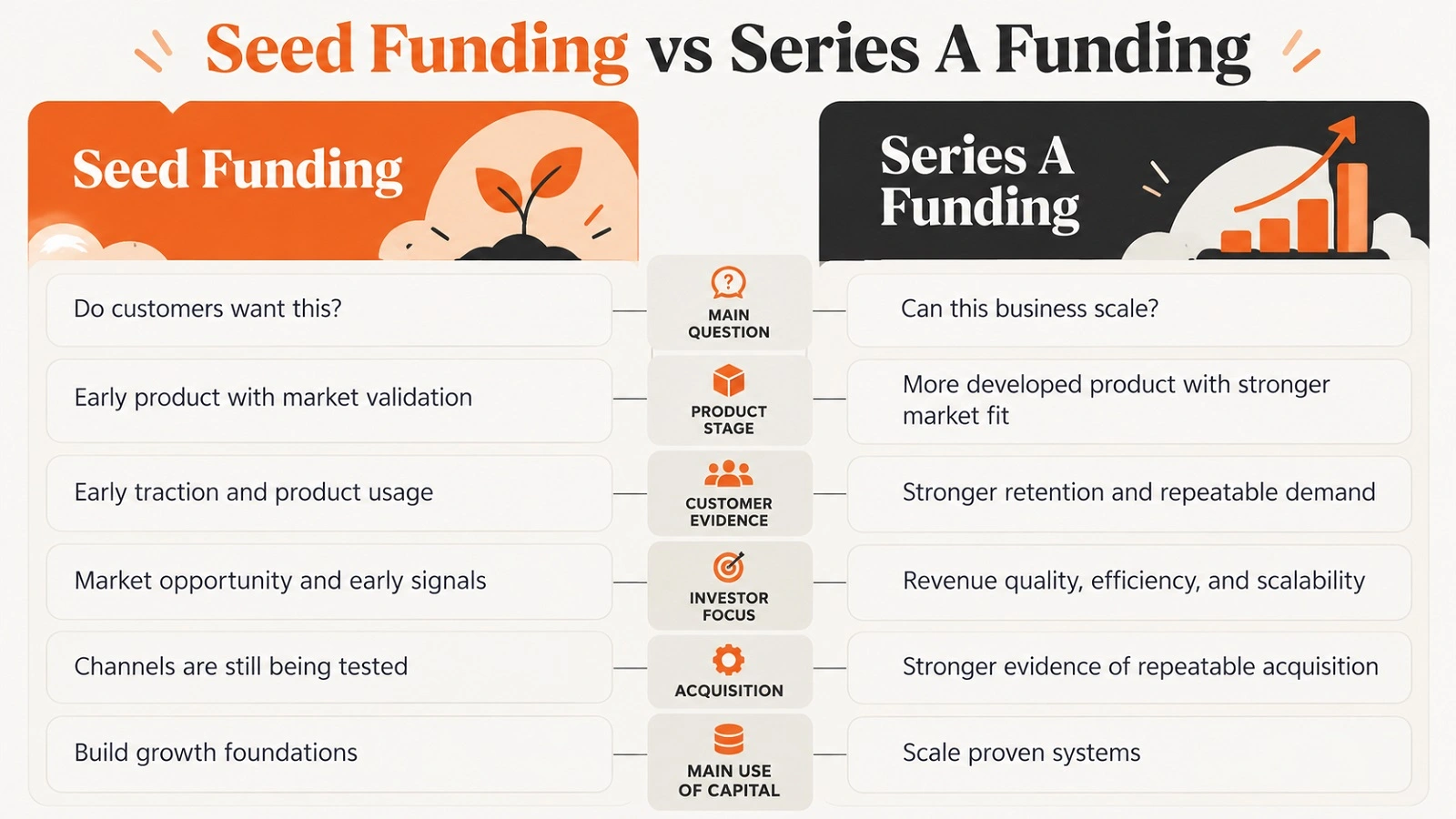
The boundary between rounds is not always exact. Startup markets evolve, and investors may define stages differently. Founders should therefore focus less on the label and more on whether the company has the evidence investors expect from a business preparing to scale.
Metrics That Matter at Series A
Series A fundraising typically involves more structured analysis than earlier rounds. Investors want enough data to understand whether growth is becoming predictable and economically attractive.
For software companies, recurring revenue, growth rate, customer retention, churn, acquisition cost, customer lifetime value, and gross margin may all matter. Marketplace startups may focus on transaction volume, repeat activity, liquidity, take rate, and contribution margin. Consumer companies may emphasize active usage, retention cohorts, engagement, revenue per user, and organic growth.
Founders do not need to present every available metric. They need to understand which metrics best explain the health of their particular business.
Strong founders can also explain why a metric changed. Investors care about the number, but they also care about whether the team understands the business well enough to improve it.
How Much Progress Should Series A Funding Create?
A Series A round should leave the startup in a substantially stronger position.
The company should ideally finish the round with a larger customer base, stronger revenue, more reliable retention, better customer acquisition systems, deeper management capacity, and clearer operational processes.
The round should also help answer questions that will matter during Series B. Can the company scale without dramatically reducing efficiency? Can it expand customer acquisition while maintaining attractive economics? Can teams operate effectively without every decision being made by the founders?
Series A should build the infrastructure and evidence required to answer those questions.
How Founders Should Prepare for a Series A Raise
Series A fundraising requires a clearer connection between past performance and future opportunity.
Founders should be able to explain what the startup has already proven, which uncertainties remain, and exactly how additional capital will create the next stage of growth. Financial models and forecasts become more important because investors need to understand how capital will be deployed and what progress it is expected to create.
The company should also have reliable internal data. Investors may want to examine customer cohorts, revenue trends, acquisition performance, retention, product usage, sales pipelines, and operating costs.
The strongest fundraising story does not simply describe the future. It connects the future to evidence the company has already created.
How Much Series A Funding Should a Startup Raise?
There is no universal Series A amount that applies to every startup. The appropriate round size depends on the business model, growth plan, hiring needs, industry, capital intensity, and the milestones the company needs to reach before its next round.
Founders should work backward from the next major objective. They need to understand what the company must prove during the Series A period, what resources are required to reach that position, and how much flexibility is needed if growth takes longer than expected.
Raising too little can force a startup back into fundraising before it has achieved enough progress. Raising too much can create pressure to spend aggressively or accept unnecessary dilution.
The round should be sized around the strategy rather than the desire to announce a large fundraising number.
When a Startup May Not Be Ready for Series A
A startup can have enthusiastic customers and still be too early for Series A.
Weak retention is one major warning sign because it suggests that acquisition may be hiding a deeper product problem. Another is unclear customer acquisition. If growth still depends almost entirely on founder relationships or unpredictable opportunities, the company may not yet have a convincing scaling model.
Inconsistent revenue, poor understanding of customer economics, and unclear positioning can also make Series A difficult. These weaknesses do not necessarily mean the startup is failing. They may simply mean the company needs more time at the seed stage.
Another warning sign is when founders want Series A capital mainly to continue discovering basic product market fit. Series A investors generally expect much of that discovery work to have already produced meaningful evidence.
Common Series A Funding Mistakes
One common mistake is presenting growth without understanding its quality. Strong revenue numbers can attract investor attention, but investors will usually investigate retention, acquisition costs, margins, customer concentration, and what caused the growth.
Another mistake is scaling headcount before the company has repeatable processes. Hiring more people into an unclear system can increase complexity without improving performance.
Founders can also underestimate investor fit. Series A investors may remain involved for years, participate in future rounds, take board seats, and influence important strategic decisions. Choosing an investor based only on valuation can therefore create long term consequences.
Another common mistake is using the round as permission to pursue too many opportunities at once. Expansion can be valuable, but Series A companies often benefit more from deepening what works before spreading resources across too many products, markets, or customer segments.
Moving From Series A to Series B
The transition from Series A to Series B occurs when scalability begins turning into demonstrated expansion.
During Series A, the startup builds systems for customer acquisition, retention, revenue growth, hiring, and operations. By Series B, investors want evidence that those systems are producing meaningful results at a larger scale.
The company should have stronger revenue growth, clearer customer economics, a more mature organization, and greater confidence in how future capital can accelerate expansion.
Series B investors generally expect more predictability. They want to see not only that the startup can grow, but that it can manage growth without losing control of execution or economics.
Series A Funding Is About Building Repeatability
The most useful way to think about Series A is as the stage where individual successes become systems.
The first group of satisfied customers needs to become reliable retention. Founder driven sales needs to become a repeatable acquisition process. Product improvements need to become an organized development system. Informal decision making needs to evolve into a company that can operate through teams and clear responsibilities.
This shift is what separates Series A from earlier rounds. The startup is no longer proving only that the opportunity exists. It is proving that the opportunity can support a scalable organization.
The Real Purpose of Series A Funding
Series A is not simply about raising more money than the seed round. Its real purpose is to transform evidence into repeatability.
A startup entering Series A should already have signals that something valuable is working. The capital gives the company an opportunity to strengthen those signals, build systems around them, and determine whether they can survive at greater scale.
A successful Series A round therefore changes how the company operates. By the end of the round, growth should depend less on isolated founder effort and more on a business engine the organization understands and can continue improving.
FAQ
What is Series A funding?
Series A funding is an institutional investment round used by startups with early traction to build scalable systems, expand teams, and accelerate repeatable growth.
What comes before Series A funding?
Pre seed and seed funding typically come before Series A. These earlier rounds focus more heavily on validation, product development, and proving customer demand.
What do investors look for in a Series A startup?
Investors usually evaluate product market fit, customer retention, revenue growth, market size, acquisition efficiency, business economics, and the team’s ability to scale the company.
Does a startup need revenue before Series A?
Many Series A startups have measurable revenue, although expectations vary by industry and business model. Investors generally expect meaningful evidence that the company has traction and can support future growth.
What is the difference between seed and Series A funding?
Seed funding focuses on proving that customer demand can become a business. Series A focuses on proving that the business can grow through repeatable and scalable systems.
How much should a startup raise in Series A?
The appropriate amount depends on the startup’s business model, growth strategy, hiring needs, capital requirements, and the milestones it needs to reach before its next stage.
What should Series A funding achieve?
Series A capital should help the company strengthen customer acquisition, retention, revenue growth, operations, leadership, and the systems required to support larger scale expansion.

Mobina Khanki
Venture & Funding Writer at PinerookMobina Khanki covers venture capital, startup funding, fundraising, and startup finance for Pinerook, focusing on founders and investors.
 Seen first.