For many startups, the hardest transition is moving from an interesting idea to a business that shows real market potential. A product can solve an important problem, but founders still need to prove that customers actually want it, that the market opportunity is meaningful, and that the company can build a repeatable growth model.
This is where understanding Startup Funding becomes important. Different investment stages exist because startups face different challenges as they grow. Early capital helps founders validate assumptions and build initial products, while later rounds provide the resources needed to expand proven business models.
Among these stages, seed funding is one of the most important milestones because it represents the transition from early experimentation toward building a more structured company. At this stage, founders are no longer only testing whether an idea works. They are collecting evidence, improving their product, and creating the foundation needed for future growth.
What Is Seed Funding?
Seed funding is an early stage investment round designed to help startups develop their products, validate customer demand, and build the systems required for growth.
Unlike the earliest stages of startup development, where founders may still be exploring whether an idea is worth pursuing, seed funding usually happens when a company has some initial proof that its solution has potential.
A startup raising seed capital may already have an MVP, early users, customer feedback, or early signs of revenue. However, the company is usually still working to answer important questions about its market, customers, and long term business model.
The purpose of seed funding is not simply to provide financial support. It is to help founders reduce uncertainty and reach meaningful milestones that can prepare the company for future expansion.
Why Seed Funding Matters for Startups
Building a startup requires more than creating a product. Founders need to understand customer behavior, improve their solution based on feedback, create reliable processes, and discover whether their business model can support growth.
Seed funding gives startups the resources to focus on these challenges.
A company at this stage may need time and capital to answer questions such as whether customers are willing to continue using the product, whether the solution solves a significant problem, and whether growth can happen through repeatable methods rather than individual successes.
Without enough resources, many startups remain stuck between having an idea and becoming a real business. Seed investment helps companies move beyond early validation and build stronger evidence that they can grow.
Seed Funding at a Glance
Before looking deeper into how seed rounds work, it helps to understand where this stage sits in the broader startup journey.
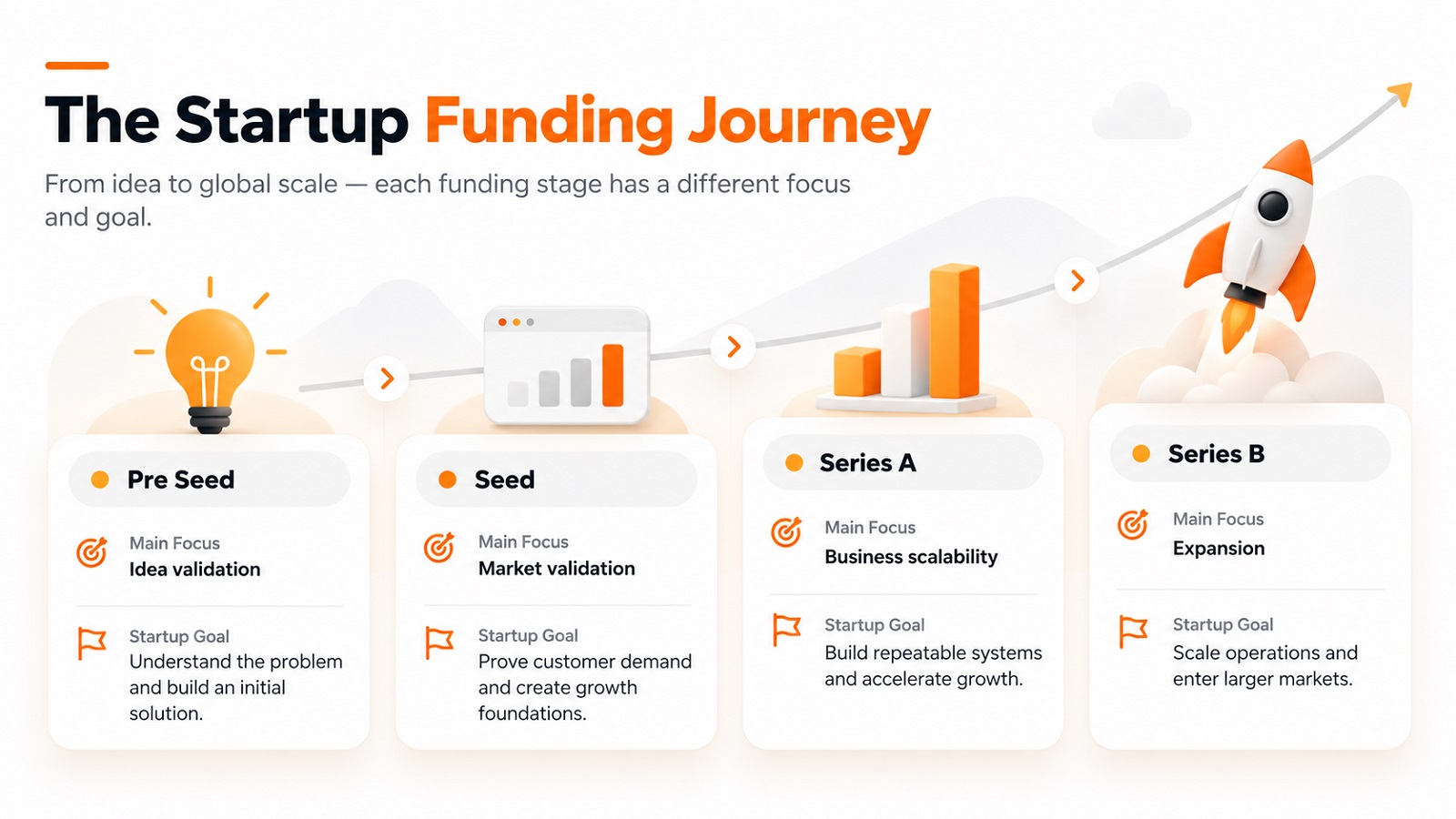
Seed funding sits between early idea validation and large scale growth. The company is no longer only proving that the problem exists, but it is also not yet operating at the scale expected from later stage startups.
What Investors Look For in Seed Funding
At the seed stage, investors understand that uncertainty is still part of the process. They do not expect the same level of performance they would expect from a mature company, but they do look for evidence that the startup has a realistic path forward.
One of the first things investors evaluate is product validation. They want to understand whether customers are showing genuine interest and whether the product is solving a problem that matters.
Early adoption, customer feedback, engagement, and retention can all provide signals that the startup is moving in the right direction.
Market opportunity is another important factor. A startup may have a strong product, but investors also need to understand whether the target market is large enough to support meaningful growth.
The founding team is also a major consideration. At the seed stage, the company may still face many unknowns, so investors often pay close attention to the founders’ ability to execute, learn quickly, and adapt when conditions change.
Early growth signals can also influence investment decisions. Revenue is valuable, but it is not always required. Strong customer demand, increasing usage, partnerships, and clear market feedback can demonstrate that the startup has potential.
How Seed Funding Works
Seed rounds are usually raised from investors who specialize in supporting early stage companies.
Common participants include angel investors, seed venture capital firms, startup accelerators, and strategic investors who see potential value in the company’s future growth.
The structure of seed investment can vary. Some startups raise capital by selling equity, while others use investment agreements that convert into equity during a future funding round.
The amount raised depends on the startup’s industry, market opportunity, growth plan, and investor interest. However, the most important factor is not the size of the investment. It is whether the capital helps the company achieve specific milestones.
A successful seed round should give founders the resources needed to improve the product, understand customers better, and create a stronger foundation for future fundraising.
Seed Funding vs Pre Seed Funding
Although pre seed and seed funding are closely connected, they represent two different points in a startup’s development. The main difference is the level of evidence the company has already created.
At the pre seed stage, founders are usually focused on understanding the problem, testing assumptions, and building an early version of their solution. The company may have limited customer feedback and significant uncertainty about whether the market will respond.
Seed funding comes when founders have stronger signals that the idea has potential. The focus shifts from asking whether the problem exists to proving that customers are interested and that the company can build a sustainable growth path.
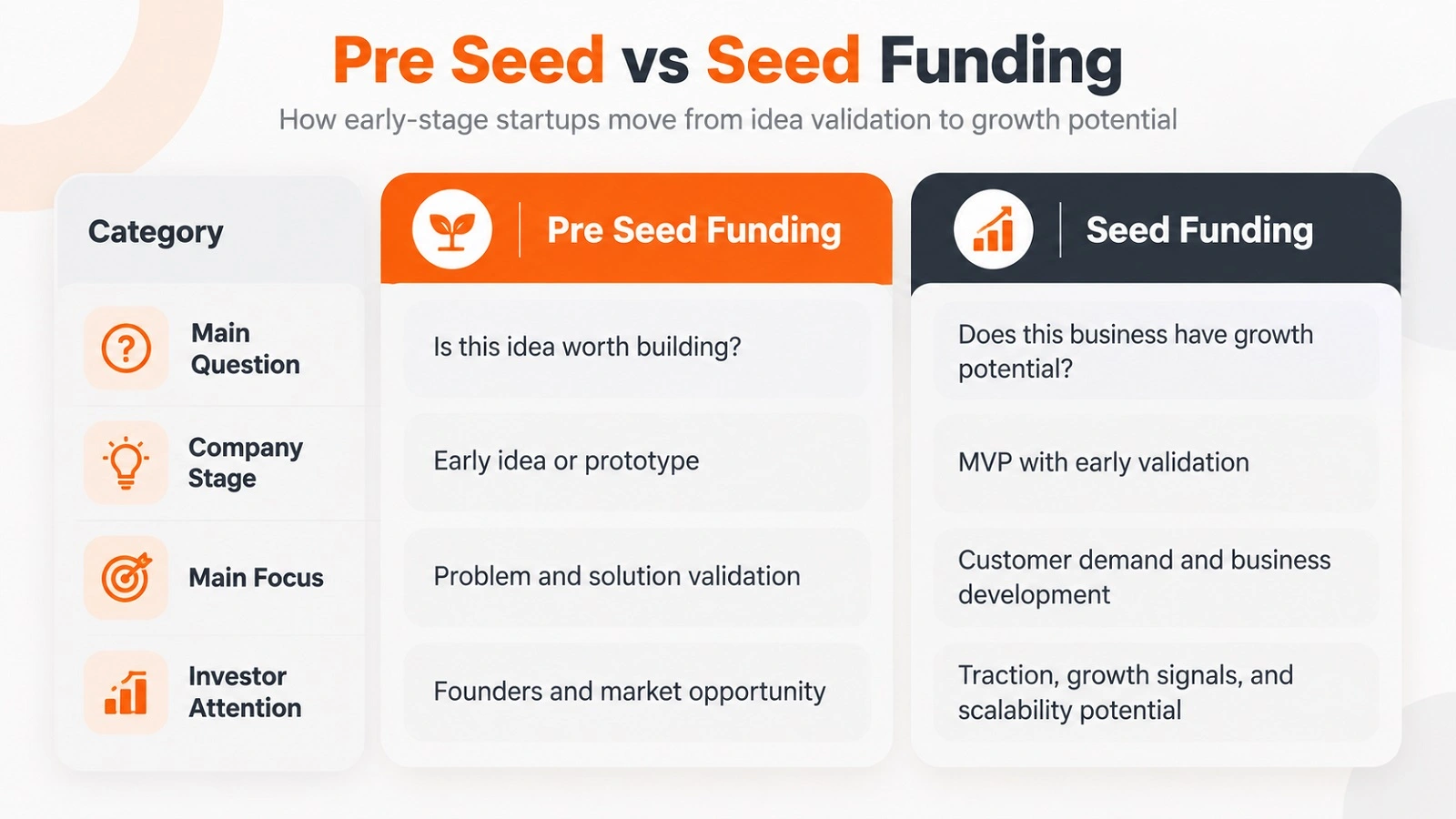
Understanding this difference helps founders approach the right investors and set realistic expectations during fundraising.
How Startups Should Use Seed Funding
The way a startup uses seed capital can determine whether it successfully reaches the next stage of growth. Raising money is only valuable when the investment creates measurable progress.
Many startups use seed funding to improve their product and create a better experience for users. This may include developing new features, improving reliability, and responding to customer feedback.
Another common use is building the early team. Founders may need specialists in areas such as engineering, marketing, sales, or operations to turn early progress into a more organized business.
Seed capital can also help startups build customer acquisition systems. A company needs to understand which channels bring valuable users and whether those channels can support future growth.
The best use of seed funding depends on the startup’s biggest challenge. Some companies need to improve their technology, while others need to better understand their customers or build stronger distribution strategies.
Common Mistakes During Seed Funding
Raising seed funding does not automatically lead to success. Many startups struggle because they use capital without a clear strategy or move toward growth before understanding their foundation.
Growing Too Quickly
Some founders spend aggressively on hiring, marketing, or expansion before proving that their product has strong market demand.
Growth is important, but premature scaling can create unnecessary costs and make it harder to adapt.
Ignoring Customer Feedback
Seed stage companies are still learning about their market. Customer feedback is one of the most valuable resources available because it helps founders understand what works and what needs improvement.
Ignoring user behavior can lead companies to build features or products that do not solve important problems.
Focusing Only on Fundraising
Fundraising can become a distraction when founders focus more on the next investment round than on building the company itself.
The purpose of seed capital is to create progress, not simply to reach another fundraising milestone.
Not Defining Clear Milestones
Every investment should have a clear purpose. Founders should understand what the capital will help them achieve and how the company will become stronger after using it.
Without clear milestones, funding can become a temporary solution rather than a strategy for long term growth.
When Should a Startup Raise Seed Funding?
The right time to raise seed funding depends on the startup’s situation and progress. There is no single timeline that works for every company.
Many startups consider raising seed capital when they have moved beyond pure experimentation and have enough evidence that their idea deserves further development.
A company may be ready when it has a clearer understanding of the customer problem, early validation from users, evidence of market interest, and a specific plan for how investment will accelerate growth.
The strongest fundraising opportunities usually appear when a startup has momentum and a clear direction. Investors are more interested when capital can help expand something that is already showing potential.
Preparing for the Next Funding Stage
Seed funding is not the final goal. It is a step toward building a company that can attract larger investment rounds or grow through its own revenue.
After raising seed capital, founders usually need to focus on proving stronger product market fit, improving customer retention, developing repeatable acquisition methods, and creating systems that support growth.
The next stage requires more than a good idea. It requires evidence that the company can operate efficiently and continue growing.
Final Thoughts on Seed Funding
Seed funding represents one of the most important transitions in a startup’s journey. It helps founders move from early validation toward building a company with stronger foundations.
The value of a seed round is not measured only by the amount of money raised. It is measured by what the company achieves after receiving that investment.
When founders use seed capital to understand customers, improve their product, and build repeatable growth systems, they create the foundation needed for future expansion.
A successful seed round does not simply provide funding. It creates the evidence and momentum required to turn an early startup into a scalable business.
FAQ
What is seed funding?
Seed funding is an early stage investment round that helps startups develop their product, validate market demand, and build the foundation required for growth.
What is the difference between seed funding and pre seed funding?
Pre seed funding focuses on validating an idea and building early proof, while seed funding focuses on proving customer demand and creating a stronger business foundation.
How do startups get seed funding?
Startups usually raise seed funding from angel investors, venture capital firms, startup accelerators, and strategic investors.
Do startups need revenue before raising seed funding?
Not always. Some startups raise seed funding before generating significant revenue if they can demonstrate market potential, customer interest, and strong early validation.
How much equity do startups give during seed funding?
The amount of equity depends on factors such as company valuation, investment terms, market conditions, and negotiation between founders and investors.

Mobina Khanki
Venture & Funding Writer at PinerookMobina Khanki covers venture capital, startup funding, fundraising, and startup finance for Pinerook, focusing on founders and investors.
 Seen first.