A startup can have a strong idea and still be far from ready for serious outside investment. In the earliest days, founders are working with assumptions. They may understand a problem, have spoken with potential customers, or even built the first version of a product, but they still need evidence that the opportunity is real and worth pursuing.
This is where Startup Funding begins to matter. Before a company can think about larger investment rounds, it needs enough time and resources to test the problem, improve the solution, understand its customers, and prove that the founding team can turn an idea into something people actually want.
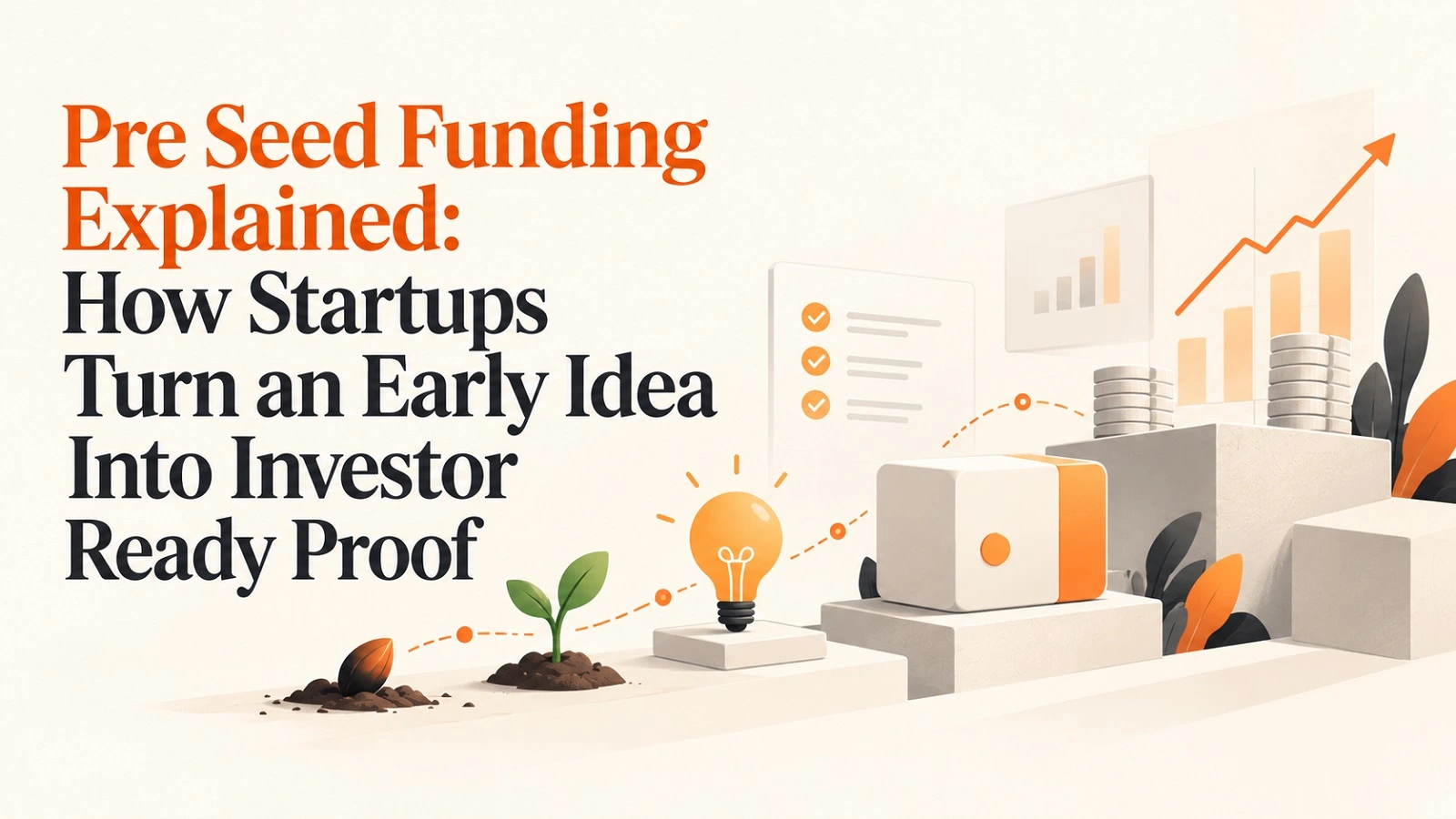
Pre seed funding sits at this early point in the journey. It is often the first outside capital a startup raises and is usually used to remove the biggest uncertainties surrounding the product, customer, and market. The goal is not rapid expansion. The goal is to create enough proof for the company to take its next step with more confidence.
What Is Pre Seed Funding?
Pre seed funding is early capital used to help founders move from an idea or prototype toward initial market validation. At this stage, the startup may not have meaningful revenue, a large team, or even a finished product. Founders are often still interviewing customers, building an MVP, testing demand, and figuring out exactly what the company should become.
The purpose of this capital is not to scale a business that already works. It is to create enough evidence to show that the business is worth building. That evidence might come from a working prototype, successful customer interviews, early users, pilot programs, a strong waitlist, initial revenue, or another signal that reduces uncertainty around the opportunity.
The exact proof will differ from one startup to another. A software company may care about product usage, while a business selling to enterprises may care more about pilot customers or letters of intent. What matters is that founders can show measurable progress beyond the original idea.
Where Pre Seed Funding Fits in the Startup Journey
Pre seed funding usually comes before seed funding and larger institutional rounds such as Series A. The distinction between these stages is not simply how much money the startup raises. The more important difference is how much uncertainty the company has already removed.
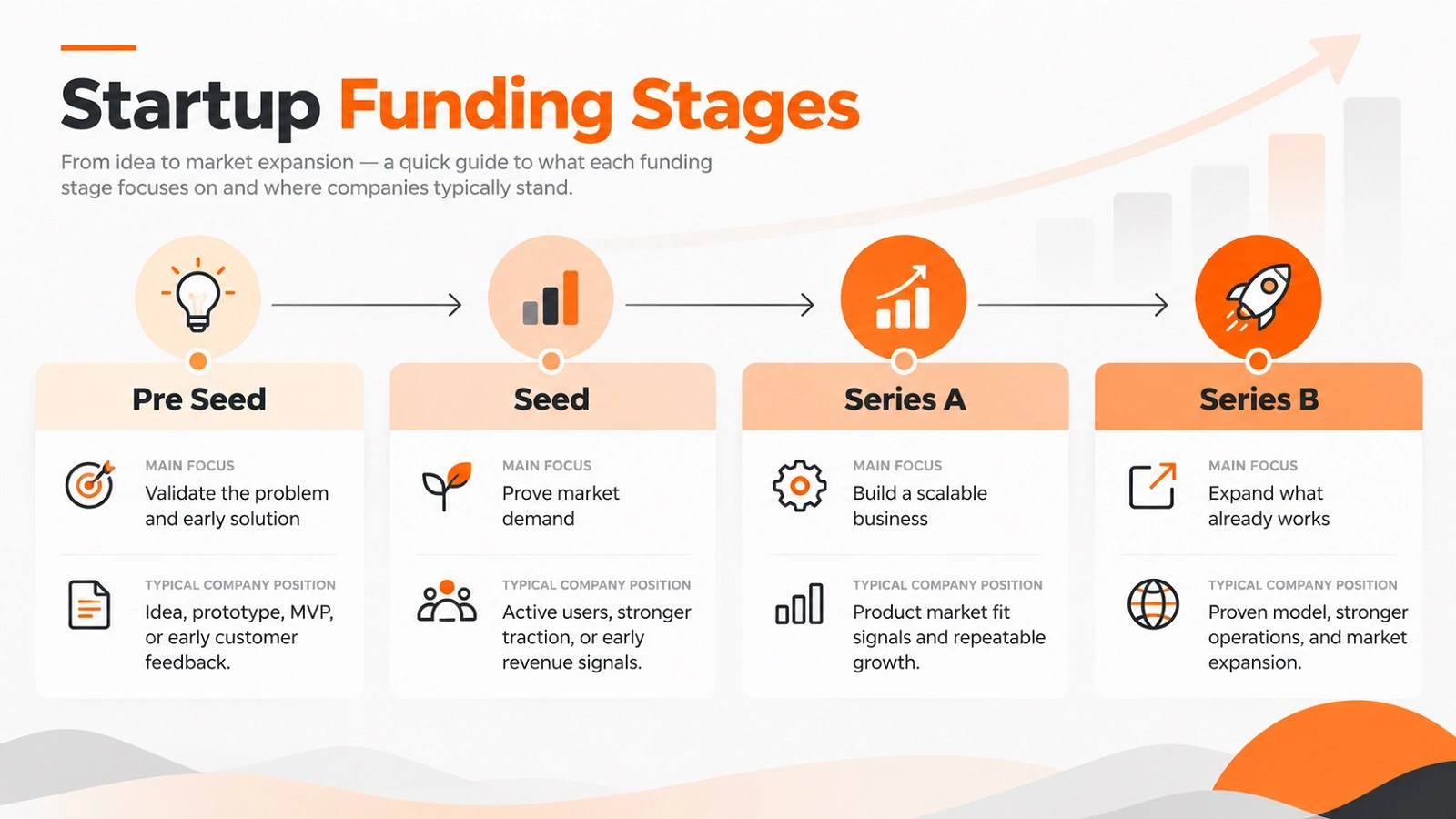
At the pre seed stage, the company is still asking whether the opportunity deserves further investment. By the seed stage, the question becomes whether early validation can develop into a repeatable business. Later rounds require increasingly stronger evidence that the company can grow efficiently at a larger scale.
Understanding this progression helps founders avoid treating fundraising as a race. Reaching the next named round is not the objective. Building enough evidence to justify the next stage is what matters.
What Pre Seed Capital Is Actually Used For
The best use of pre seed capital is usually removing a specific unknown. If the biggest uncertainty is the product, money may be used to build an MVP and observe whether customers understand its value. If the main uncertainty is the market, founders may spend more time on customer research, pilot programs, or early distribution.
In other cases, the capital gives founders enough runway to work on the company full time or hire the first person with technical, product, or commercial expertise that the founding team does not already have. The use of funds should reflect the most important problem the company needs to solve next.
This distinction matters because early capital can disappear quickly when founders treat it like growth capital. A company that has not yet proven demand usually does not need a large sales organization, an expensive advertising campaign, or aggressive geographic expansion. At this stage, the objective is learning faster and making better decisions with evidence.
What Investors Look For at the Pre Seed Stage
Pre seed investors understand that the company is early and that many parts of the business will change. They are generally not expecting the metrics they would demand from a later stage company. What they do expect is a convincing reason to believe the team can turn uncertainty into progress.
A Problem That Matters
Investors first need to believe that the startup is solving something meaningful. A founder who can describe the customer problem clearly, explain how people currently deal with it, and show why existing solutions are inadequate usually has a stronger case than someone presenting a product without a clearly defined problem.
The product may change many times, but the underlying problem should be important enough to justify building a company around it. If customers do not care enough about the problem, even an impressive solution can struggle to create demand.
Strong Founder Understanding
At such an early stage, the founders themselves carry much of the investment case. Investors often want to know why this particular team understands the problem and why it has an advantage in solving it.
That insight may come from industry experience, direct exposure to the customer, technical expertise, or years spent dealing with the problem personally. The important point is that the team should understand the market more deeply than someone who simply noticed an interesting trend.
Early Evidence From the Market
Pre seed startups do not necessarily need significant revenue, but investors usually want some evidence beyond founder enthusiasm. Customer interviews, prototype testing, early users, pilot programs, letters of intent, product usage, or an engaged waitlist can all provide useful signals.
Not every signal carries the same weight. A large waitlist, for example, may look impressive but reveal little if those users never activate the product. Strong proof should reduce uncertainty around one of the startup's important assumptions.
The Ability to Execute
An early idea will almost always change as founders learn more from customers. For that reason, investors are not only evaluating the current product. They are also evaluating whether the team can learn quickly, make difficult decisions, recruit the right people, and keep executing when the original assumptions turn out to be wrong.
At pre seed, adaptability can be as important as the initial plan. Investors know that the company they fund today may look significantly different a year later.
Who Invests in Pre Seed Startups?
The investor base at pre seed is usually different from later funding rounds because uncertainty is still high. Some founders begin by using their own savings, particularly when an initial product can be built without significant capital. This can allow the team to create early proof before bringing outside investors into the company.
Friends and family can also participate, although founders should treat these investments seriously and communicate the risks clearly. Personal relationships do not remove the need for proper documentation and clear expectations.
Angel investors are another common source of capital. Experienced angels may invest because they believe in the founders, understand the market, or see potential in the early evidence before larger firms are ready to participate.
Micro venture funds and dedicated pre seed funds also play an important role. These investors specifically look for companies that are still developing products and validating demand. Accelerators provide another route by combining capital with mentorship, founder networks, and introductions to later investors.
Pre Seed Funding vs Seed Funding
Pre seed and seed are sometimes used loosely, which can make the distinction confusing. The most useful way to separate them is by looking at the maturity of the evidence behind the company.
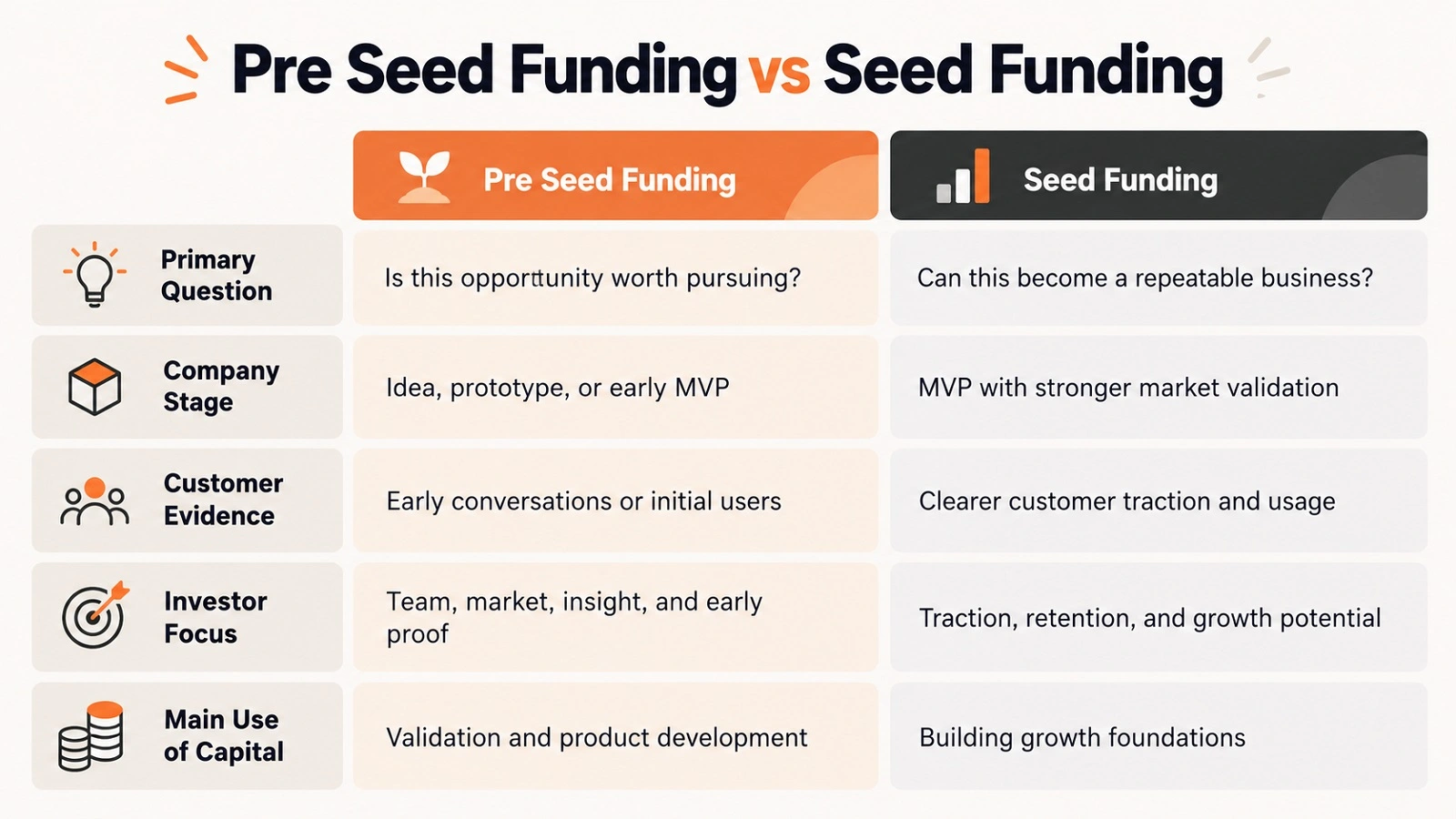
A pre seed startup is usually still proving the core assumptions behind the company. A seed stage company should have stronger evidence that customers are responding and that additional capital can help turn those signals into a more structured business.
The boundary is not always exact. Different investors may describe the same company differently, particularly when round sizes and startup maturity vary across markets. Founders should focus less on the label and more on whether their evidence matches investor expectations.
How Much Progress Should Pre Seed Funding Create?
A strong pre seed round should move the company into a meaningfully different position. If the startup begins the round with an idea, it should ideally finish with a usable product and clearer customer evidence. If it begins with a prototype, the next milestone may be active users, pilot customers, retention signals, or early revenue.
The exact target depends on the business, but the principle is straightforward. Pre seed money should buy proof. Founders should know which uncertainty they are trying to remove, what evidence should exist when the capital has been spent, and what would make the company ready for the next stage.
Thinking this way also makes fundraising easier to explain. Investors can see not only why the company needs money, but also what their capital is expected to accomplish.
How Founders Can Measure Pre Seed Progress
Pre seed companies often make the mistake of tracking metrics simply because larger startups track them. The useful metrics at this stage are the ones that help founders understand whether the core assumptions behind the business are becoming stronger.
For a product with early users, founders may look at activation, continued usage, customer interviews, and whether users return without constant prompting. A business selling to other companies may care more about qualified conversations, pilots, purchase intent, and the speed at which prospects move through an early sales process.
Revenue can be useful, but it should be interpreted carefully. A small amount of revenue from a few customers may prove willingness to pay, but it does not necessarily prove that customer acquisition can become repeatable. The metric should answer a real question rather than simply make the pitch deck look stronger.
When a Startup May Be Too Early for Pre Seed Funding
Not every startup needs to raise immediately. If founders can test their most important assumptions without outside capital, doing so may strengthen their position before fundraising. A few months of customer research or an inexpensive prototype can sometimes create enough evidence to improve investor interest significantly.
A startup may also be too early if the target customer is still unclear, the problem changes constantly, or the founders cannot explain why their solution needs to exist. Outside capital does not automatically fix these weaknesses.
In some cases, money can make the problem worse because it encourages the team to build faster before it knows what should be built. Founders should raise when capital accelerates useful learning, not when it simply allows more activity.
How Founders Should Prepare for a Pre Seed Raise
A strong pre seed pitch does not require years of financial history, but it does require clarity. Founders should be able to explain the problem, customer, product, market opportunity, and why the founding team is positioned to execute.
They should also present whatever evidence already exists and explain what the next stage of capital will achieve. Investors need to understand both the current state of the company and the specific progress the round is designed to create.
The strongest use of funds explanation is usually connected to milestones rather than broad spending categories. Instead of simply saying the company needs money for product development and marketing, founders should explain what the product needs to prove, what type of customer evidence they expect to collect, and what position the company should reach before raising again.
How Much Pre Seed Funding Should a Startup Raise?
There is no single amount that works for every pre seed company. The right raise depends on what the startup needs to prove, how expensive the product is to build, the size of the team, the market, and how long it may take to reach meaningful evidence.
A useful approach is to work backward from the next milestone. Founders can estimate the resources required to reach that point and then add enough flexibility for delays and unexpected learning.
Raising too little may leave the startup returning to investors before it has created meaningful progress. Raising significantly more than necessary can also create problems if it encourages unnecessary spending or leads founders to give away more ownership before the company has created stronger evidence.
The amount should fit the plan, rather than the plan being created to justify a particular fundraising number.
Common Pre Seed Funding Mistakes
One of the most common mistakes is raising before the founders understand what they need to learn. Money without a clear validation plan can lead to months of development without meaningful progress.
Another mistake is treating investor interest as proof of customer demand. An investor may believe in the founders or the market, but only customers can validate whether the product solves a real problem.
Some founders also spend too much time trying to make the company look more mature than it is. Pre seed investors understand that uncertainty is high. Hiding that uncertainty is usually less useful than showing that the team understands it and has a credible plan for reducing it.
The opposite problem can happen when founders wait for everything to look perfect before fundraising. Pre seed companies are expected to be unfinished. What matters is showing meaningful progress, insight, and a clear path toward stronger evidence.
Moving From Pre Seed to Seed
The transition from pre seed to seed happens when the company begins replacing major assumptions with evidence. Founders should understand their target customer more clearly, have a product that people can use, and be able to show early signs that the market is responding.
Depending on the business, those signs may include revenue, active users, retention, pilot customers, partnerships, or another measurable form of traction. There is no universal metric that marks the transition.
The company does not need to have a fully scalable growth engine yet. That challenge usually becomes more important during later stages. However, it should have enough proof to show that additional investment is funding an opportunity rather than simply extending an experiment.
Pre Seed Funding Is About Buying Proof
The most useful way to think about pre seed capital is as money that buys evidence. It gives founders the time and resources to move important questions from assumptions toward answers.
That changes how founders should approach both fundraising and spending. The objective is not to imitate a larger startup. It is to reach a point where customers, product behavior, and market signals tell the team whether it should continue, change direction, or stop pursuing a particular assumption.
When that process works, the company reaches the end of its pre seed stage knowing substantially more than it knew at the beginning.
The Real Purpose of Pre Seed Funding
Pre seed funding is not about building a large company overnight. It is about creating the proof required to justify building a larger company later.
At this stage, strong founders use capital to learn, test, and reduce uncertainty. They build enough product to understand customer behavior, gather evidence from the market, and sharpen the business before committing to aggressive growth.
A successful pre seed round therefore does more than extend runway. It changes what the company knows about itself. When the capital is used well, the startup should finish the round with fewer assumptions, stronger evidence, and a much clearer case for what comes next.
FAQ
What is pre seed funding?
Pre seed funding is early capital used to help founders validate a problem, develop an initial product, and collect early evidence that a startup opportunity is worth pursuing.
Is pre seed funding earlier than seed funding?
Yes. Pre seed typically comes before seed funding and focuses more heavily on problem validation, early product development, and initial market evidence.
Does a startup need revenue for pre seed funding?
Not necessarily. Many pre seed companies have little or no revenue, but investors usually expect some form of early validation or evidence that supports the opportunity.
Who invests in pre seed startups?
Common sources include founders, friends and family, angel investors, accelerators, micro venture funds, and dedicated pre seed investment firms.
How much pre seed funding should a startup raise?
The appropriate amount depends on the milestones the startup needs to reach, how expensive the product is to build, team requirements, and the time needed to create meaningful validation.
What should pre seed funding achieve?
The capital should help the startup reduce important uncertainties, build an initial product, validate customer demand, and create enough evidence to prepare for the seed stage.

Mobina Khanki
Venture & Funding Writer at PinerookMobina Khanki covers venture capital, startup funding, fundraising, and startup finance for Pinerook, focusing on founders and investors.
 Seen first.