Raising money is one of the most important decisions a startup can make, but fundraising is not a single event. It is a process that changes as the company moves from an idea to early validation, customer traction, repeatable growth, and eventually larger scale expansion. The investors involved, the amount of capital required, and the evidence expected from the company all evolve as the business becomes more mature.
Within Startup Funding, founders usually raise capital for a specific reason. They may need time to build a product, hire a technical team, acquire customers, enter a new market, complete regulatory work, or scale a business model that is already working. The strongest fundraising plans connect the money being raised to a clear business milestone rather than treating capital as an end in itself.
Understanding how startups raise money therefore requires more than knowing where investors come from. Founders need to understand when to raise, how much to raise, which funding source fits the business, what investors evaluate, how valuation and dilution work, and what evidence is required before the company can credibly move toward the next round.
How Do Startups Raise Money?
Startups raise money by convincing individuals, investment firms, institutions, customers, or lenders that providing capital can create enough future value to justify the risk. The process usually begins with the founders identifying what the company needs to achieve next and then determining how much money is required to reach that point.
From there, the company needs to choose the right financing structure, identify relevant investors, prepare the fundraising story, present evidence, negotiate terms, complete due diligence, and close the round. An early startup may raise primarily because investors believe in the founders, the problem, and the market opportunity, while a later stage company is usually expected to provide stronger evidence around revenue, retention, customer acquisition, margins, and scalability.
The result is that fundraising becomes increasingly data driven as the business develops. Early rounds may rely more heavily on potential, while later rounds depend much more on measurable operating performance.
How Startup Fundraising Changes by Stage
The reason a company raises money changes as the startup matures, and so does the evidence investors expect to see.
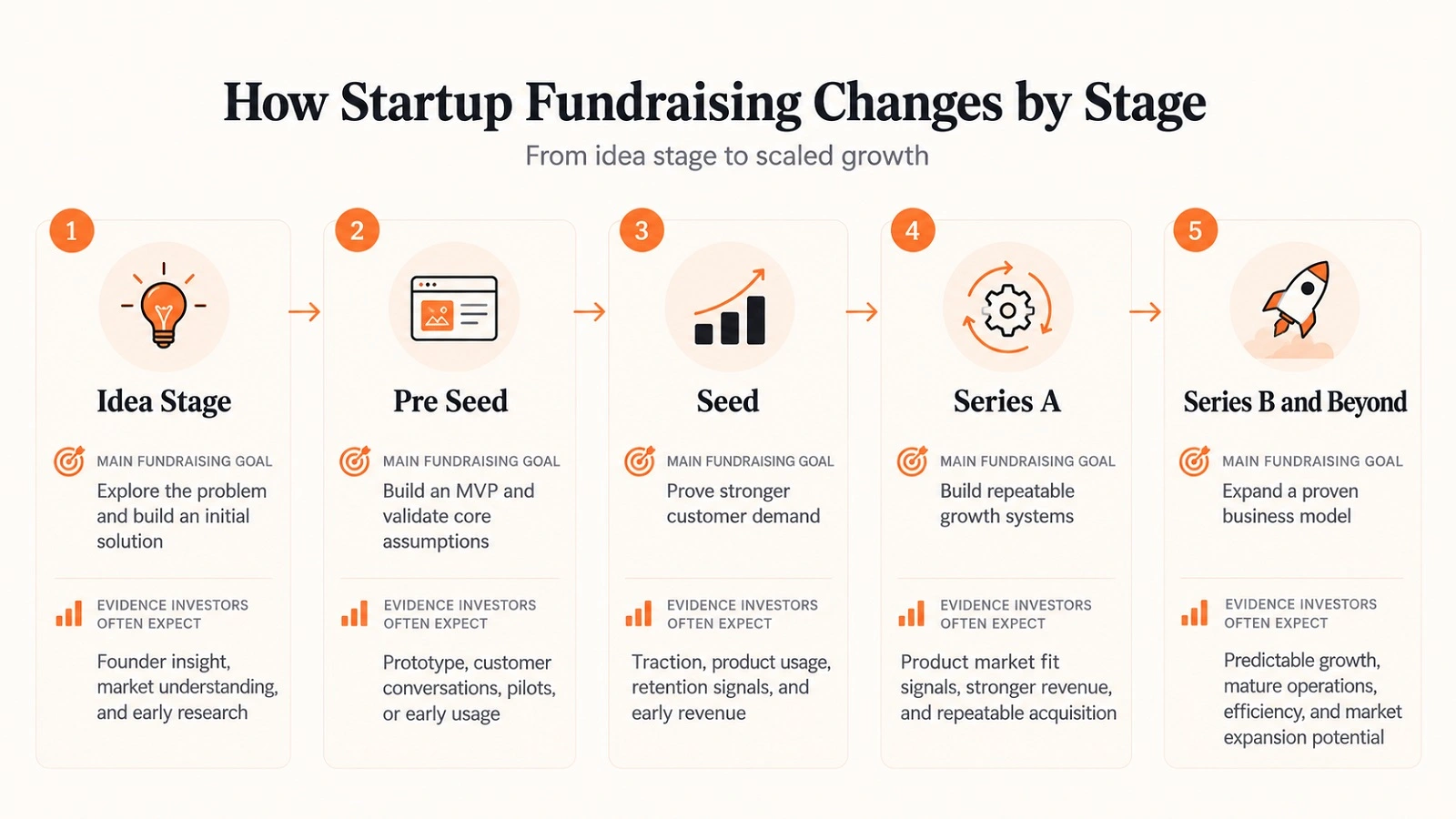
A founder cannot usually raise Series A using the same argument that worked during pre seed because investors are taking a different kind of risk. At the earliest stages, the question may be whether the opportunity is worth pursuing at all. Later, the question becomes whether the company has built something that can grow in a repeatable and economically attractive way.
Step One: Decide Why the Startup Needs Money
Before contacting investors, founders should understand exactly why the company needs external capital and what the money is expected to accomplish. A vague objective such as growing the company is not specific enough because investors need to understand the connection between the round and the next stage of business progress.
A startup may need capital to build an MVP, hire engineers, acquire its first customers, complete regulatory work, expand production, improve customer acquisition, or enter a new geographic market. The stronger the connection between the capital and a measurable milestone, the easier it becomes to explain the round and evaluate whether the company used the money effectively.
Fundraising works best when founders can describe three things clearly: where the company is today, what it needs to prove next, and how the new capital will help it reach that position.
Step Two: Determine How Much Money to Raise
The size of a funding round should be based on the progress the company needs to make rather than on an arbitrary number or the amount founders believe investors may be willing to offer. The starting point is the next meaningful milestone and the resources required to reach it.
If the company needs enough time to build a product, hire a core team, acquire early customers, and reach traction that could support another round, founders should estimate the costs associated with those activities and include enough flexibility for delays and unexpected expenses. This requires understanding hiring needs, product costs, operating expenses, sales activity, infrastructure, and the likely time required to create new evidence.
Raising too little can force the startup back into fundraising before it has made enough progress to improve its position. Raising too much can create unnecessary dilution, higher investor expectations, and pressure to spend faster than the company can learn. The right amount should give the company enough runway to reach a stronger position without creating avoidable financial or ownership costs.
Step Three: Choose the Right Source of Capital
Not every startup needs venture capital, and choosing the wrong source of money can create problems even if the fundraising itself is successful. Founders may finance the company through personal savings, friends and family, angel investors, accelerators, venture capital firms, strategic investors, crowdfunding, grants, debt, or customer revenue.
The right option depends on the company’s stage, capital requirements, business model, revenue visibility, market size, and ownership goals. A business that can reach paying customers with limited upfront costs may be able to bootstrap much longer, while a startup developing expensive technology may need outside capital before revenue becomes practical.
The financing structure should fit the economics of the business. Capital is useful when it removes a real constraint or accelerates a proven opportunity, not simply because fundraising is available.
Step Four: Build Evidence Before Fundraising
Investors are not only funding an idea. They are evaluating the evidence that suggests the company can become something larger. The type of evidence that matters changes with the startup’s stage, but the principle remains the same: founders need to reduce uncertainty around the business.
An early startup may demonstrate strong customer research, a working prototype, signed pilot customers, early product usage, or evidence that the target market cares about the problem. A seed company may show active users, retention, customer revenue, repeat usage, or increasing engagement. By Series A, investors usually expect stronger proof that customer acquisition and growth are becoming repeatable rather than depending on isolated early wins.
The stronger the evidence becomes, the less the fundraising story depends on promises about the future. Founders should ask what uncertainty investors are likely to have and what proof can reduce that uncertainty before the company begins raising.
Step Five: Prepare the Fundraising Story
A strong fundraising story explains why the startup should exist, why the opportunity is large, why the team is positioned to pursue it, and why now is the right time. These elements need to connect logically rather than appearing as separate claims in a presentation.
Investors typically want to understand the problem, target customer, product, market, traction, business model, competition, team, growth strategy, and use of capital. A startup claiming to serve a huge market should also explain how it plans to reach that market. A company presenting rapid growth should understand what is causing it. A founder asking for capital should be able to explain what the company should look like after the round has been spent.
The strongest fundraising narratives connect future ambition to existing evidence. They do not simply describe what the company might become. They show why the company has already earned the right to pursue the next stage.
Step Six: Create a Pitch Deck
The pitch deck is one of the main tools founders use to communicate the company during fundraising. Its purpose is not to answer every possible investor question but to help investors understand the opportunity quickly enough to decide whether they want to continue the conversation.
A strong deck usually covers the problem, solution, market, product, traction, business model, competition, team, fundraising request, and use of funds. The exact order can vary, but the core story should be easy to follow and the most important evidence should be visible without forcing investors to interpret complicated slides.
Clarity matters more than volume. Too many numbers, long explanations, or dense graphics can weaken the pitch if investors cannot understand why the information matters. The deck should support the conversation rather than replace it.
Step Seven: Build an Investor List
Founders should not approach every investor they can find. Fundraising becomes more efficient when the investor list is qualified before outreach begins.
A relevant investor should generally match the company’s stage, sector, geography, check size, and investment strategy. A later stage enterprise software fund, for example, may have little reason to evaluate an early consumer startup. Founders should also examine whether the investor has backed direct competitors, whether the firm follows on in later rounds, and whether its portfolio suggests useful experience.
Investor fit matters because the relationship can continue for years. Choosing investors purely based on who is willing to write a check can create strategic and governance problems later.
Step Eight: Start Investor Outreach
Fundraising often begins through introductions from founders, operators, angels, advisors, lawyers, accelerator networks, or existing investors. Warm introductions can help because they provide context and some degree of trust before the first meeting, but startups do not need to depend entirely on them.
Direct outreach can also work when the message is concise, relevant, and supported by meaningful evidence. The initial communication should make it easy for an investor to understand what the company does, why the opportunity matters, and why the startup is worth a closer look.
The purpose of outreach is not to explain the entire business in one message. It is to create enough interest for a conversation.
Step Nine: Run Investor Meetings
Investor meetings are not simply pitch presentations. They are also opportunities for investors to evaluate how founders think, how deeply they understand the business, and how they respond when assumptions are challenged.
Investors may ask about customer behavior, competition, pricing, market size, product development, hiring, financial performance, founder relationships, and the risks that could prevent the company from succeeding. Strong founders do not need to pretend that every risk has already been solved. It is often more credible to show that the team understands the most important uncertainties and has a clear plan for reducing them.
The quality of the discussion can matter as much as the pitch deck. Investors are evaluating both the company and the people responsible for building it.
What Investors Look For
Investor expectations change by stage, but several themes appear repeatedly.
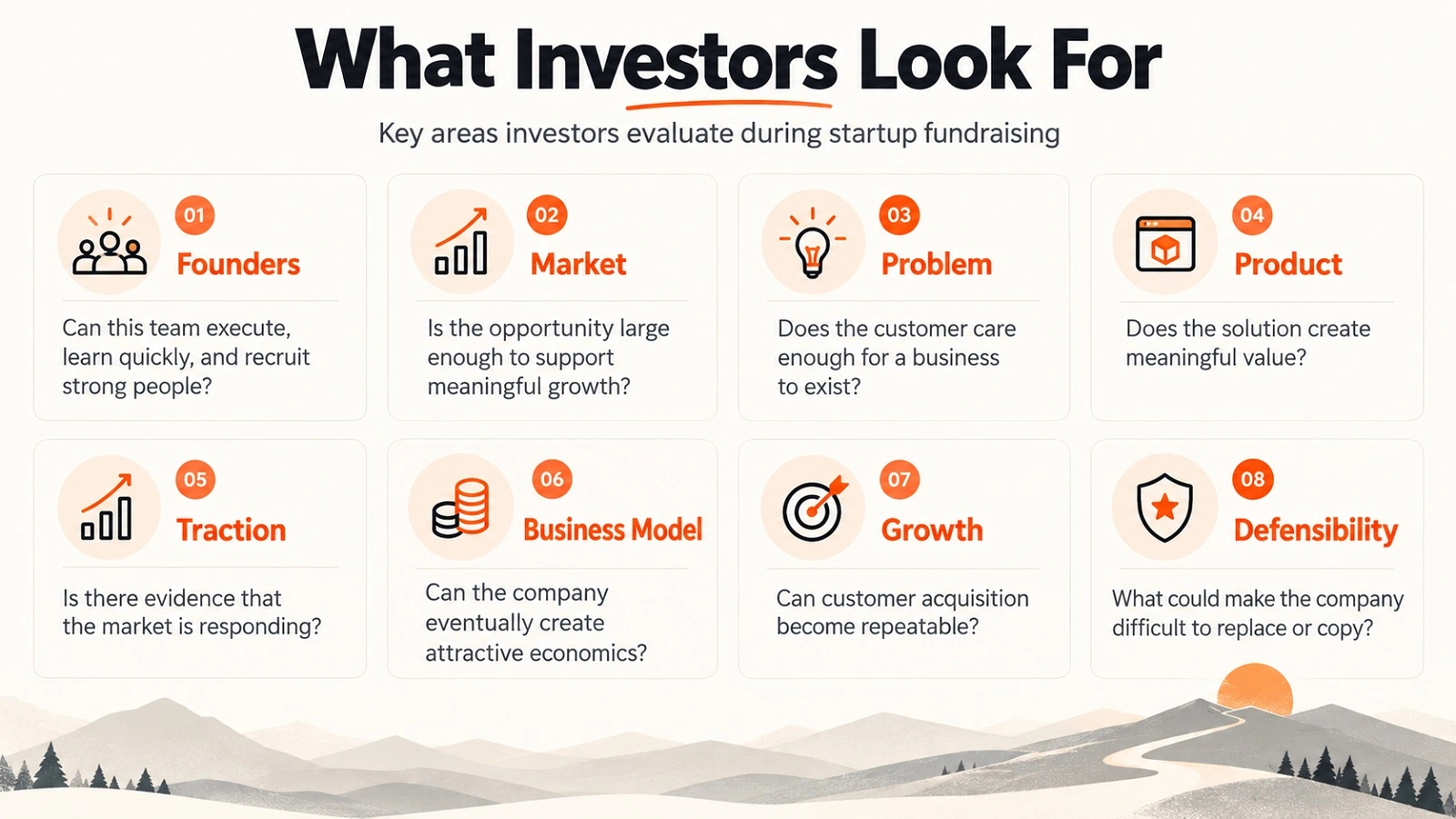
Earlier investors may place more weight on the founding team, market insight, and early validation because operating data is limited. Later investors usually require much stronger proof around growth, retention, margins, and scalability.
Step Ten: Create Fundraising Momentum
Fundraising can become easier when several investor conversations happen within a relatively concentrated period. When meetings are spread across many months, founders may repeatedly restart the same process without creating a clear decision window.
A more organized process allows the company to compare investor interest, receive feedback faster, and understand whether the round is progressing. It can also help investors make decisions because they know the company is actively evaluating multiple relationships rather than running an open ended process.
Momentum should not be manufactured through misleading claims. The objective is simply to manage fundraising efficiently enough that serious investors are evaluating the company within a similar timeframe.
Step Eleven: Receive and Evaluate a Term Sheet
When an investor decides to lead or participate in the round, the company may receive a term sheet describing the major investment terms. Founders often focus heavily on valuation, but valuation is only one part of the agreement.
Ownership, investor rights, board structure, voting provisions, employee option pools, liquidation terms, future financing rights, and other conditions can influence the company for years. A higher valuation is not always better if the surrounding terms create unnecessary complexity or make future fundraising more difficult.
Founders should evaluate the entire financing package rather than treating valuation as the only measure of whether the round is attractive.
Understanding Startup Valuation
Startup valuation determines the value assigned to the company during an equity financing round and influences how much ownership investors receive in exchange for their capital. At very early stages, valuation may depend heavily on founder experience, market size, early evidence, competition for the deal, and investor conviction.
As the company matures, operating performance becomes more important. Revenue, growth rate, retention, margins, market position, customer concentration, and comparable companies may all affect how investors think about value.
Founders should remember that valuation is not simply a reward for what the company has already achieved. It also creates expectations about what the startup will need to become before another financing event.
How Dilution Works When Startups Raise Money
Equity financing usually reduces the percentage ownership of existing shareholders because new investors receive equity in the company. Founders and previous investors may therefore own a smaller percentage after the financing than they did before it.
Dilution is not automatically negative. If new capital helps the company become significantly more valuable, founders may own a smaller percentage of a much larger business. The important question is whether the money, investor support, and strategic value created by the round justify the ownership exchanged.
Founders should also think beyond a single financing event because dilution can accumulate across multiple rounds. Ownership planning becomes increasingly important as the company raises more capital.
Step Twelve: Investor Due Diligence
Before completing an investment, investors may examine the company in much greater detail. This process can include financial statements, customer contracts, legal records, intellectual property, employment agreements, capitalization records, product information, market research, security practices, and other business documents.
The depth of due diligence generally increases as the company and investment round become larger. Founders can make the process easier by keeping company records organized before fundraising begins rather than preparing everything only after an investor requests it.
Poor documentation does not necessarily mean the business is weak, but it can slow the process and create questions that might otherwise have been avoided.
Step Thirteen: Negotiate Final Documents
After the major commercial terms are agreed, lawyers usually prepare the final investment documents. This stage turns the high level agreement into legally binding terms that determine how ownership, governance, investor protections, and future financing will work.
Founders should understand the documents they are signing rather than treating legal work as something only lawyers need to understand. Financing agreements can influence the company long after the round closes, particularly when they affect voting rights, board structure, liquidation outcomes, and future capital raises.
Professional legal advice is especially important at this stage because small differences in financing terms can have significant long term consequences.
Step Fourteen: Close the Round
The round closes when the required documents have been signed and the financing conditions have been satisfied. Capital can then be transferred according to the agreement and the company can begin using it for the objectives described during fundraising.
Closing a round is an important milestone, but it should not become the company’s definition of success. The startup now needs to produce the progress it promised investors, whether that means launching a product, growing revenue, improving retention, building a team, or entering a new market.
The real value of the round is determined by what the company achieves after the money arrives.
What Happens After a Startup Raises Money?
After fundraising, founders usually shift their attention back toward execution. The company may begin hiring, accelerate product development, increase sales activity, strengthen infrastructure, improve customer support, or enter new markets depending on the purpose of the round.
Investors may also become more involved through board meetings, reporting, strategic discussions, recruiting support, and introductions. This involvement can be valuable if the investor understands the company and contributes beyond capital.
The startup should track the milestones connected to the round. If the company raised money to prove repeatable customer acquisition, management should know whether that evidence is actually becoming stronger. If the round was designed to support market expansion, founders should monitor whether that expansion is producing the expected results.
How Long Does Startup Fundraising Take?
There is no universal fundraising timeline because the process depends on the company’s stage, investor demand, market conditions, round size, founder network, and strength of the business. Some rounds can move quickly when investor conviction is high, while others require months of outreach, meetings, diligence, and negotiation.
Founders should therefore avoid waiting until the company has almost no runway before beginning the process. Raising money from a position of financial desperation can reduce negotiating leverage, create pressure to accept weaker terms, and distract the team at exactly the moment operational focus matters most.
Planning ahead gives founders more room to choose investors rather than simply accepting the first source of capital available.
How Much Runway Should Founders Think About?
Runway describes how long the startup can continue operating before its available cash is exhausted. Founders usually think about runway when deciding how much money to raise because the company needs enough time to create meaningful progress before another financing event becomes necessary.
Longer runway can provide flexibility when product development, hiring, customer acquisition, or regulatory work takes longer than expected. However, raising more money does not automatically create financial safety because a company that increases spending aggressively after fundraising can still shorten its runway quickly.
Fundraising size and burn rate should therefore be considered together. A large bank balance means little if expenses increase even faster.
How Startups Raise Money Without Venture Capital
Venture capital receives significant attention, but startups can raise or generate capital through several other paths. Founder savings, customer revenue, grants, loans, crowdfunding, strategic partnerships, accelerators, revenue based financing, and angel investment can all support company development depending on the business.
Some companies may never need institutional venture capital. A profitable business with strong customer funded growth may have greater strategic freedom by financing itself through operations, while another company may use grants or debt because those structures fit the business better than selling equity.
The correct financing structure depends on what the company is trying to build, how quickly it needs to grow, and how much capital is required before the business can support itself.
Can Startups Raise Money Before Revenue?
Yes. Many startups raise capital before meaningful revenue exists, particularly when they need time to develop technology, build a product, obtain regulatory approval, or create a network before monetization becomes practical.
However, the absence of revenue does not remove the need for evidence. Investors may look for customer interviews, prototypes, pilot programs, waitlists, letters of intent, product usage, research results, or another signal that reduces uncertainty.
The earlier the company is, the more heavily investors may rely on the founders, market opportunity, quality of insight, and strength of the evidence that exists before revenue.
Can Startups Raise Money Without a Product?
It is possible to raise money before a finished product exists, particularly at very early stages, but founders usually need another reason for investors to believe the company can succeed.
A strong founding team with deep expertise in a large market may attract capital before launching a product. In other cases, investors may respond to detailed customer research, technical demonstrations, signed pilots, early prototypes, or evidence that the company has unique access to an important opportunity.
Investors understand that an early startup will be incomplete. What matters is whether the founders are reducing uncertainty and creating evidence that the company is moving toward something real.
How Founders Build Credibility Before Fundraising
Credibility is especially important when the startup has limited operating history because investors have fewer metrics available to evaluate. Founders can strengthen credibility by showing deep customer understanding, clear market knowledge, thoughtful decision making, and a record of turning assumptions into evidence.
Execution matters as much as presentation. A working prototype, signed pilot, customer revenue, active users, strong retention, technical progress, or a series of well designed experiments can all demonstrate that the team is capable of moving the company forward.
Founder credibility does not require pretending the startup is further along than it is. Investors generally expect uncertainty. What matters is whether the team understands that uncertainty and is addressing it systematically.
The Role of Founder Market Fit
Founder market fit refers to the relationship between the founding team and the problem the company is trying to solve. Investors may want to understand why this specific team has an advantage in building the business compared with other people who could pursue the same opportunity.
That advantage may come from industry experience, technical knowledge, customer relationships, professional networks, operational expertise, or direct personal exposure to the problem. Founder market fit becomes especially important when the startup is early and operating data is limited.
When there are few metrics to evaluate, the quality of founder insight and execution can carry much more weight in the investment decision.
How Important Is Traction When Raising Money?
Traction is one of the clearest ways for founders to reduce investor uncertainty, but the meaning of traction depends on the business. For one startup, it may mean revenue. For another, it may mean active users, retention, successful pilots, signed contracts, repeat usage, or demand from a high quality waitlist.
The strongest traction is directly connected to the assumptions that matter most to the company. A large number of social followers, for example, may attract attention but provides limited evidence if those followers do not become users or customers.
Founders should focus on evidence of real customer behavior rather than metrics that look impressive without proving anything meaningful about the business.
Fundraising Metrics by Business Model
Investors do not evaluate every startup using the same metrics because different business models create value in different ways.
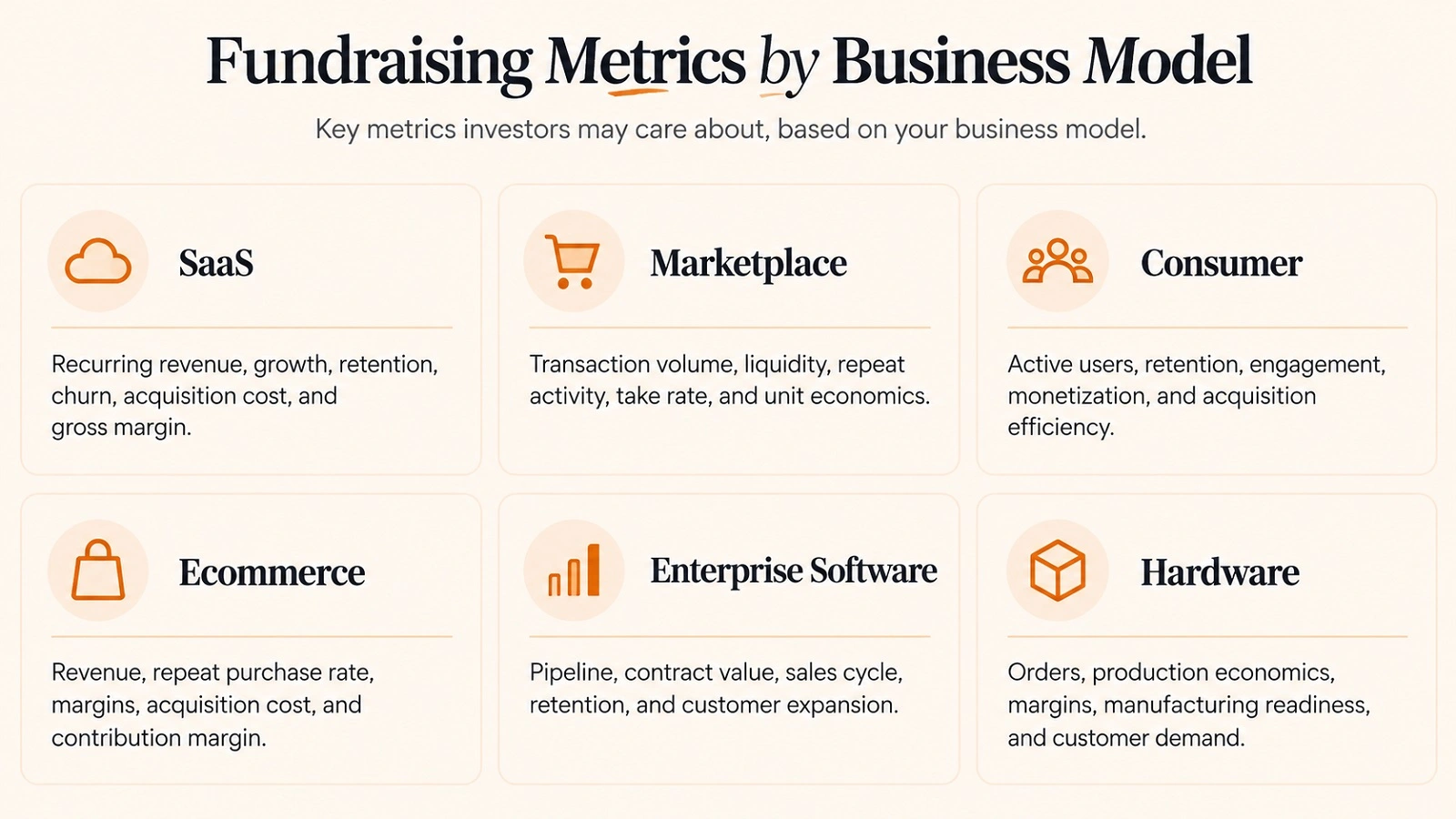
The objective is not to present as many numbers as possible. Founders need to understand which measurements best explain whether their particular business is becoming stronger and more predictable.
How Investor Fit Affects Fundraising
The investor offering the highest valuation is not automatically the best investor. Founders also need to consider whether the investor understands the market, has experience with the company’s stage, can help with recruiting or future financing, and has a communication style that fits the founding team.
Governance expectations matter as well. Some investors are highly involved in major decisions, while others provide more independence. Either approach can work depending on what the founders need and how the relationship is structured.
Because the partnership may last many years, investor selection should be treated as a strategic decision rather than simply a transaction.
Lead Investors and Participating Investors
Some financing rounds have a lead investor who plays a central role in structuring the deal. The lead may negotiate major terms, conduct deeper diligence, commit a significant portion of the round, and help attract additional investors.
Other investors may then participate under similar terms. Having a credible lead can sometimes simplify the process because other investors know that another experienced participant has already spent time evaluating the company.
The quality and fit of the lead investor matter because that relationship may carry greater governance and strategic influence after the round closes.
What Happens When Investors Say No?
Rejection is a normal part of startup fundraising, and an investor may decline for many reasons that are not necessarily a judgment that the company cannot succeed. Stage, sector, portfolio conflicts, fund strategy, timing, valuation, market concerns, or lack of conviction can all affect the decision.
Founders should look for patterns in feedback rather than reacting too strongly to any single response. If several investors independently raise the same concern about retention, market size, customer acquisition, or business economics, that pattern may reveal an issue worth investigating.
Fundraising feedback can be useful, but investors should not replace customers when founders make product decisions. Investor opinions are one source of information, not the market itself.
How to Know Whether a Funding Round Is Working
A fundraising process should produce more than meetings. Founders can examine how often first conversations lead to second meetings, whether investors request additional information, whether senior partners become involved, and whether serious discussions move toward diligence or terms.
Weak conversion can indicate several different problems. Investor targeting may be poor, the fundraising story may be unclear, the company may lack enough evidence, or the business may simply not be ready for the round it is trying to raise.
The correct response is not always to redesign the pitch deck. Sometimes the stronger move is to pause fundraising and create better operating evidence before approaching investors again.
What Happens If a Startup Cannot Raise Money?
Not every fundraising process ends successfully, and founders need to understand their alternatives before cash becomes critically low. The company may reduce expenses, extend runway, focus more heavily on revenue, pursue grants or debt where appropriate, improve product validation, or delay the round until stronger evidence exists.
In some cases, the company may need to change its strategy significantly. A failed raise may reveal that the market is not convinced by the opportunity or that the startup is attempting to raise before it has reached sufficient maturity.
The worst response is usually to continue fundraising indefinitely while the company receives less operational attention and available cash continues declining.
Common Startup Fundraising Mistakes
One of the most common mistakes is raising money without knowing what the capital needs to accomplish. A company can receive significant funding and still fail to create meaningful progress if spending is not connected to clear milestones.
Another mistake is contacting investors who do not match the company’s stage, sector, or capital needs. This wastes founder time and can create misleading feedback about the business. Founders can also focus excessively on valuation while ignoring investor fit, governance, and financing terms.
Beginning fundraising too late is another major problem. When runway becomes extremely short, founders may be forced to accept investors or terms they would otherwise avoid. Finally, some teams treat fundraising as proof that the company itself is working, even though investor interest cannot replace customer demand.
Raising Money vs Building the Business
Fundraising attracts attention because investment announcements are highly visible, but money raised is an input rather than a business outcome. A startup that closes a large round still needs to build a product customers value, acquire customers efficiently, retain them, control costs, and develop a durable organization.
A company that raises less capital but creates a stronger business may ultimately be in a better position than one that repeatedly raises money without improving the underlying economics.
Founders should therefore avoid using fundraising totals as the primary measure of progress. Capital matters because of what it allows the business to achieve.
How Startups Prepare for the Next Funding Round
A funding round should create the evidence required for whatever comes next. A pre seed round may need to produce a usable product and stronger customer validation, while seed capital may need to establish traction, retention, and early revenue.
Series A funding may need to create repeatable acquisition and more scalable operations. Series B may need to demonstrate broader market expansion, stronger financial performance, and deeper organizational capability.
Founders should define next round readiness before spending the current round. This creates a clearer connection between capital, milestones, and future financing and reduces the risk that the company reaches the end of its runway without enough new evidence.
The Real Process Behind How Startups Raise Money
Startups do not raise money simply by creating a pitch deck and asking investors for capital. Fundraising is fundamentally a process of reducing uncertainty and transferring enough confidence to an investor that the expected upside justifies the risk.
Founders create evidence that an opportunity exists, explain why their team is well positioned to pursue it, show how additional capital can create measurable progress, and then negotiate the terms under which investors participate in that future value.
As the startup matures, promises matter less and operating evidence matters more. The strongest fundraising companies understand this progression and raise capital when it can move the business into a substantially stronger position rather than treating investment itself as the objective.
FAQ
How do startups raise money?
Startups raise money through sources such as founder capital, friends and family, angel investors, accelerators, venture capital firms, strategic investors, crowdfunding, grants, debt, and customer revenue. The appropriate option depends on the company’s stage, business model, capital requirements, and growth goals.
What do startups need before raising money?
The requirements depend on the stage. Early startups may rely more heavily on a strong team, market insight, customer research, and initial validation, while later companies generally need stronger evidence around customers, revenue, retention, growth, and business economics.
Can a startup raise money without revenue?
Yes. Early startups can raise before revenue if they provide another form of evidence that reduces investor uncertainty, such as prototypes, customer validation, pilots, product usage, signed commitments, or strong founder market fit.
Can a startup raise money without a product?
Yes, particularly at very early stages, but the team usually needs another strong reason for investors to believe in the opportunity. That may include founder expertise, deep customer research, technical demonstrations, pilot agreements, or a compelling market insight.
How do founders decide how much money to raise?
Founders should calculate the amount based on the resources required to reach the next meaningful business milestone while maintaining enough flexibility for unexpected delays and expenses.
What do investors look for in a startup?
Investors commonly evaluate the founding team, market opportunity, customer problem, product, traction, business model, growth potential, competitive position, and the company’s ability to create significant future value.
Does raising investment reduce founder ownership?
Equity financing usually creates dilution because new investors receive ownership in the company. The effect depends on the round size, valuation, existing capitalization, and financing structure.
How should startups choose investors?
Founders should evaluate investor stage, sector expertise, check size, reputation, portfolio, network, governance expectations, communication style, and whether the investor can support the company beyond the initial capital.
What should founders do if they cannot raise money?
They should determine why the round is not progressing and consider options such as improving traction, extending runway, reducing expenses, generating more customer revenue, changing investor targeting, or delaying fundraising until stronger evidence exists.
Is raising money the same as startup success?
No. Fundraising provides resources, but long term success depends on what the company achieves with those resources. Customer value, retention, growth quality, financial discipline, and operational strength matter much more than the amount announced in a funding round.

Mobina Khanki
Venture & Funding Writer at PinerookMobina Khanki covers venture capital, startup funding, fundraising, and startup finance for Pinerook, focusing on founders and investors.
 Seen first.