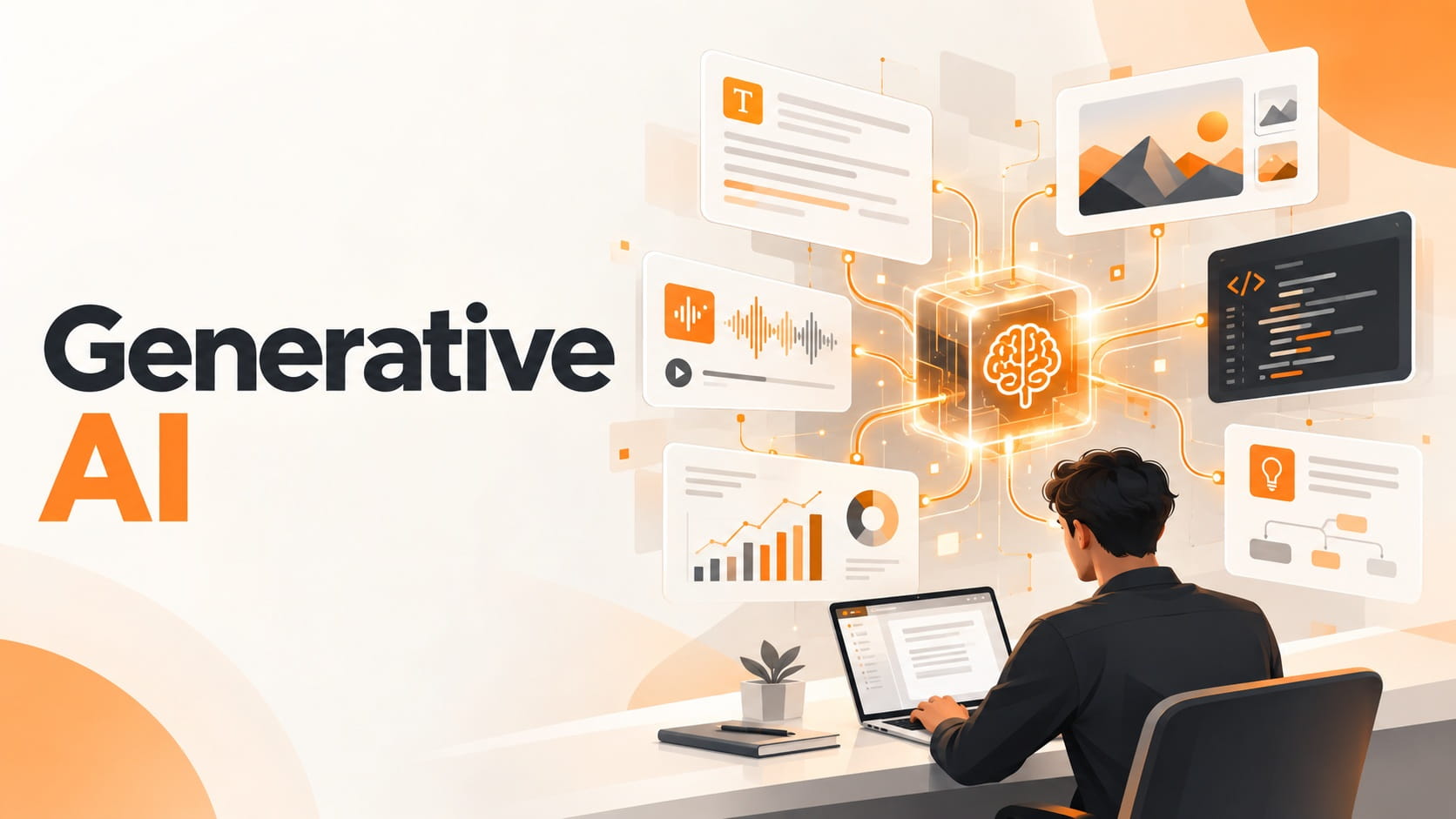
Generative AI is the part of AI that creates something new from what it has learned. That can be text, images, video, audio, code or structured data. The reason it matters is not simply that machines can now produce content. What interests me more is that people can use natural language to move from an idea to a usable output in minutes.
For founders and business teams, that changes far more than content creation. It affects research, product development, software, customer support and the amount of work a small team can handle.
Generative AI in Plain Terms
The easiest way I have found to understand generative AI is to separate creation from recognition.
Older AI systems became very good at recognizing patterns. They could classify an image, detect unusual activity, recommend a product or predict an outcome.
Generative AI learns patterns too, but it uses what it has learned to produce a new output.
Give a language model instructions and it can draft a document. Give an image model a description and it can create a new visual. The same idea extends to code, audio, video and synthetic data. Stanford and NVIDIA describe generative AI around this same core capability: learning patterns from existing data and using them to generate new content.
That distinction sounds simple, but it explains why generative AI has spread across so many types of work.
Traditional AI, Generative AI and AI Agents
I would not group every modern AI product under the same label. Traditional AI, generative AI and AI agents solve different kinds of problems.
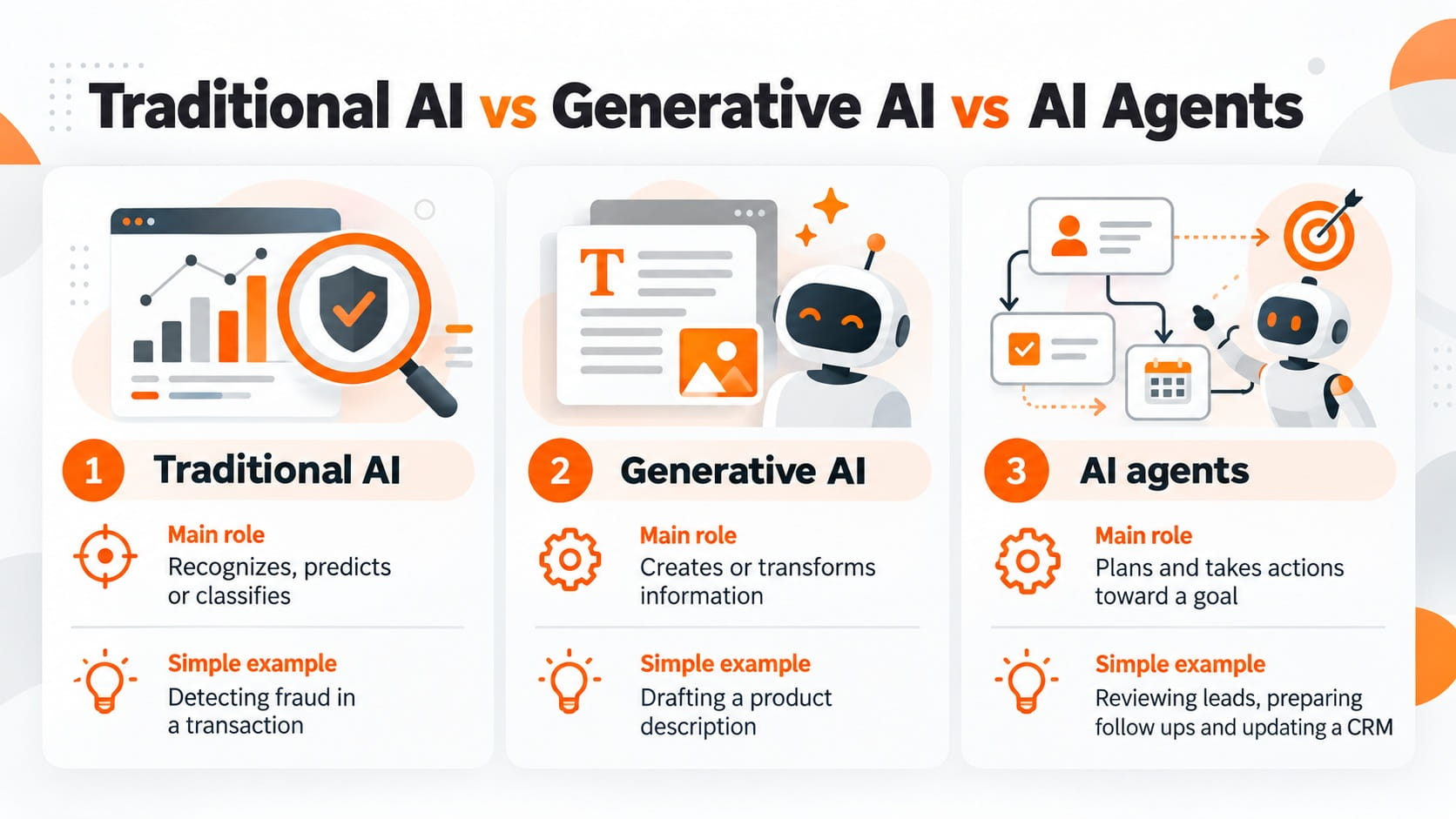
Generative AI is one part of the broader artificial intelligence landscape rather than a replacement for every other type of AI.
This distinction becomes especially useful when evaluating products. A recommendation engine can use AI without being generative. A chatbot can generate an answer without being an autonomous agent. An agent can use generative models as part of a larger system that also plans and acts.
How Generative AI Works
You do not need to understand the mathematics behind a model to understand the basic process.
A generative model is trained on large amounts of data. During training, it learns relationships and patterns inside that data. When a user later provides an instruction, the model uses those learned patterns to produce an output that fits the request.
For text models, that means working with relationships between words and tokens. Image models learn visual structures and relationships. Other models work with sound, video, code and different forms of data. Foundation models can then serve as a base for many different applications.
What matters from a business perspective is the interface this creates.
People no longer need to describe every step of a task in software logic. They can express an objective in natural language and let the model generate a useful starting point.
That is a significant change in how people interact with software.
Generative AI Outputs
Text is the most visible form of generative AI because chat interfaces made the technology accessible to millions of people. But text is only one part of it.
Generative models can create and transform:
Text for reports, summaries, emails and documentation.
Code for prototypes, scripts, tests and software development.
Images for concepts, marketing assets and product design.
Video for creative production, demonstrations and visual communication.
Audio for speech, music and voice applications.
Synthetic data for training, simulation and research.
IBM and NVIDIA both document this wider range of outputs, including text, software code, images, video, audio and synthetic data.
This is why I would not define generative AI as a writing technology. Its real importance comes from the fact that generation is becoming a capability inside many kinds of software.
Generative AI in Business
The strongest business use cases are not the ones that look the most impressive in a demo. They are the ones connected to work people already need to do.
A marketing team can move from a campaign idea to several draft directions faster.
A developer can use a model to explain unfamiliar code, create a prototype or generate tests.
A support team can summarize long conversations and prepare responses using company knowledge.
A research team can work through large amounts of documents and surface useful information more quickly.
A product team can turn a rough concept into copy, interface ideas and prototypes before investing heavily in development.
This is where the economic case becomes clearer. McKinsey identified customer operations, marketing and sales, software engineering, and research and development as four areas representing a large share of the potential value it studied for generative AI.
For me, the useful takeaway is not that every company needs generative AI in every department. It is that businesses should look for work where producing, transforming or understanding information consumes significant time.
That is where the technology becomes useful rather than decorative.
Small Teams and Product Building
The effect on startups deserves more attention than it gets in broad explanations of generative AI.
A founder used to need separate resources for many early tasks. Research had to be collected, product copy written, prototypes prepared, code created and customer feedback organized.
Generative AI compresses parts of that process.
It does not create product market fit. It does not decide which market is worth entering. It does not understand customers better than a founder who actually talks to them.
What it does change is the cost of testing an idea.
A small team can explore more directions before committing resources. Engineers can prototype faster. Non technical team members can work closer to technical tasks. Designers and marketers can test more variations before choosing a direction.
That gives startups a different kind of leverage.
The advantage is not having access to AI. Competitors have access to the same models. The advantage comes from knowing which problems deserve faster execution and which decisions still require human judgment.
Generative AI and AI Agents
Generative AI and AI agents are closely connected, but they are not the same thing.
A generative model produces an output from an input.
An agent works toward an objective across several steps. It can decide what action comes next, use tools and interact with other systems.
Consider a sales workflow.
Asking a model to write a follow up email is generative AI.
Giving a system access to a CRM, asking it to identify inactive leads, prepare personalized messages and update records after each action moves into agent based work.
IBM makes the same distinction between generative systems that create or summarize content and agentic systems that can plan, use tools and pursue a goal across multiple steps.
This matters for founders because the product opportunity changes once generation becomes connected to action. A writing assistant saves a task. A well designed agent can change an entire workflow.
Human Judgment in Generative AI
Generative AI can produce a convincing answer without guaranteeing that the answer is correct.
That changes how I would use it inside a business.
A draft marketing email can be reviewed before publication. A generated product concept can be tested. A code suggestion can go through testing and review.
The standard needs to be much higher when the output affects money, legal obligations, private customer information, medical decisions or important factual claims.
There is another issue around data.
Teams need to know what information they are putting into a model, how that information is handled and whether generated material creates intellectual property or privacy concerns. NVIDIA highlights data quality and licensing among the challenges involved in generative systems, while IBM emphasizes governance and human oversight in enterprise use.
The practical principle is simple. The greater the consequence of a wrong output, the stronger the review process needs to be.
Generative AI as a Business Layer
The first version of generative AI that most people encountered was a blank chat box.
I do not think that is the most important part of where the technology is going.
The more significant shift is generative capability moving inside products and workflows people already use. Writing software gains generation. Development tools gain coding assistance. Customer systems gain language interfaces. Research tools gain summarization and synthesis.
The AI becomes less visible while its role inside the product becomes more important.
For startups, this creates a harder but more useful question than simply asking whether to add AI.
The question is where generation fundamentally improves the product.
If removing the AI feature leaves the customer problem unchanged, the product may only be using AI as decoration. If generation makes something possible, faster or economically viable in a way that was difficult before, there is a stronger foundation for a real product.
That is where I see the lasting value of generative AI.
FAQ
Can I actually trust content made by generative AI?
Generative output should be evaluated according to its use. Low risk drafts can require light review, while factual, financial, legal or safety related material requires stronger verification and qualified human oversight.
Do I need my own AI model to build a generative AI startup?
No. A startup can build products using existing models through APIs or other infrastructure. Building a proprietary model becomes relevant when control, economics, specialized performance, privacy or another product requirement justifies the additional cost and technical complexity.
Is my company data used to train every generative AI tool?
No. Data policies differ between providers, products and account types. A business should review the specific provider terms, retention settings and training policies before sending confidential information to any system.
Can generative AI create something completely original?
Generative models create new outputs from patterns learned during training. The output can be novel, but originality and intellectual property status are separate legal and creative questions that depend on the material, jurisdiction and use case.
Does adding generative AI make a startup an AI company?
No. Using a generative model is a technology choice. A company's identity and competitive position depend on the problem it solves, the product it builds and the value customers receive.

Fatemeh Jahangard
Technology & AI Writer at PinerookFatemeh Jahangard covers AI, emerging technologies, and digital innovation for Pinerook, focusing on how technology shapes startups and industries.
 Seen first.