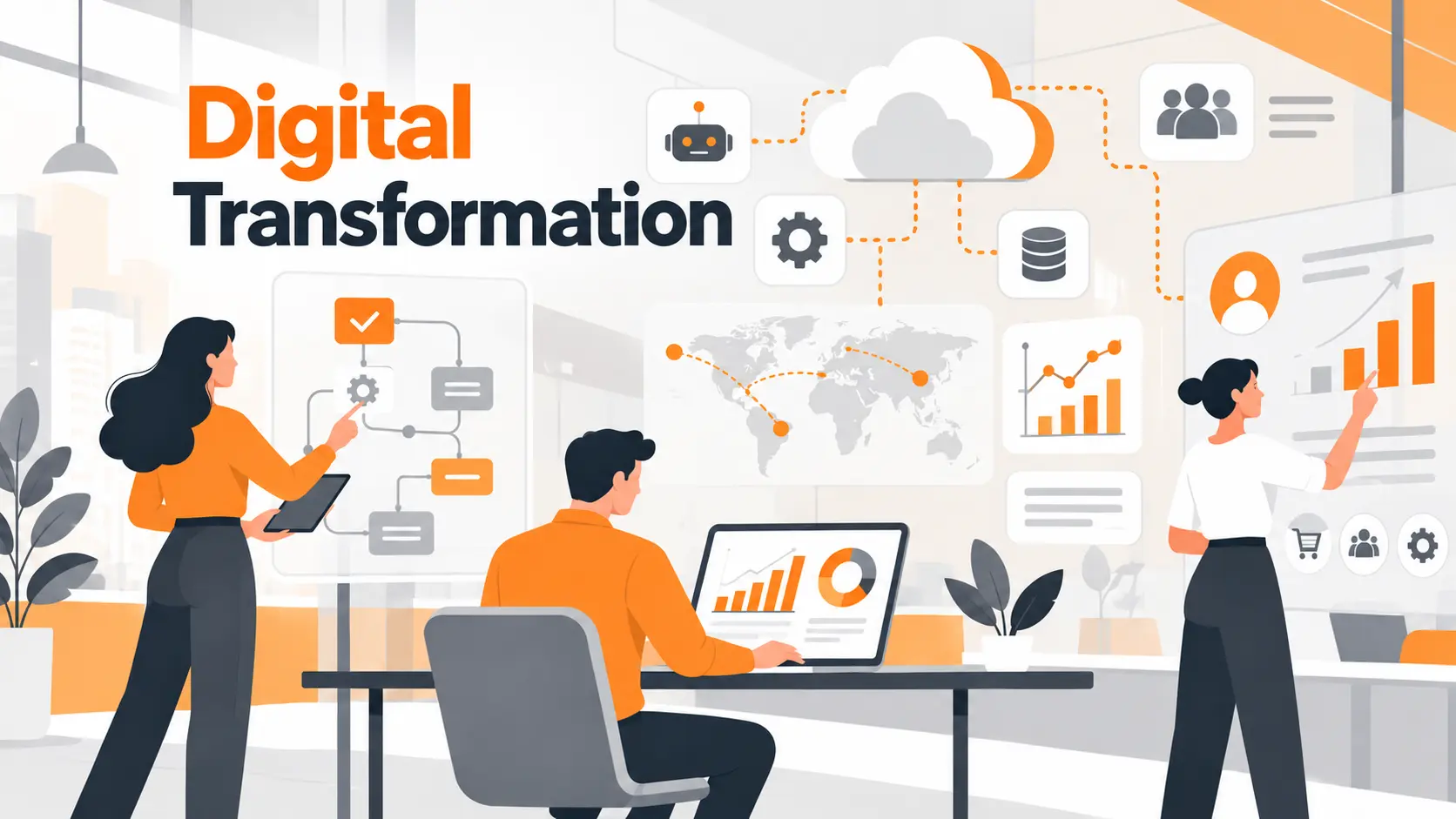
Digital transformation is the redesign of how a business operates, serves customers and creates value through digital technology. I do not see it as a software upgrade or an IT project. The real transformation starts when technology changes the process itself.
That distinction matters because a company can adopt cloud software, automation and AI without transforming anything meaningful. The stronger approach starts with a business problem, redesigns the way work happens and then uses technology to make that new model possible.
Digital Transformation Meaning
When I look at digital transformation, I focus on the operating change behind the technology.
Google Cloud defines digital transformation around using digital technologies to create or modify business processes, culture and customer experiences. McKinsey goes further and describes it as rewiring how an organization operates so technology can create value at scale.
That means digital transformation can change how a company sells, delivers a service, makes decisions, collaborates internally or creates a product.
A retail company does not transform because it launches an app. Transformation happens when that app becomes part of a better customer journey, connects with inventory and payments, uses data to improve decisions and changes how the business serves customers.
Technology is the mechanism. Business change is the outcome.
Digitization Versus Transformation
I find this distinction useful because these terms are often treated as the same thing.
Digitization moves something from physical to digital.
A paper form becomes an online form.
Digitalization improves a process with digital tools.
The online form connects to a system that stores and processes the information.
Digital transformation goes further.
The company can redesign the entire process so information moves automatically, employees no longer repeat manual tasks, customers receive faster service and managers can see performance in real time.
Microsoft makes the same distinction between digitalization and digital transformation, describing transformation as a broader rethinking of workflows, customer journeys and business models.
That is why I would never measure transformation by the number of tools a company buys.
Business Areas That Change
Digital transformation becomes easier to understand when you look at what actually changes inside a company.
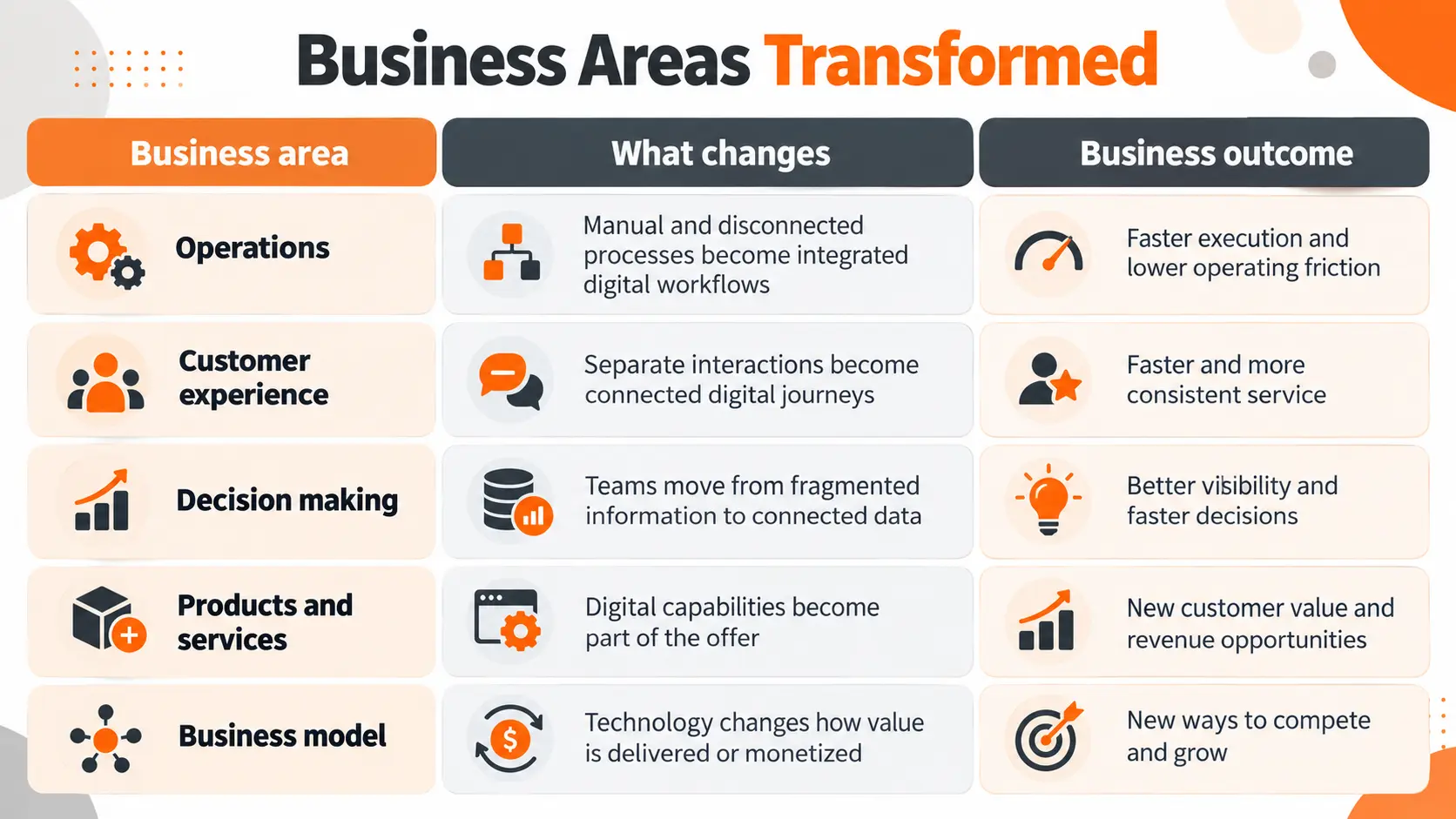
IBM identifies business models, processes, products, employee experience and customer experience as major transformation domains.
What I find important is that these areas are connected.
Improving a customer journey can require new internal workflows. Better workflows can require cleaner data. Better data can change decision making. That is why successful transformation rarely stays inside one department.
Strategy Before Technology
I would not start a digital transformation project by asking which software the company should buy.
I would start with the business constraint.
Where does the customer wait too long?
Where are employees repeating the same work?
Where does information get lost between teams?
Where is a decision being made without reliable data?
Where is the current operating model limiting growth?
Once that problem is clear, technology choices become much easier.
IBM recommends connecting transformation strategy to customer relationships, business needs and measurable improvement rather than treating new technology as the strategy itself.
For example, imagine customer onboarding takes seven days because five teams exchange documents manually.
The transformation goal is not to install automation software.
The goal is to redesign onboarding so customer information enters once, verification happens inside the workflow, teams use the same data and the customer can see progress.
Automation, cloud systems and data integration support that change.
The redesigned process is the transformation.
Technology as an Enabler
Cloud computing, artificial intelligence, automation and data analytics have become major parts of digital transformation because they allow companies to redesign work that older systems could not support efficiently.
Cloud infrastructure makes systems easier to scale and connect.
Automation removes repeatable manual steps.
Data analytics turns operational information into decisions.
AI adds capabilities such as prediction, content generation, classification and more advanced workflow automation.
These technologies sit within a wider landscape of Emerging Technologies that continues to expand what businesses can redesign.
The mistake I avoid is starting with the technology and searching for a reason to use it.
A company does not need an AI project because AI is important.
It needs AI when AI produces a better business outcome than the existing process.
Google Cloud also frames AI, cloud and data analytics as technologies that enable transformation rather than as the transformation itself.
Execution and Adoption
A transformation does not become successful when the new system goes live.
It becomes successful when the new way of working becomes the normal way of working.
This is where people and process become as important as technology.
If a new platform is introduced but employees continue maintaining spreadsheets outside the system, the business now has more technology and the same operational problem.
If teams do not understand why a workflow changed, they will find ways around it.
If management does not change how success is measured, employees will continue optimizing for the old process.
This is why I see digital transformation as an operating change rather than an implementation project.
McKinsey also describes transformation as continuous rather than a one time initiative, with technology being deployed repeatedly as the business evolves.
That approach is much more realistic.
Markets change. Customer expectations change. Technology changes. A transformed company needs the ability to keep adapting.
Business Outcomes and Measurement
One of the clearest ways to tell whether transformation is working is to stop measuring the technology and measure the business.
Instead of measuring how many automation workflows were created, measure how much processing time was removed.
Instead of measuring how many employees received a new platform, measure whether the work became faster or more accurate.
Instead of celebrating an AI deployment, measure whether customer response time, operating cost or conversion improved.
McKinsey has found that companies capture very different levels of economic value from transformation efforts, which reinforces why implementation alone is not enough
When I assess a transformation initiative, I want the outcome defined before the technology is selected.
That creates a simple test.
If the project succeeds technically but the business result does not improve, the transformation has not delivered its purpose.
Digital Transformation in the AI Era
AI is changing digital transformation because businesses can now redesign work that previously required people to process large amounts of information manually.
This goes beyond chatbots.
AI can support service teams, analyze documents, assist software development, coordinate workflows and help employees make decisions using information spread across multiple systems.
The current shift is moving from isolated AI experiments toward AI being integrated into operating models and business processes. McKinsey reported in its 2026 technology research that leading organizations are connecting AI and data directly to how the company operates. Microsoft has described a similar move from AI experimentation toward business wide transformation.
That changes the transformation question again.
It is no longer only about which processes can become digital.
The next question is which processes can become more intelligent.
The same principle still applies.
Start with the business outcome. Redesign the workflow. Then decide where AI improves the result.
Final Perspective
The simplest way I think about digital transformation is this:
A digital business does not just use more technology. It operates differently because of technology.
That difference can show up in faster decisions, smoother customer journeys, lower operating friction, new products or entirely new business models.
The companies that get the most value from transformation do not treat it as a technology shopping exercise. They connect technology to a specific business problem, redesign the process around the desired outcome and keep improving that operating model as the company changes.
That is what turns digital adoption into digital transformation.
FAQ
Can a small business actually do digital transformation without a huge budget?
Yes. Digital transformation does not require replacing every system at once. A small company can focus on one high value process, redesign it, introduce the necessary technology and expand from the measurable results.
Do we need a digital transformation team just for this?
Not necessarily. A dedicated team can help large organizations coordinate complex programs, but smaller businesses can assign clear ownership across operations, technology and leadership without creating a separate department.
How long should a digital transformation take?
There is no universal completion date because digital transformation is continuous. Individual initiatives should have defined timelines and outcomes, while the broader transformation continues as the business, technology and customer needs change.
Can digital transformation work with old legacy systems still in place?
Yes. Legacy systems do not need to disappear immediately. Businesses can modernize around them, integrate them with newer platforms or replace specific components in stages when the business value justifies the change.
Who should own digital transformation inside a company?
Ownership should sit with business leadership rather than IT alone. Technology teams are essential to execution, but the transformation must be tied to business priorities, operating processes and measurable outcomes.

Fatemeh Jahangard
Technology & AI Writer at PinerookFatemeh Jahangard covers AI, emerging technologies, and digital innovation for Pinerook, focusing on how technology shapes startups and industries.
 Seen first.