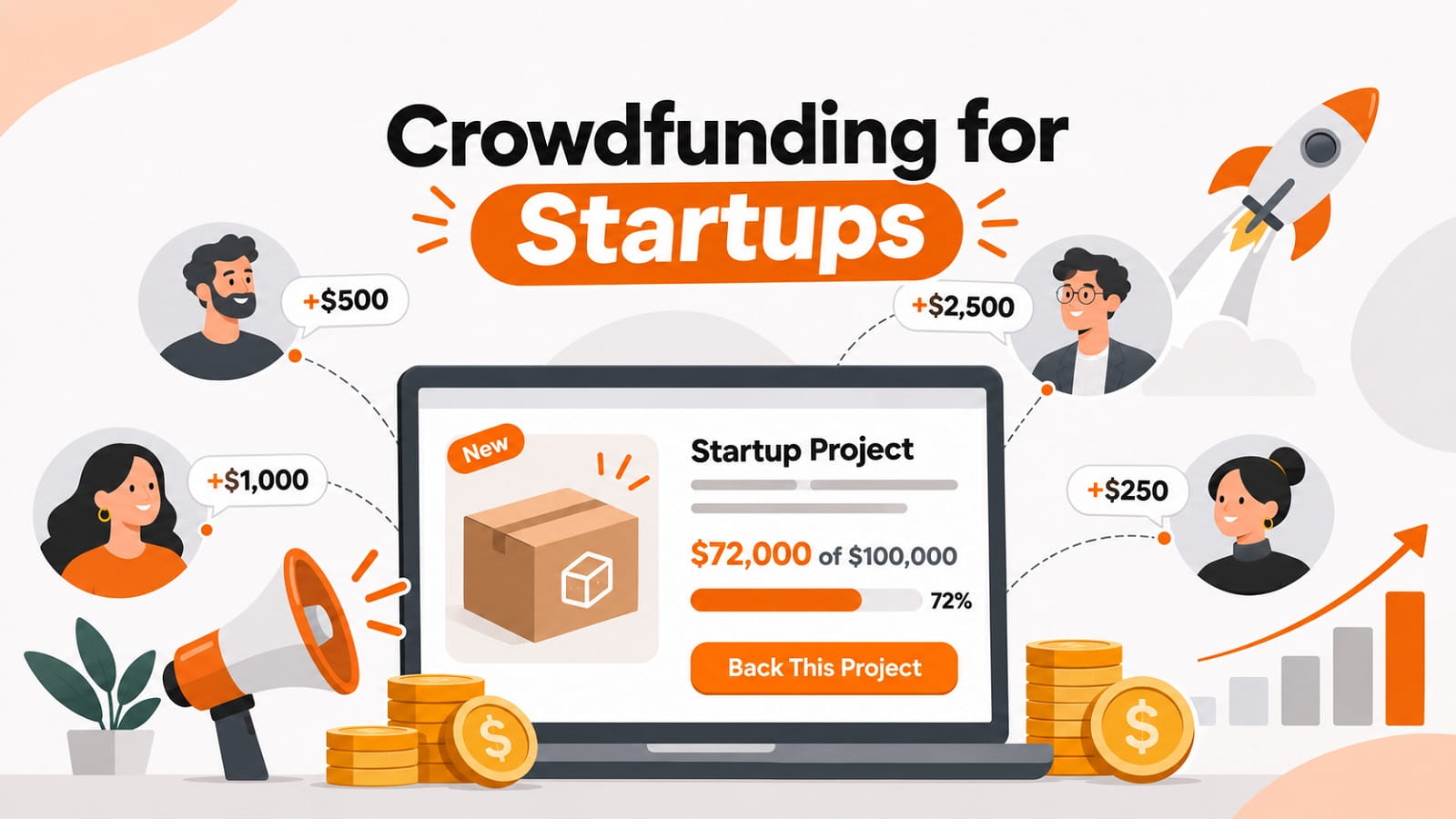
Crowdfunding for startups allows entrepreneurs to raise money from a large number of individuals rather than relying exclusively on banks, venture capital firms, or traditional business investors. Depending on the funding model, contributors may receive a product, a financial return, an ownership interest, or no material reward at all. For early stage businesses, crowdfunding can provide capital while helping validate customer demand, build an initial audience, and assess whether a proposed product or project attracts meaningful support.
Within Startup Debt and Alternative Funding, crowdfunding represents a collection of financing approaches rather than one standardized financial instrument. A rewards campaign creates obligations to deliver promised products, while lending arrangements require repayment and securities offerings may create investor rights. These distinctions affect the company's finances, legal responsibilities, and future flexibility. Founders should understand the economic consequences of their chosen model before launching a campaign or accepting contributions.
This guide explains the main types of crowdfunding, how to select a suitable platform, and what founders should prepare before asking the public for financial support. It also examines campaign targets, promotional costs, payment processing, reward fulfillment, and the operational challenges that arise after funding. A practical budget example demonstrates why the amount raised through a successful campaign can differ substantially from the capital available for business development.
What Is Crowdfunding for Startups?
Crowdfunding is a financing method in which a company, entrepreneur, or project organizer receives financial contributions from multiple supporters, commonly through an online platform. Individual contributions may be relatively small, but their combined value can provide meaningful capital for developing a product, launching a business, or supporting a specific commercial initiative.
The relationship between the startup and its contributors depends on the campaign structure. In rewards crowdfunding, supporters typically contribute in exchange for a promised product or benefit. Donation crowdfunding involves contributions without an ordinary expectation of financial repayment or ownership. Securities crowdfunding allows qualifying investors to acquire financial interests, while lending arrangements establish repayment obligations under applicable terms.
Crowdfunding also provides information about the market. A campaign attracting genuine customer commitments can help founders evaluate product appeal, pricing, and the effectiveness of their messaging. However, reaching a funding target does not guarantee sustainable demand, product profitability, or the ability to fulfill orders. Campaign performance should be interpreted alongside production costs, customer acquisition expenses, and the startup's broader commercial plans.
The Main Types of Crowdfunding for Startups
Choosing the funding model is the first major decision because it determines what the startup receives and what it promises in return. The four principal models differ in their treatment of ownership, financial repayment, contributor expectations, and operational responsibilities.
Rewards Crowdfunding
Rewards crowdfunding allows supporters to contribute money in exchange for a promised product, service, experience, or other benefit. It is commonly associated with creative projects, consumer products, hardware development, and businesses preparing to bring something new to market.
For example, a startup developing a portable productivity device might offer early production units to contributors who support its campaign. The funds can help finance manufacturing, but the business must account for production, packaging, shipping, customer support, and potential delays before deciding how much money it needs.
Rewards crowdfunding does not ordinarily involve selling company ownership. Nevertheless, the money raised should not be treated as unrestricted profit because fulfilling contributor commitments can consume much of the campaign proceeds. Consumer law, tax rules, and contractual obligations may also apply.
Donation Crowdfunding
Donation crowdfunding involves supporters contributing to a cause, initiative, or project without receiving ordinary financial returns or equity. This structure is most closely associated with charitable, community, and socially motivated fundraising.
A startup pursuing a social or public benefit project may encounter donation funding opportunities, but eligibility depends on the platform and applicable laws. Businesses should not assume that a conventional commercial venture can receive donations under the same conditions as a recognized charitable organization.
Transparency is particularly important. Organizers should explain how contributions will be used, whether donors receive anything in return, and what happens if the proposed initiative cannot be completed.
Debt Crowdfunding
Debt crowdfunding connects eligible borrowers with individuals or other lenders willing to provide financing. The startup receives capital and agrees to repay it under contractual terms that may include interest, fees, security, and scheduled payments.
Unlike a rewards campaign, borrowed money creates financial liabilities. The business must demonstrate that it can meet its obligations even if sales or project performance falls below expectations. The applicable regulatory framework may also govern lending platforms, investor eligibility, and disclosures.
This structure can be relevant to businesses with established repayment capacity, but it may be inappropriate for startups whose future revenue remains highly uncertain.
Equity Crowdfunding
Equity crowdfunding allows eligible companies to raise capital by issuing shares or other qualifying securities to investors through permitted fundraising arrangements. Investors participate in the company's potential financial performance and accept the possibility of losing their investment.
The process involves securities laws, ownership allocation, investor disclosures, and ongoing contractual or reporting obligations. Depending on the jurisdiction, the campaign may need to operate through an appropriately registered intermediary.
For founders, the main distinction is that equity financing generally avoids ordinary loan repayments but introduces ownership dilution and potentially additional governance responsibilities. Its suitability depends on the company's investment proposition, financial condition, and future fundraising strategy.
Comparing Crowdfunding Models
Each crowdfunding model supports a different relationship between the company and its financial supporters. Founders should therefore identify whether they need customer commitments, voluntary contributions, repayable capital, or investment in exchange for ownership.
The following table compares the major models and highlights the obligations that should influence the funding decision.
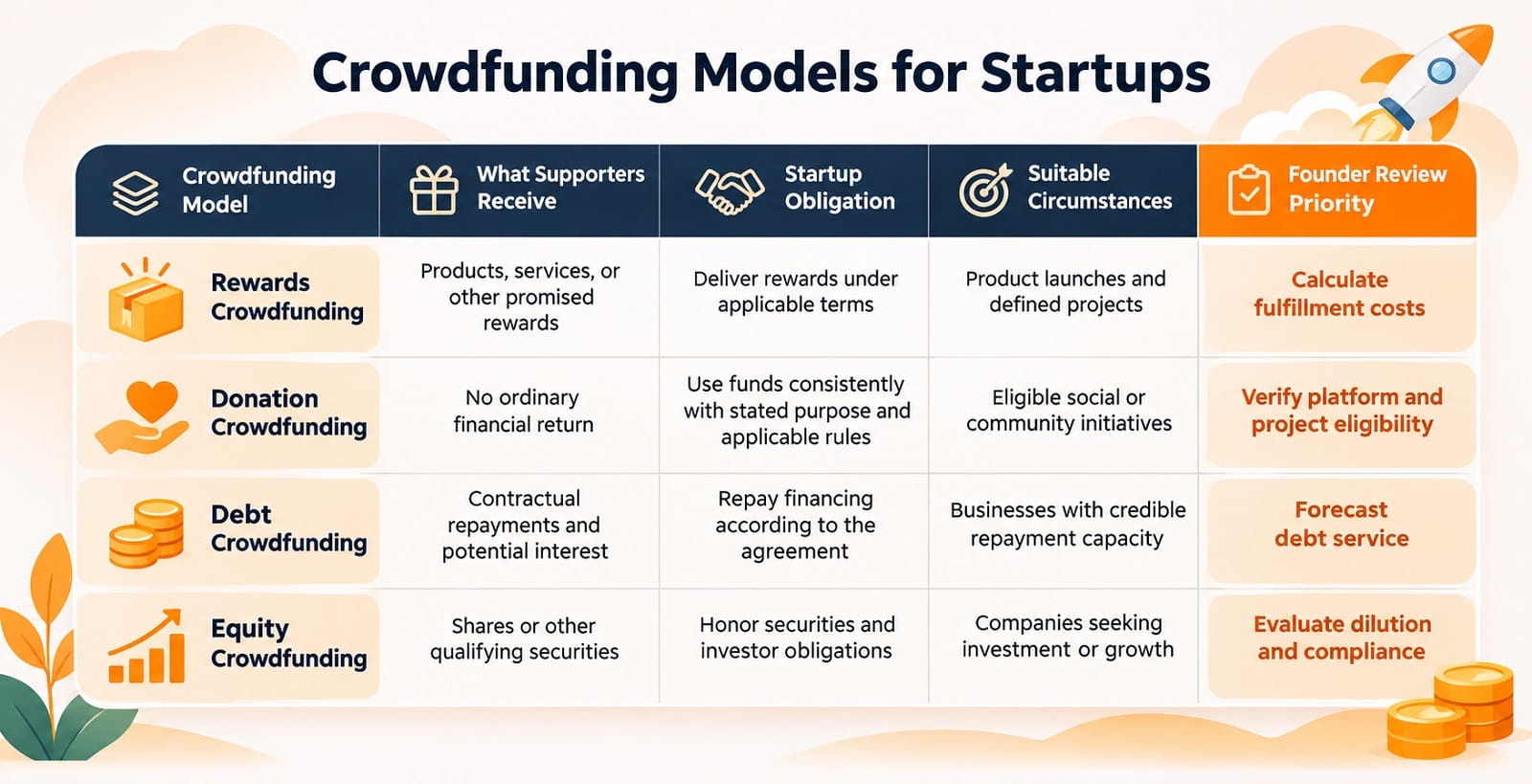
The right model should reflect the startup's financial needs and its ability to satisfy future commitments. A product company with an established manufacturing plan may benefit from collecting customer commitments through rewards crowdfunding, while a business seeking longer term expansion capital might consider an investment structure. Debt financing requires a credible repayment source, whereas donation funding generally depends on the purpose and eligibility of the project. Choosing a model simply because a particular platform is popular can create obligations that do not match the company's operating circumstances.
How to Choose a Crowdfunding Platform
The platform should be selected after the funding model and project requirements are clear. Different providers serve different audiences, apply different eligibility rules, and establish their own payment, campaign, and fulfillment procedures. A platform suitable for launching a consumer product may not support a company seeking an equity investment or a business financing arrangement.
Kickstarter is associated primarily with creative projects and rewards crowdfunding. Its funding model requires a project to reach its goal before supporters are charged. This can help prevent a creator from receiving insufficient funding for a project that requires a minimum production budget, but it also means an unsuccessful campaign may generate no collected capital.
Indiegogo supports product crowdfunding and offers campaign services that can differ in their funding and fulfillment arrangements. Founders should review the currently available campaign options rather than relying on outdated comparisons of fixed and flexible funding. GoFundMe is more closely associated with donation fundraising, and its eligibility and permitted uses depend on the organizer's circumstances and location.
The platform's audience matters, but it is only one consideration. Founders should also examine campaign eligibility, geographic restrictions, fee structures, payment timing, refund policies, contributor communications, and the resources available after the campaign. An established audience on a major platform does not guarantee that a particular project will receive meaningful attention.
Setting a Realistic Crowdfunding Goal
One of the most common planning mistakes is treating the fundraising target as the amount required to manufacture or develop the product without accounting for other obligations. A campaign that successfully raises $100,000 may leave substantially less available after fees, taxes, fulfillment, and marketing expenses.
Founders should begin by preparing a complete project budget. This includes the cost of developing and producing the promised rewards, packaging, shipping, applicable taxes, payment processing, customer support, and any necessary contingency reserve. Fixed costs should be distinguished from expenses that increase as more supporters participate. This helps management understand whether additional contributions improve the project's finances or create more fulfillment commitments than the company can support.
Minimum Funding and Flexible Funding
An All or Nothing campaign generally collects contributions only when the specified minimum goal is reached. This approach can be useful when a project requires a threshold amount to become viable. Founders should nevertheless ensure the target reflects the actual minimum necessary to meet their obligations, rather than selecting an artificially low figure to make success appear more likely.
Other campaign arrangements may permit fundraising without the same minimum threshold, depending on the platform and product. Such flexibility can benefit companies that can execute useful portions of a project with smaller amounts of capital. However, retaining contributions without enough money to deliver promised rewards can create serious financial and reputational problems.
The correct target therefore depends on project economics. A founder should be able to explain what the company can accomplish at the minimum target, what additional funding enables, and how commitments will be managed if contributions differ from expectations.
Preparing a Crowdfunding Campaign Before Launch
A crowdfunding campaign requires substantial preparation before it becomes publicly available. Founders need to demonstrate what they are creating, why the project matters, and how contributed funds will support completion. Campaign materials should communicate a coherent commercial proposition rather than relying entirely on promotional enthusiasm.
Validating the Project and Building an Audience
For a product campaign, meaningful validation begins with evidence that prospective customers understand the product and are interested in obtaining it. Demonstrations, prototypes, customer interviews, and controlled product testing can help identify whether the proposed features address a genuine need.
Founders should also begin communicating with potential supporters before launching. An email list, existing customer community, and relevant industry audience can provide opportunities to explain the project and gather feedback. However, expressions of interest are not equivalent to confirmed financial commitments, and projected conversion rates should be treated as assumptions rather than guaranteed outcomes.
An effective audience strategy focuses on relevance. A smaller group of people who understand the product and have a credible reason to support it may be more valuable than a large audience with little interest in the proposed offering.
Creating a Campaign That Explains the Product
The campaign page should explain the problem being addressed, the proposed solution, the current development stage, and what supporters can realistically expect. Product demonstrations should distinguish existing capabilities from features that remain under development.
Founders should communicate anticipated delivery dates alongside the principal risks that could affect production. A prototype may demonstrate that a technology works, but it does not necessarily establish that the business can manufacture thousands of reliable units at the expected cost.
Visual materials, demonstrations, and product specifications can improve clarity when they accurately reflect the current state of development. Unsupported claims about manufacturing readiness or delivery certainty can create unrealistic expectations and damage trust.
Designing Reward Tiers
Rewards should be structured around the value delivered to supporters and the company's ability to fulfill each commitment. Early access, limited editions, product bundles, and other benefits may appeal to different audiences, but every variation can introduce additional operational complexity.
A reward tier should not be priced solely according to what founders believe supporters are willing to pay. The price must also account for production, packaging, transaction fees, expected shipping costs, taxes where applicable, and potential service expenses.
Introducing too many reward variations can increase inventory requirements and fulfillment errors. Simpler reward structures may be easier to manage, particularly for startups launching their first physical product.
Crowdfunding Campaign Marketing and Launch Strategy
A campaign's public launch is only one stage of the fundraising process. Founders should prepare the messaging, audience communications, and operational resources necessary to support the campaign from its opening through its closing date.
Before launch, the company can test whether its explanation of the product is understandable and whether the proposed rewards are attractive to the intended audience. This feedback should be used to resolve confusing claims, improve product demonstrations, and identify unanswered questions. Marketing should focus on helping prospective supporters evaluate the project rather than creating artificial urgency or presenting uncertain outcomes as guaranteed.
During the campaign, management should monitor actual contributions, average pledge value, traffic quality, advertising expenditure, and contributor questions. These indicators can help identify which promotional activities attract relevant supporters and whether the campaign remains economically viable.
Paid advertising deserves particular scrutiny. An advertisement that generates more pledged revenue than its immediate cost is not automatically profitable because the startup still has to deliver rewards and absorb processing fees. Management should consider contribution margins after fulfillment expenses when deciding whether additional promotional spending makes sense.
Campaign updates should also remain consistent with actual progress. If manufacturing assumptions change or a technical problem emerges, transparent communication can help supporters understand the situation. Promising improvements that cannot realistically be delivered may increase short term contributions while creating costly obligations later.
A Practical Crowdfunding Budget Example
Consider Atlas Home, a fictional startup developing a compact smart home device. The company has completed a functional prototype and wants to launch a rewards crowdfunding campaign to finance its initial production run.
Atlas sets an illustrative gross fundraising target of $120,000 and expects approximately 1,000 supporters to contribute an average of $120 each. The rewards include the device and related benefits, and the campaign budget assumes that all supporters receive their promised rewards.
To evaluate the campaign, management estimates platform fees, payment processing charges, manufacturing expenses, shipping, campaign marketing, and a reserve for applicable taxes and miscellaneous project obligations.
For this example, assume a 5% platform fee and payment processing equal to 3% of gross contributions plus $0.20 per transaction. These rates are hypothetical campaign assumptions, not a quotation from a particular provider. Production and fulfillment costs are also illustrative.
Calculating the Net Campaign Proceeds
At $120,000 in gross contributions, the assumed platform commission equals $6,000. Payment processing costs total $3,800, comprising $3,600 in percentage charges and $200 in fixed transaction charges.
Atlas estimates manufacturing costs of $50,000, shipping and packaging costs of $12,000, campaign marketing expenses of $9,000, and an $8,000 reserve for specified additional obligations.
The following table shows how the gross contributions are allocated and the amount left after these assumed costs.
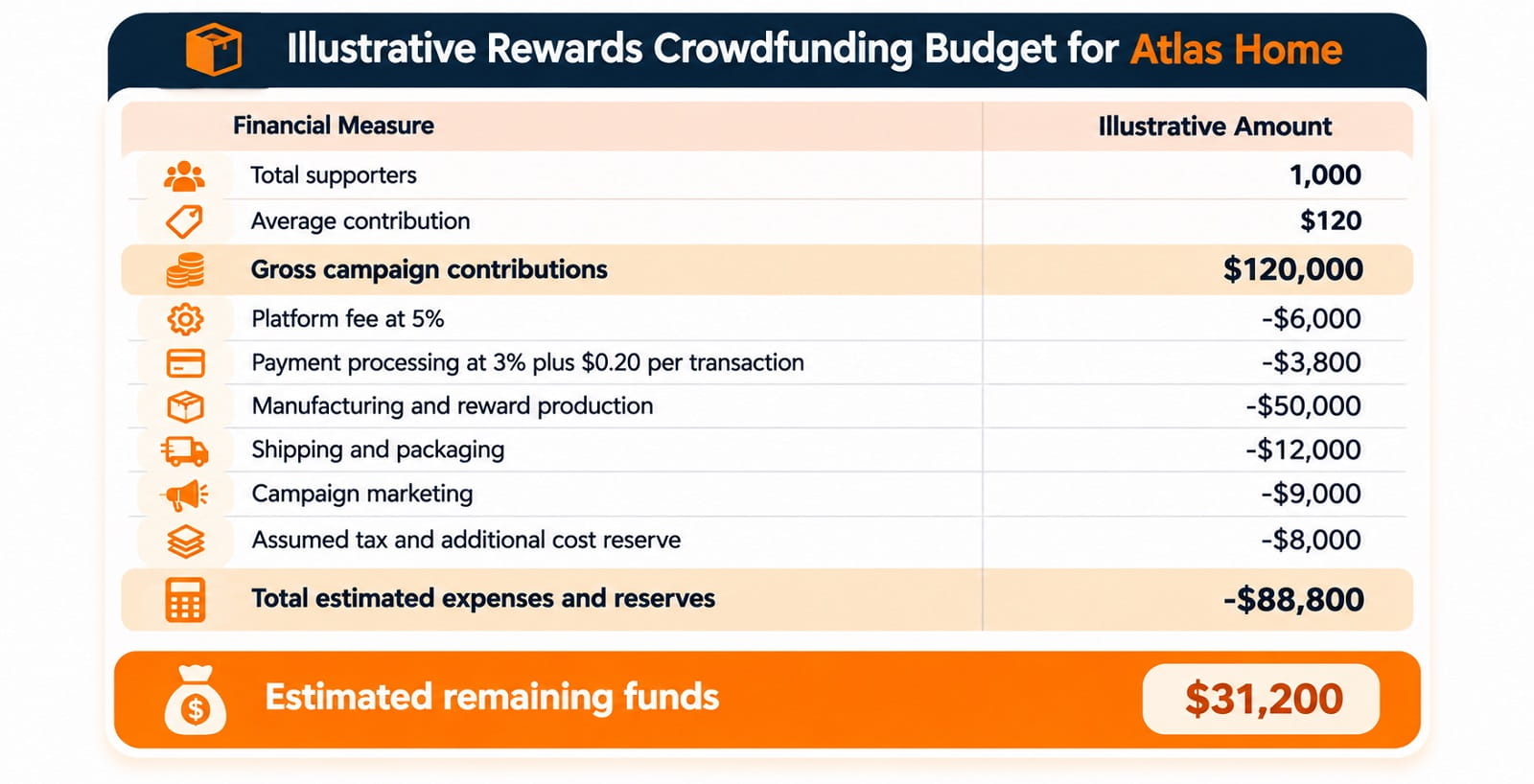
The example illustrates that a successful $120,000 campaign does not create $120,000 in freely available operating capital. After allowing for estimated costs and reserves, Atlas retains only $31,200 for additional project requirements and business development. That amount depends on the original assumptions being accurate, and unexpected manufacturing changes, shipping charges, refunds, or taxes could reduce it further. The reserve is a planning assumption rather than a determination of the company's actual tax liability, which must be calculated under applicable rules.
What Happens if the Campaign Attracts More Supporters?
Additional contributions can increase available capital, but they may also increase manufacturing requirements, customer support workloads, and delivery costs. If Atlas attracts twice as many supporters, it cannot assume the additional contributions represent pure financial surplus. The company may need more inventory, higher production capacity, additional packaging, and greater working capital before goods can be shipped.
Founders should model both the revenue and marginal fulfillment cost of additional pledges. Volume discounts may improve production economics, but those savings should not be assumed before suppliers confirm pricing and capacity.
This is particularly important when campaigns introduce stretch goals. Additional product features may attract supporters but also increase engineering complexity, material costs, and production risk. Management should evaluate whether every new commitment remains financially viable.
Managing Crowdfunding Obligations After Funding
A campaign does not end when the contribution period closes. For a rewards campaign, the next stage can be more operationally demanding than fundraising because the company must turn financial commitments into delivered products or services.
Management should confirm the final supporter information, reconcile collected payments, and establish a production schedule consistent with the actual funds received. Supplier agreements, manufacturing milestones, quality checks, and logistics arrangements should be reviewed before issuing firm delivery commitments.
The project also needs a financial tracking process. Campaign proceeds may arrive before many of the expenses associated with fulfilling rewards, creating the appearance of substantial liquidity. Founders should maintain sufficient funds for committed production and delivery costs rather than using the entire available balance for unrelated business activities.
Contributor communication remains important throughout fulfillment. Delays can arise from component shortages, technical defects, manufacturing changes, or customs requirements. When circumstances change, supporters should receive meaningful information about the problem, its consequences, and the revised plan. The company's specific refund and delivery obligations depend on platform terms, contractual promises, and applicable consumer protection laws.
For investment or lending campaigns, post funding obligations are different. Companies may need to provide financial disclosures, service debt, maintain investor records, or satisfy continuing regulatory requirements. This is another reason founders must understand their financing model before launching.
Common Crowdfunding Mistakes Startups Should Avoid
A frequent mistake is launching before the company has sufficient evidence that it can deliver the proposed project. A working prototype can support a campaign, but manufacturing at scale introduces separate risks involving suppliers, quality control, unit costs, and delivery schedules. Founders should distinguish product validation from production readiness.
Another problem is setting a funding goal that ignores the full cost of fulfilling commitments. Underestimating shipping, taxes, packaging, or payment processing can leave the company with insufficient capital despite meeting its target. The campaign budget should be reviewed under several contribution and cost scenarios before launch.
Some startups also rely too heavily on the platform to generate demand. An established crowdfunding website provides infrastructure and access to potential supporters, but it does not replace audience development, credible communication, or a compelling project proposition. Campaign performance depends partly on whether the company has attracted relevant attention before the offering begins.
Finally, founders may make additional promises after seeing strong campaign momentum. New reward tiers, accelerated delivery dates, or unexpected product features can increase operational obligations. A successful campaign should be measured not only by the amount raised but also by whether the startup can satisfy its promises while maintaining a financially sustainable business.
Final Thoughts
Crowdfunding can help startups access capital, engage potential customers, and evaluate interest in new products or projects. Its usefulness depends on selecting an appropriate funding model and understanding what contributors are entitled to receive. Rewards, donations, loans, and securities offerings create fundamentally different obligations, making the initial financing decision more important than simply selecting a popular platform.
A successful campaign also requires financial discipline. Platform commissions, payment processing, production, shipping, and other obligations can consume a substantial portion of the contributions collected. Founders should evaluate available capital after expenses, prepare for changes in demand, and maintain enough liquidity to fulfill commitments.
The most effective crowdfunding strategy connects a clearly defined funding requirement with a credible project, a relevant audience, and realistic delivery plans. When the economics and obligations are understood before launch, crowdfunding can support startup development without creating avoidable financial or operational problems.
FAQ
What Is Crowdfunding for Startups?
Crowdfunding for startups is a method of raising capital from multiple individuals, usually through an online platform. Depending on the structure, contributors may receive products, financial returns, ownership interests, or no material benefit. The appropriate model depends on the company's objectives, eligibility, and ability to satisfy its obligations.
Is Crowdfunding a Good Way to Fund a Startup?
Crowdfunding can be useful when a company has a clear funding objective, a relevant audience, and a realistic execution plan. Rewards campaigns may also provide evidence of customer demand before larger production commitments are made. However, fundraising success does not guarantee profitability, and the company must account for fees, fulfillment expenses, and other commitments.
Do Startups Have to Repay Crowdfunding Money?
The answer depends on the model. Lending arrangements normally establish repayment obligations, while rewards campaigns generally require delivery of promised benefits rather than conventional loan repayments. Equity investors receive securities, and donation contributors generally do not expect ordinary financial repayment. Refunds, legal remedies, and other obligations may still arise under applicable rules.
Which Crowdfunding Platform Is Best for Startups?
There is no universally suitable platform for every startup. Kickstarter is associated with creative and rewards projects, while Indiegogo supports product crowdfunding with its own campaign arrangements. Donation fundraising and securities offerings require different platform capabilities and eligibility conditions. Founders should compare audience suitability, fees, legal requirements, and post campaign services.
How Much Does It Cost to Launch a Crowdfunding Campaign?
Costs depend on the platform, funding structure, and project. They may include platform commissions, payment processing, marketing, legal services, manufacturing, shipping, and contributor support. Some costs are incurred before any money is collected, while others depend on the number and value of contributions. Founders should prepare a complete financial forecast rather than relying only on the advertised platform fee.
Can Startups Use Crowdfunding Without Giving Away Equity?
Yes. Rewards and donation crowdfunding do not ordinarily require issuing company shares. However, rewards campaigns create fulfillment obligations, and donation campaigns must satisfy applicable eligibility and platform requirements. Avoiding equity dilution does not necessarily mean the financing has no cost or legal consequences.
What Happens if a Crowdfunding Campaign Does Not Reach Its Goal?
The outcome depends on the platform's funding arrangement. Under Kickstarter's All or Nothing model, supporters are not charged if the project fails to reach its goal. Other arrangements may apply different conditions to funding collection or campaign completion. Founders should understand these rules and any expenses incurred regardless of campaign success.
How Long Does a Crowdfunding Campaign Take?
Campaign durations depend on the platform and project requirements. However, preparation and fulfillment can take substantially longer than the public contribution period. Founders should allow adequate time for audience development, budgeting, content preparation, production planning, and communication with supporters after fundraising closes.

Mobina Khanki
Venture & Funding Writer at PinerookMobina Khanki covers venture capital, startup funding, fundraising, and startup finance for Pinerook, focusing on founders and investors.
 Seen first.