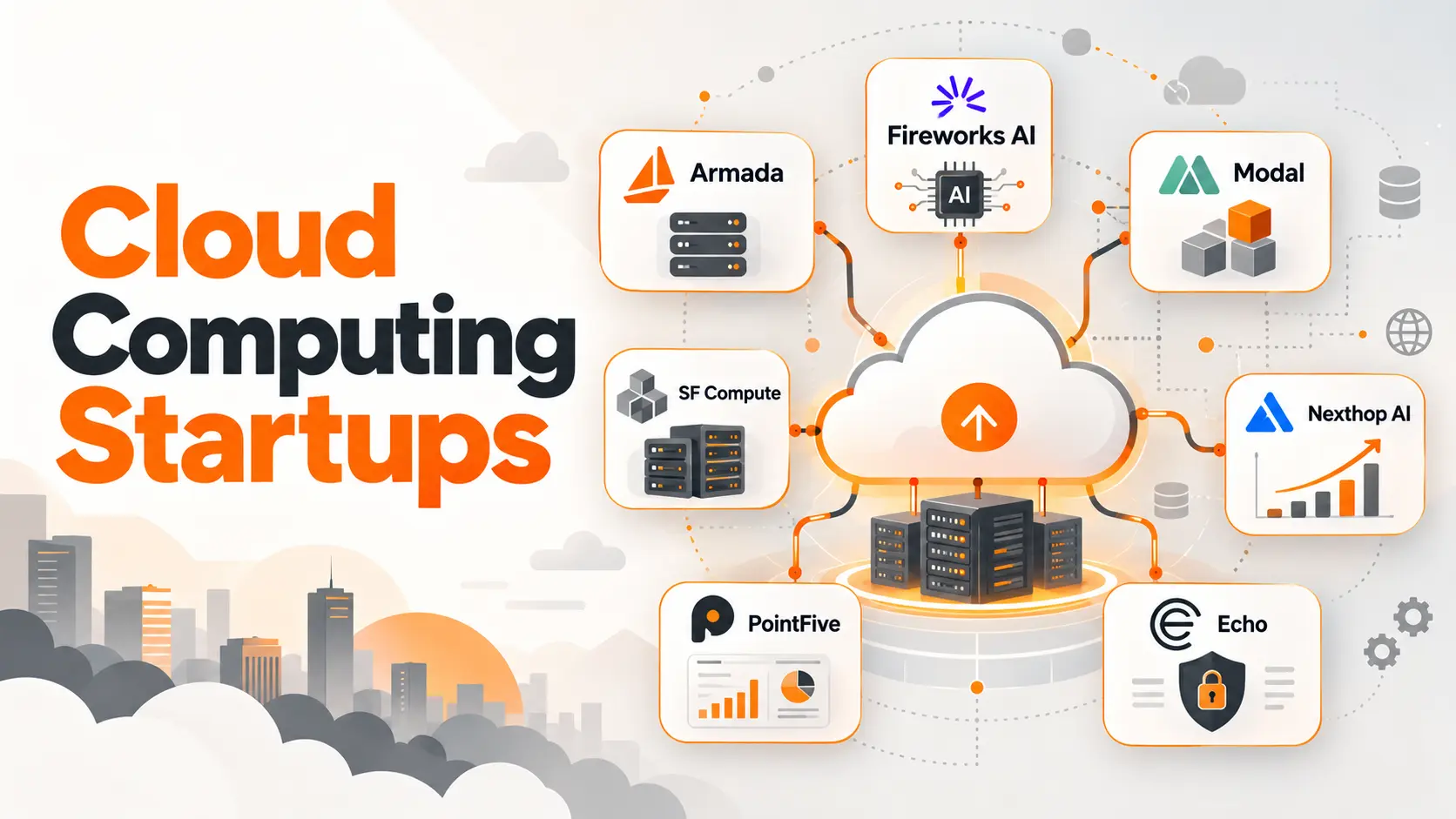
Cloud computing startups in 2026 are not trying to rebuild AWS from scratch. The companies I find most interesting are attacking specific parts of the cloud stack where demand has changed faster than traditional infrastructure: GPU access, AI workloads, cloud networking, security, edge computing and cost control.
That shift matters for founders and investors because AI has created new infrastructure problems at the same time that cloud spending continues to expand. The result is a new generation of companies building around gaps left between hyperscale clouds and the needs of modern workloads. CRN reports that global public cloud services spending is expected to pass $1 trillion in 2026, while demand for AI infrastructure and neocloud services continues to accelerate.
Cloud Computing Startups to Watch in 2026
I would not rank cloud startups by funding alone. I pay more attention to the problem they are solving and whether that problem becomes more important as cloud infrastructure evolves.
These are seven companies that represent some of the clearest directions in the current market.
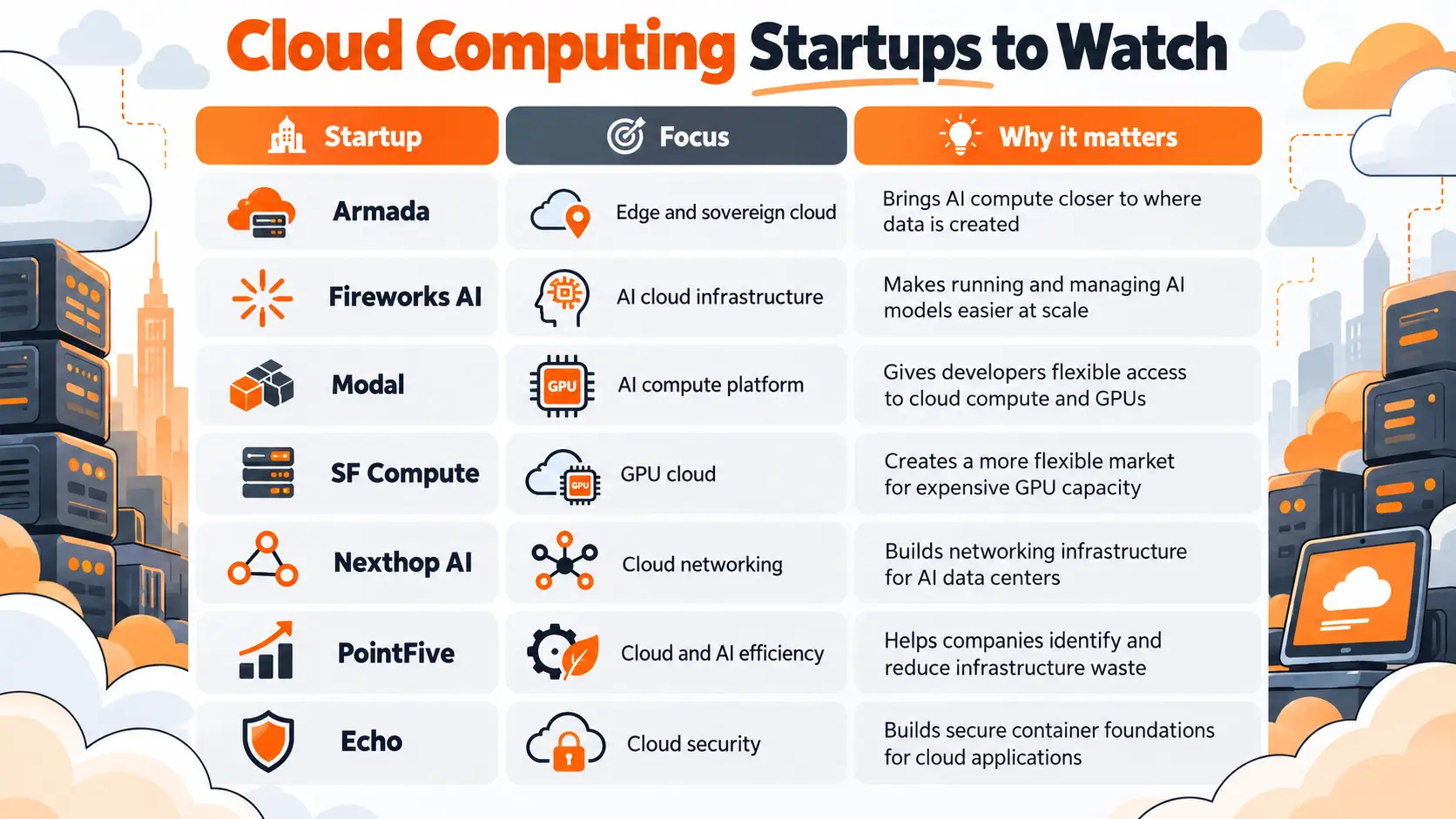
The list is deliberately broad. Cloud computing is no longer one market. The opportunities now sit across several layers of the infrastructure stack.
Armada
Armada stands out because it is taking cloud computing outside the traditional data center.
Its platform combines software with modular data centers designed to provide computing power in remote locations. Its Galleon systems can run CPUs, GPUs and specialized hardware close to where the data is generated rather than sending everything back to a centralized cloud.
I find Armada interesting because edge computing becomes much more valuable when AI workloads need low latency, data sovereignty or reliable operation in locations with limited connectivity.
The company also introduced a sovereign AI collaboration with Microsoft Azure Local in 2026 and raised $230 million in Series B funding to expand its modular AI infrastructure.
The opportunity here is not another generic cloud. It is cloud infrastructure for places where a centralized cloud does not fit the problem.
Fireworks AI
Fireworks AI represents another major direction in cloud startups: infrastructure designed specifically for AI models.
Instead of forcing development teams to manage the full infrastructure behind model deployment, Fireworks provides a cloud platform for running and managing AI workloads. CRN reports that the company entered 2026 after raising $250 million and has continued expanding its compute footprint and model platform.
This category matters because building an AI application and operating the infrastructure behind it are different jobs.
As companies deploy more models, they need systems that handle inference, model management, performance and scaling without turning every product company into an infrastructure company.
That creates room for a specialized AI cloud layer between foundation models and the applications built on top of them.
Modal
Modal is approaching the same AI infrastructure market from a developer experience angle.
The platform lets developers build with Python and run workloads on cloud infrastructure without manually planning GPU capacity or managing the underlying infrastructure. CRN reports that Modal can route workloads across multiple cloud providers and regions to access available compute. The company announced a $355 million Series C in 2026 at a $4.65 billion valuation.
The part I find more important than the funding is the abstraction.
Cloud computing became successful partly because developers stopped thinking about physical servers. AI infrastructure is now going through another abstraction layer where developers want compute without having to think about clusters, regions and GPU allocation every time they ship something.
Modal is building directly around that change.
SF Compute
GPU capacity has become one of the most interesting parts of the cloud market, and SF Compute is taking a different approach to how that capacity is bought.
The company builds GPU clusters and allows customers to reserve compute while also reselling unused capacity. Its platform includes virtual machines, bare metal infrastructure and managed Slurm for large computing workloads.
The underlying problem is easy to understand.
AI teams need large amounts of expensive compute, but their demand is not perfectly predictable. Buying too little slows development. Committing to too much creates idle infrastructure and unnecessary cost.
SF Compute is trying to turn GPU capacity into something closer to a market where customers have more flexibility to buy and sell compute.
That business model is what makes the company more interesting to me than another GPU provider.
Nexthop AI
The cloud AI boom is not only increasing demand for GPUs. It is also putting pressure on the networks connecting those GPUs.
Nexthop AI is building networking products for hyperscale cloud operators and AI data centers. In 2026, it introduced new networking systems designed around performance, power efficiency and deployment speed for hyperscalers and neocloud providers.
CRN also reported that Nexthop raised a $500 million Series B in March 2026 at a $4.2 billion valuation.
This is an important reminder for founders looking at AI infrastructure.
The opportunity is not limited to creating models or renting GPUs. As AI systems become larger, networking, storage, power management and orchestration all become critical parts of the stack.
Infrastructure constraints create startup markets of their own.
PointFive
Cloud growth creates another predictable problem: waste.
PointFive focuses on cloud and AI infrastructure efficiency. Its platform connects cost information with engineering context so teams can identify inefficient infrastructure and move from finding waste to fixing it.
The AI side makes this more interesting.
PointFive now tracks spending and efficiency across areas including cloud AI services, GPU infrastructure, models, tokens and coding agents.
As AI costs become a larger part of technology budgets, traditional FinOps tools need to understand more than servers and storage. Teams need visibility into model selection, GPU utilization and token consumption.
That creates a new category around AI infrastructure economics, not just cloud billing.
Echo
Security remains one of the strongest opportunities in cloud infrastructure because every new layer creates another surface that companies need to protect.
Echo focuses on the container layer. It provides container base images designed to remove known vulnerabilities while remaining compatible with existing cloud development workflows.
CRN included Echo among its cloud computing startups to watch after the company raised a $35 million Series A and expanded its secure container image platform.
What interests me here is the position in the stack.
Containers are foundational to modern cloud applications. Improving security at that level can remove work from development and security teams before an application reaches production.
That is a stronger infrastructure proposition than adding another security dashboard after the software has already been deployed.
The Cloud Market Shift
Looking across these companies, I see a cloud market becoming more specialized.
The previous cloud era concentrated enormous amounts of computing inside hyperscale platforms. The current wave is creating companies around more specific requirements.
AI teams need GPU clouds.
Enterprises need better infrastructure efficiency.
Governments and regulated industries need sovereign computing.
Developers want infrastructure with less operational complexity.
Security teams want vulnerabilities removed earlier in the software lifecycle.
These developments sit alongside other Emerging Technologies that are changing where computing happens and how software companies build products.
Y Combinator's current cloud computing directory reflects the same shift. New companies are building infrastructure for AI agents, serverless computing, task orchestration and developer tools rather than trying to reproduce a traditional public cloud platform.
For founders, that is the useful signal.
The next major cloud company does not need to replace AWS. It can own one expensive, difficult or rapidly changing part of the infrastructure stack and solve that problem better.
Final Perspective
The cloud startup market in 2026 is increasingly tied to what AI has changed about computing.
More GPU demand creates new compute markets. More AI workloads create networking and infrastructure challenges. Higher cloud spending creates stronger demand for optimization. More automated software creates new security requirements.
That is why I would watch the infrastructure beneath AI as closely as the applications built on top of it.
The most interesting cloud computing startups are finding bottlenecks created by the next generation of software and turning those bottlenecks into products.
FAQ
Can a small cloud startup really compete with AWS or Azure?
Yes, but direct competition is not required. A startup can build a strong business by solving a specialized infrastructure problem that hyperscale platforms do not address with the same focus.
Do cloud startups need to own their own data centers?
No. A cloud startup can lease infrastructure, build software on existing cloud providers, operate colocated hardware or combine several infrastructure models. The correct structure depends on the product and its economics.
Is a neocloud the same thing as a cloud computing startup?
No. Neocloud refers to a newer group of cloud providers focused heavily on accelerated computing and AI infrastructure. Cloud computing startups cover a wider market that also includes security, networking, developer infrastructure, FinOps and data platforms.
Where can I check the funding of a cloud startup before investing time in researching it?
Funding databases such as Crunchbase can provide investment rounds, investors and company information. Company announcements and investor portfolio pages should then be used to verify important figures.
How fast does a cloud startup list like this become outdated?
The company landscape changes continuously because funding rounds, acquisitions and product launches can change a startup's position. A current market review should therefore verify company status and recent developments before using the list for investment or business decisions.

Fatemeh Jahangard
Technology & AI Writer at PinerookFatemeh Jahangard covers AI, emerging technologies, and digital innovation for Pinerook, focusing on how technology shapes startups and industries.
 Seen first.