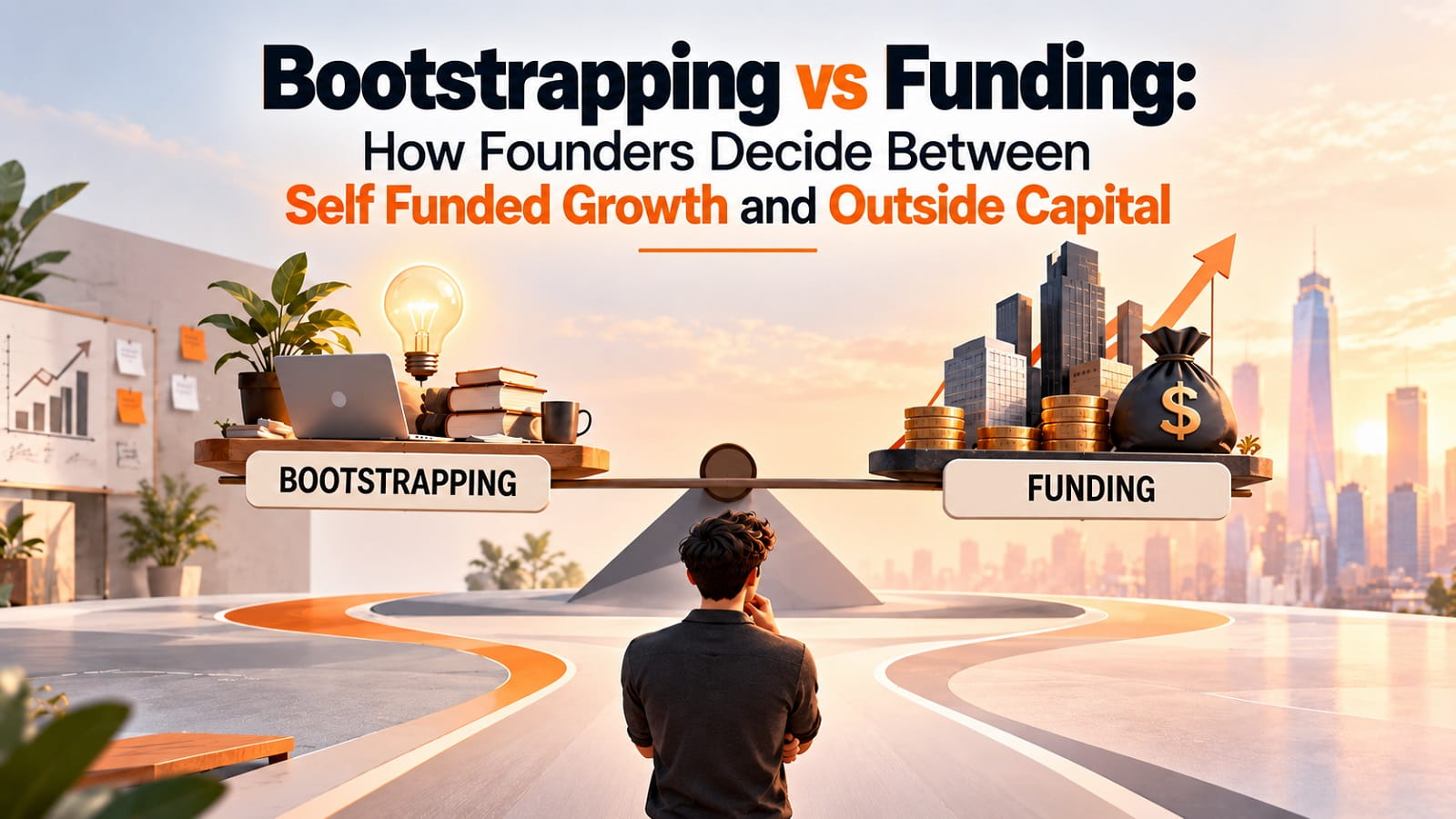
One of the earliest strategic decisions founders face is whether to grow a startup using their own resources or raise money from outside investors. Both paths can create successful companies, but they produce very different pressures, incentives, ownership structures, and growth expectations.
Within Startup Funding, this decision matters because capital does more than pay expenses. It influences how quickly the company can expand, how much ownership founders retain, how much financial pressure the business carries, and what investors may expect from future growth.
Bootstrapping vs funding is therefore not simply a choice between using your own money and taking investor money. It is a decision about how the company should grow, what risks founders are willing to accept, and which constraints are more manageable for the business.
What Is Bootstrapping?
Bootstrapping means building and growing a startup primarily with founder resources and money generated by the business itself.
The company may begin with personal savings and then finance product development, hiring, marketing, and operations through customer revenue. The founders generally avoid selling significant ownership to outside investors during the early stages.
Bootstrapped companies often operate with tighter budgets because every major expense must eventually be supported by available cash. This can encourage disciplined spending and early attention to revenue.
The limitation is that the company may grow more slowly if important opportunities require capital before sufficient revenue exists.
What Does Outside Funding Mean?
Outside funding means bringing external capital into the company.
That capital may come from angel investors, venture capital firms, strategic investors, accelerators, or other equity financing sources. Depending on the structure, founders may exchange part of the company for capital and investor support.
Outside funding can give a startup resources to hire faster, build technology, acquire customers, enter new markets, or survive a long development period before meaningful revenue appears.
However, the capital changes the company’s ownership structure and often introduces new expectations around growth, governance, reporting, and future fundraising.
The relevant question is not whether investment is good or bad. It is whether outside capital creates enough value to justify what the founders give up in return.
Bootstrapping vs Funding at a Glance
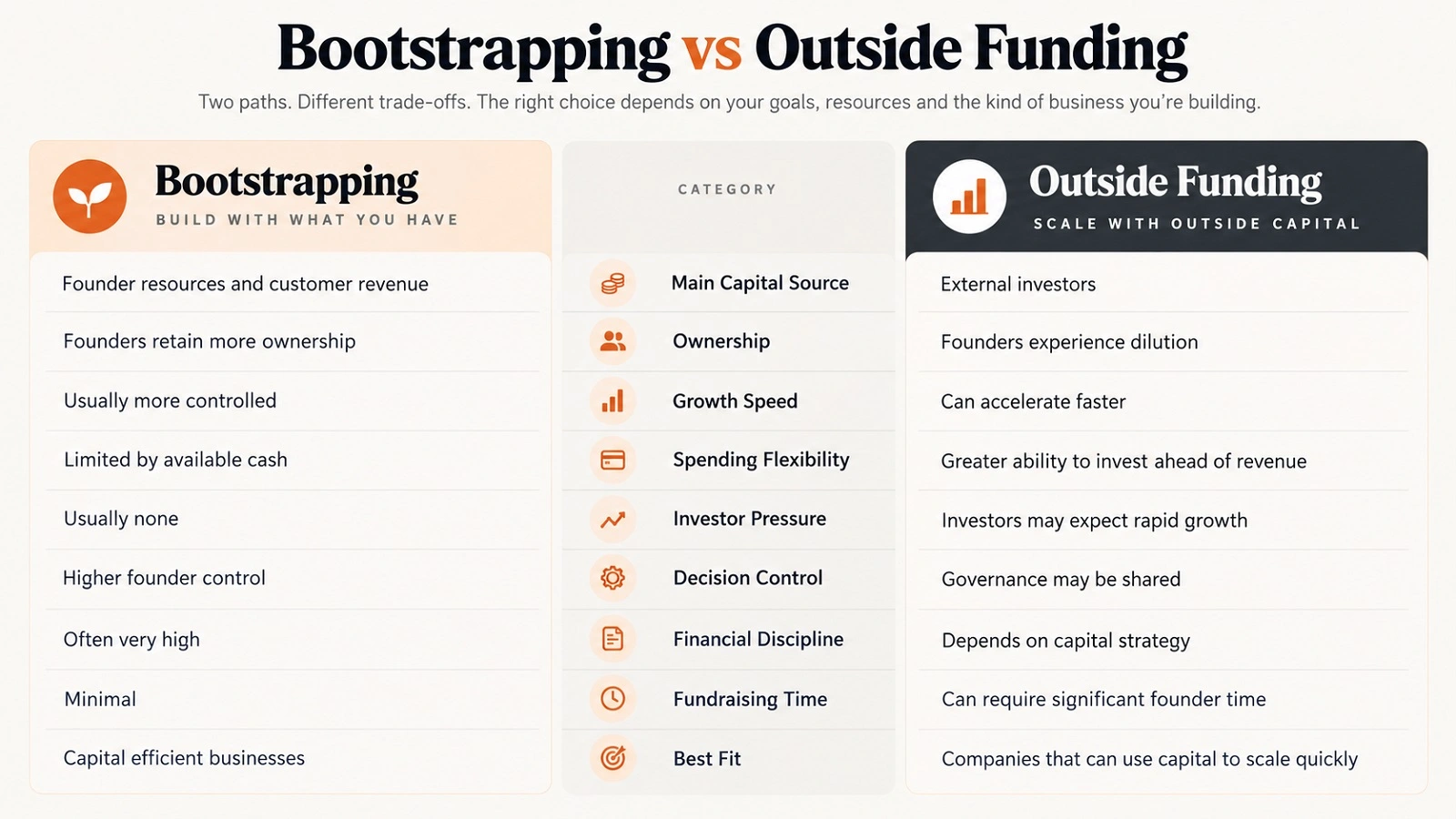
Neither path is automatically superior. The better choice depends on the economics and objectives of the startup.
The Main Advantage of Bootstrapping: Ownership
One of the strongest reasons founders choose bootstrapping is ownership.
When a company grows without selling significant equity, founders can retain a larger percentage of the business. If the company becomes valuable later, that ownership can have substantial economic importance.
Ownership also affects decision making.
A bootstrapped founder usually has greater freedom to choose how fast the company grows, which markets it enters, when it becomes profitable, and whether the company should eventually be sold.
This flexibility can be especially valuable to founders whose goals do not require building the largest possible company as quickly as possible.
However, ownership percentage alone should not determine the decision. A smaller percentage of a much larger business can sometimes be more valuable than complete ownership of a company that lacks enough resources to grow.
The Main Advantage of Funding: Speed
Outside capital can significantly increase the speed at which a startup operates.
A funded company can hire engineers before revenue fully supports them, build a sales organization, spend on customer acquisition, improve infrastructure, and enter markets earlier than a company depending entirely on internal cash.
Speed can matter when timing is critical.
If a startup is entering a rapidly growing market, competing against heavily funded companies, or developing technology that requires substantial investment, waiting for customer revenue to finance every step may create a competitive disadvantage.
Funding can therefore become valuable when capital allows the company to capture an opportunity that would otherwise disappear.
Ownership and Dilution
Dilution is one of the most important differences between bootstrapping and outside funding.
When investors receive new equity, the ownership percentages of existing shareholders generally decrease. Founders may still own a significant share of the company, but their percentage becomes smaller after each financing round.
This is not necessarily negative if the investment increases the company’s value substantially.
The important question is what founders receive in exchange for dilution.
Capital, investor networks, recruiting support, strategic guidance, credibility, and access to later financing can all create value. If those resources help the company grow significantly faster, dilution may be economically worthwhile.
Founders should therefore evaluate dilution in relation to the expected increase in company value rather than treating any reduction in ownership as automatically undesirable.
Control and Decision Making
Bootstrapping usually gives founders greater control over the company.
Without outside shareholders or a formal investor board, founders may be able to make strategic decisions more quickly and pursue a longer term approach that fits their own priorities.
Outside investment can change that dynamic.
Investors may receive voting rights, board representation, information rights, or approval rights over certain major decisions. These arrangements vary depending on the investment structure.
External governance can be useful. Experienced investors may improve decision making, challenge weak assumptions, and provide guidance during difficult periods.
The tradeoff is that founders are no longer making every important decision entirely on their own.
Profitability vs Growth
Bootstrapped and funded companies often develop different relationships with profitability.
A bootstrapped company usually needs to pay close attention to revenue and cash flow because there is less outside capital available to cover losses.
This can push founders toward earlier monetization, disciplined hiring, and careful spending.
Funded startups may have more freedom to prioritize growth before profitability.
A company may intentionally spend heavily on product development, hiring, or customer acquisition because investors believe the long term opportunity justifies short term losses.
Neither model is automatically healthier. The important question is whether the company’s spending strategy matches the economics of the market.
How Bootstrapping Affects Company Culture
Financing decisions can shape company culture.
Bootstrapped teams often develop strong cost awareness because spending decisions have an immediate impact on runway and founder resources. Employees may work with smaller teams and broader responsibilities.
This can create a culture focused on efficiency, customer value, and practical execution.
Funded startups may have greater access to talent, technology, and specialized teams. This can allow employees to move faster and pursue larger opportunities.
The risk is that abundant capital can reduce spending discipline if the company begins measuring progress through hiring and expenditure rather than customer outcomes.
Capital itself does not determine culture, but the constraints surrounding capital can influence how teams behave.
When Bootstrapping Makes Sense
Bootstrapping becomes particularly attractive when the company can make meaningful progress without large amounts of outside capital.
Software businesses, digital services, consulting enabled products, niche platforms, and some ecommerce companies may be able to build initial products and reach paying customers with relatively modest resources.
Bootstrapping can also make sense when founders value independence highly or want to build a profitable company without pursuing venture scale growth.
The approach is stronger when revenue arrives early enough to fund continued development.
If customers can finance the next stage of the company, outside equity may not be necessary.
When Outside Funding Makes Sense
External funding becomes more valuable when capital is a major constraint on a strong opportunity.
A startup may need significant research and development before launching. Another may need to build a marketplace quickly so that competitors do not dominate the market first. A hardware company may face manufacturing costs long before customer revenue becomes available.
In these situations, bootstrapping can limit the company’s ability to reach the opportunity.
Funding also makes sense when additional capital can be deployed into an already working growth engine.
If the company knows that investing more into sales, product, or customer acquisition can create significantly greater value, raising capital may allow the startup to grow faster than internal revenue alone would permit.
Bootstrapping vs Venture Capital
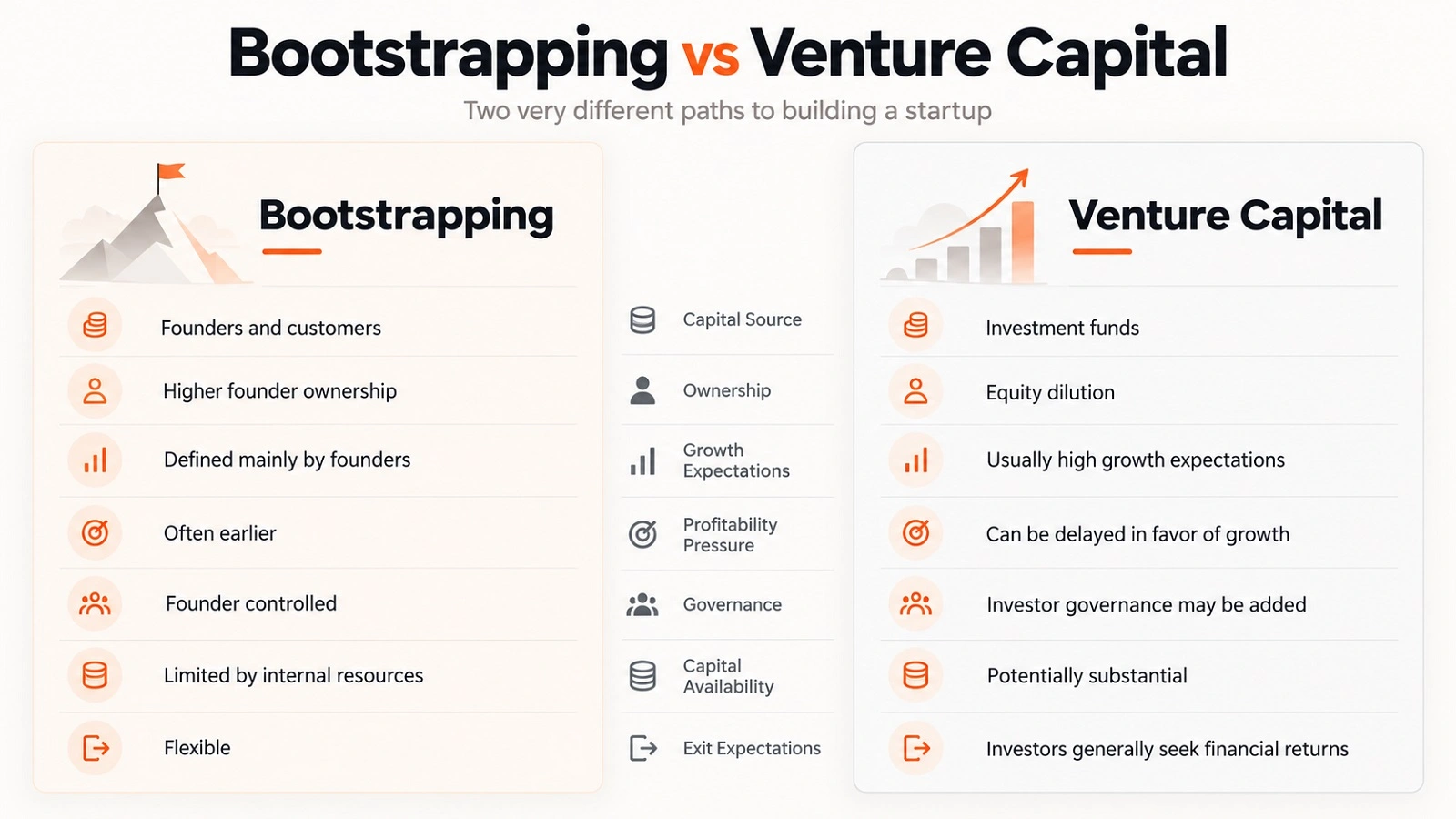
Venture capital is designed for companies that have the potential to produce very large outcomes.
That means the financing model may not fit every founder or every business.
A company can be successful, profitable, and valuable without being appropriate for venture capital.
Bootstrapping vs Angel Funding
Angel investment can sit somewhere between pure bootstrapping and institutional venture capital.
An angel investor may provide enough money to help the startup move faster without immediately introducing the same structure or expectations associated with a larger venture fund.
This can make angel funding useful when founders need capital to reach an important milestone but are not ready for a large institutional round.
The company still experiences dilution, and investor compatibility remains important.
A supportive angel can bring valuable knowledge and connections, while the wrong investor can add complexity without contributing much beyond capital.
How Funding Changes Founder Incentives
Financing can influence what founders optimize for.
Bootstrapped founders may focus heavily on cash flow, customer revenue, profitability, and ownership value.
Venture backed founders may focus more aggressively on market share, growth rate, expansion, and company valuation because investors are seeking significant returns from the company’s future value.
These incentives are not necessarily in conflict with building a strong business, but they can produce different strategic choices.
For example, a bootstrapped founder may choose steady profitable growth over rapid expansion. A funded company may intentionally sacrifice short term profitability to capture a larger market position.
Understanding these incentives before raising money can prevent future disagreement between founders and investors.
How Funding Changes Risk
Bootstrapping and external funding create different types of risk.
Bootstrapping exposes founders more directly to personal financial risk if they invest significant savings into the company. The business may also lose market opportunities because it lacks enough capital to move quickly.
Outside funding reduces the amount of company growth that founders need to finance personally, but it introduces ownership and expectation risk.
Investors may expect faster expansion, future financing rounds, strategic changes, or eventual liquidity.
The best decision depends on which risks are most important in the specific company.
Customer Revenue as an Alternative
The bootstrapping versus funding decision is not always binary.
Customer revenue can become an important third source of capital.
A startup may begin with founder money, reach paying customers, reinvest those earnings, and only raise external investment later if a larger opportunity becomes clear.
This approach allows founders to reduce early dilution while building evidence that can improve their negotiating position with investors.
Revenue can also validate the business in a way that fundraising cannot.
An investor may believe the idea is promising, but paying customers provide stronger evidence that the market finds real value in the product.
Can a Bootstrapped Startup Raise Funding Later?
Yes. Bootstrapping does not prevent a company from raising investment later.
In fact, reaching meaningful traction before fundraising can strengthen the founder’s position.
A startup with paying customers, clear retention, proven demand, and disciplined spending may appear less risky than a company raising money before establishing those signals.
This can give founders more leverage when discussing valuation and investment terms.
Bootstrapping can therefore be a stage rather than a permanent financing philosophy.
The company may remain self funded while uncertainty is high and raise external capital only after it discovers a repeatable opportunity worth accelerating.
Can a Funded Startup Return to Self Funded Growth?
A funded company can eventually become financially independent if revenue and cash flow become strong enough to support operations.
However, accepting institutional capital may create long term expectations that do not disappear simply because the company becomes profitable.
Investors still hold ownership and typically expect a return on that investment.
The company may therefore gain financial independence from future fundraising while remaining responsible to existing shareholders.
This distinction matters because being profitable after raising capital is not the same as having never taken outside investment.
How Much Capital Does the Startup Actually Need?
Before deciding between bootstrapping and funding, founders should identify what capital is supposed to achieve.
A company may need money to build an MVP, hire a technical team, reach a regulatory milestone, acquire its first customers, or expand into a new market.
If that milestone can realistically be reached using founder resources and customer revenue, bootstrapping may preserve valuable ownership.
If the milestone requires more capital than the founders can provide, outside funding may be necessary.
The amount should therefore be calculated around a business objective rather than around how much money investors might be willing to provide.
Bootstrapping vs Funding by Business Situation
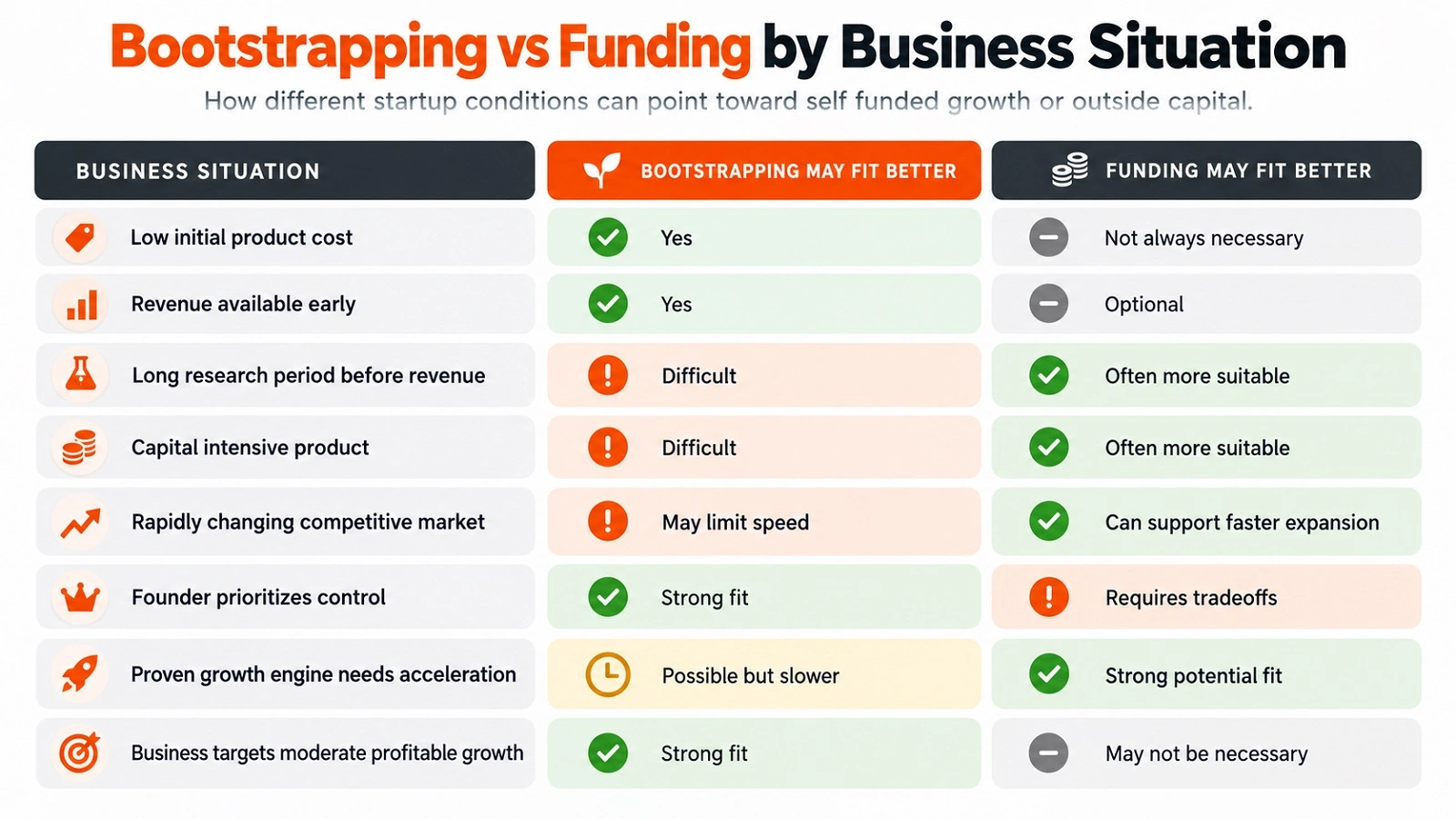
The table should be treated as a decision framework rather than a strict rule. Company context matters more than labels.
Bootstrapping vs Funding by Startup Stage
The right financing choice can also change as the company moves through different stages.
Startup StageBootstrapping ApproachFunding ApproachIdea StageFounder savings and early customer researchFriends and family or small angel checksEarly ValidationCustomer revenue and lean product developmentAngels or accelerator capitalEarly GrowthReinvesting revenueSeed funding to accelerate tractionScalingGrowth financed by stronger cash flowVenture capital for expansionEstablished GrowthInternal cash and profitsLarger equity or debt financing
A startup may bootstrap early and raise later, or raise early and become financially self sustaining afterward.
The important point is that the financing strategy can evolve with the company.
Time Cost of Fundraising
Outside funding does not only cost equity. It also costs founder time.
Fundraising can require weeks or months of meetings, investor outreach, due diligence, negotiations, legal work, and follow up.
During that period, founders may spend less time on product, customers, recruiting, and operations.
For some companies, the capital raised justifies the distraction.
For others, particularly businesses that can continue growing from revenue, repeated fundraising can become an expensive use of management attention.
The time cost should therefore be included when founders compare bootstrapping with external investment.
The Role of Runway
Runway affects both paths.
For a bootstrapped company, runway depends on founder capital and the company’s ability to generate revenue before cash runs out.
For a funded startup, runway is usually determined by the amount raised and the company’s burn rate.
More funding can create more time, but only if spending remains controlled.
A startup that raises a large round and increases expenses immediately may still have limited runway.
Founders should therefore think about capital together with burn rate rather than treating money raised as a standalone measure of financial strength.
Hiring Under Bootstrapping and Funding
The financing model can influence hiring strategy.
Bootstrapped companies often hire more gradually and may prioritize generalists who can handle several responsibilities.
This can keep costs lower and preserve flexibility.
Funded companies may be able to hire experienced specialists earlier. They can build dedicated teams across engineering, sales, marketing, operations, and finance before revenue fully supports those functions.
The advantage is speed and specialization.
The risk is building an organization faster than the business itself is developing.
Hiring should follow the company’s actual needs rather than the amount of money available.
Market Timing and Capital
Market timing can change the answer to the bootstrapping versus funding question.
Some opportunities remain available for years. In those markets, founders may be able to grow gradually without losing much competitive position.
Other markets develop very quickly.
A new technology shift, regulatory change, or consumer behavior can create a short window in which several startups compete to establish leadership.
In those situations, capital may have greater strategic value because moving slowly can cost market position.
Founders should therefore consider not only how much money the business needs but how quickly the opportunity itself is changing.
How Founders Should Make the Decision
The decision should begin with the business rather than founder identity.
Founders should understand how much money the company needs, when revenue is likely to appear, how quickly the market is moving, and whether additional capital would create a meaningful advantage.
They should also think about personal goals.
A founder who wants to maintain long term control may evaluate financing differently from a founder whose primary goal is to build the largest possible company in a rapidly expanding market.
Ownership, risk tolerance, growth ambition, market timing, capital intensity, and customer demand all belong in the same decision.
Signs Bootstrapping May Be Working
Bootstrapping is usually working when the business can continue creating meaningful progress without creating dangerous financial pressure.
Revenue may be increasing, customers may be funding product improvements, and the company may be able to hire gradually without requiring external investment.
The business should also be maintaining enough cash to handle normal uncertainty.
Bootstrapping becomes less effective when the company has a strong opportunity but repeatedly cannot pursue it because resources are too limited.
At that point, avoiding dilution may begin costing more than dilution itself.
Signs It May Be Time to Raise Funding
A startup may need external capital when lack of money becomes the primary constraint on a proven opportunity.
This can happen when customer demand is significantly larger than the company can serve, product development is limited by hiring capacity, competitors are expanding faster, or entering a new market requires resources the business cannot generate internally.
The key word is proven.
Raising capital is more compelling when founders know what additional money will accelerate.
If the company is still unsure what customers want or how the business will grow, more capital may simply allow uncertainty to become more expensive.
Common Bootstrapping Mistakes
One mistake is treating low spending as the main objective.
Financial discipline is useful, but refusing to invest in opportunities with strong expected returns can limit the company unnecessarily.
Another mistake is placing too much personal money at risk. Founders may become emotionally committed to continuing because they have invested significant savings even when the business evidence is weak.
Bootstrapped founders can also wait too long to hire because they want to protect cash.
The goal is efficient capital use, not avoiding every expense.
Common Funding Mistakes
Funded companies can make the opposite errors.
One common mistake is raising capital before understanding how it will be used. Money can create activity without creating progress if the company hires rapidly or spends aggressively before identifying a strong business model.
Another mistake is confusing fundraising with customer validation.
A successful investment round proves that investors were willing to invest. It does not prove that customers will continue buying the product.
Companies can also raise at valuations that create unrealistic expectations for future growth.
Funding should strengthen a business model rather than become the business model.
Is Bootstrapping Cheaper Than Funding?
Bootstrapping does not involve selling equity to investors, which can make it appear cheaper.
However, the economic cost is more complicated.
If a startup could use outside capital to capture a large opportunity but chooses to grow slowly instead, the opportunity cost of bootstrapping could be substantial.
Funding also has a cost. Equity given to investors may become extremely valuable if the company succeeds.
The correct comparison is therefore not simply how much cash each approach costs today.
Founders should compare the future value created by the capital with the ownership, control, financial, and strategic costs required to obtain it.
Can Founders Combine Bootstrapping and Funding?
Yes. Many companies use both approaches at different stages.
A startup can bootstrap its early product, use customer revenue to validate demand, and raise external capital only after it has identified a strong growth opportunity.
This can reduce early dilution while still allowing the business to accelerate later.
Another company may raise a small angel round, become profitable, and then avoid additional fundraising.
The financing strategy does not need to remain fixed for the life of the company.
The best path can change as uncertainty decreases, customer demand becomes clearer, and the economics of growth improve.
The Real Difference Between Bootstrapping and Funding
The real difference is not simply where the money comes from.
Bootstrapping asks the company to grow primarily within the financial resources founders and customers can provide. This tends to prioritize ownership, cash flow, financial discipline, and controlled growth.
Outside funding gives the company access to additional resources before the business could generate that money on its own. In exchange, founders accept dilution, investor expectations, and potentially shared governance.
Neither model guarantees success.
The better path is the one that matches the startup’s capital needs, market opportunity, economics, founder goals, and ability to turn additional resources into meaningful value.
FAQ
What is the difference between bootstrapping and funding?
Bootstrapping relies mainly on founder resources and customer revenue, while external funding brings capital from investors in exchange for equity or other financial rights.
Is bootstrapping better than raising funding?
Not universally. Bootstrapping can preserve ownership and control, while outside funding can accelerate growth when the company has a capital intensive or time sensitive opportunity.
Does bootstrapping mean founders cannot raise money later?
No. A bootstrapped company can raise external capital later, and strong customer traction may improve its fundraising position.
Why do founders choose venture capital instead of bootstrapping?
Founders may choose venture capital when significant capital can accelerate product development, hiring, customer acquisition, or market expansion.
What is the biggest disadvantage of bootstrapping?
The main limitation is access to capital. A company may grow more slowly or miss opportunities that require resources before enough customer revenue exists.
What is the biggest disadvantage of outside funding?
Outside investment usually reduces founder ownership and may introduce investor expectations, governance rights, and pressure for faster growth.
Can a startup use customer revenue instead of investor funding?
Yes. Companies that can generate revenue early may use customer payments to fund continued development and expansion.
When should a bootstrapped startup consider raising money?
Raising outside capital becomes more compelling when the company has proven demand and lack of capital has become the main constraint preventing it from pursuing a larger opportunity.

Mobina Khanki
Venture & Funding Writer at PinerookMobina Khanki covers venture capital, startup funding, fundraising, and startup finance for Pinerook, focusing on founders and investors.
 Seen first.