For years, startup fundraising followed a familiar pattern: prove enough potential to raise, use the round to hire aggressively, and come back to the market after the larger team created the next stage of growth. AI is weakening that default. A small company can now produce more research, code, content, support, analysis, and operational throughput without increasing headcount at the same rate.
For an AI native startup, that changes what a credible fundraising plan looks like. If software can absorb some of the work that capital once bought through payroll, founders need a sharper explanation for why outside money is required and what capability it will unlock.
That does not mean every AI company should bootstrap or raise less. Some AI businesses are among the most capital intensive companies being built today. Training models, securing compute, acquiring proprietary data, deploying hardware, meeting regulatory requirements, or winning enterprise distribution can require enormous investment. The point is more specific: capital should follow the constraint, not the fashion.
Key Takeaways
AI can reduce the cost of early execution, but it raises the standard for explaining what new capital will actually unlock.
Headline AI funding numbers are heavily distorted by a small number of frontier model and infrastructure companies; they are not a useful fundraising benchmark for most founders.
A strong raise connects money to a specific proof point: stronger demand, better economics, a defensible technical milestone, regulatory clearance, or a repeatable growth engine.
Capital efficiency is not the same as spending as little as possible. It means converting cash into durable evidence and capability faster than the company increases risk.
AI Funding Is Booming, but the Market Is More Selective Than the Headlines
The AI funding market can look almost unlimited from the outside. Record rounds and extraordinary private valuations dominate the news. But the headline total is a poor guide for a typical early stage founder because the market is unusually concentrated.
According to Crunchbase data on the first half of 2026, OpenAI and Anthropic alone accounted for 43% of global startup funding during that period. The important signal is not simply that “AI gets funded.” It is that investors are willing to place extremely large bets on a narrow group of companies with unusual technical ambition, strategic position, or market power.
For an application layer startup raising a seed round, the useful question is therefore not “How much are AI companies raising?” It is “What evidence does a company like ours need before capital becomes easier to justify?” Those are very different questions.
AI Changes the Capital Equation, Not the Need for Capital
AI startups do not share one financing model. A five person workflow software company and a frontier model lab can both be called AI startups while having completely different cost structures. Treating them as one category leads to bad fundraising decisions.
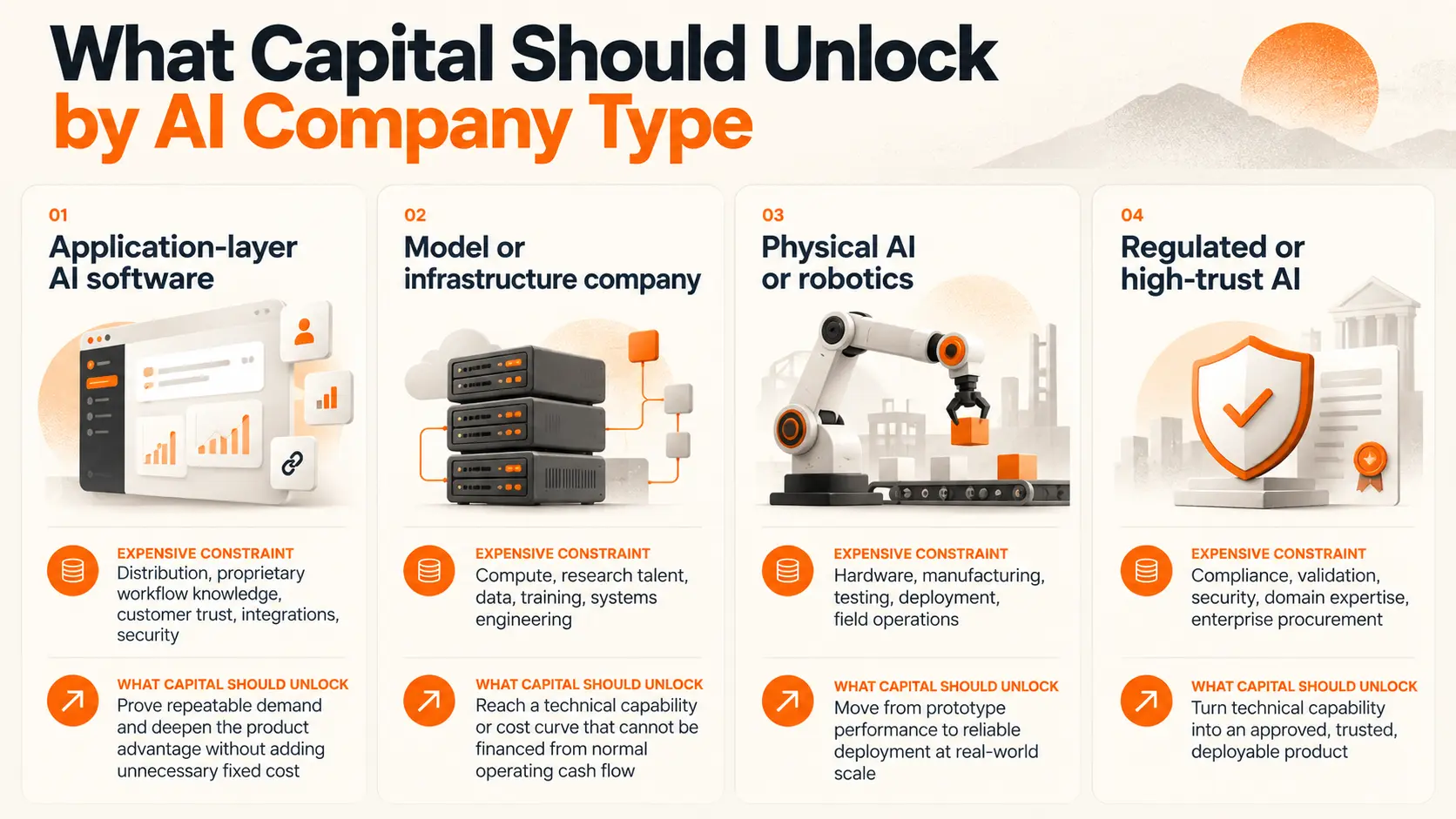
The implication is simple: “AI startup” is not a use of funds plan. Founders need to identify the expensive constraint that remains after AI has made other forms of execution cheaper.
Fundraising Is a Constraint Decision, Not a Milestone
A funding round can create momentum, but it can also hide uncertainty. The cleanest way to decide whether to raise is to identify the constraint that capital will remove and the evidence that should exist after the round.
If the current problem is that the team has not found a customer who urgently wants the product, more capital may simply finance a longer search. If demand is clear but the company cannot serve it because of compute, security, regulatory work, deployment capacity, or a repeatable go to market bottleneck, funding has a much clearer job.
A useful founder test is to finish this sentence before opening a deck: “If we invest this capital well, the company will be meaningfully de risked because we will have proven.” The blank should contain a business or technical proof point, not an activity such as hiring ten people or shipping more features.
The AI Fundraising Readiness Test
Before starting a process, founders should be able to answer five questions without relying on vague optimism:
1. The bottleneck is real. What is the company unable to do today because it lacks capital rather than clarity?
2. The next proof point is specific. What will become demonstrably true if the round works?
3. The economics are understandable. What happens to gross margin, model cost, support cost, and acquisition efficiency as usage grows?
4. The company has a reason to win. What compounds beyond access to the same models and APIs available to competitors?
5. The round does not require a perfect next round. Can the plan create a stronger financing position rather than merely extending the current one?
A “no” on one question does not automatically mean the company should not raise. It means that question will eventually appear in investor diligence, and the founder should know whether the gap can be closed before the process starts.
Capital Efficiency Is Now Part of the Product Story
Capital efficiency used to be treated mostly as a finance discipline: burn less, extend runway, avoid waste. For AI native teams, it increasingly reflects the operating model itself. The same product can sometimes be built, supported, and sold with fewer people because software absorbs more of the execution layer.
Pilot’s 2026 analysis of 2,500 customers found that AI adoption was associated with a much stronger efficiency difference at the earliest revenue stages than later on. The sample is not the whole startup market, but the direction is useful: AI is changing the startup efficiency curve, especially before a company has accumulated a large fixed cost base.
That changes the investor conversation. A founder who claims that AI makes the company more efficient should be able to show where the leverage appears. Useful evidence can include:
Gross margin and cost to serve: Does the product become economically stronger as usage grows, or does model and human review cost scale almost linearly with revenue?
Retention and engagement: Are customers staying because the product solves an important workflow, or are they experimenting with a novelty?
Burn and runway: Is spending buying durable growth and proof, or only more activity?
Revenue or qualified output per employee: Is a leaner team actually producing more business value, while quality and customer outcomes remain healthy?
Model dependence: What happens to margin, reliability, and product differentiation if a model provider changes price, policy, or capability?
There is no single “AI startup metric” that replaces judgment. Even fundraising guidance for AI companies from Pilot emphasizes that gross margin, retention, and engagement need to be understood together rather than as isolated numbers.
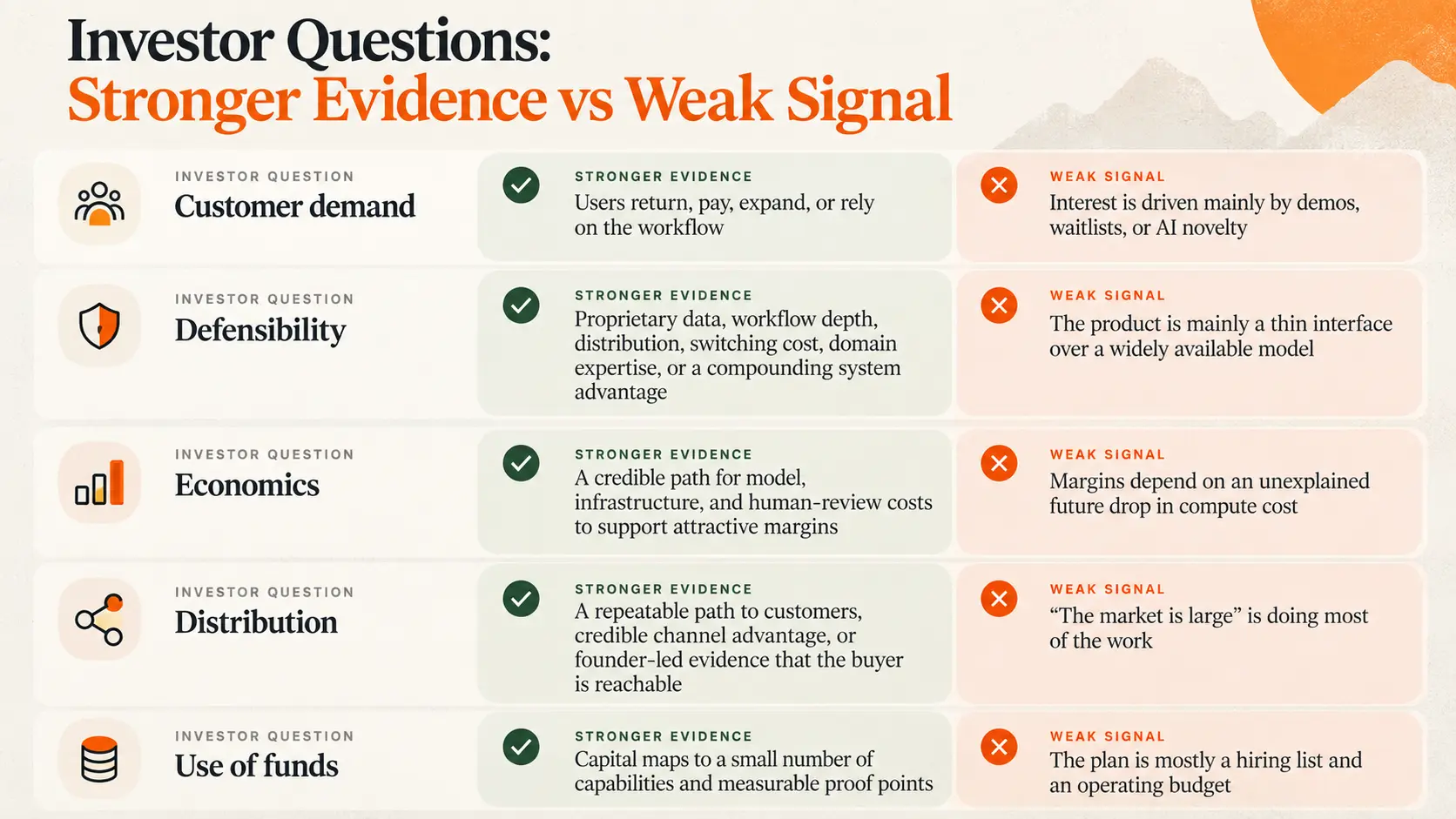
What Investors Need to Believe Before the Round Makes Sense
The strongest fundraising story is not “AI is a huge market.” Investors already know that. The story is why this company can convert a large technological shift into durable business value.
How Much Should an AI Startup Raise?
The useful answer is not a market average. It is enough capital to reach the next financing quality proof point with a realistic operating buffer.
Start from the milestone and work backward. If the next important proof is repeatable enterprise demand, model the cost of product reliability, security, integrations, sales cycles, and customer success required to get there. If the proof is technical, model the research, data, compute, testing, and talent required to reach the threshold investors or customers will care about.
Then pressure test the plan. What happens if revenue arrives slower? What if inference costs stay higher? What if enterprise procurement takes twice as long? What if the next round is delayed? The raise should be sized around the actual uncertainty of the plan, not around what a comparable company announced on social media.
Raising more can be rational when the opportunity is time sensitive or capital itself creates a strategic advantage. It can also make a company less disciplined if there is no clear way to convert the additional cash into stronger evidence. The amount is only useful in relation to what it enables.
When Raising Capital Is the Right Move
Fundraising becomes easier to justify when capital accelerates something the company already understands.
Demand exists but capacity is constrained. Customers want the product, and the bottleneck is now delivery, reliability, implementation, or distribution.
The technical milestone is expensive but meaningful. Compute, data, research, hardware, or specialized talent is required to prove a capability that materially changes the business.
Trust is the bottleneck. Security, compliance, audits, certifications, or enterprise grade infrastructure are necessary to unlock real buyers.
The market window is genuinely time sensitive. Speed matters because distribution, data, partnerships, or installed base can compound.
The company knows what a dollar of growth capital does. The use of funds is connected to repeatable acquisition, expansion, or a clearly measurable operating constraint.
When Waiting Can Be the Better Fundraising Strategy
Not raising can be an active strategic decision, especially for application layer AI startups whose cost of building has fallen faster than the cost of finding a real market.
The buyer is still unclear. Capital cannot substitute for learning who has the problem, who owns the budget, and why the problem matters now.
Usage is high but commitment is weak. AI products can generate experimentation quickly; retention and willingness to pay reveal whether that attention is durable.
The moat is mostly model access. If the company cannot explain what compounds beyond a third party model, more funding may scale a fragile position.
The plan is primarily to hire ahead of evidence. A larger team can increase burn faster than it increases learning.
The round is being used to avoid a hard operating decision. Fundraising does not fix unclear positioning, weak pricing, poor retention, or a product that has not earned urgency.
Waiting is useful only if the company uses the time to become more fundable: stronger customer evidence, better economics, deeper product integration, clearer distribution, or a more defensible technical advantage. Delay without learning is just delay.
Build the Fundraising Narrative Around Evidence, Not AI Vocabulary
A founder should be able to tell the company story without relying on the words “AI,” “agent,” or “automation” as the main source of excitement. Those terms describe the technology layer. Investors still need to understand the business underneath it.
A disciplined narrative usually moves in this order:
1. The customer problem: What expensive, frequent, or painful outcome is not being solved well enough?
2. The product wedge: Why does this product solve that problem in a way customers can adopt now?
3. The evidence: What has usage, retention, revenue, expansion, or customer behavior already proven?
4. The advantage: What becomes stronger with every customer, workflow, dataset, integration, or distribution relationship?
5. The economics: How does the company make money, what drives cost, and why should the model improve with scale?
6. The use of funds: Which constraint will the round remove?
7. The next proof point: What should investors be able to see at the end of the runway that they cannot see today?
This structure also protects founders from a common problem in hot markets: raising on a category story that is stronger than the company story. Category momentum can open the first meeting. It rarely carries the full diligence process.
Common AI Startup Fundraising Mistakes
Leading with the model instead of the customer. The model can change. The business needs a reason customers will continue to care.
Treating a large AI market as proof of demand. A large category does not prove that a specific buyer will pay for this product.
Assuming software economics without modeling AI costs. Inference, data, human review, support, and reliability can materially change gross margin.
Ignoring platform dependence. If one external model provider controls cost, capability, or access, investors will want to know the fallback and the strategic risk.
Using headcount as the main use of funds. A hiring plan is stronger when each role maps to a validated capability gap.
Optimizing only for valuation. A high price can feel like success, but a round is useful only if the company can grow into the expectations attached to it.
Starting the process when cash is already the emergency. Fundraising is easier when the company has momentum and choices, not when every conversation is tied to survival.
Capital Efficiency Is Not the Same as Underinvestment
The rise of lean AI teams can create a new mistake: treating every dollar of spend as a failure of efficiency. That is not the point.
A startup can be lean and still underinvest in the thing that matters most. A team may avoid hiring the enterprise seller who could turn founder led sales into a repeatable motion. It may postpone security work that blocks large contracts. It may use the cheapest model even when reliability is damaging retention. It may preserve runway while losing the market window.
Capital efficiency should answer a more useful question: is the company converting cash into durable progress faster than it is increasing fragility? Sometimes the efficient decision is to spend aggressively because the return is clear. Sometimes it is to wait because the company has not yet earned the right to scale the expense.
Raise for an Inflection Point, Not for the Appearance of Momentum
AI is changing the economics of building a startup, but it has not changed the purpose of fundraising. External capital is still a tool for crossing a gap that the company cannot cross efficiently with its current resources.
The difference is that founders now have more ways to create output before adding fixed cost. That raises the bar for the fundraising story. A credible AI startup should know which parts of execution have become cheap, which constraints remain genuinely expensive, and why this particular round is the right instrument for removing them.
The strongest capital plan is not the one that produces the biggest team or the longest list of initiatives. It is the one that leaves the company with more evidence, stronger economics, deeper defensibility, and a better set of choices when the money has done its job.
FAQ
What do investors look for in AI startups?
Investors typically look for real customer demand, defensibility beyond model access, credible unit economics, a reachable market, and a clear explanation of what new capital will unlock.
How is AI startup fundraising different from traditional SaaS fundraising?
AI startups often face more scrutiny around model costs, gross margin, data, reliability, platform dependence, and defensibility. At the same time, lean AI teams may be expected to show more progress before adding headcount.
Should AI startups raise less money because AI makes teams more efficient?
Not automatically. Application layer companies may need less capital for early execution, while model, infrastructure, robotics, and regulated AI companies can remain highly capital intensive.
Which metrics matter most when raising for an AI startup?
The right metrics depend on stage, but gross margin, retention, engagement, revenue quality, burn, runway, and cost to serve often reveal whether growth is becoming more durable.
How much should an AI startup raise?
Raise enough to reach the next meaningful proof point with a realistic buffer. The right amount should come from the company’s milestone plan and risk profile, not from a market average.
When should an AI startup delay fundraising?
Delay can make sense when the buyer, retention, pricing, unit economics, or defensibility is still unclear and additional capital would mainly finance more experimentation rather than accelerate proven demand.
Does relying on third party AI models hurt fundraising?
Not necessarily. The important question is whether the company creates durable value beyond model access and has a plan for cost, reliability, provider changes, and strategic dependence.

Mohsen Avid
Founder & Editor, PinerookMohsen Avid is the founder of Pinerook, covering entrepreneurship, startup strategy, digital business, and the decisions behind building new ventures.
 Seen first.