An AI startup is a company where artificial intelligence is part of the product’s core value, not a feature added for marketing. If removing the AI would break the main customer outcome, you are looking at an AI centered business.
That distinction matters more now because access to powerful models is no longer rare. A founder can build on existing AI infrastructure without training a model from scratch. The harder part is turning that access into a product customers need, pay for and keep using.
AI at the Core
When I look at an AI startup, I start with one question: where does the customer value come from?
If artificial intelligence only adds an optional feature to an existing product, the company is using AI without making it the core of the business.
If the product exists because AI can analyze sales conversations, identify opportunities and turn that information into actions the team could not handle at the same scale manually, AI sits much closer to the core.
That is the distinction founders need to understand.
TechCrunch has made a similar distinction around AI native companies, arguing that connecting a user interface to an AI API does not make a business AI native when algorithms and data are not central to the value being delivered.
For me, the useful definition is straightforward:
An AI startup uses AI as a core part of how its product creates a meaningful customer outcome.
The technology matters, but the outcome matters more.
AI Native and AI Enabled Companies
AI native and AI enabled companies can use the same underlying models and still be very different businesses.
An existing software company that adds AI summarization is AI enabled. The original product still works without that feature.
An AI native startup is designed around capabilities that AI makes possible from the beginning. Remove the AI and the central product experience disappears.
This distinction becomes useful when evaluating startup ideas because adding AI to software is easy. Building a company whose product becomes meaningfully better because of AI requires deeper product thinking.
The customer should not need to care which model sits underneath the interface. They should notice that the product saves time, improves a decision, completes work or creates an outcome that was previously expensive or difficult.
Three AI Startup Models
I find it easier to understand the market when AI startups are separated by what they actually build.
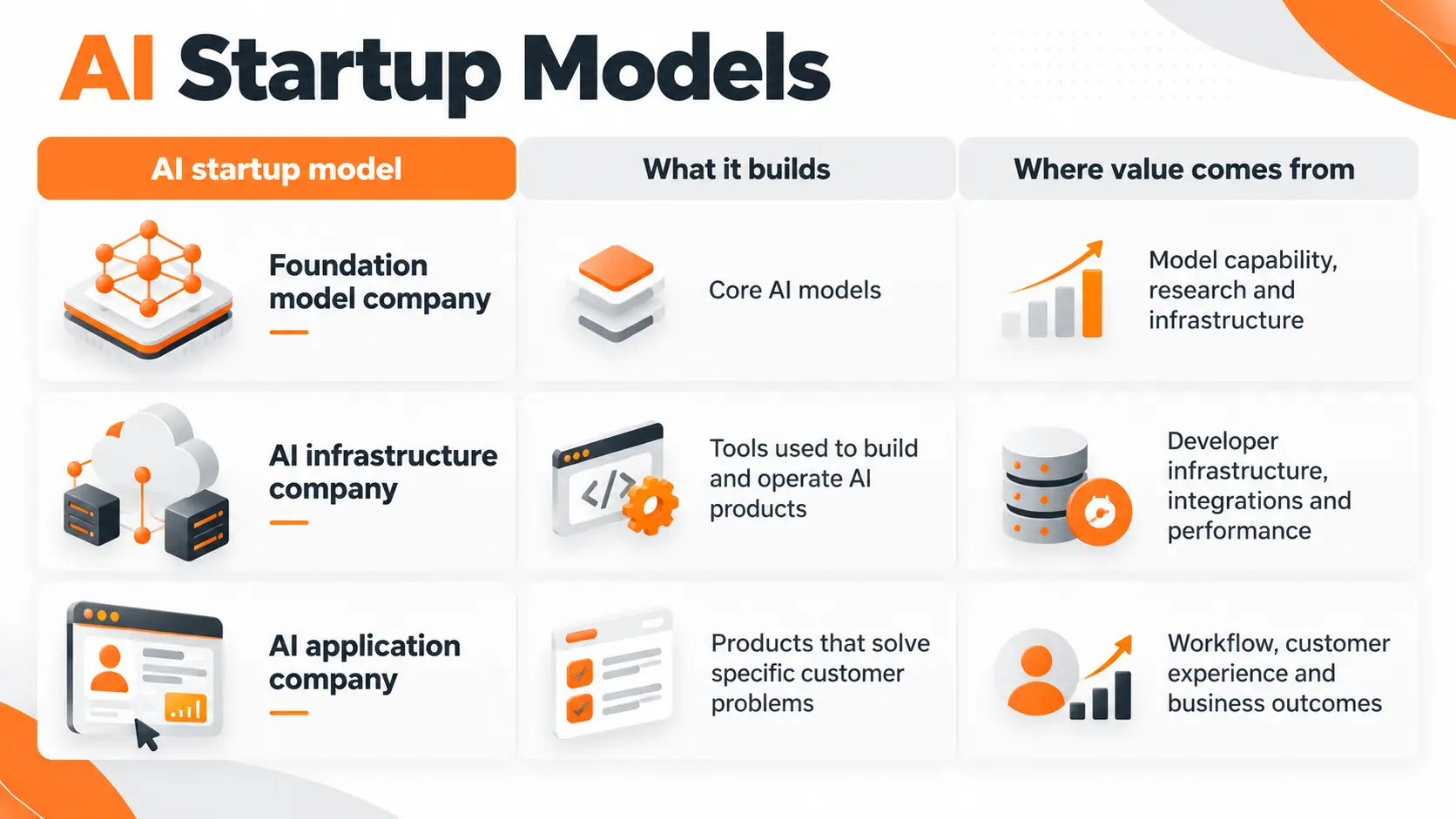
This framework is also used by Startups.com to distinguish foundation model labs, AI infrastructure businesses and application companies. The economics and competitive advantages differ significantly across those layers.
Most founders do not need to compete at the foundation model layer.
Building an application on top of existing models gives a startup access to strong AI capabilities without taking on the cost of developing a frontier model.
That lowers the technical barrier to launching an AI product, but it also lowers the barrier for competitors.
This is why the startup still needs something valuable beyond access to a model.
Value Before Technology
One of the clearest ways I separate a promising AI business from an AI demo is by looking at how the founder describes it.
If the pitch starts with the model, the technology is leading the business.
If the pitch starts with the customer problem and explains why AI creates a better outcome, the company is thinking like a product business.
Customers do not buy a language model.
A legal team buys faster document review.
A sales team buys more productive selling time.
A support operation buys faster resolution.
A developer buys a faster way to move from an idea to working software.
Foundra makes the same point in its current AI startup guidance: differentiation comes from the problem being solved, while customers pay for outcomes rather than AI itself.
That sounds obvious, but it changes how a founder chooses what to build.
Instead of asking, “What can this model do?” I would ask, “Which expensive or frustrating customer process becomes fundamentally better because this model exists?”
That question leads toward a business.
Building on Existing Models
An AI startup does not need to own the model underneath its product.
Many application companies build on foundation models provided by companies such as OpenAI, Anthropic and others. Andreessen Horowitz notes that foundation model usage introduces variable costs into AI software because model usage creates an ongoing cost for the company serving the customer.
Using an existing model lets a startup focus resources on the product layer.
That includes:
Customer workflow
User experience
Industry knowledge
Integrations
Data
Distribution
Reliability
I would only treat building a proprietary model as necessary when the model itself creates a meaningful advantage that existing models cannot provide at the required quality, cost, privacy or level of control.
Training a model because it sounds more defensible is not a product strategy.
AI Startup Economics
AI software introduces a cost structure founders need to understand early.
With conventional software, serving one additional user can have a very small marginal software cost.
AI products can be different. Model calls, tokens, image generation, reasoning workloads and agent activity create usage based costs.
That means a startup cannot look only at revenue per user.
It also needs to understand:
Model cost per task
Customer usage
Gross margin
Infrastructure spend
Pricing
The relationship becomes more important as the product performs more work for the customer.
A16z has highlighted this difference in AI software economics, noting that foundation model usage creates variable costs that scale with product usage and has pushed AI companies toward new pricing approaches, including usage and outcome based structures.
This is one reason I would not copy a standard SaaS pricing model without first understanding how much each customer costs to serve.
The product can grow quickly and still become a weak business if usage grows faster than healthy margins.
Defensibility Beyond the Model
Model access is not a durable advantage when competitors can access the same technology.
This is where the AI wrapper discussion becomes useful.
A thin product can still become a good business, but the competitive advantage has to develop somewhere else.
The strongest places I look for are:
Workflow ownership
A product becomes embedded in how a customer completes important work.
Proprietary data
The company has access to useful data competitors cannot easily reproduce.
Domain knowledge
The product understands a specific industry better than a general AI interface.
Distribution
The startup has a repeatable way to reach customers.
Integrations
The product connects deeply with the systems a customer already depends on.
Trust
Customers rely on the product because its output is consistent and the company understands the consequences of getting the work wrong.
Startups.com identifies workflow integration, unique data, distribution, domain expertise and trust as important sources of defensibility for AI applications rather than raw model access alone. Startups
The model can change.
A strong customer position survives that change.
Leaner Startup Teams
AI is also changing what a small startup team can produce.
A founder can research a market, turn interviews into structured notes, prototype interfaces, draft product copy and work through early technical ideas faster than before.
Developers can move through repetitive coding tasks more quickly. Marketing teams can explore more creative directions. Support teams can process more information without adding the same amount of manual work.
The important part is not replacing every role with AI.
It is increasing the amount of useful work a small team can complete before increasing headcount.
That changes the early economics of building a startup.
A five person team with strong product judgment and well designed AI workflows can operate differently from a five person software team that treats AI as an occasional assistant.
The advantage still comes from the team deciding what deserves to be built.
AI increases leverage. It does not create product judgment.
The Real AI Startup Advantage
The strongest AI startups are not defined by having access to the smartest model.
They are defined by what they build around that capability.
A useful product solves a real problem. A strong business captures enough value to support healthy economics. A defensible company creates reasons customers stay even when better models become available.
That is the part of AI startups I find most important.
Models will continue changing. Costs will change. Capabilities will expand.
A company built around a real workflow, customer relationship and measurable outcome has something more durable than access to an API.
FAQ
Can I start an AI startup if I am not technical?
Yes. A nontechnical founder can validate the customer problem, define the product and build early versions with technical partners or existing development platforms. A technical cofounder becomes important when the product requires deep engineering, custom infrastructure or proprietary model development.
Do I have to tell customers which AI model my startup uses?
There is no general requirement to promote the underlying model as part of the product. Disclosure requirements depend on the product, contract, industry and jurisdiction. Enterprise customers can also request information about model providers, data processing and security during procurement.
Can one AI startup use models from several providers?
Yes. A product can route different tasks to different models based on performance, cost, latency or other requirements. The architecture must be designed so provider changes do not create inconsistent product behavior.
Should an AI startup patent its technology?
A patent can protect specific inventions that meet legal requirements, but patents are only one form of intellectual property protection. Founders should evaluate patents alongside trade secrets, copyright, contracts and data rights with qualified legal counsel.
Can an AI startup bootstrap instead of raising venture capital?
Yes. Funding needs depend on what the company is building. An application business using existing models can operate with a far lighter capital structure than a company training large foundation models or building compute infrastructure.

Fatemeh Jahangard
Technology & AI Writer at PinerookFatemeh Jahangard covers AI, emerging technologies, and digital innovation for Pinerook, focusing on how technology shapes startups and industries.
 Seen first.