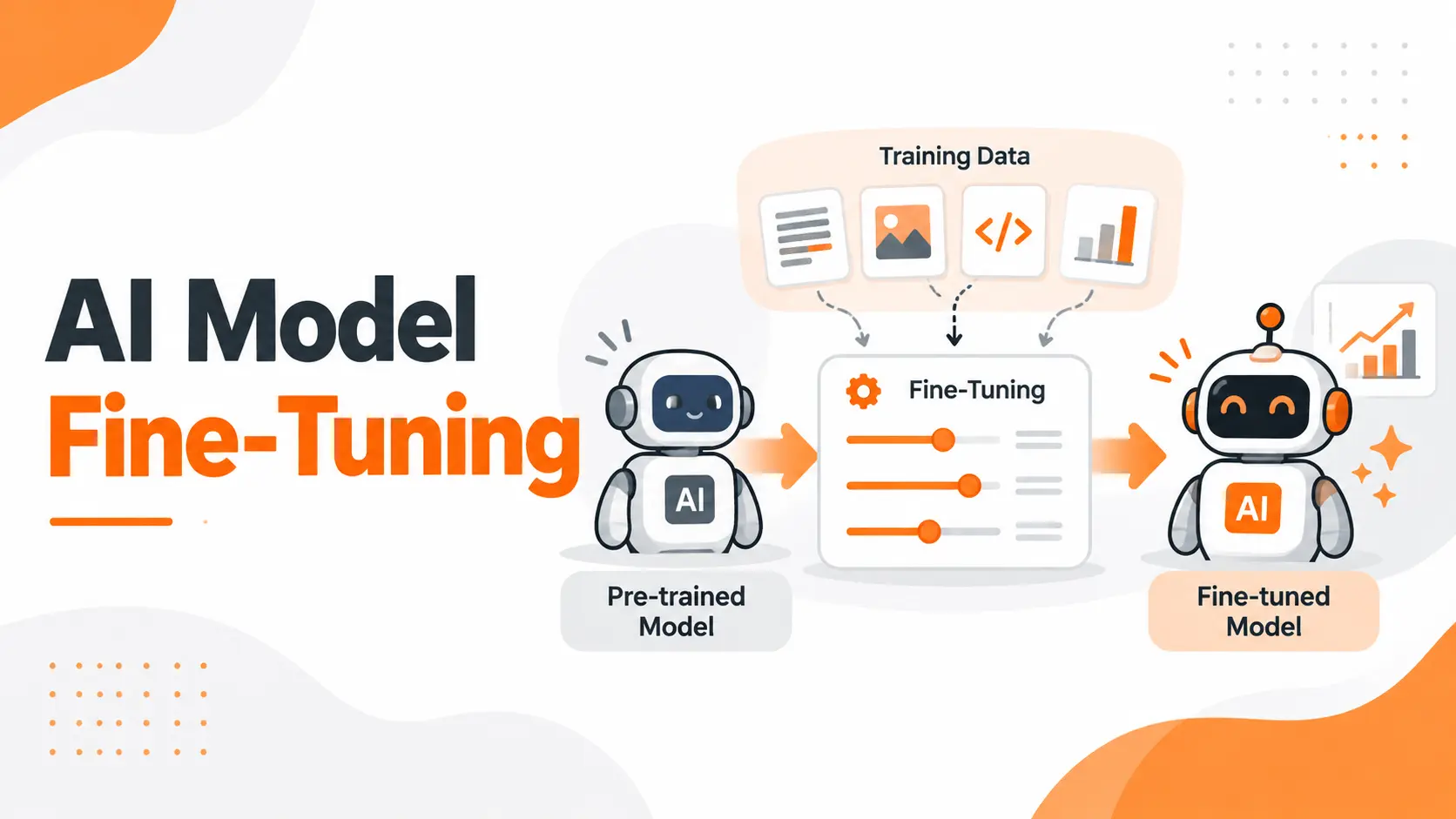
AI model fine-tuning is the process of adapting a pretrained artificial intelligence model to perform a specific task more accurately. Instead of training a model from scratch, developers use targeted examples to adjust its existing capabilities. The result can be a model that follows specialized instructions, classifies industry-specific information, or produces more consistent outputs.
The key is knowing when additional training delivers a real improvement. Fine-tuning requires suitable data, a clear training objective, and evaluation against the original model. Without those elements, a customized model can become more expensive without performing better.
How AI Model Fine-Tuning Works
A pretrained model has already learned patterns from a large collection of data. Fine-tuning continues its training on examples related to a narrower objective, updating either the original parameters or a smaller set of trainable parameters.
During training, the model processes an input, generates an output, and receives feedback through a training objective. The optimization process adjusts trainable parameters to reduce the difference between the model's output and the expected result.
Consider a customer support system that needs to classify incoming messages. A general-purpose model understands requests about subscriptions, refunds, and technical issues, but it may not follow the company's internal classification rules.
Fine-tuning allows the model to learn those rules from representative examples.
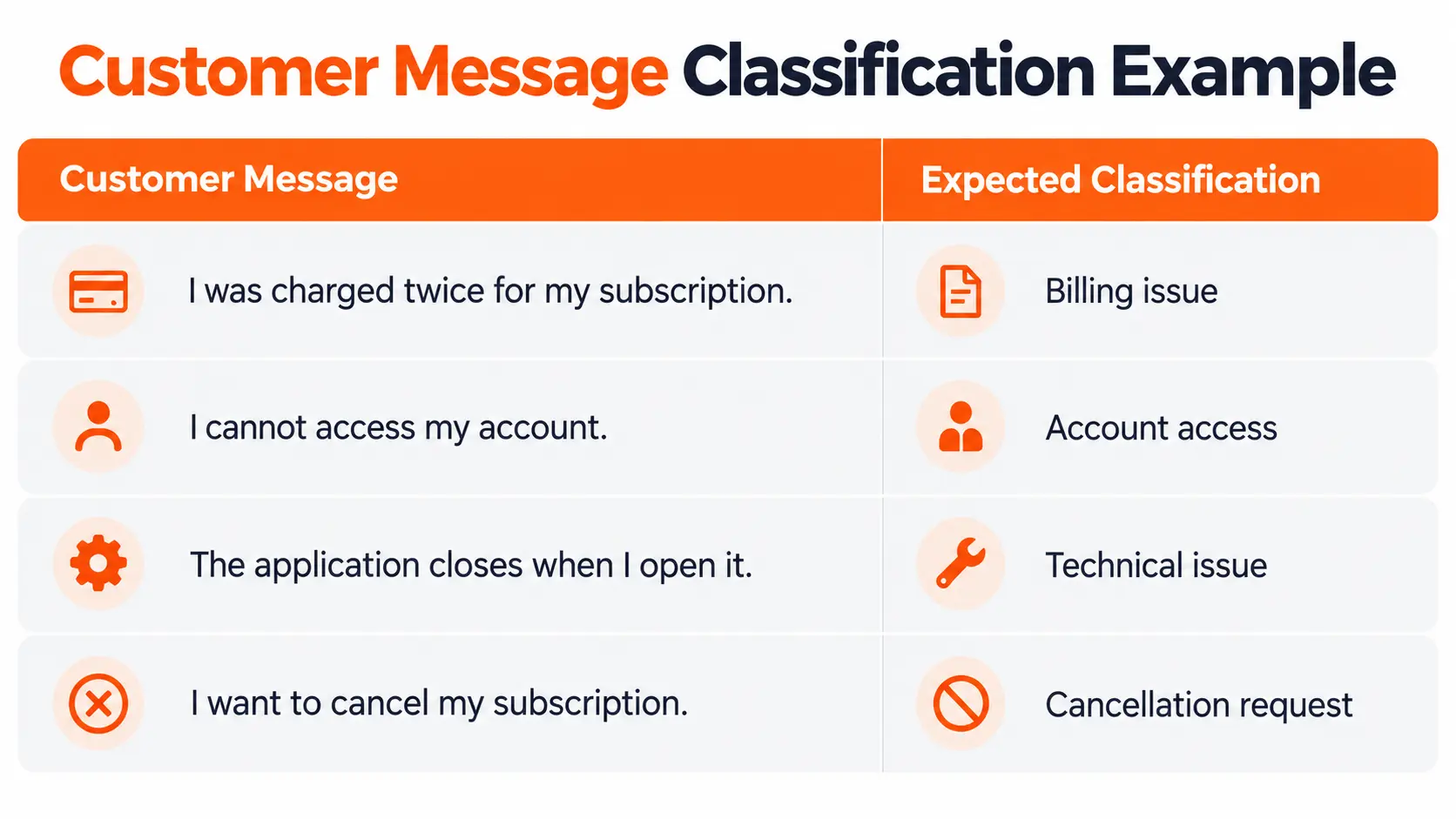
This table illustrates the relationship between training inputs and expected outputs. During fine-tuning, the model learns patterns from these examples and is then evaluated on new messages it has not seen before.
The objective is not to memorize the examples. It is to apply the learned classification rules to future requests.
When to Use AI Model Fine-Tuning
Fine-tuning is appropriate when a model repeatedly fails to produce the required behavior despite receiving clear instructions and relevant context.
In a real development project, I would first test the original model against the intended task. This establishes whether additional training is necessary and creates a baseline for measuring improvement.
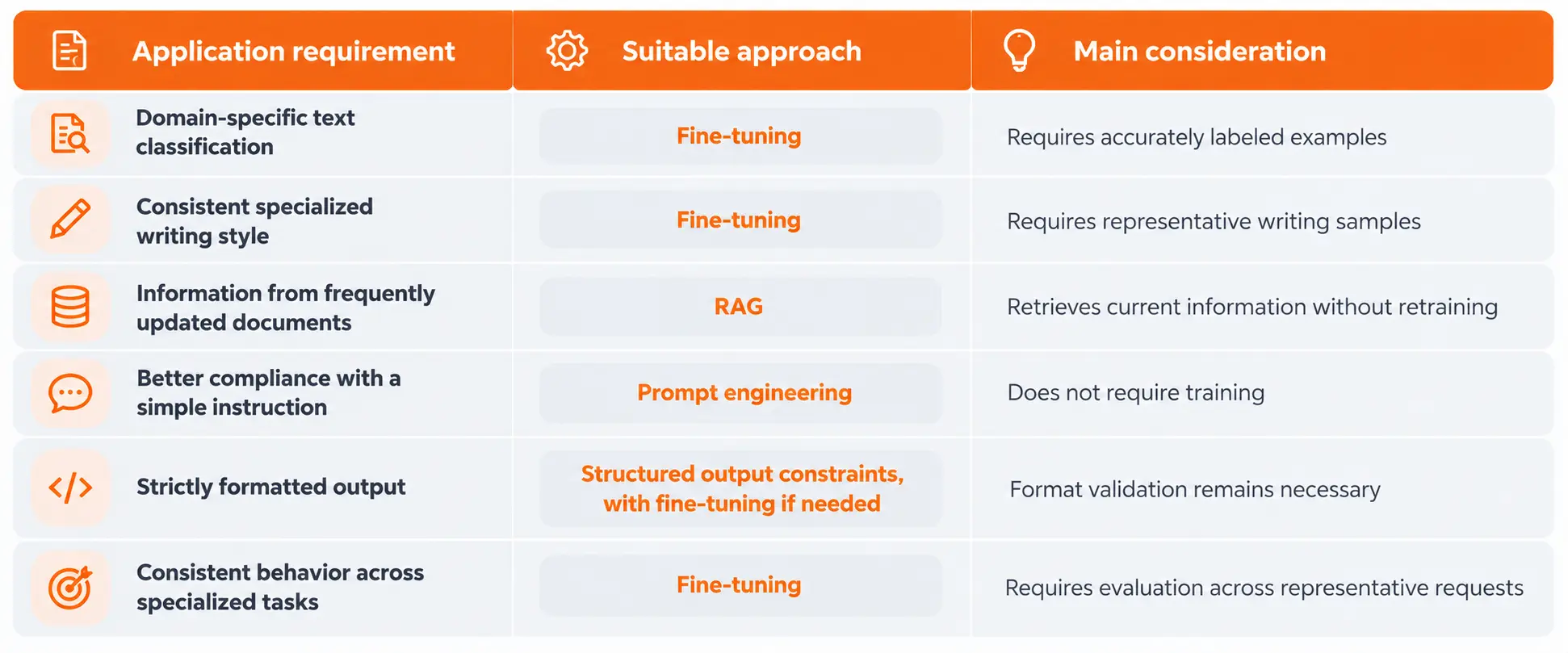
Fine-tuning should not be treated as a replacement for a knowledge retrieval system.
For example, a model that needs access to updated product prices benefits from retrieval or another current data source. Training it repeatedly to memorize those prices would introduce unnecessary maintenance.
By contrast, a model that needs to classify thousands of industry-specific documents according to fixed internal categories can benefit from learning that behavior directly.
AI Model Fine-Tuning Process
The training process consists of several connected stages. Each stage needs a defined output before the next begins.
Define the Training Objective
Start by identifying the behavior the original model cannot perform to the required standard.
The objective must be measurable. A document classification model, for instance, may need to assign every document to one of six approved categories and achieve a defined accuracy threshold on unseen examples.
This makes it possible to compare the original model with the customized version.
Select the Base Model
Choose a pretrained model with capabilities suited to the target task.
Model size, context length, licensing, supported training methods, deployment requirements, and hardware availability all influence the decision.
A smaller model that already performs well on the task can be more efficient to customize than a significantly larger alternative.
The model must also support the intended fine-tuning method. Access to a model for inference does not automatically mean its weights or training interface are available for customization.
Prepare the Training Data
The quality of training examples directly affects the result.
A suitable Fine-Tuning Dataset contains representative inputs, reliable target outputs, and enough variation to cover the situations the model will encounter after deployment.
For a customer support classifier, this includes straightforward requests as well as messages containing multiple issues or ambiguous wording.
Training, validation, and test examples should be separated. This prevents the final evaluation from relying on data the model has already learned or that developers used to select training settings.
Data preparation also includes removing duplicates where appropriate, correcting labeling inconsistencies, checking usage permissions, and excluding sensitive information that should not enter the training process.
Choose the Training Method
The training method determines which parameters are updated and how the model learns from the data.
Supervised Fine-Tuning (SFT) uses examples with defined target outputs. The model is trained to produce responses that better match those examples.
This is suitable for classification, structured extraction, and task-specific response generation.
The learning objective is separate from the parameter-update technique. Supervised training can use full-parameter updates or a parameter-efficient method such as LoRA.
Configure the Training Run
Training settings determine how the optimization process updates the model.
The learning rate controls the size of parameter updates, batch size determines how many examples contribute to an optimization step, and the number of epochs determines how many passes are made through the training data.
These Fine-Tuning Hyperparameters must be selected using validation results rather than relying on training loss alone.
A model can continue improving on its training examples while performing worse on unseen inputs. Monitoring validation performance helps identify this divergence.
Evaluate and Deploy the Model
After training, compare the customized model with the original version using the same held-out evaluation data.
Measure the qualities that matter to the application, including task accuracy, output consistency, latency, and operating cost.
Deployment should follow acceptance testing. Keeping the previous model version available makes rollback possible if the new version introduces unexpected regressions.
AI Model Fine-Tuning Methods
Fine-tuning approaches differ in their memory requirements, trainable parameters, and optimization objectives.
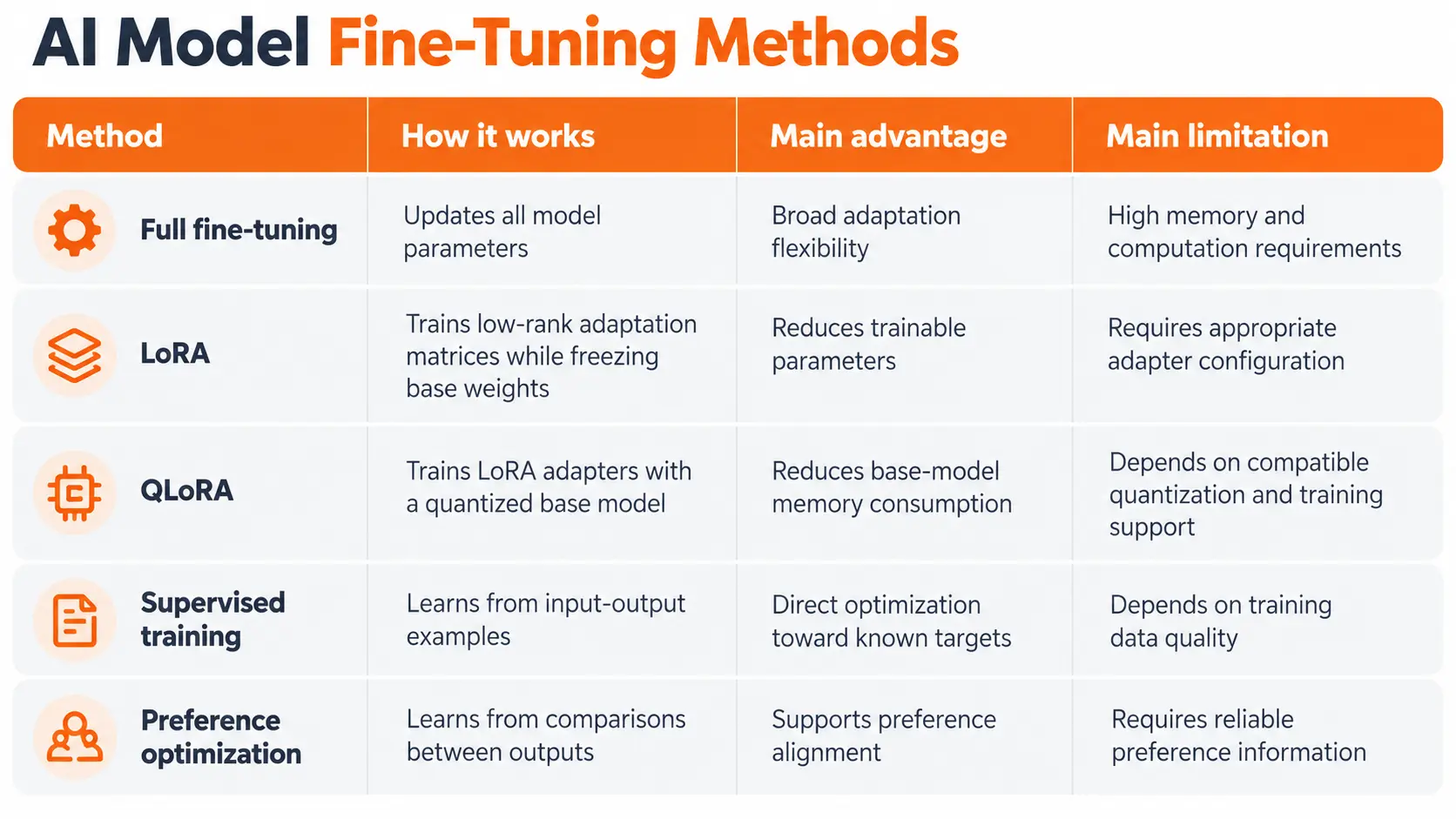
Full fine-tuning updates the original model parameters. It offers extensive control but can require substantial computational resources for large models.
LoRA reduces the number of parameters that need to be trained by introducing smaller trainable matrices while keeping the original model weights frozen.
For memory-constrained environments, QLoRA Fine-Tuning combines low-rank adaptation with a quantized base model. This reduces the memory required to hold the base model during training.
Quantization and parameter-efficient adaptation reduce infrastructure requirements, but they do not guarantee identical results across tasks. Model architecture, data quality, and configuration remain important.
Fine-Tuning vs RAG vs Prompt Engineering
Fine-tuning, Retrieval Augmented Generation (RAG), and prompt engineering address different limitations in AI applications. The distinction comes down to whether a system needs to change how a model behaves, access information outside its training data, or communicate a task more clearly.
Prompt engineering is the most direct starting point. It changes the instructions and examples supplied to a model without modifying its parameters. If a language model already understands a task but produces inconsistent responses because the instructions are unclear, improving the prompt can resolve the problem without additional training or infrastructure.
RAG serves a different purpose. It retrieves information from documents, databases, or other connected sources and supplies that information to the model when generating a response. This makes it suitable for applications that depend on current information, such as internal company policies, product documentation, and frequently updated knowledge bases. The model itself does not need retraining whenever the source information changes.
Fine-tuning becomes relevant when the model needs to learn specialized behavior that prompting alone cannot deliver to the required standard. It adjusts trainable parameters using examples that demonstrate the target behavior. In a customer support application, for instance, fine-tuning can improve classification according to internal business categories, while RAG provides the latest policies needed to answer the customer's question.
I would begin by testing the original model with well-defined prompts and representative inputs. If the problem is missing information, retrieval is the appropriate solution. If the model consistently fails to follow specialized patterns despite having the required information and instructions, fine-tuning becomes a stronger option. These approaches can also work together within the same application.
Practical Applications of AI Model Fine-Tuning
Fine-tuning is most useful in applications where the expected behavior can be demonstrated through training examples and evaluated against measurable requirements. Its value becomes clearer when a general-purpose model understands the subject but fails to meet the consistency, terminology, or classification standards of a specific organization.
Customer Support Automation
Customer support systems need to identify the purpose of incoming messages, assign appropriate categories, and determine which requests require escalation. Although pretrained language models understand everyday customer language, they do not automatically follow the internal classification rules used by individual businesses.
Fine-tuning helps a model learn these distinctions from approved examples. A company can train its model to differentiate billing disputes from general subscription questions, recognize requests requiring human review, and apply consistent categorization across different writing styles. The effectiveness of the customized model should then be measured using previously unseen customer messages, including requests that contain multiple issues.
Financial Document Processing
Financial organizations process invoices, transaction records, account statements, and other documents containing specialized terminology and structured information. Fine-tuning can improve a model's ability to categorize documents, recognize transaction descriptions, and extract information according to predefined business requirements.
For financial applications, accuracy must be assessed at the field level. Correctly identifying a document category does not establish that extracted amounts, dates, or account details are accurate. I would therefore evaluate classification performance separately from numerical accuracy and apply additional validation to information used in financial decisions.
Healthcare Text Analysis
Healthcare applications involve specialized terminology, clinical documentation, and strict requirements for handling sensitive information. Fine-tuned models can support medical entity recognition, clinical text classification, and the organization of unstructured healthcare records.
The training process requires appropriately authorized data and evaluation against representative clinical documents. Performance must also be assessed across relevant patient groups and document types. Fine-tuning improves adaptation to a specialized language-processing task, but it does not establish clinical reliability or remove the need for appropriate professional oversight.
Software Development
Code-focused language models can be adapted to perform specific programming tasks, follow internal development conventions, or generate standardized components. This is useful when an organization needs outputs that comply with clearly documented technical requirements rather than general coding suggestions.
In this application, the quality of generated code should be assessed through executable tests, functional correctness, and compliance with the intended software architecture. A model that produces code resembling the reference examples has not demonstrated success until the resulting software behaves as required.
Fine-Tuning Costs and Resource Requirements
The cost of AI model fine-tuning extends beyond the GPU time used to complete a training run. A realistic budget must include data preparation, training experiments, evaluation, deployment, and maintenance. These expenses vary according to the model architecture, dataset size, training method, and infrastructure selected.
Data preparation is a significant part of the work. Training examples must be collected, cleaned, labeled, and reviewed before they can support a reliable training process. If the dataset contains conflicting labels or does not represent production inputs, additional training resources will not correct those weaknesses.
The training cost itself depends on model size, token volume, hardware requirements, and the number of optimization steps. Full fine-tuning updates all model parameters and requires more training memory than parameter-efficient techniques on the same base model. LoRA reduces the number of trainable parameters, while QLoRA further reduces base-model memory consumption through quantization. These techniques can make model adaptation feasible on less expensive hardware, although the total cost still depends on the training configuration.
Experimentation adds another expense. A single training run does not establish the best configuration, so a development budget must account for comparing training settings and evaluating checkpoints. The final model also needs production infrastructure, which introduces ongoing hosting, inference, monitoring, and maintenance costs.
Managed platforms reduce the engineering work involved in maintaining training infrastructure, while self-managed solutions provide greater control over the environment and optimization process. I would compare the complete cost of reaching and maintaining the required model performance rather than choosing a platform based only on its advertised training price.
Model Performance and Training Limitations
Fine-tuning changes a model's behavior, but improvement on the target task does not guarantee that every existing capability will remain unchanged. The training process must therefore protect the model's ability to generalize beyond the examples used for customization.
Overfitting is one concern. A model can become highly effective at reproducing patterns from its training data while performing poorly on new inputs. This becomes visible when training performance continues improving but validation performance deteriorates. A separate validation dataset provides evidence that the model is learning useful patterns rather than relying too heavily on its training examples.
Another concern is Catastrophic Forgetting, where additional training reduces the model's performance on capabilities acquired during earlier training. A model adapted to a narrow technical domain, for instance, can lose performance on broader language tasks. Evaluating the original capabilities alongside the new task helps identify these changes before deployment.
Data leakage can also produce misleading results. When examples used during training appear in the final evaluation dataset, the reported performance no longer provides an independent measurement of generalization. Separating training, validation, and testing data is essential, particularly when documents contain duplicated or closely related content.
Privacy introduces additional responsibilities because models can memorize and reproduce information from training examples. Confidential documents, personal records, and restricted business information require appropriate authorization, data minimization, and security controls before being included in a training dataset. These protections remain necessary even when the fine-tuned model is intended for internal use.
Fine-Tuning Tools and Platforms
The choice of fine-tuning tools depends on the required level of customization, the model being trained, and the engineering resources available. Open-source frameworks provide direct access to training configurations, while managed platforms handle more of the underlying infrastructure.
Hugging Face and PyTorch
Hugging Face Transformers provides tools for loading, training, and evaluating pretrained models. It supports custom workflows built around different model architectures and training objectives, making it useful when developers need direct control over the training process.
The Hugging Face ecosystem also includes PEFT for parameter-efficient adaptation and TRL for post-training workflows, including supervised and preference-based optimization. These libraries work with PyTorch, which supplies the underlying capabilities needed for tensor operations, automatic differentiation, and custom model training.
For development teams working with accessible model weights, this combination provides control over optimization settings, evaluation procedures, checkpoints, and deployment preparation. It also requires responsibility for software compatibility, GPU resources, and training environment management.
Google Vertex AI
Google Vertex AI provides managed infrastructure and model customization capabilities for supported models. It is suited to teams that want to work within a cloud environment without building every component of their training infrastructure.
The available tuning options depend on the specific model and service. Before choosing this platform, the team needs to verify the supported training methods, data requirements, regional availability, and deployment arrangements for its intended model.
OpenAI API
The OpenAI API provides managed customization capabilities for models that support fine-tuning. Where available, this approach allows developers to submit training examples and manage training jobs without directly operating the model's underlying infrastructure.
Model support, access requirements, training methods, and pricing are specific to the available service. The decision to use a managed API should therefore be based on the currently supported models and whether their customization capabilities meet the application's technical requirements.
For projects requiring direct access to model weights or custom optimization algorithms, an open-weight training environment offers capabilities that a managed API does not necessarily expose.
Instruction Following and Model Customization
Some applications require more than understanding a user's request. They need a model to follow detailed operational instructions consistently across different inputs, even when the wording or complexity of those inputs changes.
A document-processing application, for example, may need to identify the document type, extract a fixed set of fields, preserve their required order, and indicate when information is missing. A general-purpose model can understand these instructions but still produce inconsistent responses across a large collection of documents.
Instruction Tuning addresses this behavior by training a model on examples containing instructions paired with appropriate responses. The objective is to improve the model's ability to interpret and follow task instructions rather than relying entirely on the wording of each new prompt.
The distinction matters because instruction-based training changes learned behavior, while prompt engineering changes the instructions supplied during inference. However, even a model trained for consistent responses needs external validation when an application requires exact field types, approved values, or strict output formats. These requirements should be enforced by the surrounding software rather than entrusted entirely to generated text.
Measuring Fine-Tuning Results
A fine-tuned model should be evaluated against the original model using the same unseen examples and clearly defined acceptance criteria. The purpose is to establish whether additional training produces an improvement that matters to the application, not simply whether the training objective has been optimized.
For text classification, precision, recall, and F1 score help measure the quality of predictions. Precision shows how many predictions assigned to a category were correct, while recall measures how many relevant examples were successfully identified. F1 combines the two measurements, making it useful when both false positives and missed classifications matter.
Information extraction requires a different assessment. Field-level accuracy measures whether individual values are extracted correctly, while exact-match evaluation determines whether the output matches the expected result. For code generation, functional test pass rates provide stronger evidence of success than similarity to reference code.
Instruction-following applications should be evaluated against explicit task requirements. These can include whether the model followed required steps, respected response constraints, and handled missing information correctly. Structured output applications also need schema validation and checks for content accuracy.
I would compare the baseline and customized models across the same evaluation categories, then examine the differences in inference speed and operating cost. A model that improves classification accuracy but significantly increases response latency may not satisfy the requirements of a real-time application.
The final deployment decision should reflect the importance of each metric to the product. A general improvement in average performance is insufficient when the model still fails an essential acceptance criterion.
The Future of AI Model Fine-Tuning
The development of parameter-efficient training methods has reduced the computational resources needed to customize large pretrained models. Instead of updating billions of parameters for every application, developers can adapt a smaller set of parameters while retaining the capabilities of the base model.
This creates opportunities to maintain specialized versions of a shared model for different tasks. Organizations can adapt existing models to their classification rules, terminology, and operational requirements without undertaking the full expense of foundation model pretraining.
The important shift is toward selective customization supported by measurable evaluation. Rather than assuming that a larger model or additional training will solve every problem, development teams can identify specific limitations and test whether targeted adaptation produces a worthwhile improvement.
Fine-tuning is most effective when the application requires learned behavior that cannot be achieved to the required standard through prompting or external information retrieval alone. The quality of the training data, the suitability of the chosen method, and independent performance testing determine whether the customized model delivers practical value.
FAQ
Can I fine-tune a model and still keep the original version?
Yes. The original model can remain available alongside the fine-tuned version. With compatible adapter-based methods, separate task-specific adapters can also be maintained for the same base model. This allows developers to preserve the original configuration while deploying customized behavior for selected tasks.
Can a fine-tuned model expose private information from its training data?
Yes. Language models can memorize and reproduce sensitive information encountered during training. Data minimization, controlled access, privacy testing, and restrictions on confidential training material are necessary to reduce this risk. Fine-tuning does not automatically make sensitive information inaccessible.
Can I fine-tune a model that someone else has already fine-tuned?
Yes, provided that the model's license, architecture, available weights, and training environment permit further customization. The new training process must be evaluated against both the previous model's capabilities and the newly targeted task to detect any performance changes.
Can specific information be removed from a fine-tuned model?
Deleting a record from the original training dataset does not guarantee that its influence has been removed from the trained model. Machine unlearning methods aim to address this problem, but reliable removal requires verification appropriate to the technique used. Retraining from a dataset that excludes the information provides a more direct approach when removal guarantees are essential.
Can one application use several fine-tuned versions of the same base model?
Yes. An application can route different requests to separate fine-tuned models or load compatible task-specific adapters on a shared base model. The implementation must account for adapter compatibility, memory requirements, loading overhead, and response latency to maintain reliable performance.

Fatemeh Jahangard
Technology & AI Writer at PinerookFatemeh Jahangard covers AI, emerging technologies, and digital innovation for Pinerook, focusing on how technology shapes startups and industries.
 Seen first.


