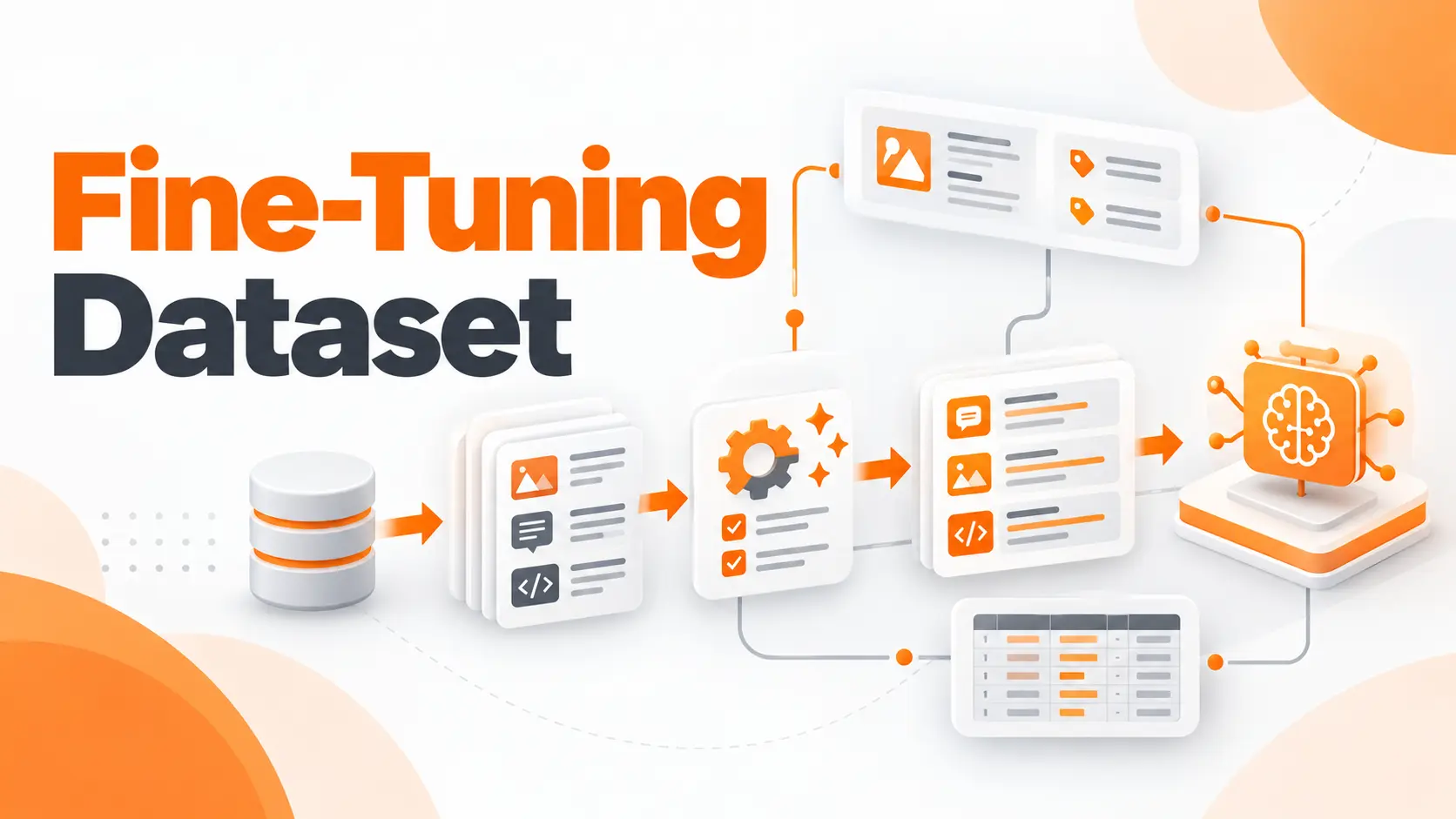
A fine-tuning dataset is a collection of training examples that teaches an AI model how to respond to specific inputs. To prepare one, you need to collect representative examples, write accurate target responses, choose the right data format, remove unreliable records, and separate training data from evaluation data.
When working with AI Model Fine-Tuning, I treat the dataset as a set of practical instructions expressed through examples. Each record should demonstrate a behavior I want the model to reproduce. That principle guides every decision I make during dataset preparation.
Fine-Tuning Dataset Preparation
I start by identifying the exact task the model needs to perform. Collecting thousands of conversations without defining the expected behavior creates a dataset that is difficult to evaluate and improve.
My preparation process follows five steps.
1. Define the Training Objective
The first step is to describe the behavior the model needs to learn. This could involve classifying customer messages, extracting information from documents, following a specialized writing style, or producing responses in a consistent format.
For example, if I am preparing a customer support model, I define whether it should identify customer intent, generate support responses, or perform both tasks. These objectives require different training examples and evaluation criteria.
I also test the base model on representative requests before collecting training data. This reveals which behaviors already work and which failures the dataset needs to address.
2. Collect Representative Training Examples
I use actual task inputs as the foundation of the dataset. Support conversations, reviewed business documents, expert-written responses, and approved application logs provide material that reflects real usage.
The important distinction is between source material and a training example. A support document containing refund policies is not automatically a useful fine-tuning record. I turn that information into a realistic customer request paired with an approved response.
I also record where each example came from. This makes it possible to trace questionable labels, review data permissions, and correct problems without rebuilding the entire dataset.
3. Create Accurate Target Responses
Each input needs a target response that demonstrates the intended behavior.
Consider a customer message:
User input: "I received the wrong item and need a replacement."
Target response: "I'm sorry you received the wrong item. Please provide your order number so I can check the replacement options."
This example teaches the model to acknowledge the problem and request the information needed for the next step.
I keep target responses consistent with the application rules. If one example tells customers to contact support and another promises an immediate refund for the same situation, the training data contains conflicting instructions.
Responses must also distinguish verified information from missing information. Teaching a model to invent an order status or account balance would create an unreliable support assistant.
4. Cover Real User Variations
A useful fine-tuning dataset includes more than straightforward requests. Users express the same intention through short messages, detailed explanations, incomplete sentences, spelling errors, and indirect language.
For an intent classification dataset, I include these variations while keeping the labels consistent. I also include unrelated requests and inputs that fall outside the supported categories.
For response generation, I include examples where the correct action is to request clarification, acknowledge missing information, or decline an unsupported operation.
The objective is to cover the input patterns the application will encounter, rather than repeat nearly identical examples to increase the record count.
5. Review Examples Before Formatting
Before converting the records into a training file, I review the input and expected output together.
The input must contain enough information to justify the response. The output must follow the same rules that will apply when the model is deployed.
I also preserve a unique identifier for each original conversation or document. This becomes important when separating training examples from evaluation data.
Fine-Tuning Dataset Formats and Examples
The correct fine-tuning dataset format depends on the model, training framework, and learning objective.
For supervised fine-tuning, two important structures are prompt-completion records and conversational records. A prompt-completion record connects an input with its expected output. A conversational record preserves message roles and the sequence of a dialogue.
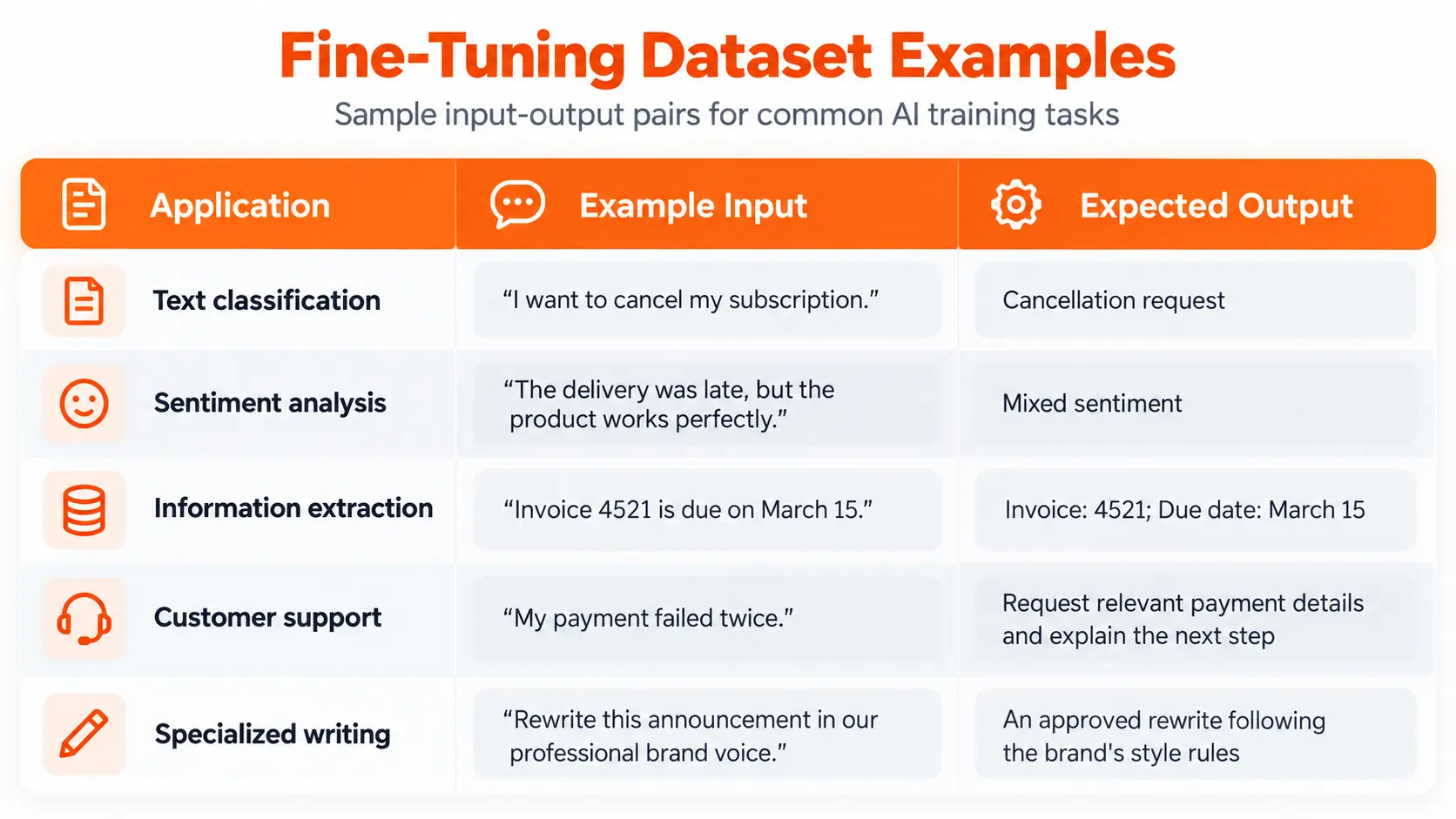
Here are practical fine-tuning dataset examples for different applications.
JSONL and Conversational Data
JSONL is a common file format for fine-tuning datasets. Each line contains one complete JSON record, allowing a training system to process examples individually.
A conversational record can contain system, user, and assistant messages. A prompt-completion dataset separates the input from the target completion.
These structures are not interchangeable across every platform. OpenAI-compatible training systems, Amazon Bedrock, and Hugging Face training workflows have different schema requirements.
For Hugging Face models, I pay particular attention to the tokenizer's chat template. The training pipeline must represent the conversation using the message boundaries and special tokens expected by the selected model.
I verify the required schema before exporting the dataset rather than adapting the model to an arbitrary file structure.
Fine-Tuning Dataset Size and Coverage
The number of examples needed depends on the task, the base model, and the performance target. There is no universal dataset size that guarantees a successful fine-tuning run.
For an initial supervised fine-tuning experiment, I use 50 carefully reviewed examples as a starting point and measure the results before expanding the dataset. This is an experimental starting size, not a minimum accepted by every training platform.
If the model handles straightforward requests but fails on ambiguous inputs, I add examples that represent those failures. Increasing the number of easy examples would not address that weakness.
Dataset coverage deserves the same attention as dataset size. A classification model trained mostly on billing requests will have limited evidence for recognizing technical support issues. Each important category needs enough varied examples to support reliable evaluation.
I track performance by category instead of relying on the total number of records as a measure of quality.
Cleaning and Validating Fine-Tuning Data
I check the dataset at both the content level and the technical level before starting training.
Duplicate records: Remove repeated and near-identical examples that provide no additional learning value.
Incorrect labels: Compare classifications and target responses against the approved task definitions.
Sensitive information: Remove unnecessary personal data, confidential details, credentials, and information that lacks appropriate authorization for training.
Formatting consistency: Validate required fields, message roles, data types, and the syntax expected by the training system.
Token limits: Measure token counts after applying the selected model's tokenizer and chat template. Review examples that exceed the configured sequence length.
Token limits require particular attention. A training pipeline can truncate long examples, removing part of the target response. A structurally valid dataset is not useful if the model never receives the complete answer it is expected to learn.
I inspect a sample of the fully formatted training records after tokenization. This catches problems that are not visible when reading the original text.
Training, Validation, and Test Dataset Splits
A fine-tuning dataset needs independent data for training and evaluation. Testing the model on examples it has already learned does not establish how well it handles new requests.
For a dataset containing 1,000 independent examples, one practical allocation is:
Training: 800 examples used to update the model.
Validation: 100 examples used to monitor training and guide model selection.
Test: 100 untouched examples used for final evaluation.
This 80/10/10 allocation is an illustrative starting point, not a mandatory rule. The appropriate split depends on dataset size, task requirements, and the training platform.
I separate the data before introducing generated variations or augmented examples. Records originating from the same customer conversation, document, or underlying case belong in the same split.
Otherwise, nearly identical information can appear in both training and evaluation, producing misleading results.
I also preserve the test set throughout model development. Once those examples influence training decisions, they no longer provide an independent final assessment.
Evaluating Dataset Performance
A clean dataset is not automatically an effective dataset. Its value becomes measurable when the fine-tuned model is tested against the original model on the same independent requests.
I select evaluation criteria that correspond to the training objective.
For classification, I examine precision, recall, and F1 score, including results for individual categories. For information extraction, I measure whether the required fields contain the correct values. For specialized writing, I evaluate adherence to a defined style rubric and whether the responses preserve the requested meaning.
I compare the results with the baseline established before fine-tuning.
If performance improves on common requests but declines on unusual cases, I inspect the training examples associated with those behaviors. The evaluation should identify which types of records need improvement, not just report a single overall score.
Finding Public Fine-Tuning Datasets
Hugging Face Datasets and Kaggle provide access to public datasets that can support fine-tuning projects. Their usefulness depends on the training objective and the conditions under which the data was collected.
Before using a public dataset, I examine its documentation, licensing terms, language coverage, label definitions, and intended purpose.
For a specialized application, I compare public examples against the inputs collected from the actual product. A general instruction dataset does not replace representative customer requests or organization-specific response requirements.
Public datasets are valuable starting material, but they still need to pass the same formatting, quality, and evaluation checks as internally collected records.
Dataset Versioning and Final Preparation
I keep a record of every dataset version used for training.
Each version includes the source records, reviewed labels, preprocessing rules, data splits, and the training format. I also record which model and tokenizer were used when preparing the final inputs.
This allows me to compare experiments without confusing changes in training data with changes in model configuration.
Before training, I confirm that the dataset passes schema validation, contains complete target responses, respects the configured token limits, and has an untouched evaluation set.
The goal is to produce a dataset whose contents are reliable, reproducible, and directly connected to the behavior the model needs to learn.
FAQ
Can I put English and other languages in the same fine-tuning dataset?
Yes. A multilingual fine-tuning dataset can contain examples in different languages. The training data should represent the languages and tasks the application needs to support. Each language should also have separate evaluation examples so performance can be measured independently.
Can I use responses generated by another AI model as training data?
Yes, provided the applicable licenses and service terms permit the intended use. AI-generated responses should be reviewed for factual accuracy, instruction compliance, and suitability before being accepted as training targets. Generated output should not be treated as verified ground truth without evaluation.
What if two reviewers disagree on the correct label for an example?
The disagreement should be resolved using a documented labeling guide and a designated review process. If the example remains ambiguous, it should be revised or excluded from training. Recording the final decision also helps maintain consistency during future annotation work.
Can I add new examples after my model has already been fine-tuned?
Yes, new examples can be added to the dataset, but changing the dataset file does not update an existing model's weights. The model must undergo another supported training process. Depending on the platform, this involves creating a new fine-tuning job or continuing training from an eligible checkpoint.
Can I reuse the same fine-tuning dataset with a different base model?
The original input-output examples can be reused when their content and licensing remain suitable. However, the training records must be converted to the new model's required schema, chat template, and tokenizer configuration. Sequence-length compatibility and evaluation performance must also be checked for the new model.

Fatemeh Jahangard
Technology & AI Writer at PinerookFatemeh Jahangard covers AI, emerging technologies, and digital innovation for Pinerook, focusing on how technology shapes startups and industries.
 Seen first.


